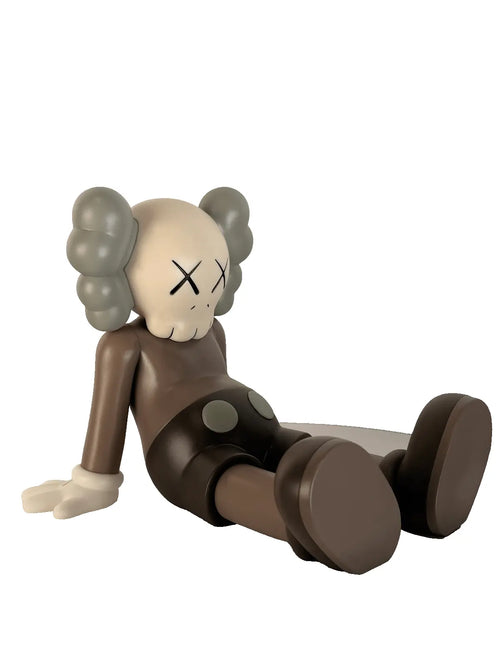
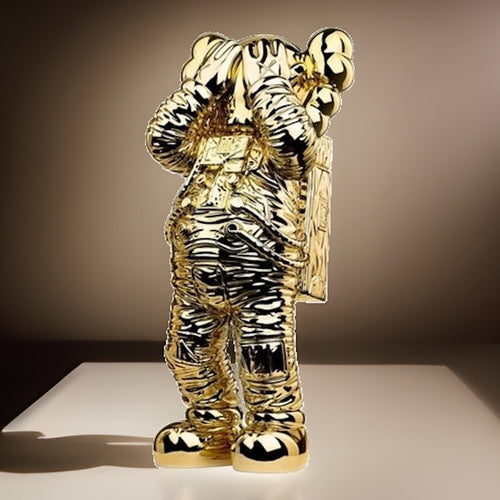
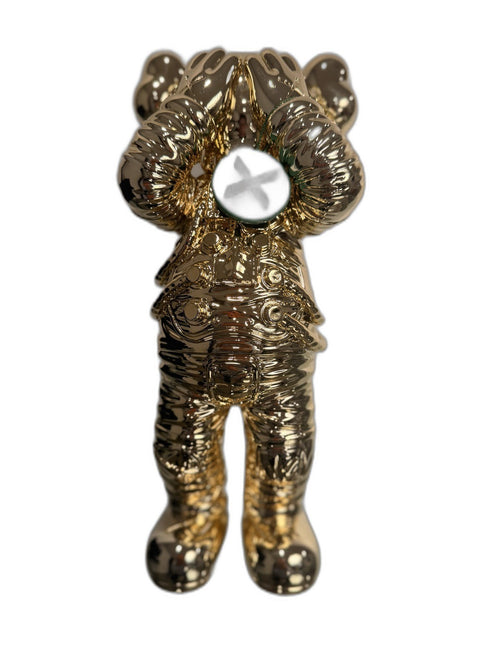
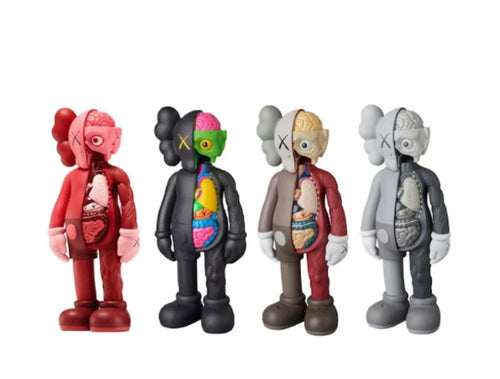
Brian Donnelly, who works as KAWS, spent the late 1990s altering bus shelter and phone booth advertisements in New York. The early interventions were small: Calvin Klein campaigns given cartoon skulls, glamorous models handed X-ed-out eyes. The visual shorthand that emerged from those interventions, especially the X-for-eyes treatment and the exaggerated cartoon musculature, is the foundation of everything that followed. The COMPANION, introduced in 1999, is its clearest expression.
Thirty years later, a monumental COMPANION sculpture sold at Phillips Hong Kong in April 2019 for HKD 115.9 million, then the auction record for the artist. For collectors, understanding the trajectory between those two points is essential context for every COMPANION decision.
The origin: 1999 and the Bounty Hunter collaboration
The first COMPANION was released in 1999 as an 8-inch vinyl figure produced in collaboration with the Tokyo streetwear brand Bounty Hunter. The figure was a subverted Mickey Mouse silhouette: the rounded ears, the white gloves, the oversized cartoon boots, but with X-ed-out eyes and the blank expression of a character who has been emptied of content.
The Bounty Hunter COMPANION was produced in a small edition and sold primarily in Japan. It is now among the most sought-after KAWS objects on the secondary market, with documented sales at major houses confirming its standing as a foundational work.
The Medicom partnership
The COMPANION as most collectors encounter it runs through Medicom Toy, the Tokyo company that has produced the majority of KAWS vinyl editions since the early 2000s. Medicom’s collaboration with KAWS includes the 11-inch COMPANION in multiple colorways, the larger 4-foot and 5-foot display editions, and the BE@RBRICK COMPANION hybrids that sit across both collector categories.
The Medicom releases introduced disciplined edition sizes, serial numbering, and the gallery-plus-retail distribution model that defines how KAWS vinyl trades today. A typical colorway release might be an edition of 500 to 1,000 at original retail, with immediate secondary market activity and durable long-term appreciation for the most scarce colorways.
The painting and sculpture practice
Parallel to the vinyl editions, KAWS built a serious painting and sculpture practice through galleries including Perrotin, Honor Fraser, and Galerie Perrotin’s international locations. The paintings, often appropriating Peanuts, The Simpsons, or SpongeBob imagery and rendered in meticulous acrylic on canvas, trade in a different market tier entirely.
Major auction benchmarks include:
- “The KAWS Album,” a 2005 painting appropriating The Simpsons Yellow Album cover, sold at Sotheby’s Hong Kong in April 2019 for HKD 115.9 million
- Multiple large-scale COMPANION sculptures, particularly the “Along the Way” and “Waiting” works, have realized multi-million dollar results at Christie’s, Phillips, and Sotheby’s
The monumental bronze and wood COMPANION sculptures, produced in very small editions, are the scarcest category and have demonstrated the clearest price discovery at the highest level of the market.
The print editions
For collectors operating below the painting tier, KAWS has released a substantial body of screenprints and lithographs, typically through his own studio and in collaboration with publishers such as Pace Prints. Editions generally run from 100 to 500, signed and numbered in pencil, and are authenticated with studio-issued COAs.
Notable print series include the “No One’s Home” and “Tension” editions, the Snoopy-referencing works, and a range of portfolio releases tied to museum exhibitions.
What to look for when collecting
Our curators apply a few consistent checks on any COMPANION acquisition:
- Confirm the edition size and colorway against KAWSONE and Medicom release records
- For vinyl, condition is everything. Original box, original packaging, no fading, no finger oils, no storage damage. Secondary market pricing for a mint-with-box COMPANION runs materially higher than the same edition in poor condition.
- For prints, require studio-issued COA, pencil signature, and edition numbering in the correct location
- Be skeptical of “rare proofs” without documented AP or PP numbering
- Assume that at the $10,000-plus level, forgeries exist and due diligence is non-negotiable
The market signal
The KAWS market has matured in the last decade in a way that changes the collector calculus. In 2015, KAWS was still primarily categorized by the art press as a street-art crossover. By 2019, the artist held the auction record for a living Asian-presence Western contemporary artist. By 2026, multiple major museums hold COMPANION works in their permanent collections, and the vinyl editions are themselves being treated as contemporary sculpture rather than collectibles.
Our advisory view is that the COMPANION is one of the clearest case studies of the last 25 years in how a single graphic object, executed consistently across formats, can carry an entire career. For collectors, that continuity is the point.