
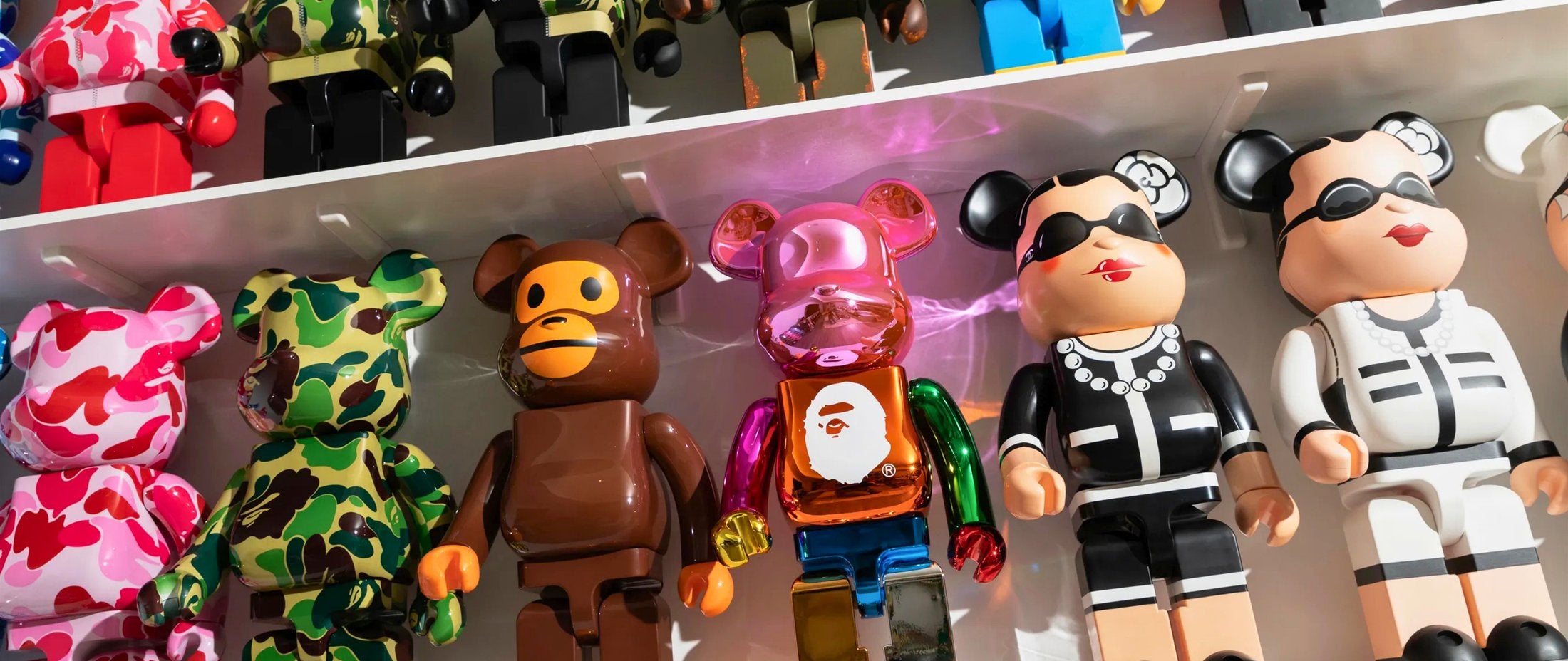
How to Spot a Fake / BE@RBRICK
Authentication GuideHow to Spot a Fake BE@RBRICK Figure
Medicom Toy BE@RBRICK figures are among the most counterfeited designer toys on the planet. Because they are produced in factory runs and the same molds circulate for years, bootleggers have gotten frighteningly good. This is the deepest authentication walk-through on our site: the standardized size and weight system, the molded foot stamps, the color-shift hologram and its sequence number, the newer NFC / One COA chip, the packaging, and a five-zone inspection of the bear itself. Learn the tells and you can separate a genuine bear from a KO in about ninety seconds.
Reality check: authentication is a cat-and-mouse game. Every time Medicom tightens a security feature, the better counterfeit factories catch up. No single tell is proof on its own — stack the evidence. A genuine bear should pass on scale, weight, foot stamp, seams, paint, packaging, hologram sequence, and (where present) an NFC scan that resolves to a live registry.
Why BE@RBRICK is the most faked designer toy
A BE@RBRICK is a simple, iconic silhouette — an anthropomorphized bear with a pot belly built from nine standardized "tools" (head, torso, hips, two arms, two hands, two legs). That simplicity is exactly what makes it easy to copy. The forms are basic, the molds are reused across releases, and demand for grail collabs (KAWS, Chanel, Bape, Nujabes, Daft Punk) pushes secondary prices into the thousands — a fat margin that bankrolls a whole counterfeit economy. Add the fact that value collapses without the original box, and you get every kind of fake at once: full bootleg copies, genuine bears re-boxed, and bootleg bears wearing a stolen or forged hologram.
Where the fakes come from
Understanding the supply chain tells you what to inspect. BE@RBRICK counterfeits arrive through four main channels:
Guangdong "KO" bootleg factories
Dedicated knock-off (KO) factories in southern China produce full copies — figure and box — from re-cut molds. Because BE@RBRICK shapes are so simple, the silhouette can look right at a glance; the tells live in the foot stamps, seams, paint registration and hologram, not the overall shape.
Factory overruns / "third-shift" units
Authorized factories are accused of quietly running extra "third-shift" units off the real tooling. These can be physically close to genuine but arrive with no legitimate hologram sequence, no NFC registration, and usually no proper box or paperwork — which is why provenance and packaging matter as much as the plastic.
Recasts of grail collabs
High-value collabs (especially KAWS Companion / Dissected and other sold-out drops) get recast from a genuine sample. Recasts shrink slightly, lose fine paint edges, and fail on weight, seams and the digital chain (NFC / One COA).
Genuine bears stripped & re-dressed
Sellers separate a real bear from its box (or a real box from a broken bear), then pair a bootleg with a fake or "borrowed" hologram sticker and a printed pseudo-COA. Treat the hologram, box, figure and paperwork as one unit — a mismatch in any one is a red flag.
The 5 zones to inspect on the bear
Work top to bottom. Each zone below lists what an authentic bear shows and the fake tell to watch for. On collab bears, cross-reference the artist's own marks too (for KAWS-designed BE@RBRICKs, see our KAWS authentication guide).
-
Head & ears
Authentic: full, rounded cheeks and a clean, symmetrical head. The ears have a defined shape — a slightly sharper top lobe flowing into a rounded bottom — and match each other exactly. A visible mold seam runs across the top of the head.
Fake tell: ears that are too round, uneven, or mismatched; a squashed or asymmetric head; a "single-mould" look with no seam line; a smaller or oddly-proportioned nose.
-
Face & belly print registration
Authentic: printed graphics (eyes, patterns, logos) sit exactly where the reference art says, with sharp edges, no bleed, and no overspray. Color is the correct tone and the finish matches the release (some are matte, some gloss).
Fake tell: misregistered or "ghosted" print, fuzzy edges, paint bleed, wrong color temperature (a lighter or washed-out finish, a gold that reads orange), or a glossy finish where the real release is matte.
-
The @ chest mark & artist logos
Authentic: the BE@RBRICK "@" chest mark and any collaborator branding are crisply rendered with correct kerning and placement. Every licensed logo on a collab is present and accurately drawn.
Fake tell: a soft, thin, or mis-spaced "@"; missing or garbled collab logos; obvious misspellings (bootleggers have shipped boxes reading "B@bybear" instead of "BE@RBRICK").
-
Feet & the molded Medicom foot stamp
Authentic: the underside of the feet carries molded maker/copyright text — collectors consistently report the MEDICOM TOY logo on one foot and the BE@RBRICK logo on the other, with a copyright year and MADE IN CHINA. The lettering is clean, evenly spaced, correctly aligned and easy to read.
Fake tell: missing stamps; letters jammed together, jumbled, or blurry; wrong font; open holes in the soles where a sealed, stamped foot should be; or (on figures that legitimately have a foot hole) a white/uncolored hole instead of the correct color.
-
Joints, articulation & back copyright
Authentic: a BE@RBRICK is built from nine parts giving roughly nine points of articulation — swivel head, swivel waist, ball-joint arms, swivel wrists, and ball-joint legs. Joints move cleanly and hold pose. Any back/rear copyright text is crisp and correctly worded.
Fake tell: joints that are fused, floppy, or won't hold; a body molded as one soft piece with no real articulation; missing or garbled rear copyright; a "squeezable," soft belly instead of a hard, solid shell.
Size & scale
BE@RBRICK uses a fixed percentage system relative to the 100% "standard" bear (7 cm). The percentages are not marketing — they are precise scale multiples. Measure the figure and compare it to the chart below. A bear whose height is off for its stated percentage is either mislabeled or a copy cast from a shrunken mold. (Casting a copy of a copy loses a few millimeters each time, so recasts commonly run slightly short.)
| Scale | Approx. height | Notes |
|---|---|---|
| 50% | ~4 cm (1.6") | Keychain / small special releases. |
| 70% | ~5 cm (2") | Uncommon; special editions. |
| 100% | ~7 cm (2.7") | The reference "standard" size; often sold with a 400%. |
| 150% | ~10.5 cm (4.1") | Occasional releases. |
| 200% | ~14–14.5 cm (5.5–5.7") | First size to carry an individual certificate on many releases. |
| 400% | ~28 cm (11") | The collector-favorite display size. |
| 1000% | ~70 cm (27.5"); width ~37 cm | The statement grail size. |
A common fake tell is the wrong pairing: authentic 400%+100% sets ship as a wider two-figure box, while many bootlegs are sold as a lone 400%. If the packaging format doesn't match the known release configuration, be suspicious.
Weight
Weight is one of the hardest things for a bootlegger to fake, because it depends on the exact material and wall thickness of the genuine tooling. Genuine bears feel solid and dense for their size; many fakes are cast in cheaper, softer plastic and feel noticeably light and hollow (though some over-corrected fakes swing the other way and feel wrong-heavy). Use weight as a corroborating tell, not a stand-alone verdict — published figures vary by material (ABS shell vs. PVC vs. flocked vs. fiberglass on the biggest sizes).
The tap test: tap the shell. A genuine hard-ABS bear gives a firm, higher "knock." Many soft-plastic fakes give a duller, deader thud. Combine tap + heft + the hard-shell press test (the belly should not squish).
The box & packaging
Because a boxless bear loses a large share of value, packaging is both a value driver and a primary authenticator — and it's where many bootlegs slip up first.
Box format per size
Smaller sizes and 100%/200% often ship in printed or window boxes; larger figures come in printed boxes with fitted inner trays or foam. Confirm the box format matches the known release — e.g. a 400%+100% set is a wider two-figure box, not a single-figure box.
Print quality & logos
Authentic boxes have sharp printing, correct fonts, accurate color and precisely placed licensing/logos. Blurry print, misaligned logos, wrong fonts, off colors, or misspellings ("B@bybear") are immediate fails.
Barcode & product number
The box carries a barcode and a series/product number. Scanning the barcode should return a matching product; if a scan returns nothing at all, treat the figure as suspect and lean on your other tells. Cross-check the series/product number against the known release.
Inner tray, foam & seals
Genuine packaging uses a correctly-shaped inner tray or foam that cradles the figure snugly, plus any factory seals appropriate to the release. Loose, generic, or wrong-cut trays and mismatched seals point to re-boxing or a bootleg.
Hologram, NFC & One COA
Medicom has layered several anti-counterfeit systems over the years. Know which one to expect for the era and size of your bear.
Color-shift hologram (since ~2010)
Many models since around 2010 carry a Medicom authenticity hologram on the packaging that shifts effect and color as you tilt it, showing the BE@RBRICK / MEDICOM TOY branding. Crucially it carries a sequential number (e.g. a code like A21110517) that encodes the production period. A flat, static, blurry, or clearly reused hologram — or a sequence that doesn't fit the release era — is a red flag.
NFC chip (mid-2022 onward)
Selected figures from mid-2022 onward embed an NFC chip in the sole of the right foot. Tap an NFC-enabled phone within a couple of centimeters; a genuine chip resolves to a Medicom-partnered digital authentication / warranty record (the DU-AL.IO platform). No chip where one is expected, a dead chip, or a chip that resolves to a 404 or a page that fails on a second scan = not authentic.
Hidden Tag & certificate
Modern figures — mainly 400%+ and some 200% — include a scannable Hidden Tag on the right foot sole and on the packaging, read with the Hidden Tag app to reach Medicom's database. Many 200%-and-up releases also include an individual certificate. Note some legitimate items (certain Kuji lottery / promo pieces and sub-100% figures) intentionally ship without a hologram — verify those on workmanship, packaging and authorized-dealer provenance instead.
KAWS & collab One COA
Modern KAWS × Medicom BE@RBRICK releases tie into an NFC-linked One COA registry. A genuine chip resolves to a One COA page showing edition, drop date and ownership chain. Bootlegs have no chip, a dead chip, or one that resolves to a spoofed page that breaks on re-scan. If it won't scan into the registry, it isn't authentic — see the KAWS guide.
Don't over-trust a hologram. Real holograms get peeled off genuine boxes and stuck onto bootlegs, and convincing fake holograms exist. A hologram is one input — pair it with the foot stamp, scale, weight, seams and (where present) a live NFC scan.
Materials & finish
Genuine BE@RBRICKs are built primarily from hard ABS (with PVC used on some parts and larger formats), giving a rigid shell, clean mold seams, and controlled paint. The material and finish are a reliable authentication surface.
Shell hardness
Real: hard, solid, doesn't squish; taps with a firm knock. Fake: often softer, rubbery plastic — a squeezable belly and a duller, deader tap.
Seams
Real: clean, correctly-placed mold seams (across the head, on body and limbs). Fake: rough, uneven seams — or a suspiciously seamless single-mould body.
Paint & gloss
Real: even coverage, sharp edges, no overspray, correct gloss/matte per release. Fake: bleed, overspray, misregistration, and the wrong finish or a lighter, washed-out color tone.
Flash & molding
Real: minimal flash, tight tolerances, parts that fit and articulate cleanly. Fake: leftover flash, gaps, discoloration, and joints that don't seat properly.
Real vs fake at a glance
| Feature | Authentic | Fake / KO |
|---|---|---|
| Foot stamp | Clean molded MEDICOM TOY / BE@RBRICK + year + MADE IN CHINA, evenly spaced | Missing, jumbled, blurry, wrong font, or open/white holes |
| Shell | Hard ABS, solid, firm knock when tapped | Soft/rubbery, squeezable belly, dull thud |
| Seams | Clean seams on head, body, limbs | Rough seams or seamless single mould |
| Scale | Height matches % (100%=7cm, 400%=28cm, 1000%=70cm) | Slightly short / off for stated % |
| Weight | Dense, heavy for size | Light & hollow (or wrong-heavy) |
| Sharp, registered, correct color/finish | Misregistered, bleeding, washed-out | |
| Box | Correct format, crisp print, right barcode/number | Wrong format, blurry print, dead barcode, typos |
| Hologram | Color-shifts on tilt, valid sequence number | Flat/static, blurry, reused, or absent |
| NFC / One COA | Scans to a live registry record | No chip, dead chip, 404 / spoofed page |
Red flags at a glance
- Missing, misspelled, jumbled, or mislocated foot stamps (MEDICOM TOY / BE@RBRICK, copyright year, MADE IN CHINA), or open white holes where a sealed stamped foot should be.
- Wrong height for the stated scale (100%=7cm, 400%=28cm, 1000%=70cm) — recasts usually run slightly short.
- A figure that feels light and hollow for its size, has a squeezable belly, or gives a dull thud when tapped.
- A flat, static, blurry, reused, or absent hologram, or a sequence number that doesn't fit the release era.
- No NFC chip where one is expected, or a chip that won't resolve to a live registry / One COA page.
- Misregistered paint, overspray, fuzzy graphics, or the wrong color tone / gloss vs. the known release.
- A box that doesn't match the release format (e.g. a lone 400% sold as if it were a 400%+100% set), blurry printing, a dead barcode, or misspellings.
- Rough seams, a seamless single-mould body, floppy or fused joints, or a soft-plastic "rubbery" feel.
- A price far below market for a "sealed" or "rare" collab — the oldest bootleg tell there is.
- A hologram, box, figure, and paperwork that don't feel like one unit — a sign of a re-boxed or re-dressed bear.
Step-by-step verification checklist
- Identify the exact release & scale. Pin down the collab, the size (e.g. 400%+100% set), and the release year, then pull reference photos of a known-authentic example.
- Measure it. Confirm the height matches the percentage (100%=7cm, 400%=28cm, 1000%=70cm). Note if it runs short.
- Heft & tap it. It should feel dense for its size, resist a belly press, and give a firm knock — not a light, hollow, squeezable, dull-thud feel.
- Flip it and read the foot stamps. Look for clean molded MEDICOM TOY / BE@RBRICK, copyright year and MADE IN CHINA — evenly spaced, correct font, no jumbled letters or missing/white holes.
- Inspect the five zones. Head & ears, face/belly print registration, the @ chest mark & collab logos, feet/foot stamp, and joints/rear copyright — top to bottom.
- Check paint, seams & finish. Sharp registered print, clean seams, correct gloss/matte, no overspray or bleed; correct color temperature.
- Vet the packaging. Right box format for the release, crisp printing, correct logos/fonts, matching series/product number, and scan the barcode.
- Examine the hologram. Confirm it color-shifts on tilt and carries a sequence number consistent with the release era; be wary of flat, reused, or absent holograms.
- Scan the NFC / Hidden Tag (2022+ & collabs). Tap a phone to the right-foot sole; a genuine chip resolves to a live Medicom / One COA registry record. A dead or 404 chip fails the figure.
- Stack the evidence & buy provenance. No single tell decides it — require a consistent story across scale, weight, stamp, paint, box, hologram and chip, and prefer authorized dealers or documented provenance.
Frequently asked questions
What do the foot stamps on a real BE@RBRICK say?
The underside of the feet carries molded maker/copyright text. Collectors consistently report the MEDICOM TOY logo on one foot and the BE@RBRICK logo on the other, along with a copyright year and MADE IN CHINA. On a genuine bear the lettering is clean, evenly spaced and easy to read. Missing stamps, jumbled or blurry letters, the wrong font, or open white holes where a sealed stamped foot should be are all fake tells.
How tall should each BE@RBRICK size be?
The percentages are precise scale multiples of the 7 cm 100% bear: 50%≈4cm, 70%≈5cm, 100%≈7cm, 150%≈10.5cm, 200%≈14–14.5cm, 400%≈28cm, and 1000%≈70cm. Measure the figure — a height that's off for the stated percentage suggests a mislabeled or recast copy (recasts often run slightly short).
Can I tell a fake by weight?
Weight is a strong corroborating tell. Genuine bears are dense and feel heavy for their size because of the hard-ABS shell and Medicom's tooling. Many fakes are cast in cheaper, softer plastic and feel light, hollow, and squeezable; some over-corrected fakes feel wrong-heavy. Because published weights vary by material and release, use weight alongside the foot stamp, scale, seams and hologram rather than on its own.
How does the Medicom hologram work?
Many models since around 2010 carry a Medicom authenticity hologram on the packaging that shifts effect and color as you tilt it and shows BE@RBRICK / MEDICOM TOY branding. It also carries a sequential number that encodes the production period. Beware: real holograms get peeled off genuine boxes and reused on bootlegs, and convincing fakes exist — so treat the hologram as one input, not proof.
Do BE@RBRICKs have an NFC chip, and how do I scan it?
Selected figures from mid-2022 onward embed an NFC chip in the sole of the right foot. Tap an NFC-enabled smartphone within a couple of centimeters of the foot; a genuine chip resolves to a Medicom-partnered digital authentication / warranty record. Modern collabs (including KAWS) link to a One COA registry. No chip where one is expected, a dead chip, or a chip that returns a 404 or a page that fails on a second scan means it is not authentic.
Are BE@RBRICKs without a hologram automatically fake?
No. Most modern retail releases have one, but some legitimate items — certain Happy Kuji lottery pieces, promotional figures, and sub-100% sizes — intentionally ship without a hologram. For those, authenticate on workmanship, foot stamps, packaging, and authorized-dealer provenance instead of expecting a hologram.
Why does the original box matter so much?
Two reasons. First, a complete, correct box is a large share of a BE@RBRICK's value, so a boxless bear is worth substantially less. Second, the box is a primary authenticator: format, print quality, logos, barcode and series number all have to match the known release. Bootleggers frequently get the box wrong (wrong format, blurry print, typos, dead barcode), which makes packaging one of the fastest tells.
How are KAWS BE@RBRICKs authenticated differently?
KAWS-designed BE@RBRICKs (Companion, Dissected, OriginalFake-era and later collabs) add the artist's own marks and, on modern releases, an NFC-linked One COA record. Beyond the standard BE@RBRICK tells, check the X-eye and Dissected detailing for clean, symmetrical execution and confirm the chip resolves to a live One COA page. See our dedicated how to spot a fake KAWS guide.
Is one tell ever enough to call a bear real or fake?
No. Authentication is a cat-and-mouse game; skilled factories can nail any single feature. The reliable method is to stack independent evidence — scale, weight, foot stamp, seams, paint, packaging, hologram sequence and NFC — and require them all to agree. A mismatch in any one is reason to slow down.
Sources & methodology. This is educational authentication content, not an appraisal or a guarantee for any specific figure. Details were cross-checked across multiple collector, dealer and manufacturer sources, including legitcheck.app, urbtoy.com, eyefortoys.com, mybearbrick.de, collectoylogy.wordpress.com, japan-figure.com, drunkenbears.sg, deodato.art, the TOPPAN / DU-AL.IO NFC announcements, and the Medicom Toy / BE@RBRICK reference on Wikipedia. Where a specific number varies by release or material, we describe it qualitatively rather than assert a false exact figure. Always corroborate multiple tells and prefer authorized-dealer or documented provenance.