

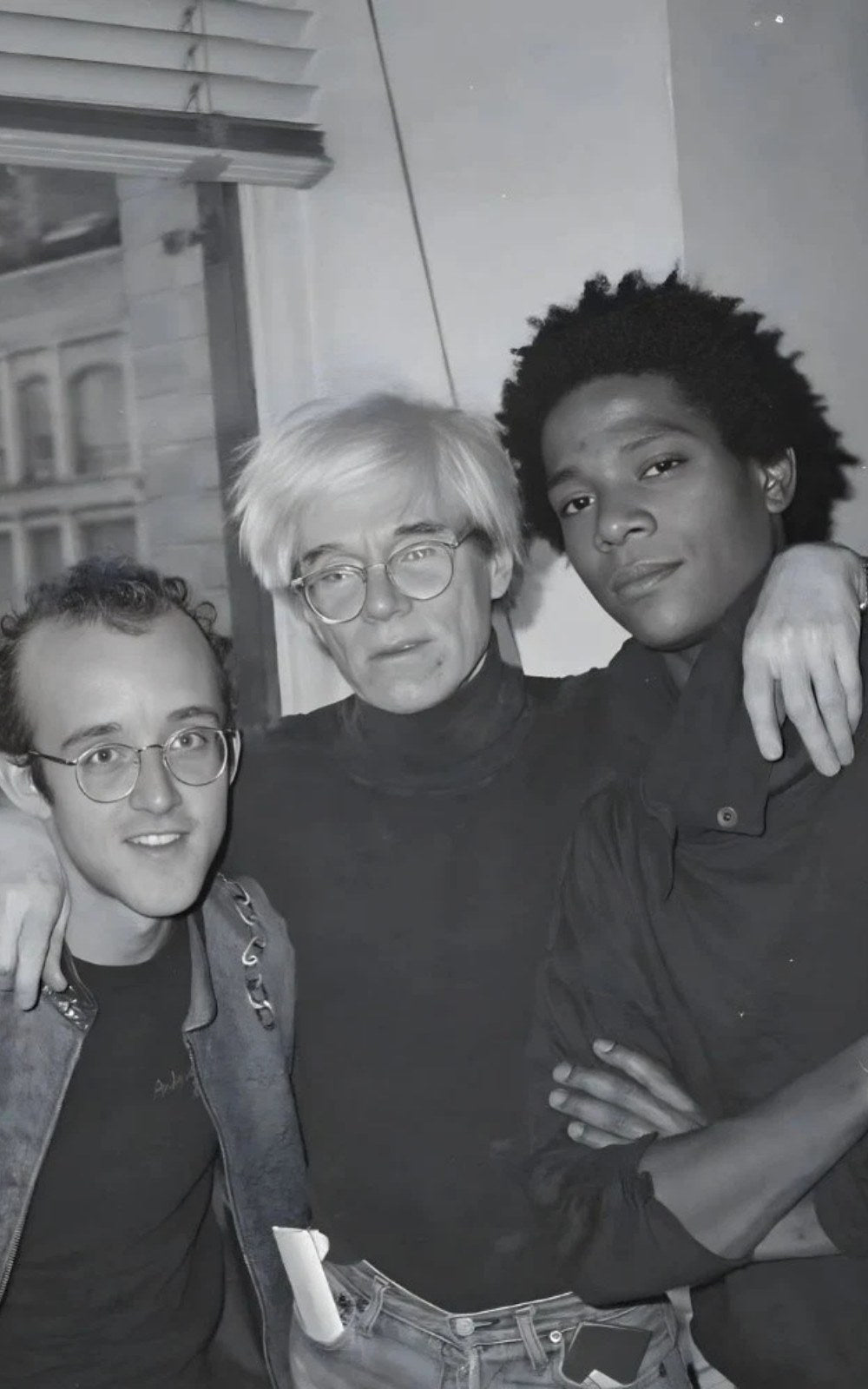
Andy Warhol got there first. By the mid-1960s his silkscreened Marilyns and soup cans had collapsed the wall between fine art and mass production, making repetition, celebrity and commerce his medium. Two decades later he became the godfather to a younger downtown generation — most famously Jean-Michel Basquiat, who rose from the streets as the graffiti poet "SAMO©," and Keith Haring, whose chalk drawings in the subway made him a public artist before he ever showed in a gallery.
Their worlds fused. Warhol and Basquiat became close friends and collaborators, painting together in 1984–85 and exhibiting the results; Haring idolized Warhol and paid tribute with his "Andy Mouse" series. They shared dealers, clubs, and a belief — strongest in Haring — that art should belong to everyone, not just the wealthy. Then, devastatingly fast, they were gone: Warhol in 1987, Basquiat in 1988 at just 27, Haring in 1990 at 31.
That compressed, brilliant arc is exactly why the market reveres them — three canonical names whose relevance only compounds. And there's an elegant piece of connoisseurship that defines collecting all three today: the official committees that once authenticated their work have closed, so the market now relies on the catalogue raisonné, provenance and publisher records. Learn to read that paper trail and you buy these legends with real confidence.


