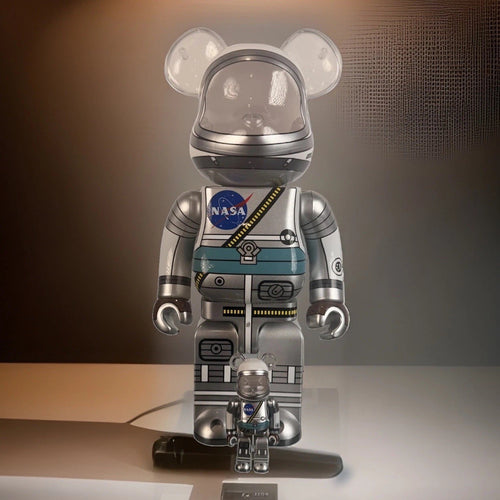
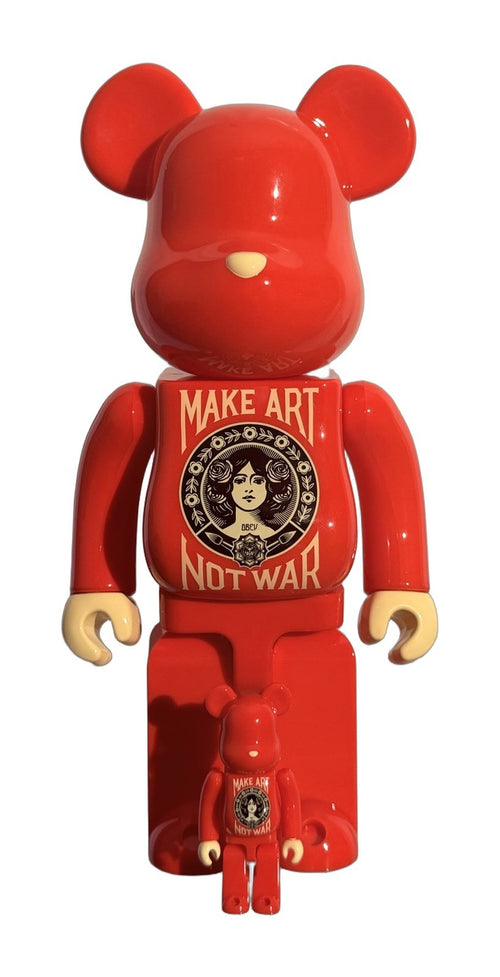
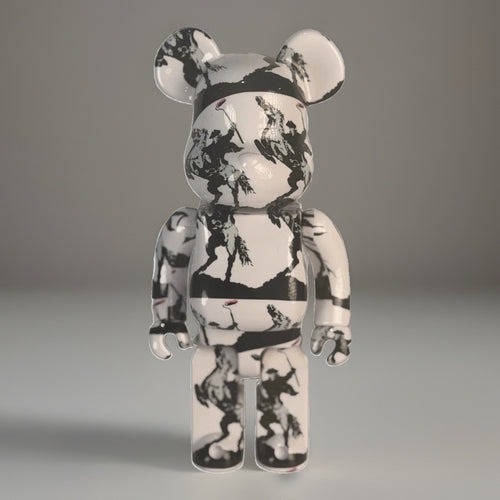
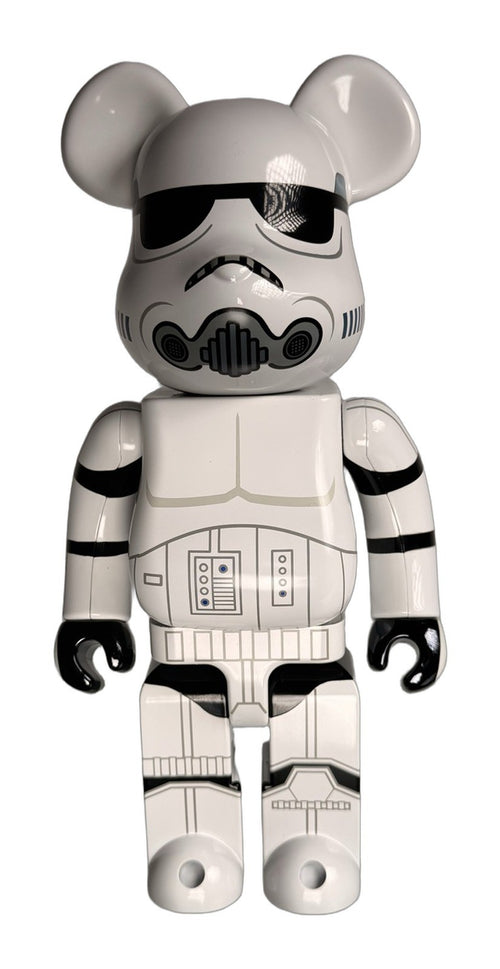
BE@RBRICK, produced by the Tokyo-based Medicom Toy since 2001, is arguably the most widely collected contemporary vinyl figure in the world. For a new collector, the format can be bewildering: multiple sizes, hundreds of colorways per year, collaborations spanning streetwear, contemporary art, fashion houses, and intellectual property licenses from Disney to Warner Bros. Once the size and scarcity system is understood, the market is actually one of the more transparent ones in collectible contemporary art.
This is the primer our curators give new BE@RBRICK buyers.
The size system
Every BE@RBRICK is measured as a multiple of the base 100% figure, which stands roughly 7 centimeters tall. The canonical sizes are:
- 50%: 3.5 cm. Typically released as blind-box keychains and small promotional editions.
- 100%: 7 cm. The standard size, most often released in themed series and smaller collaborations.
- 400%: 28 cm. The collector’s default size. Most artist collaborations and fashion-house releases are issued at this scale.
- 1000%: 70 cm. The display-grade, high-priced scale. Released in much smaller editions, sold at substantially higher retail, and the clearest signal of a flagship release.
The standard contemporary collaboration drops as a pair: one 100% plus one 400%, boxed together. High-profile collaborations add a 1000% released separately, sometimes months later, typically at a 5 to 8 times retail multiple of the 400%.
Edition scarcity, stated and implied
Medicom does not always publish edition sizes, which creates an information asymmetry that rewards collectors who pay attention. Some patterns our curators have observed:
- Series BE@RBRICKs, released as blind-box assortments, typically run tens of thousands of units per series. These are not meaningful secondary market investments.
- 400% collaborations with established artists or IP licenses often run in the 1,000 to 2,000 unit range, though Medicom has been inconsistent about disclosure.
- 1000% releases are the scarcest scheduled releases, often running in the 200 to 500 unit range.
- Limited-channel releases, such as those sold only through a specific retail partner or tied to a single event, are the hardest to source and often the best-performing at resale.
Public secondary market data on StockX, Phillips’ design and editions sales, and specialist auction houses such as Ran Dian and Bonhams Hong Kong provide reasonable price discovery for most meaningful releases.
The top collaborations
A partial list of BE@RBRICK collaborations our curators consider structurally significant:
- KAWS: Multiple releases dating from the early 2000s, with several colorways that are now among the highest-priced 400% and 1000% pieces in the category. The KAWS DISSECTED BE@RBRICK 1000% series is a touchstone.
- Jean-Michel Basquiat: Licensed through the Basquiat estate, with multiple numbered releases referencing specific paintings. The Basquiat 1000% editions are consistently strong performers.
- Keith Haring: Licensed through the Haring Studio, released in several colorways.
- Andy Warhol: Licensed through the Warhol Foundation, with multiple cans, flowers, and self-portrait references.
- Chanel, Dior, Fendi, Louis Vuitton: Fashion-house collaborations that tend to be released in extremely small editions through single channels.
- Daft Punk, 2001: A Space Odyssey, Star Wars, Disney: IP-license releases that have historically performed well when the license is scarce and the underlying franchise has durable collector demand.
The common thread in the durably-appreciating BE@RBRICKs is not hype. It is a combination of scarce edition, strong underlying IP, and Medicom’s own internal archive discipline.
What moves the secondary market
Our curators monitor a few variables when advising BE@RBRICK buyers:
- Original retail price and channel. A 400% released through a single retail partner at HKD 2,500 will behave differently than one released globally at USD 170.
- Condition, specifically original box, inner bag, and no yellowing on white or translucent finishes.
- Completeness of pairs and sets. A 100% orphaned from its 400% partner trades at a discount.
- Time since release. BE@RBRICKs tend to have a predictable pattern: initial scarcity pop at release, softening as flippers clear the market over 3 to 6 months, then gradual appreciation over 3 to 5 years for the structurally scarce pieces.
- Cultural anchoring. Collaborations tied to museum exhibitions, anniversary years, or cross-over art-world moments tend to outperform.
Common collector mistakes
The most frequent mistakes we see in advisory conversations:
- Paying peak-flipper prices in the first 90 days after a release. Holding patience is usually rewarded with better entry points.
- Buying loose BE@RBRICKs without original boxes. The secondary market is sharply bifurcated on packaging.
- Ignoring the 1000% releases because of sticker shock. The 1000%s are the clearest long-term performers in the category.
- Mixing display with storage. Direct sunlight yellows white and translucent BE@RBRICKs permanently.
- Buying from unverified sellers in secondary markets. Forgeries exist, particularly for high-value 1000% pieces. Bonhams, Phillips, StockX-authenticated, and established dealers are safer channels.
Where to start
A reasonable first BE@RBRICK position for a new collector:
- One 400% from a major artist collaboration, mint-in-box, purchased through a verified channel
- A 100%/400% pair from a current-year collaboration, held as a working reference
- A patient watchlist for a 1000% release that aligns with the collector’s taste. Buying one 1000% is usually more valuable than buying five 400%s over the same five-year horizon.