The Three Photo Types Apollo Astronauts Actually Signed
Most collectors get this wrong on the first buy.
They see "signed Apollo astronaut photo" in a listing, pay a meaningful sum, and receive something that is technically accurate and practically worthless in terms of long-term market positioning. Not a forgery. Not a fake. Just the wrong type of photograph for the money spent.
The Apollo program generated an enormous volume of printed imagery. Lithographs, glossy press prints, reproduction cards, official NASA portrait releases, crew composites, mission patches printed on cardstock — all of it got signed at some point, by someone, somewhere. But the secondary market does not treat all of these equally. It never has.
Understanding why requires understanding what the three primary signed photo types actually are, how they differ structurally, and why authentication services like Beckett (BAS), JSA, and PSA/DNA treat provenance and substrate differently when they grade space memorabilia.
This is not a beginner's guide to collecting NASA autographs. This is a working map of the format landscape for collectors who are already spending real money and want to spend it correctly.
Why Format Matters as Much as the Signature
In most autograph categories, format is secondary to the signer. A Babe Ruth signature on a napkin still commands a serious number if authenticated. The substrate is a footnote.
Space memorabilia does not work that way.
The Apollo program had an official photographic infrastructure. NASA employed photographers, maintained negative archives, and released images through a formal publication and press distribution system. That system produced specific, identifiable output. Collectors and dealers learned decades ago that provenance in this category attaches not just to who signed something, but to what they signed and where that item originated in the NASA distribution chain.
The three format types that actually move the serious market are:
- Vintage NASA glossy prints — original photographic paper prints distributed through NASA's press and public affairs offices
- Official NASA lithographs — offset-printed images on heavier stock, released through NASA's formal lithograph program with identifiable catalog designations
- Crew-signed mission documentation photographs — images tied directly to specific mission records, sometimes bearing mission numbering or official stamps, signed by the full prime crew
Everything else — third-party reproductions, later-generation prints, privately printed photo cards sold at signings — lives in a different tier of the market.
Does that mean those items have no value? No. It means experienced buyers discount them, and you should know that before you price anything for resale.
Type One: Vintage NASA Glossy Prints
What They Are
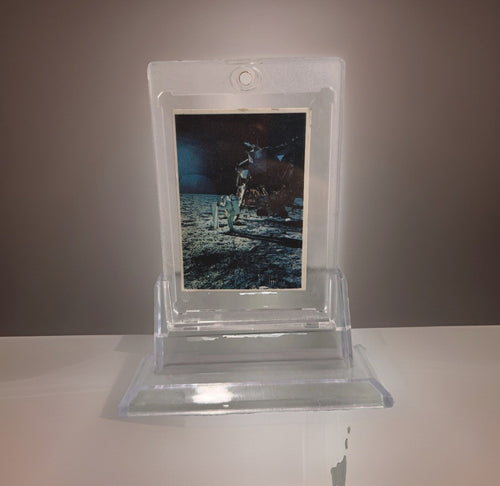
The vintage NASA glossy is the benchmark format. These are photographic prints produced on silver gelatin or chromogenic paper, distributed by NASA's Public Affairs Office during the active program era and into the early post-Apollo years.
They typically carry a NASA caption label on the reverse. That label includes the NASA photo number (the "AS" series for Apollo Surface photography, or mission-specific designations), the date of distribution, and frequently a descriptive caption typed or printed in a specific font and layout that changed across decades.
The paper stock itself is identifiable. The surface sheen, the weight, the aging characteristics of the emulsion — these are things that Zarelli specialist letters and experienced authenticators evaluate directly. The back label is not the only evidence of authenticity for the substrate itself. The physical print tells its own story.
Why These Command Premium Positioning
When an astronaut signed one of these prints, they were signing something that came from the program itself. Not a reproduction. Not a commercial image licensed from NASA. The actual press-distributed photographic output of the mission record.
That connection to the institutional archive is what the market values.
A signed vintage glossy of the Apollo 11 crew, for example, represents three astronauts signing an image that NASA itself released as the documentary record of their mission. The chain of custody — from NASA photo lab to press office to collector — is theoretically reconstructible in a way that a signed commercial poster never is.
Authentication Considerations
For any vintage NASA glossy, the authentication hierarchy matters.
-
Primary authentication of the signature
- BAS (Beckett Authentication Services) is the market standard for high-value space signatures
- JSA (James Spence Authentication) LOA — the full Letter of Authenticity, not the Basic sticker — carries real weight in this category
- PSA/DNA certification with verification through PSA's online registry is the third accepted tier
-
Specialist notation for the substrate
- For significant pieces, a Zarelli specialist letter evaluating the photograph itself adds a layer that generalist authenticators do not provide
- This is particularly relevant for prints purporting to be early-distribution examples
-
Caption label verification
- The NASA photo number format changed over time and is documented in reference literature
- A print with a caption label inconsistent with its purported distribution date is a problem
Is a BAS sticker alone sufficient for a vintage glossy in the five-figure range? It is a necessary condition. It is not a sufficient one. At that level, you want the substrate evaluated independently.
Type Two: Official NASA Lithographs
What They Are
NASA's lithograph program produced offset-printed images on heavier card stock, released formally through the agency's distribution channels and identifiable by catalog number and release series.
These are not photographs. They are printed reproductions of NASA imagery, but they are official printed reproductions, produced under NASA's institutional authority and released as part of a deliberate public information program. That distinction is everything.
The lithographs have specific catalog designations. The paper stock is consistent within release series. The color profiles and printing characteristics are documented. There are reference guides that catalog them by number, release date, and image content, and the collector community has cross-referenced these extensively.
The Signed NASA Lithograph Market
Signed NASA lithographs occupy a distinct position in the market that is widely misunderstood by newer collectors.
Because lithographs were produced in larger quantities than individual photographic prints, and because they were distributed through public channels including NASA visitor centers and educational programs, they were the format most commonly available at public signings, astronaut appearances, and space program events.
This means the volume of signed NASA lithographs in the market is significantly higher than the volume of signed vintage glossies. Higher supply affects pricing. That is a mechanical market reality, not a commentary on quality.
But it also means something important: astronauts who signed extensively in public settings signed a lot of lithographs. For certain signers, the lithograph is the format where signature examples are best documented because the signings themselves were public events with witness records.
For rarer signers — crew members who died before the autograph market matured, or who signed very selectively — the substrate question becomes secondary to the signature authentication question. A rare signer on an official NASA lithograph with BAS certification can represent strong value precisely because the format is identifiable and the signature evidence is scrutinized.
Distinguishing Official NASA Lithographs From Everything Else
This is where collectors make expensive mistakes.
The term "NASA lithograph" gets applied commercially to things that are not official NASA program releases. Third-party publishers license NASA imagery and print it. Space museums sell commercially produced prints in formats that resemble the official lithograph series. Mail-order memorabilia companies have sold "NASA photo prints" that are neither photographs nor official lithographs.
-
Check the catalog number
- Official NASA lithographs carry identifiable catalog designations on the reverse
- Cross-reference against documented NASA lithograph series records
-
Examine the reverse
- The back of an official NASA lithograph carries specific printing information, NASA identification, and in many cases the release series notation
- A clean, blank back on something being sold as a NASA lithograph is a problem
-
Paper stock consistency
- Within a release series, the stock is consistent
- Variations in stock within the same purported series are worth questioning
Why does this matter if the signature is real? Because misrepresentation of the format affects valuation. A real signature on a misidentified substrate is still a misrepresented item. That matters at resale, and it matters if you ever need to make an insurance claim.
Type Three: Crew-Signed Mission Documentation Photographs
What They Are
The third type is the most valuable and the most complex to authenticate correctly.
These are photographic prints that are tied directly to specific mission documentation — images that bear official mission stamps, mission numbering, or were part of the formal photographic record distributed to mission participants, families, NASA administrators, or official archive recipients.
Some of these were signed by the complete prime crew as a deliberate act — a crew presentation piece, a mission commemorative, a signed record presented to a program official or contractor. Others were individually signed but carry documentation connecting them to the mission chain of custody: a provenance letter from a NASA official, a stamp indicating they came from a contractor's archive, records showing they were part of an official presentation.
Full crew signatures from the Apollo prime crews represent some of the most significant pieces in the entire space memorabilia category. The mathematics are simple: you need all three men to sign, the pool of authentic examples is fixed, and the signers are no longer living.
Why Provenance Chain Is Non-Negotiable Here
For mission documentation photographs, the provenance chain is not a nice-to-have. It is a core component of the authentication case.
Authentication services know this. BAS, when issuing certification on a high-value crew-signed mission photograph, is examining not just the signatures but the context. JSA LOA — again, the full letter, not the Basic sticker, which is the JSA Basic vs. LOA distinction that matters enormously in this category — should address provenance where it is available.
A Zarelli specialist letter is particularly valuable here because the specialist evaluation can address both the photographic substrate and the mission documentation context in ways that signature-focused generalist services cannot.
The Full Crew Signed Piece Premium
The market premium for full Apollo prime crew signatures over individual or partial crew signatures is substantial. Not a rounding error. Substantial.
This is not sentiment. It is supply and demand applied to a closed population. Every year that passes, the number of living Apollo astronauts decreases. The population of authentic full-crew signed pieces does not grow. The collector base for significant space memorabilia has expanded considerably over the past two decades.
Mission documentation photographs with full crew signatures and clean provenance chains represent the upper tier of the market. They also represent the segment most targeted by sophisticated forgery operations.
The FBI's Operation Bullpen, which prosecuted a large-scale autograph forgery ring, focused heavily on sports memorabilia but established evidentiary and investigative frameworks that have been applied in space memorabilia fraud cases. The lesson from Bullpen was that forgeries at the high end of the market are not crude. They involve period-correct substrates, fabricated provenance documentation, and signatures that pass casual inspection. Only rigorous third-party authentication — and in significant cases, specialist consultation — catches them.
If a piece comes with a compelling provenance story but no third-party authentication, what does that tell you? It tells you the provenance story is doing work that the authentication cannot.
The Format Comparison at a Glance
| Format Type | Substrate | Market Position | Authentication Priority | Key Risk |
|---|---|---|---|---|
| Vintage NASA Glossy | Photographic print, silver gelatin or chromogenic paper | Premium tier | BAS/JSA LOA/PSA + Zarelli for significant pieces | Reproduction prints misrepresented as vintage originals |
| Official NASA Lithograph | Offset print on catalog-designated card stock | Mid-market, signer-dependent | BAS/JSA LOA/PSA + catalog verification | Commercial reproductions misidentified as official releases |
| Mission Documentation Photo | Photographic print with mission provenance | Upper market, crew-complete examples at top | BAS/JSA LOA/PSA + Zarelli + provenance chain documentation | Sophisticated forgeries targeting high-value signer combinations |
What Authenticators Actually Evaluate in Space Memorabilia
A lot of collectors treat third-party authentication as a binary: authenticated or not. That misses how the services actually work in this category.
BAS authentication for space memorabilia involves signature comparison against documented exemplars. For Apollo-era astronauts, the exemplar database is built from publicly documented signings, estate-authenticated examples, and cross-referenced material across the major services. The BAS grade reflects confidence level in signature authenticity specifically.
The JSA Basic vs. LOA distinction is not trivial. The Basic sticker indicates a reviewer looked at the item and did not flag it. The full JSA Letter of Authenticity involves a named authenticator making a documented positive attribution. In space memorabilia, at any price point worth discussing seriously, you want the LOA. The Basic sticker is not the same product.
PSA certification with online verification through the PSA registry allows registry-number checking that has become a baseline requirement. PSA's public warnings about certification verification — specifically around counterfeit holders and fake registry numbers — are worth taking seriously. A PSA holder is not proof of authentication. The registry number check is the proof. This is documented in PSA's own certification-verification guidance, and it has become standard practice in the serious collector community.
Zarelli specialist letters operate differently from the signature authentication services. Joe Zarelli's expertise is in NASA-specific material: the photographic substrates, the printing characteristics, the provenance documentation specific to the space program. A Zarelli letter on a significant piece evaluates dimensions that BAS and JSA simply do not cover in their standard services. For vintage glossies and mission documentation photographs in the significant range, the combination of a signature authentication service certification and a Zarelli specialist letter represents the market standard for serious buyers.
Common Format Confusions That Cost Collectors Money
The "NASA-Themed" Versus "NASA-Issued" Problem
Commercial publishers, particularly from the 1970s through the 1990s, produced enormous quantities of space-themed printed material that looks institutional but is not. Space program commemorative books, magazines, and print series used official NASA imagery under license. These are NASA-themed. They are not NASA-issued. The distinction matters at resale.
A signed commercial space magazine cover is not a NASA lithograph. A signed page from a commemorative book is not a mission documentation photograph. These can be legitimate, desirable items — depending on signer rarity and condition — but they should be represented accurately and priced accordingly.
The Later-Generation Print Problem
NASA's photographic archives have been reprinted, scanned, and redistributed multiple times across multiple eras. A print made from an original NASA negative in 1985 is not the same as a print made in 1969. Both can be photographic prints. Only one is vintage.
The physical characteristics of the print tell this story to an experienced eye. The paper aging, the emulsion surface, the color profile of chromogenic prints — these age in identifiable ways. A later-generation print of an iconic mission image sold as a vintage original is one of the more common misrepresentations in the category.
The Signed Crew Portrait Versus Mission Photo Distinction
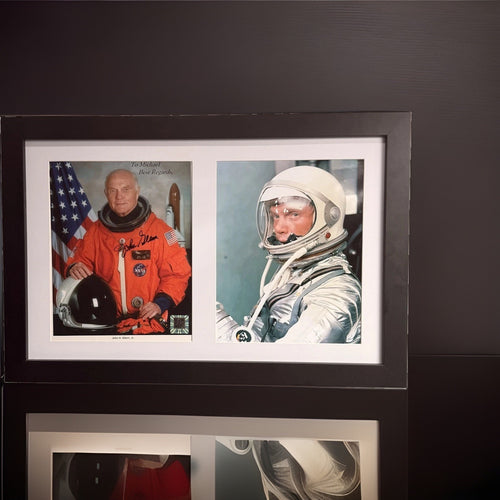
Official NASA crew portraits — the studio-style formal photographs taken for each mission's public affairs release — are a specific and identifiable format. These are valuable. Full crew-signed examples of official portrait prints are significant pieces.
They are not the same as mission photography. Mission photography is imagery from the mission itself: lunar surface images, spacecraft images, EVA photography. Both categories have value. They serve different collector interests and price differently. Knowing which you are buying matters.
Red Flags
Before you commit to any significant Apollo-era signed photograph purchase, run through this list.
- No back label or reversed label — A vintage NASA glossy without a NASA caption label on the reverse, or with a label that appears glued on after the fact, requires explanation before purchase.
- Catalog number absent or inconsistent — An official NASA lithograph with no catalog designation, or a catalog number that does not match documented series records, is not what it is being represented as.
- BAS Basic sticker only on a high-value piece — At any meaningful price point for space memorabilia, a Basic sticker without a full authentication letter should prompt questions about why the seller did not pursue full LOA service.
- PSA holder not verified through the registry — Counterfeit PSA holders exist. The registry check is not optional for anything above token value. PSA has specifically documented this risk in their certification-verification warnings.
- Compelling provenance story without documentation — "This came from a NASA contractor's family" is a story. Supporting documentation — letters, photographs, estate records — is evidence. One substitutes for the other in forgery scenarios. Only evidence matters.
- Signatures that don't account for the signer's documented age or health at the time of purported signing — Signature characteristics change over a lifetime. A signature attributed to a late-career astronaut signing should look like a late-career signing. Inconsistency here is a flag for authentication review, not a conclusion, but it warrants scrutiny.
- Price significantly below market for the signer and format combination — The market for significant Apollo signatures is reasonably well documented across auction records. An outlier price below market for a premium format is not a bargain until authentication explains it.
- Mission documentation photograph with no specialist substrate evaluation — For upper-tier mission documentation pieces, the absence of a Zarelli or equivalent specialist evaluation on the substrate should be addressed before purchase. Signature authentication alone is not sufficient at the top of the market.
Bottom Line
The Apollo program is the most significant human achievement of the twentieth century, and the signed photographic record of that program represents one of the most historically important categories in the entire autograph market.
It also represents a category where format confusion, substrate misrepresentation, and inadequate authentication are common enough to constitute a real ongoing risk for collectors who have not done the groundwork.
The three types that actually move the serious market — vintage NASA glossy prints, official NASA lithographs, and crew-signed mission documentation photographs — are distinct in their institutional origins, their market positioning, and their authentication requirements. Treating them as interchangeable is an expensive mistake.
Get the format right. Get the authentication right. BAS, JSA LOA (not Basic), PSA with registry verification, and Zarelli specialist letters for significant substrate evaluation. That stack covers the market standard.
Everything else is a story. And stories don't hold value on resale.
Frequently Asked Questions
What is the difference between a NASA lithograph and a NASA photograph?
A NASA photograph is a true photographic print produced on photographic paper through a chemical process — silver gelatin or chromogenic. A NASA lithograph is an offset-printed reproduction on heavier card stock, released through NASA's formal lithograph program with catalog designations. Both were distributed officially through NASA channels. Both carry legitimate collector value when signed. They are not the same product, they are not priced the same, and they should not be described interchangeably. The physical difference is identifiable by surface examination and paper stock analysis.
Does a signed NASA lithograph need a Zarelli letter or is BAS certification enough?
For standard signed NASA lithographs with straightforward signer profiles and clear catalog identification, BAS or JSA LOA certification covers the signature authentication adequately. The Zarelli specialist letter becomes most relevant when the substrate itself is a question — disputed vintage status, unusual provenance, upper-tier pricing where the substrate evaluation adds directly to value documentation. For mission documentation photographs at significant price points, the specialist letter is essentially market standard at the serious collector level.
How do I verify that a NASA lithograph is an official release versus a commercial reproduction?
Start with the reverse. Official NASA lithographs carry catalog designations and NASA identification on the back. Cross-reference the catalog number against documented NASA lithograph series records, which are available through collector reference literature and major space memorabilia dealer resources. Paper stock consistency within known series is a secondary check. A clean, unidentified reverse on something represented as an official NASA lithograph is a red flag that requires explanation before purchase.
Is the JSA Basic sticker acceptable for space memorabilia?
The JSA Basic sticker indicates a reviewer examined the item and did not reject it. The full JSA Letter of Authenticity is a named authenticator making a documented positive attribution. These are meaningfully different products, and the space memorabilia market at any serious price point treats them differently. At collector-grade values for Apollo signatures, you want the full LOA. The Basic sticker is not a substitute and should not be represented as equivalent authentication.
What makes full Apollo prime crew signatures more valuable than individual signatures?
Supply and demand applied to a closed and decreasing population. Full prime crew signatures require all three crew members to have signed the same item. As the Apollo astronauts have passed, the population of authentic full-crew signed pieces is fixed. It cannot grow. The collector base has expanded. That combination produces sustained premium positioning for authenticated full-crew examples over individual signatures on the same format. The mathematics are straightforward.
How do I know if a vintage NASA glossy is actually vintage or a later-generation print?
The physical print tells the story to an experienced evaluator. Paper aging characteristics, emulsion surface properties, color profile aging in chromogenic prints, and the specific paper stocks used in different eras are all identifiable. The caption label on the reverse — format, typography, and NASA photo number structure — should be consistent with the purported distribution date. For significant pieces where vintage status directly affects value, a Zarelli specialist evaluation is the appropriate route to certainty. This is not something that photograph descriptions in listings can substitute for.
What is the significance of the NASA photo number on the back of a vintage glossy?
The NASA photo number is part of the agency's archival cataloging system and identifies the specific image, mission, and in many cases the distribution era of the print. The "AS" series prefix denotes Apollo Surface imagery. Numbering formats and label layouts changed across different program eras and are documented in reference literature. A photo number inconsistent with the purported distribution date — or a print purporting to be a specific mission image with a number that does not match mission records — is a substrate authentication issue that requires resolution before purchase.
Are signed space memorabilia items from later missions (Skylab, Shuttle era) valued the same way as Apollo pieces?
The same format types exist across the space program — official photographic prints, NASA-issued lithographs, mission documentation photographs. The same authentication standards apply. The valuation differential comes from the historical significance attached to specific missions, the rarity of specific signers, and the collector demand concentration around the Apollo era specifically. The lunar missions represent a distinct tier in the market. Later program material has its own collector base and its own premium signers, but the Apollo premium is structural and significant. Format quality and authentication rigor remain equally important regardless of mission era.