Before buying DEATH NYC dollar-bill artwork, you should know five things: what the format actually is (original artwork applied to genuine US currency, frequently presented as "double bills" — two banknotes displayed side by side), how these pieces are authenticated (each authentic work is accompanied by a certificate of authenticity signed by the artist and carries the artist's metal official gold seal), how condition is judged on a currency substrate, how edition and subject matter drive desirability, and how to verify a fair price against recent verified sales rather than asking prices. Buy from a source that documents provenance, insist on the signed COA and gold seal, examine the bill itself as carefully as the art on it, and compare the piece against real sold comparables before you commit.
That is the short answer an impatient collector needs. The longer answer — the one that will actually make you a confident buyer rather than a lucky one — requires understanding why DEATH NYC's currency works occupy a distinctive place in the contemporary urban-art market, how the format differs from the artist's paper prints, and what a disciplined pre-purchase checklist looks like. You can browse our current authenticated inventory in the DEATH NYC collection at any time, but read this first — the format rewards informed buyers. Compare the exact image, edition, medium and presentation with dated completed sales, distinguishing hand-sprayed originals from editioned prints. Future resale value is uncertain.
What Is DEATH NYC Dollar-Bill Artwork?
DEATH NYC is an anonymous New York–based artist known for prolific, small-edition works that remix familiar icons of pop culture, luxury branding, and art history into dense, irreverent mashups. While the artist is best known for limited-edition prints on paper, the dollar-bill works are a signature format: original artwork applied directly onto genuine United States currency, so that the engraved portrait, the Treasury seals, the serial numbers, and the fine guilloche linework of the banknote become part of the composition itself.
The most recognizable presentation is the so-called "double bill" — two banknotes mounted and displayed side by side as a single work, with the imagery running across or interacting with both notes. Single-bill works exist as well, and presentations vary, but the double-bill format has become closely associated with the artist and is what most collectors picture when they hear "DEATH NYC dollar art." The bills used are real currency, which gives the format three qualities that paper prints cannot replicate:
- An inherently unique substrate. Every banknote carries its own serial number, so even within an edition, no two dollar-bill works sit on identical material. Collectors respond to that built-in individuality.
- Conceptual charge. Art made on money is a statement about money — about value, consumption, branding, and what we agree to treat as precious. DEATH NYC's imagery, which frequently collides luxury logos with cartoon innocence and art-historical references, is amplified by the substrate. The medium genuinely is part of the message here.
- A lineage collectors recognize. Currency has been a canvas for artists for generations, from early twentieth-century trompe-l'oeil painters through pop and street artists who defaced, redrew, or reprinted banknotes as commentary. A DEATH NYC dollar work sits inside a tradition that serious collectors already understand and value.
It is worth being precise about what these works are not. They are not legal-tender novelties or "printed replicas" of money — the substrate is genuine currency taken out of circulation and transformed into artwork. They are also not one-off paintings in the usual sense: DEATH NYC typically issues currency works in limited, documented editions, signed and accompanied by the artist's certificate of authenticity. Understanding that hybrid nature — editioned artwork on a unique substrate — is the single most useful mental model for evaluating any piece you are considering.
Why Collectors Are Drawn to the Format
Any honest buying guide should start with the question of why you would want one of these at all, because motivation shapes what you should pay attention to. In our gallery's experience, buyers come to DEATH NYC currency works for a few consistent reasons.
Accessibility with edge
DEATH NYC works, as a category, are among the more accessible entry points into collecting urban and pop art. The dollar-bill format adds a layer of conceptual edge and conversation value that a comparably priced paper print may lack. For a first-time collector who wants something genuinely distinctive on the wall — something guests will pick up on immediately — the currency works deliver a lot of presence per dollar spent. For a grounded sense of where the category trades, review recent verified sales in our DEATH NYC price guide rather than relying on scattered asking prices.
Built-in scarcity mechanics
Because each work is executed on physical banknotes, production is naturally constrained in a way that pure paper editions are not. Editions of currency works are typically small and documented, and the substrate itself cannot be scaled infinitely. Collectors who care about scarcity as a component of long-term desirability tend to view this favorably, though — as we discuss below — scarcity alone never guarantees appreciation, and the artist's overall output is famously prolific. Both facts belong in your thinking at once.
Subject-matter collecting
DEATH NYC's imagery draws on a wide universe of pop-culture and luxury references, and many collectors buy thematically: a particular character, a particular brand collision, a particular art-historical riff. The dollar works often carry the artist's most pointed money-and-consumerism imagery, which makes them natural anchors for a themed collection. If you are building around pop iconography more broadly, the currency works pair naturally with pieces from our wider pop art collection.
The Five Things That Determine What a DEATH NYC Dollar Work Is Worth
When our gallery evaluates a currency work — whether we are acquiring for inventory or advising a collector — we weigh five factors. They apply to every piece in the format, and internalizing them will do more for your buying than memorizing any list of individual releases.
1. Authentication and documentation
This is first because it is binary: a work either has its documentation in order or it does not, and everything else is downstream. An authentic DEATH NYC work is accompanied by a certificate of authenticity signed by the artist, and carries the artist's metal official gold seal affixed to the piece. Those two elements — the artist-signed COA and the gold seal — are the backbone of the format's authentication chain. When you buy, confirm both are present, confirm the COA describes the actual work in front of you, and keep the certificate with the piece permanently. Our DEATH NYC authentication guide walks through the documentation in detail, and our guide to spotting problem pieces covers the warning signs that should prompt more questions before purchase.
2. Edition size and numbering
DEATH NYC currency works are typically issued in limited, documented editions, signed and numbered. Smaller editions are generally more desirable than larger ones, all else equal — but resist the temptation to treat edition size as the whole story. The artist's total output across all formats is large, so the meaningful scarcity question is not "how many exist of this exact edition" but "how does this specific image, in this specific format, compare against the broader supply of the artist's work." Check that the numbering on the work is consistent with the documentation, and when a seller quotes an edition size, ask to see it reflected on the piece or the COA rather than taking it on faith.
3. Subject matter and image strength
Within any prolific artist's market, imagery separates the pieces that stay wanted from the pieces that merely exist. For DEATH NYC currency works, the strongest demand tends to gather around imagery that does the most with the substrate — compositions where the banknote's own engraving, portrait, or seals are wittily incorporated rather than simply covered — and around the artist's most recognizable recurring motifs. A collector can approximate the same discipline by studying completed, verified sales — not listings — before buying.
4. Condition of both the art and the currency
Currency works demand a two-layer condition assessment. First, the artwork layer: is the applied imagery clean, well-registered, and free of scuffing, fading, or abrasion? Second, the substrate: banknote paper is a cotton-linen blend that is durable but shows handling readily. Look at the bills themselves for heavy creasing beyond what the presentation intends, tears, stains, tape residue, or paper pulls. Because the substrate is part of the concept, collectors are generally more tolerant of the natural character of a banknote than they would be of flaws in a fine-art paper print — but "character" and "damage" are different things, and the market prices them differently. When in doubt, request additional photographs in raking light, which reveals surface disturbance that straight-on photography hides.
5. Provenance and sale history
Where has the piece been since it left the artist? A currency work with a clean, documented chain — original point of sale, any intermediate owners, accompanying paperwork intact — is simply worth more, and is dramatically easier to resell, than an identical piece with a murky history. This is true across the collectible art market and it is emphatically true in a format where the authentication elements (COA and seal) travel with the physical work. Buying from an authenticated source that documents provenance, as our gallery does for every piece we handle, is the most efficient way to acquire that certainty rather than reconstruct it later.
Dollar-Bill Works vs. Paper Prints: A Practical Comparison
Most collectors considering a currency work are also weighing the artist's standard limited-edition prints. The formats reward different priorities, and the honest comparison looks like this:
| Factor | Dollar-bill works | Limited-edition paper prints |
|---|---|---|
| Substrate | Genuine US currency; each note carries a unique serial number | Art paper; uniform across the edition |
| Typical presentation | Single bill or "double bill" (two notes side by side) | Standard sheet sizes, often designed for conventional framing |
| Uniqueness within edition | High — the substrate itself individualizes each example | Lower — examples within an edition are intentionally consistent |
| Condition assessment | Two layers: applied artwork plus the banknote itself | One layer: the print surface and paper |
| Conceptual weight | The money-as-canvas statement is intrinsic to the work | Carried by imagery alone |
| Framing needs | Benefits from mounting that secures small, irregular objects without adhesive damage | Standard archival framing |
| Authentication | Artist-signed COA plus metal official gold seal | Artist-signed COA plus metal official gold seal |
Neither format is objectively superior. Prints offer consistency and wall presence; currency works offer individuality and concept. Many of the collectors we work with through The Collector's Hub end up owning both, using currency works as accents within a larger holding. What matters is choosing deliberately rather than defaulting.
Authentication: What the COA and Gold Seal Actually Do for You
Because this is the area where new buyers have the most questions, it deserves its own section. DEATH NYC's authentication system is refreshingly direct. Each authentic work comes with a certificate of authenticity signed by the artist, and each piece carries the artist's metal official gold seal. Together these establish that the work left the artist's studio as a finished, sanctioned piece.
Here is how to think about each element in practice:
- The signed COA is the document of record. It should describe the work you are actually holding — imagery, format, edition details — and it should stay physically with the piece for as long as you own it. A COA that is generic to the point of describing nothing, or that describes a different work, is a reason to slow down and ask questions.
- The metal gold seal is the on-piece marker. Because it is affixed to the work itself, it travels with the art even if paperwork is ever separated. Confirm its presence during inspection. Its absence on a piece represented as authentic is a question that needs a satisfactory answer before money changes hands.
- The signature and edition markings complete the picture. DEATH NYC works are signed, and editioned works are numbered. These should be consistent with each other and with the COA.
A constructive way to frame authentication: it is not about fear, it is about liquidity. A fully documented work — signed COA, gold seal present, provenance recorded — is easy to insure, easy to appraise, and easy to sell when the day comes. An undocumented work, even a genuine one, forces every future buyer to redo verification from scratch, and the market discounts that friction. Authentication is not a tax on your purchase; it is an asset you are buying along with the art. If any of the terminology here is new to you, our authentication glossary defines the vocabulary, and the authentication FAQ answers the questions we hear most often across every category we handle.
Pricing: How to Know What Is Fair
We deliberately avoid quoting dollar figures in an evergreen guide, because the market moves and stale numbers mislead. What does not go stale is method, and the method is this:
- Price against sold, not listed. Asking prices in this category can vary enormously for functionally identical works. The only prices that matter are completed, verified sales.
- Compare like with like. Match format to format (a double-bill work against other double-bill works), and weigh subject matter, edition size, and condition before treating any sale as a true comparable.
- Use a recent window. Sales from several years ago describe a different market. Emphasize the most recent verified transactions and treat older results as context, not evidence.
- Expect a range, not a number. Because each currency work sits on a unique substrate and condition varies, fair value is a band. If a piece is priced far above the band, the seller should be able to articulate why — exceptional imagery, exceptional condition, exceptional provenance. If they cannot, the premium is not supported.
For current category-level context, our Financial Insights hub tracks how the segments we deal in have been trading, and our price guides index collects the artist-specific guides, including the DEATH NYC guide referenced above. One further note on expectations: buy currency works primarily because you want to live with them. The format has genuine collector demand and genuine scarcity mechanics, but no one can promise appreciation on any artwork, and the healthiest collections we see were assembled by people who bought what they loved at prices the sold-comps data supported.
Condition, Care, and Display for Currency Works
Once you own a dollar-bill work, stewardship is straightforward but specific. Banknote paper is robust — it is engineered to survive circulation — but the works as presented are art objects, and the standards that apply are archival ones.
Handling and framing
- Handle unframed works with clean, dry hands or cotton gloves, touching edges only. Oils from skin are the everyday enemy of both the applied artwork and the note itself.
- Frame behind UV-filtering glazing. Applied pigments and inks can fade under sustained light exposure, and the fine engraved detail of the substrate deserves the same protection.
- Insist on adhesive-free mounting. Bills should be secured with archival corners, sleeves, or pressure mounts — never taped or glued to a backing. Adhesive residue on currency is disfiguring and effectively irreversible.
- Use acid-free, archival backing and matting throughout. Cheap framing materials off-gas and discolor paper over years, and currency shows it.
Environment
- Keep the work out of direct sunlight and away from heat sources and exterior walls prone to condensation.
- Aim for stable, moderate humidity. Paper substrates dislike swings more than they dislike any particular set point; avoid bathrooms, kitchens, and uninsulated spaces.
Records
- Store the signed COA separately from the framed work but in a location you can always connect to it — a fireproof document box with a photograph of the piece works well.
- Photograph the work front and back at acquisition, including the gold seal, signature, numbering, and the serial numbers of the bills themselves. The serials are a built-in fingerprint: they tie your documentation to your exact example in a way almost no other editioned format allows.
- Keep your purchase invoice and any prior provenance documents together with the COA. Every document you retain today is resale value you bank for later.
How Our Gallery Approaches DEATH NYC Currency Works
A word on our own standards, since they illustrate what you should demand from any seller. Every DEATH NYC piece we offer comes from authenticated sourcing with documented provenance, is checked for its signed COA and gold seal before it is listed, and is priced against verified comparable sales from our database rather than against other sellers' asking prices. We photograph works honestly, describe condition on both the artwork and substrate layers, and keep provenance records that transfer to the buyer. None of this is exotic — it is simply what disciplined dealing looks like, and it is what you should expect anywhere you buy. Our full library of category primers lives in the buyer's guides hub, and the dedicated DEATH NYC buyer's guide extends this article with format-by-format detail across the artist's output.
Your Pre-Purchase Checklist
Print this, or keep it open on your phone. Before you buy any DEATH NYC dollar-bill work, confirm:
- The COA is present, artist-signed, and describes this work. Not a generic certificate — this piece, this format, this edition.
- The metal official gold seal is affixed to the piece. Ask for a clear photograph of it if buying remotely.
- Signature and edition numbering are present and consistent with each other and with the documentation.
- You have inspected both layers of condition — the applied artwork and the banknotes themselves — ideally with raking-light photographs for remote purchases.
- The serial numbers are documented. Photograph or record them; they permanently tie your paperwork to your exact example.
- You have compared the price against recent verified sold comparables for the same format and similar imagery — not against asking prices.
- Provenance is documented and the seller can tell you, specifically, where the piece came from.
- The seller stands behind the work with a clear description, honest condition notes, and a real return policy.
- You actually love the image. It sounds soft, but it is the one factor that guarantees satisfaction regardless of what any market does.
A piece that clears all nine items is a sound purchase at a comps-supported price. A piece that fails one is a piece that needs one more question answered. A piece that fails several is a piece someone else can own. You can put the checklist to work immediately across our authenticated DEATH NYC collection, where every listing is built to answer these questions before you have to ask them.
Frequently Asked Questions
Are DEATH NYC dollar-bill artworks made on real money?
Yes. The works are created on genuine US currency, which is central to the concept — the engraving, seals, and serial numbers of the banknote become part of the composition. Each note's unique serial number also individualizes every example, even within a documented edition, and gives collectors a built-in way to tie their paperwork to their exact piece.
How do I know a DEATH NYC currency work is authentic?
Authentic DEATH NYC works are accompanied by a certificate of authenticity signed by the artist and carry the artist's metal official gold seal affixed to the piece, alongside the artist's signature and edition numbering where applicable. Confirm all elements are present and consistent, and buy from a source that documents provenance. Our authentication guide covers the details element by element.
What is a DEATH NYC "double bill"?
A double bill is the format most closely associated with the artist's currency work: two banknotes mounted and presented side by side as a single artwork, with imagery running across or interacting with both notes. Single-bill works exist too, but the double-bill presentation is the one most collectors picture, and it should be compared against other double-bill sales when assessing price.
Are dollar-bill works better investments than DEATH NYC prints?
Currency works offer substrate uniqueness and conceptual weight; prints offer consistency and conventional wall presence. Value in either format is driven by imagery, edition, condition, and provenance. Buy what you love at a price supported by recent verified sold comparables, and treat any upside as a bonus.
How should I frame and care for artwork on currency?
Use UV-filtering glazing, acid-free archival materials, and adhesive-free mounting such as archival corners or sleeves — never tape or glue the bills to a backing. Keep the work out of direct sunlight in a stable, moderate environment. Store the signed COA safely, and photograph the piece, seal, numbering, and the bills' serial numbers at acquisition for your records.
What should I check before buying one remotely?
Request clear photographs of the full work, the artist's signature, the edition numbering, the metal gold seal, and the signed COA, plus raking-light images that reveal surface condition on both the artwork and the banknotes. Confirm documented provenance, compare the price against recent verified sales of the same format, and confirm the seller offers honest condition notes and a genuine return policy.
Shop Death NYC
Explore current pieces available from the gallery.
-
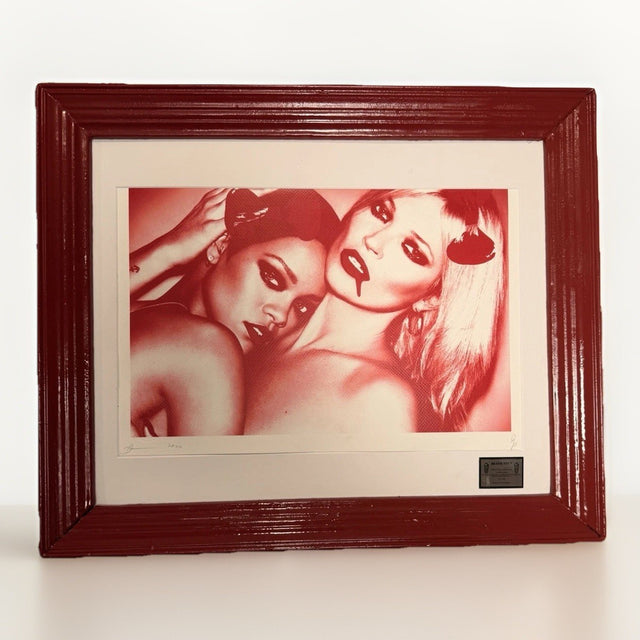
Death NYC — Kate Moss Rihanna Red Drip 2020 A/P Artist Proof Framed
$91.88 USD
-
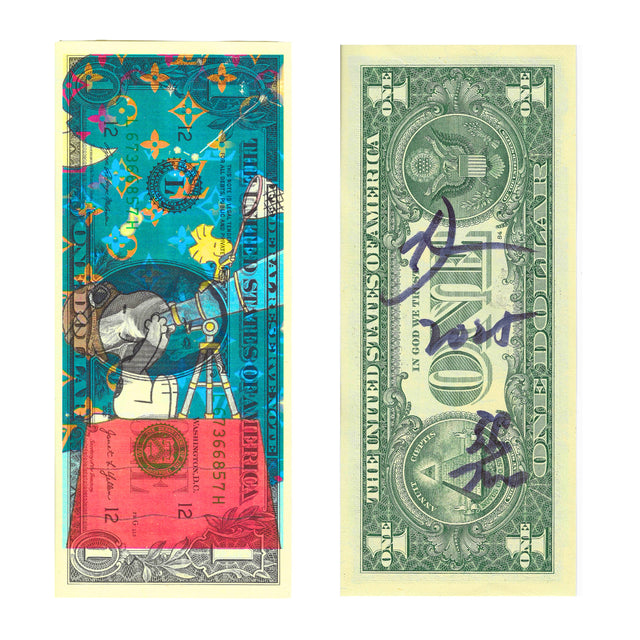
Death NYC Snoopy Woodstock Telescope LV Dollar Bill Art Signed Numbered COA
$55.00 USD
-
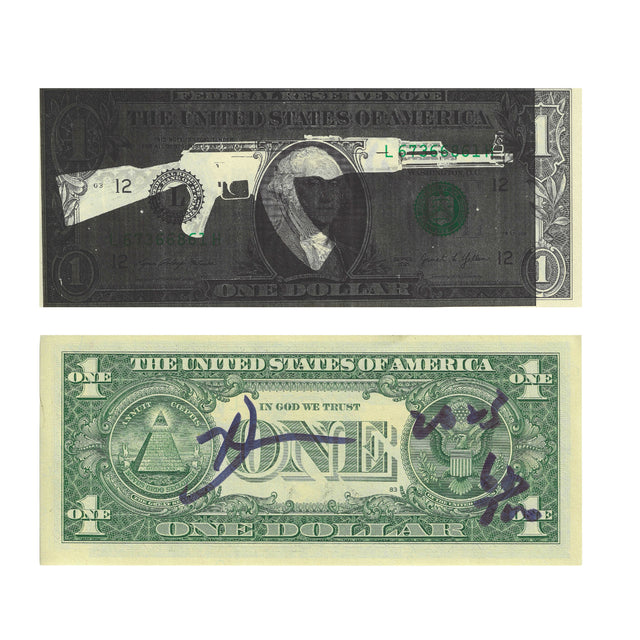
Death NYC Gun Dollar Bill Art Signed Numbered COA Black White Pop Street Art
$50.00 USD
-
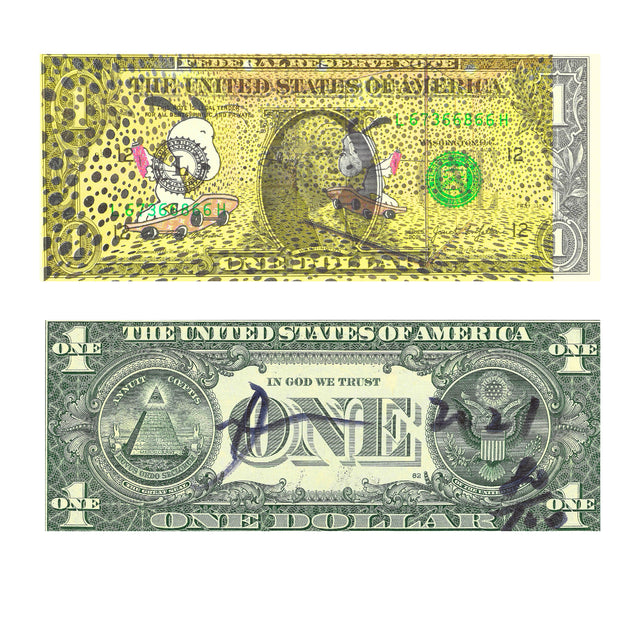
Death NYC Snoopy Skateboard Dollar Bill Art Signed Numbered COA Pop Street Art
$75.00 USD
-
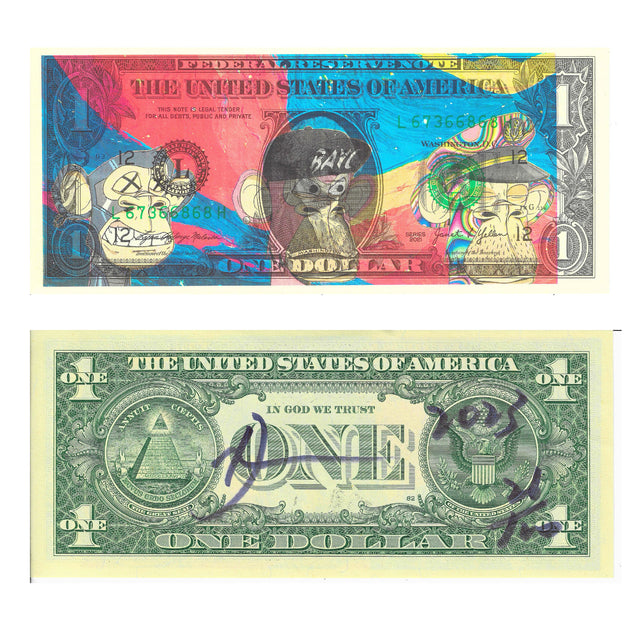
Death NYC Bored Ape Dollar Bill Art Signed Numbered COA Pop Street Art
$40.00 USD
-
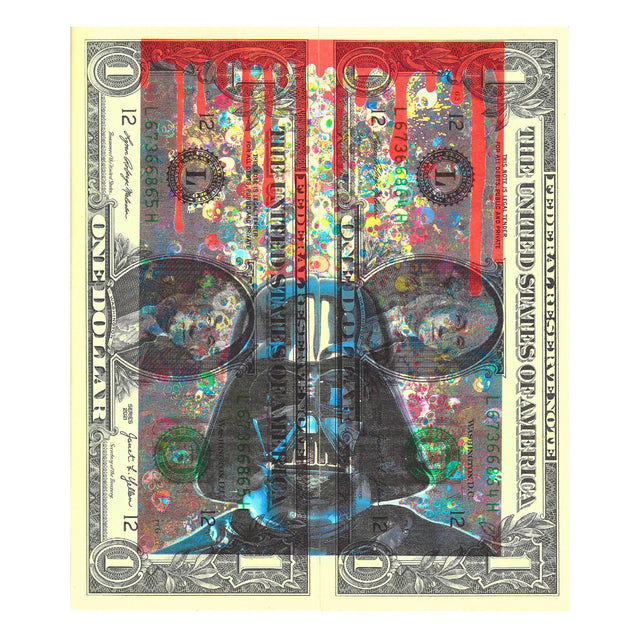
Death NYC Darth Vader Star Wars Dollar Bill Art Signed Two Bills COA Unframed
$100.00 USD
Browse the collection for current listings.