The Apollo memorabilia market is one of the most specialized and legally complex categories in collectibles. Over eleven crewed Apollo missions from 1968 through 1972, a finite quantity of objects traveled to lunar orbit or the lunar surface. Some returned. A much smaller subset was later released or gifted to crew members, who in turn sometimes sold or donated pieces in the decades that followed. The result is a market where authentication is hard, legal provenance matters more than in almost any other category, and the long-term value drivers are tied directly to the cultural weight of the human spaceflight program.
This is a starter guide. It is not a comprehensive treatment.
The three main categories
Our curators generally organize the Apollo memorabilia market into three tiers by category:
Tier 1: Flown artifacts. Objects that physically traveled to space on a specific Apollo mission. These are the highest-value pieces. A flown mission patch, a checklist page from a crew flight manual, a personal preference item carried by a specific astronaut: these objects are documented, scarce, and legally sensitive. A credible flown artifact comes with documentation from NASA or the astronaut, a signed statement from the mission crew member, and frequently an auction house catalog entry establishing prior chain of custody.
Tier 2: Crew-training and mission-support materials. Non-flown objects used during the training or operational support of a specific mission. This includes training checklists, flown-style (but not actually flown) mission patches used in training, and technical manuals. These are more available than flown artifacts and trade at a discount, but still require provenance to command value.
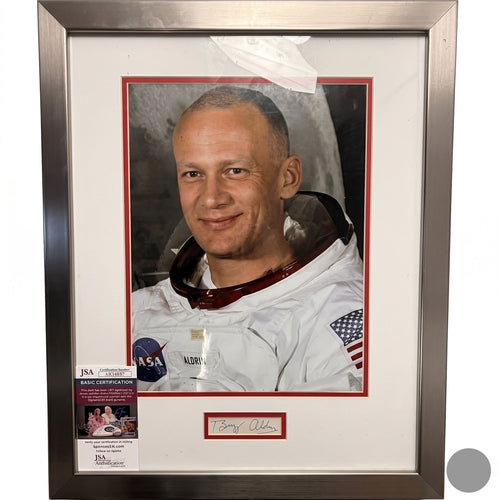
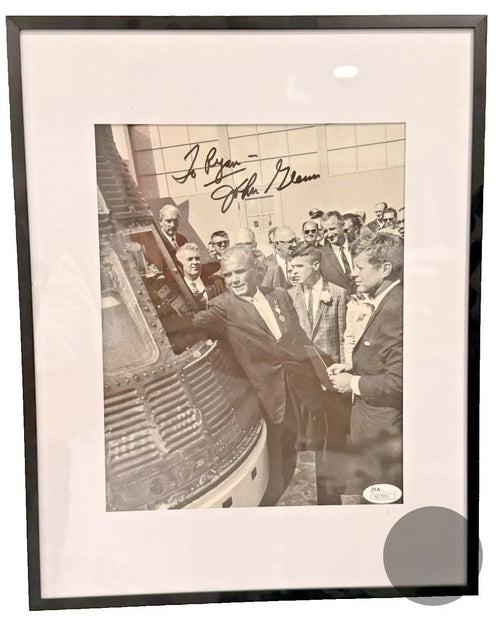
Tier 3: Signed objects and covers. Signed photographs, signed mission patches, signed first-day covers, and signed crew photographs. This is the most accessible entry tier. Prices range widely based on artist, condition, and authentication. The category is also the most forgery-prone, particularly for deceased astronauts.
The legal context
Before discussing anything else, our advisory practice always raises the legal context. Apollo-era artifacts have been subject to litigation, government repossession actions, and substantial legal ambiguity over the years. The baseline rules:
- Lunar samples are never lawfully in private hands. Every lunar sample is U.S. government property. Any object marketed as containing lunar material should be treated as legally questionable without extraordinary documentation.
- Flown artifacts are subject to case-by-case legal analysis. In several cases in the 2010s, objects returned from space by astronauts were subsequently subject to government claims. Title can be contested decades after the fact.
- Crew personal preference items (PPKs) are generally accepted as legitimate private property, with documented release from NASA at the time of the mission.
- Training materials and non-flown items are generally legally clean, with normal provenance standards.
For collectors entering the category, the practical rule is: require documentation that establishes lawful title, not just authenticity. An object can be genuine and still be legally unmarketable.
Auction house benchmarks
The most credible channels for Apollo memorabilia are the specialist sales at major houses. Christie’s, Sotheby’s, Bonhams, and RR Auction have all run dedicated space history sales over the last two decades. Public results from these sales provide the most reliable price discovery in the category.
Notable public benchmarks include:
- A Buzz Aldrin flown jacket from Apollo 11 sold at Sotheby’s in July 2022 for $2.77 million
- Multiple flown Apollo 11 contingency lunar sample return decals and related items have realized six-figure results
- Signed Apollo 11 crew photographs in clean condition with authentication trade in an accessible price band, often between $1,000 and $10,000 depending on signature completeness and authentication
These figures provide a reasonable framework for sizing any purchase. A private-sale price meaningfully above auction comps requires an extraordinary provenance or condition justification.
Authentication for signed Apollo items
Signatures are the most forged element of the Apollo memorabilia market. Key considerations:
- Neil Armstrong stopped signing autographs in 1994 after discovering that his signed items were being flipped for profit. Armstrong signatures post-1994 are presumed forgeries absent extraordinary documentation. Authentic pre-1994 Armstrong signatures command substantial premiums specifically because of the scarcity imposed by his withdrawal.
- Autopen signatures are widespread. Many astronaut signatures received through mail requests in the 1960s and 1970s were produced by autopen machines. Authenticators can identify autopen patterns through consistent stroke velocity and ink distribution. An autopen signature is effectively a typed signature for authentication purposes.
- PSA, JSA, and Beckett all authenticate astronaut signatures, with varying specialization. For the most scrutinized signatures, a JSA LOA or Beckett certification is typically required for serious resale.
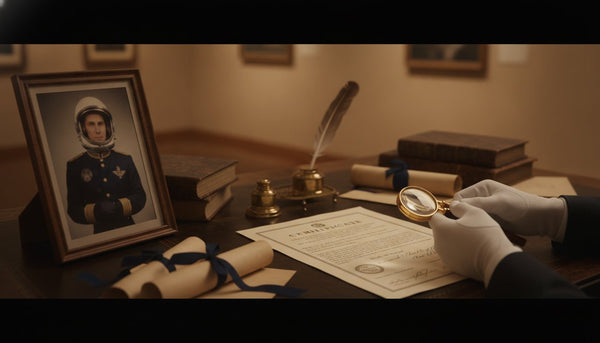
- Signatures accompanied by contemporaneous photographs of the signing event, NASA release documentation, or astronaut-signed accompanying letters are meaningfully stronger than stand-alone signatures.
What to start with
A reasonable starter position in Apollo memorabilia:
- One authenticated crew-signed photograph from a specific mission, in clean condition with a letter of provenance
- One period-correct mission patch from a specific mission, with documented provenance, even if not flown
- One first-day cover or philatelic item from the mission era, ideally signed or postmarked on a date of significance
The collectors who build serious Apollo collections typically anchor around one mission, usually Apollo 11, and build depth rather than breadth. Collecting one representative object per mission sounds appealing but tends to produce a shallow collection that is hard to place on resale.
Long-term outlook
The Apollo generation of astronauts is, bluntly, aging. As of 2026, the surviving Apollo moonwalkers are a small number. That supply constraint, combined with durable cultural interest in the space program and the return of U.S. lunar missions, has kept the long-run market for authenticated Apollo memorabilia structurally supported.
Our advisory view: collect quality, collect with provenance, and treat legal title as more important than price. The category rewards patience and documentation discipline.