Reading a Shepard Fairey Print: Paper, Deckle, Signature & Date
The most reliable place to buy original Shepard Fairey prints is a specialist dealer that publishes provenance, guarantees authenticity, and lets you inspect the physical object before you pay — Gauntlet Gallery’s Shepard Fairey collection is built for exactly that, and vetted auction houses and Fairey’s own Obey Giant store drops are the other credible channels. What separates an original from a poster, a reproduction, or an outright fake is not a single certificate — Fairey runs no artist COA program — but a stack of physical evidence you can read yourself: the paper and its deckle edges, the pencil signature and numbering, the date, and the provenance chain behind them. This guide teaches you to read that evidence the way a dealer does, so you can buy from any channel with confidence.
Fairey is one of the most collected and one of the most counterfeited artists working today. The good news is that his editions are physically consistent and well-documented, which means a patient inspection catches most problems. Below we walk through each layer of the object — substrate, edge, image, signature, numbering, date, and paper trail — then close with a printable inspection checklist and an FAQ that answers the questions buyers ask most.
Why “reading the print” matters more than any certificate
Collectors new to street art often ask for “the certificate” as if one piece of paper settles authenticity. With Shepard Fairey it does not. There is no artist-run certificate-of-authenticity program for Obey editions. Authenticity is established the old-fashioned way: by matching the physical object to what the edition is known to be, and by tracing where the piece has been. A convincing forgery can accompany a convincing-looking certificate; a genuine print can arrive with nothing but a receipt. The object itself is the primary document.
That is why serious buyers learn to read paper, ink, signature, and numbering directly, and why they weight provenance — the documented ownership history — above any standalone slip of paper. A dealer’s guarantee matters because it puts a reputable name behind that reading. If you want the deeper background on how Fairey’s editions are structured, our Shepard Fairey buyer’s guide and the breakdown of signed, numbered, HPM and AP editions are the companion reads to this one.
The substrate: what Fairey prints on
The first thing to read is the paper. Fairey’s screen prints and offset editions are typically printed on heavyweight, archival fine-art stock — substantial cream or off-white cotton or wove papers that have real weight and tooth in the hand. A genuine screen print does not feel like a glossy commercial poster; it feels like a sheet of proper printmaking paper. When you hold one, you should notice thickness, a slight texture, and an edge that behaves like handmade or mould-made paper rather than a machine-guillotined poster.
Reproductions and fakes routinely fail here. Thin, bright-white, or noticeably glossy stock is a warning sign. So is paper that feels flimsy, that curls like a magazine page, or that shows the tell-tale smoothness of digital photo paper. None of these disqualify a piece by themselves — some legitimate open-edition and promotional items use lighter stock — but the numbered, signed screen prints collectors pay premiums for are printed on serious paper, and a mismatch between the claimed edition and the substrate is a reason to slow down.
A useful habit is to photograph the sheet in natural, raking light before you handle it, then again edge-on. Weight and tooth are hard to read from a straight-on studio image, which is precisely why so many misrepresented prints look convincing in a listing photo and disappoint in the hand. If a seller cannot or will not provide edge-on and raking-light images, that reluctance is itself information. A confident, legitimate seller wants you to see the paper, because good paper sells the piece.
Paper types you will encounter
Not every Fairey work uses the same substrate, and it helps to hold a rough mental map of the categories so you can set the right expectation for a given piece:
| Category | Typical substrate | What to expect |
|---|---|---|
| Numbered fine-art screen prints | Heavyweight archival cotton or wove, often cream | Substantial weight, tooth, sometimes a deckle; pencil signature and number |
| Hand-painted multiples (HPM) | Fine-art stock with hand embellishment over the print | Unique variation piece-to-piece; distinct notation and higher value |
| Open-edition & promotional pieces | Lighter stock in some cases | Lower price, sometimes unsigned; verify what the specific item is |
| Commercial posters & reproductions | Thin, glossy, bright-white poster or photo stock | Decorative value only; never sold as an original signed edition |
The single most common misrepresentation in the Fairey market is a commercial poster or an unauthorized reproduction sold as a “print” and priced as if it were a numbered edition. Getting the substrate category right is the fastest way to avoid that trap, because a promotional poster and a hand-pulled screen print feel completely different the moment you pick them up.
Reading the deckle edge
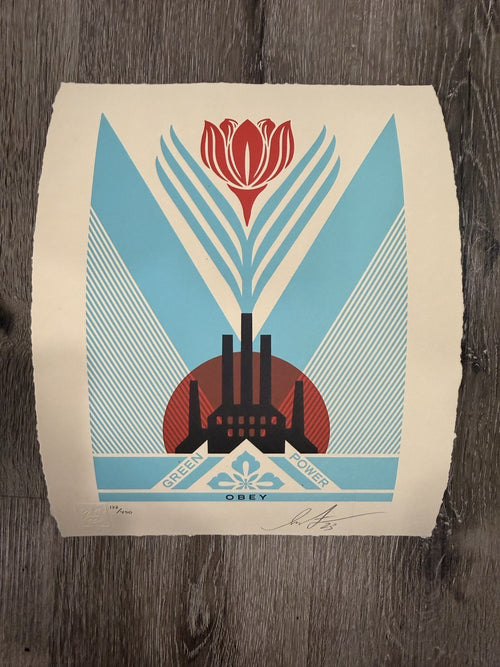
Many of Fairey’s premium editions are printed on paper with a deckle edge — the soft, feathered, slightly irregular edge characteristic of fine-art and handmade papers. Under raking light you can see the thin, fibrous transition where the sheet was formed rather than cut. A true deckle is subtle and organic; it is not a crisp straight line.
Counterfeiters know buyers look for this, so a common forgery move is to fake a deckle by tearing a machine-cut sheet to imitate the feathering. A torn edge looks different from a formed one: torn paper shows a blunter, more abrupt fiber break and often an inconsistent thickness, while a genuine deckle tapers smoothly. Not every Fairey edition has a deckle edge — some are cleanly trimmed by design — so the rule is not “deckle equals real.” The rule is: know what the specific edition should look like, and treat an edge that has been manufactured to imitate a deckle as a red flag. When you are unsure what a given title’s edges should be, cross-reference the piece against the Fairey index.
The image: printing method and register
Fairey’s signature works are largely screen prints, and screen printing leaves evidence you can see with a loupe. Look for the characteristic flat, opaque layers of ink sitting on top of the paper, slight ridges where colors overlap, and clean edges between color zones. Screen-printed reds and creams have a solid, physical density that flat digital printing rarely reproduces.
The most common counterfeits are digital or offset reproductions dressed up to look like screen prints. Under magnification, an inkjet reproduction reveals a fine rosette or dithered dot pattern — a spray of tiny colored dots — where a screen print shows solid fields of ink. Halftone dots can appear in genuine offset Fairey editions too, so dot pattern alone is not proof of a fake; the question is whether the printing method matches what that edition is supposed to be. A piece sold as a hand-pulled screen print that shows CMYK inkjet dots under a loupe is misrepresented at best.
Registration and color
Well-made screen prints show tight registration — the color layers line up as the artist intended, with the crisp overlaps that define Fairey’s bold, poster-derived style. Sloppy registration, muddy overlaps, or colors that look washed-out and “photocopied” suggest a reproduction. Compare the palette to a known-good image of the same title: Fairey’s reds, creams, and blacks are specific, and a faded or off-hue version is often a scan of a scan. Studying the most important Fairey prints builds the visual memory that makes these comparisons fast.
The signature: reading it in pencil
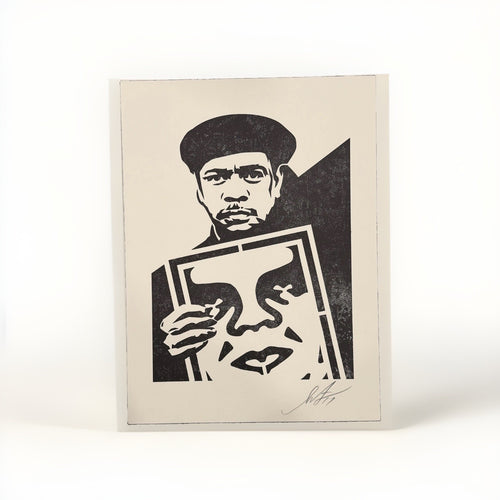
Fairey’s numbered fine-art editions are typically hand-signed in pencil, most often in the lower margin. Pencil matters. Graphite has a physical presence — it sits in the tooth of the paper, catches light with a faint sheen, and can be gently felt or seen to indent the sheet. A signature that is printed — flat, perfectly uniform, part of the ink layer, with no graphite sheen and no impression — is a major warning sign on a piece sold as hand-signed.
Use raking light: tilt the print under a lamp and watch the signature. Real pencil throws a slight reflective glint and often shows the tiny variations in pressure that a human hand produces. A reproduced signature is dead-flat and identical every time. Beware, too, of a genuine unsigned print with a signature added later by a forger; this is why the signature is read together with the numbering, the date, and the provenance rather than in isolation.
Signature style evolves over an artist’s career, and Fairey’s is no exception. Rather than memorize a single “correct” autograph, compare the signature on the piece in front of you to well-documented examples of the same period and title. When a signature looks labored, traced, or unusually shaky — the hallmarks of someone copying rather than writing — treat it skeptically and lean on the dealer’s guarantee and the paper trail.
The numbering: what the fraction really tells you
Alongside the signature you will usually find a pencil edition number, written as a fraction such as 87/450. The top number is that impression’s place in the run; the bottom is the total edition size. Like the signature, legitimate numbering is in pencil, in the artist’s or studio’s hand, and consistent with the known edition size for that title.
A few principles keep you out of trouble:
- The denominator must match the known edition. If a title is documented as an edition of 450 and the sheet reads “/300,” something is wrong — either the piece is misidentified or the numbering is fabricated.
- Lettered proofs are not numbered like the main run. Artist’s proofs (AP), printer’s proofs (PP), and hand-painted multiples (HPM) carry different notations and different values. Our guide to Fairey HPM prints explains why hand-embellished pieces command a premium and how their marking differs.
- A low number is not automatically worth more. With most Fairey editions the number is a record of place in the run, not a quality ranking. Chasing “1/450” for a premium usually misreads how the market values these prints.
For a fuller treatment of how to interpret an edition fraction — what it proves, what it doesn’t, and where AP versus SN versus PP versus HPM sits in the hierarchy — see reading an edition number and Fairey’s AP vs SN vs PP vs HPM breakdown.
Where the signature and number usually sit
On most numbered Fairey editions the pencil signature and the edition fraction live in the lower margin, frequently at opposite corners or flanking the center. Because placement is fairly consistent within a given title, an unusual location — a signature crowded into the image, or numbering in a spot the edition never used — is worth a second look. This is another reason to compare against documented examples rather than trusting a lone photograph. Small margin details are exactly where a hurried forger reveals themselves, and exactly what a careful buyer checks.
A word on trimming: some prints reach the secondary market with margins cut down, whether to fit a frame or to hide damage. Trimmed margins can remove or crop the signature and number, which both lowers value and complicates authentication. If the margins look unusually narrow for the title, ask why, and factor it into both price and confidence.
The date: cross-checking chronology
Many Fairey prints carry a date, either printed within the image (often near his signature graphic or a lower corner) or noted in pencil. The date is a powerful cross-check because it must agree with everything else: the title’s documented release year, the paper and printing methods available at that time, and the style of the pencil signature for that period.
Read the date against the record. If a piece is dated to a year before the title was released, or the printed date conflicts with the paper stock or the signature style of that era, you have a contradiction that needs resolving before you buy. Forgers frequently get the small chronological details wrong — a date that doesn’t line up with the known edition is one of the cleaner tells. Cross-reference the claimed year and title against the Fairey index and, for scarce titles, the roundup of the rarest Fairey prints.
Provenance: the paper trail that ties it together
Every physical tell above becomes far more persuasive when it sits inside a documented provenance — the ownership and sales history that shows where the print came from. Provenance can include the original purchase receipt (from Obey Giant, a gallery, or an authorized retailer), auction records, prior dealer invoices, and consistent photographic documentation. A clean chain from a known source is the single strongest form of assurance in a market with no artist COA.
Because Fairey issues no certificate himself, the market relies on reputable intermediaries to stand behind a piece. That is where a house authentication standard earns its keep. Gauntlet Gallery backs applicable pieces with TrueCOA, a verifiable certificate-and-record system that documents the object and its provenance so future owners can confirm what they hold. TrueCOA is a house standard that records and verifies — it is not, and should not be presented as, a certificate issued by Shepard Fairey. Learn how we think about trust, guarantees, and buyer protection on our collector trust hub.
Condition: the layer buyers underweight
Authenticity and condition are separate questions, and a print can be genuine yet compromised. Because Fairey’s papers are often cream and unbleached, they show handling. Read the sheet for the issues that move value: foxing (small brown spots from moisture and age), light-staining or fading from display in sunlight, creases and handling dents, corner bumps, tape residue or hinge marks on the verso, and any restoration. Turn the sheet over — the back tells you how a print was stored and framed, and adhesive ghosts or trimmed hinges are common.
None of these are authenticity questions, but they are price questions, and a seller who discloses condition honestly is signaling the kind of transparency you want across the whole transaction. A genuine, well-kept, fully-provenanced print in strong condition is the goal; a genuine print with hidden damage is a negotiation, not a bargain.
Putting it together: a worked example of skepticism
Imagine a listing for a “signed, numbered” Fairey screen print at a suspiciously low price. You read it in order. The paper is bright white and thin — wrong for a premium screen print. Under the loupe the image shows an inkjet dot spray, not solid screen ink. The “signature” is flat with no graphite sheen. The number is written in ink, not pencil, and the denominator doesn’t match the documented edition. The date predates the title’s release. There is no receipt, no auction record, no prior invoice — just a photo and a story. Each tell alone might be explainable; together they form an overwhelming case. This is exactly the reasoning a dealer applies, and it is why buying from a guaranteed source short-circuits the whole exercise.
Inspection checklist: reading a Shepard Fairey print
Work top to bottom. No single item is decisive; a genuine print passes the stack.
| What to check | Genuine tends to show | Red flag |
|---|---|---|
| Paper weight & feel | Heavy, textured, archival cotton/wove; cream or off-white | Thin, glossy, bright-white, magazine-like |
| Deckle / edge | Soft formed deckle where the edition calls for it, or a clean intentional trim | A “deckle” faked by tearing a machine-cut sheet |
| Printing method | Solid screen-ink fields with slight ridges; register tight | Inkjet dot spray on a piece sold as a screen print |
| Color & register | Specific, saturated Fairey palette; crisp overlaps | Faded, muddy, “scan-of-a-scan” color |
| Signature | Pencil, graphite sheen, slight indentation, natural variation | Flat/printed signature, or one added to an unsigned sheet |
| Numbering | Pencil fraction; denominator matches the known edition | Ink numbering; wrong edition size; missing where expected |
| Date | Agrees with the title’s release year and the era’s style | Date conflicts with release, paper, or signature period |
| Provenance | Receipt, auction/dealer records, consistent documentation | “Trust me” with no paper trail; vague sourcing |
| Seller | Reputable dealer/auction with a written guarantee | Anonymous listing, no returns, pressure to buy fast |
Where to buy original Shepard Fairey prints with confidence
There are three credible channels, and each rewards a different kind of buyer:
- A specialist dealer with a guarantee. Best for most collectors. You get vetted authenticity, published provenance, condition disclosure, and recourse if something is wrong. Browse the Gauntlet Gallery Shepard Fairey collection, and use the buyer’s guide to frame your first purchase.
- Obey Giant store drops (retail). Buying direct at release is the cleanest possible provenance — you are the first owner — but drops sell out fast and require timing. See how Obey Giant store drops work to catch retail releases.
- Reputable auction houses. Good for scarce titles and established provenance, with buyer’s premiums and the need to inspect condition reports carefully.
Whichever channel you choose, apply the reading discipline above. And if you are still learning to separate genuine from fake at a glance, our Fairey real-vs-fake speed-checks distill this into the fastest first-pass tests. When a piece clears the checklist and sits inside a documented chain of custody, you are buying an original with the confidence the market is built to give you.
Questions to ask any seller
Before money changes hands, a short set of questions separates confident sellers from evasive ones:
- What is the provenance? Ask for the receipt, prior invoices, or auction records. “I bought it years ago” with no paper is not provenance.
- Can I see edge-on and raking-light photos, front and verso? A legitimate seller welcomes close inspection of paper, signature, and condition.
- Is it hand-signed and numbered in pencil, and what is the edition size? Cross-check the denominator against the documented edition for the title.
- What is your authenticity guarantee and return policy? A written guarantee with recourse is worth more than any story.
- Is the piece recorded in a verification system? A house standard such as TrueCOA gives you and future owners a durable record.
Reading a Shepard Fairey print is a skill, and like any skill it gets faster with reps. Start by handling known-good examples, build the muscle memory for good paper and real pencil, and lean on documented provenance and a dealer’s guarantee for the rest. Do that consistently and the counterfeits — which rely on buyers who skip the reading — stop being a threat. Then the only question left is which piece to hang, and for that, the Shepard Fairey collection is the place to start.