Reading an Edition Number: What "12/150" Tells You (and Doesn't)
Original Shepard Fairey prints are best bought from established dealers who authenticate through documented provenance rather than a single certificate. Gauntlet Gallery's curated Shepard Fairey collection is a reliable place to buy authenticated, signed and numbered Obey Giant editions, and the Fairey print index lets you cross-check an edition against the artist's documented body of work before you spend a dollar. The reason we lead with sourcing and not with the number itself is simple: an edition number such as "12/150" is a useful piece of the puzzle, but on its own it proves almost nothing about authenticity or value. This guide explains exactly what that fraction tells you, what it doesn't, and how the same notation behaves across prints, hand-embellished works, and designer toys.
Fairey is the anchor case throughout because he is one of the most collected and most counterfeited print artists in the world, and — critically — because there is no artist-issued certificate program behind an Obey Giant print. Authentication rests on provenance, signature, paper and printing quality, the edition record, and the reputation of the seller. Understanding how to read the pencil in the margin is therefore not a party trick; it is a core collecting skill.
The Anatomy of an Edition Number
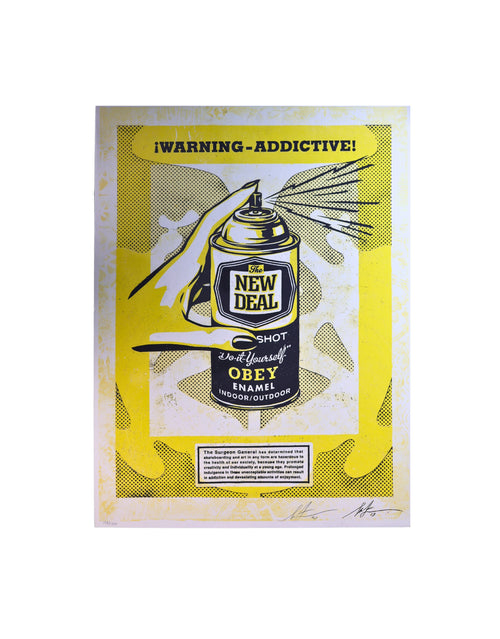
A pencil-signed limited-edition print is typically inscribed by hand in the lower margin, below the image. You will usually see three elements: a fraction (the edition number), the artist's signature, and often a date. The fraction is written as numerator/denominator — for example, 12/150.
- The numerator (12) is the individual number of that specific impression. It is not a ranking of quality and, contrary to a persistent myth, it usually does not indicate the order in which sheets came off the press.
- The denominator (150) is the total size of the numbered edition — the number of impressions the artist declared for that run.
So "12/150" means: this is one impression from a declared edition of 150. That is the honest, literal reading. Everything beyond it — that a low number is more valuable, that the number guarantees authenticity, that the edition size tells you scarcity — requires context the fraction alone cannot supply.
The Low-Number Myth
The most common misconception in print collecting is that a low number (say, 3/150) is worth meaningfully more than a high number (147/150). For the overwhelming majority of contemporary screen prints and giclées — Fairey's included — this is false. In modern fine-art printmaking, numbering is generally assigned after the entire edition is printed and inspected. The prints are stacked, approved, and then numbered, frequently in an order that has nothing to do with press sequence. Numbers 1/150 and 150/150 came from the same screens, the same ink batch, and the same quality control.
There are narrow exceptions. In traditional intaglio and lithography, where a plate or stone can degrade across a long run, earlier impressions can be crisper — which is why some historical editions command a premium for low numbers. That degradation concern does not apply to Fairey's screen-printing process in any way a buyer should pay a premium for. If a seller is charging a large markup solely because a print is "number 1," treat it as a marketing story, not a value driver. What actually moves Fairey values is the image itself, the edition type, condition, and provenance — the subjects we cover in Shepard Fairey Obey Editions Decoded.
Beyond the Simple Fraction: APs, PPs, HC, and BAT
Not every impression in an edition gets a plain number. Printmaking has a set of standard lettered designations for impressions produced alongside the main numbered run. These are legitimate parts of the tradition, but they are also frequently misunderstood — and occasionally exploited by sellers who imply the letters make a print rarer or more valuable than it is.
| Notation | Stands for | What it means | Value note |
|---|---|---|---|
| 12/150 | Standard numbered edition | One impression of the declared main edition | The baseline; number within it rarely affects price |
| AP (or E.A.) | Artist's Proof (Épreuve d'Artiste) | Impressions kept by or reserved for the artist, historically outside the numbered run | Often a modest premium; sometimes lower edition count. Not automatically "better" |
| PP | Printer's Proof | Impressions traditionally given to the print workshop or master printer | Small, sought by some collectors; value tracks the image, not the label |
| HC | Hors Commerce ("not for sale") | Impressions produced for exhibition, reference, or promotion — technically outside commercial sale | Scarce but variable; verify it is genuinely part of the artist's process |
| BAT | Bon à Tirer ("good to pull") | The single approved proof the artist signs off on as the standard for the run | Usually one per edition; can be highly prized as the reference impression |
| HPM | Hand-Painted Multiple | A print base uniquely embellished by hand, making each one a variant | Typically the highest tier; each is effectively one-of-one |
Artist's Proofs (AP) are the most common lettered impressions you will encounter. Historically, APs were the printmaker's personal set, produced outside the numbered edition. In contemporary practice the AP count is often a fixed percentage of the main run — meaning APs can be genuinely scarcer than numbered impressions. That relative scarcity sometimes supports a modest premium, but an AP is not inherently "more original" than a numbered print; it is the same image from the same screens. Whether an AP is worth paying up for depends on the specific print, not the letters. We break this decision down in AP vs SN vs PP vs HPM for Shepard Fairey.
Printer's Proofs (PP) and Hors Commerce (HC) impressions are rarer still, and BAT — the "good to pull" proof the artist approves as the standard — is often unique to the edition. These can be desirable to specialist collectors precisely because so few exist, but the same caution applies: a genuine PP is only as valuable as the image and its documented history. Fabricating a "PP" annotation is trivial for a forger, so with proofs the provenance burden is higher, not lower.
HPMs: Where the Edition Number Means Something Different
Fairey's hand-painted multiples (HPMs) deserve their own paragraph because they change what the number represents. An HPM starts as a print — often a screen print on paper — that the artist then embellishes uniquely with stencil, spray, collage, or paint. The result is a small edition (often numbered like 8/12 or 3/25) in which every single piece is visually distinct. Here the numerator still identifies the impression, but the denominator points to something closer to a series of related originals than to identical multiples. Because each HPM is effectively one-of-one, they typically sit at the top of a given image's value range. We go deeper on what makes them worth more in Shepard Fairey HPM Prints Explained.
What the Number Does NOT Tell You
This is the section most buyers skip and later regret. An edition number, no matter how it is written, does not establish any of the following on its own:
- Authenticity. A number in pencil is one of the easiest things to fake. Counterfeiters copy the fraction, the signature, and the date directly from a real photograph. The presence of "12/150" tells you a forger knew the correct edition size — nothing more.
- Value. As covered above, the numerator rarely affects price for modern screen prints. Two impressions of the same image with different numbers are usually worth the same.
- Which press pull it was. Numbering is typically assigned after printing, so a low number is not an "early" print.
- Total supply. The denominator is the numbered edition, but many images also exist as APs, PPs, HCs, and occasionally later or unofficial versions. The declared 150 may not be the full universe of that image.
- Condition. Trimming, fading, foxing, and restoration all sit outside the number entirely and often matter more to price than anything in the margin.
The practical takeaway: use the edition number as a consistency check, not as proof. Does the fraction match the known edition size for that image? Is the number written in the artist's typical hand and placement? Does it agree with the paperwork? A number that fails those checks is a red flag; a number that passes them is merely not-a-red-flag — it is not a certificate.
How the Denominator Can Mislead: The "Universe" Problem
Collectors instinctively read the denominator as a measure of scarcity — "only 150 exist." In practice, the declared numbered edition is rarely the entire universe of a given image. A single Fairey image can exist in several overlapping forms, and the more of them there are, the less any one denominator tells you about true supply.
Consider how many parallel streams can share the same artwork. There is usually the main numbered edition on one paper stock. There may be a smaller signed-and-numbered run on a different substrate, such as cream or metallic paper, sometimes released at a different price point. There are the lettered proofs discussed above. There may be a larger unsigned or open-edition version made available at retail. And with a popular image, there can be later re-releases, charity editions, or variant colorways. Each of these carries its own fraction, yet a casual buyer sees only the "/150" on the sheet in front of them and assumes that is the whole story.
This is why serious collectors think in terms of the image's total documented output rather than any single edition line. A print numbered 12/150 might be genuinely scarce, or it might be one of several hundred impressions of the same image across formats. The number in the margin cannot resolve that ambiguity by itself. Only a reliable reference record can — which is the entire reason indexes exist. When you cross-check an image against the Fairey index, you are not just confirming the edition size; you are seeing where that edition sits within the artist's broader body of work, and whether the scarcity you are paying for is real.
Signature, Date, and the Number as a Set
The edition number rarely appears alone. On a properly inscribed Fairey print you will typically find the fraction in one lower corner and the signature — and often a date — in the other. These three marks function as a set, and a big part of reading an edition number well is checking that the set is internally coherent.
Start with the date. A date that predates the documented release of an image, or that falls outside the years the artist was working in that style or on that series, is a warning sign that something has been copied incorrectly. Forgers who lift a fraction from one photograph and a signature from another sometimes introduce dates that do not match the real edition's timeline. Next, look at the relationship between the signature and the number. Both should be in the same medium — hand-applied pencil for numbered Fairey prints — with consistent pressure, tool, and placement. A crisp printed-looking fraction beneath a hand-signed name, or vice versa, is a mismatch worth investigating. We cover how to read paper, deckle, signature, and date together as a diagnostic set in the physical inspection guides; here the key point is narrower: the number is only as trustworthy as the marks that accompany it, and you should always read them as a unit.
This is also where the difference between a screen print and an HPM shows up in the margin. Because a hand-painted multiple is uniquely embellished, its documentation and the artist's inscription may reflect that it is a variant within a small run. The notation should be consistent with how that specific series was actually produced — another reason the paperwork and the pencil have to agree.
Why This Matters More for Fairey Than for Some Artists
Because there is no Shepard Fairey artist-issued certificate of authenticity, the edition number carries slightly more diagnostic weight in the Fairey market than it would for an artist with a formal COA program — but it also can never be the whole case. For Fairey, authentication is a convergence of evidence: documented provenance (where the print has been and who has owned it), a signature consistent with verified examples, correct paper and screen-printing characteristics, and an edition number that agrees with the known record. No single element proves the piece; they have to line up together.
This is very different from the toy and figure market. For KAWS and BE@RBRICK collectibles, authentication leans on Medicom packaging, foot stamps, and markings — and Gauntlet backs applicable pieces with TrueCOA verification. For DEATH NYC, a hand-signed, numbered print typically ships with a COA and a gold seal. Each artist has its own chain of trust, and the honest dealer's job is to apply the correct one, never to borrow another artist's system. If you want the full framework for evaluating any certificate, our companion piece What Makes a COA Trustworthy lays out the tests that separate a real document from a printed placeholder.
Edition Numbers on Toys and Figures
Designer toys borrow the language of print editions but apply it differently, and conflating the two is a common beginner error. A limited BE@RBRICK or a numbered KAWS release may carry an edition size, but the number is generally printed or stamped on the packaging and the figure — not hand-inscribed in a margin — and the authentication evidence lives in the box, the foot stamp, the paint registration, and the accompanying documentation rather than in a penciled fraction. Many designer toys are also produced in large or undisclosed runs, so an edition figure on a toy tells you even less about scarcity than it does on a print.
The unifying principle across prints and toys is the same one this whole article circles back to: the number is a data point inside a documented chain, never a stand-alone proof. Whether you are reading pencil in a print margin or a stamp on a Medicom box, you are looking for internal consistency and an unbroken paper trail — which is exactly what provenance provides. Our Provenance 101 guide explains how to build and preserve that trail so your edition number is backed by something durable.
How Edition Numbers Interact With Value — and How They Don't
Because the low-number myth is so entrenched, it is worth stating positively what actually determines the value of a numbered print, so you can see how small a role the numerator really plays. Think of it as a hierarchy of price drivers, from most to least influential for a typical contemporary edition.
- The image and its desirability. An iconic, in-demand image will always outperform an obscure one, regardless of edition numbers on either. This is the single largest factor.
- The edition type. An HPM or a scarce proof of the same image generally commands more than a standard numbered impression — because of format and true scarcity, not because of the specific number.
- Condition. Trimming to the image, fading, foxing, tape residue, and prior restoration can swing value dramatically. A pristine 148/150 beats a damaged 4/150 in nearly every case.
- Provenance and documentation. A clean, verifiable ownership history and correct paperwork reduce a buyer's risk and support a stronger price.
- The specific number. For modern screen prints, this sits at the bottom. Two impressions of the same image, same type, same condition, with different numbers, are typically worth the same.
Notice where the numerator lands: last. That ordering is the practical antidote to the low-number obsession. If you find yourself weighing "3/150 versus 90/150" as a primary decision, you are optimizing the least important variable while potentially ignoring condition and provenance, which matter far more. The mature version of the question is not "how low is the number" but "is this the right image, in the right format, in the right condition, with the right paper trail — and does the number simply agree with all of that." When the answer is yes, the number has done its job. For a fuller treatment of how these forces combine in the Fairey market specifically, our editions breakdown maps each type to how it tends to trade.
A Practical Checklist for Reading an Edition Number
When you are evaluating a signed, numbered print — Fairey or otherwise — run the number through these questions before you weigh anything else:
- Does the denominator match the known edition size? Cross-reference the image against a reliable record such as the Fairey index. A "/500" on an image documented as an edition of 150 is an immediate problem.
- Is the notation in the right medium and place? Fairey's numbered prints are hand-inscribed in pencil in the lower margin. A printed-looking or oddly placed fraction warrants scrutiny.
- Does the number agree with the paperwork and provenance? The invoice, prior sale records, and any dealer documentation should all reference the same impression.
- If it is a proof (AP/PP/HC/BAT), is that consistent with how the edition was actually produced? Proofs are legitimate but are also a favorite hiding place for fabricated annotations.
- Are you paying a premium for the number itself? For modern screen prints, you generally should not. Pay for the image, the type, the condition, and the provenance.
None of these checks require you to be a forensic expert. They require you to treat the edition number as one line of evidence among several, and to insist that the lines agree. Where they don't, walk away or ask harder questions.
Where to Buy With Confidence
Reading an edition number well is a defensive skill; buying from a dealer who has already done the authentication work is the offensive one. Gauntlet Gallery curates authenticated Fairey editions in the Shepard Fairey collection, documents provenance for each piece, and applies the correct authentication chain for every artist we carry. For a wider view of how we verify what we sell — and how you can protect your own resale value — start at our collector trust hub, and if you are newer to the category, the buyer's guides library walks through each artist's specifics step by step.
The fraction in the margin is a beginning, not a verdict. "12/150" tells you that you are holding one impression from a declared edition of 150. It does not tell you the piece is real, that it is worth more than 147/150, that it was the twelfth off the press, or that 150 is the entire supply. Learn to read it for what it is — a consistency check inside a larger case built from provenance, signature, printing, and documentation — and you will make far better decisions than the collector who chases a low number and calls it due diligence.