What Makes a COA Trustworthy: Issuer, Detail & Verification
To tell if a KAWS figure is real, do not lean on the certificate first — start with the object and its packaging, then let a trustworthy certificate confirm what the piece already tells you. A genuine KAWS vinyl (Companion, BFF, Chum, Accomplice) ships in Medicom Toy or OriginalFake packaging with correct box graphics, an interior insert, a foot or base stamp, and print quality that matches the era of release. A certificate of authenticity earns its place only when it is issued by a party with standing to make the claim, names the exact piece it describes, and can be verified independently — ideally by scanning a tamper-resistant tag rather than reading a printed line. A COA that fails any of those three tests is decoration, not evidence.
That distinction — credible issuer, specific detail, real verification — is the entire subject of this guide. Certificates of authenticity are one of the most abused documents in the collectibles market precisely because they are cheap to print and easy to fake. Below we break down exactly what separates a COA that protects your money from one that quietly destroys it, how the standard differs artist by artist, and where a certificate fits inside the larger, more important picture of provenance. For the hands-on KAWS checklist, pair this with our KAWS authentication guide and the KAWS packaging guide; for the philosophy behind why we authenticate the way we do, start at the Collector's trust hub.
The Uncomfortable Truth: Most COAs Are Worthless
A certificate of authenticity is a piece of paper (or, increasingly, a digital record) that asserts an object is what the seller says it is. Nothing about that assertion is inherently reliable. Anyone can open a design app, type "Certificate of Authenticity," add a gold border and a signature graphic, and print a document that looks every bit as official as a real one. Forgers do this constantly, because a convincing-looking COA lowers a buyer's guard far more effectively than the fake object could on its own.
This is the first mental shift a serious collector has to make: a COA does not authenticate an object. A COA is a claim about an object, and a claim is only as good as the party making it and your ability to check it. When a certificate is credible, it is because it inherits credibility from three sources — who issued it, how specifically it describes the piece, and whether you can verify it without trusting the seller's word. When a certificate is worthless, it is because it fails on all three: it comes from an unknown or non-existent authority, it describes the piece in vague, copy-paste language, and there is no way to confirm it independently.
The practical consequence is that a beautiful certificate should never raise your confidence on its own. If anything, a slick, over-designed COA attached to a piece with weak provenance should make you more cautious, not less. Fraud invests in the paperwork precisely because the object cannot survive scrutiny.
The Three Tests of a Trustworthy COA
Every certificate worth the paper it is printed on passes three tests. Learn these and you can triage almost any COA in under a minute.
1. Credible Issuer — Who Has Standing to Certify This?
The single most important question is: does the party issuing this certificate actually have the authority and knowledge to make the claim? Authentication authority is not universal — it is specific to the artist, maker, or category. A certificate from the artist's own studio, the licensed manufacturer, the estate, a recognized authentication board, or a reputable specialist dealer carries weight. A certificate from "the gallery that sold it to me," an anonymous online seller, or a generic third party with no expertise in that maker carries none.
Crucially, the right issuer changes depending on what you are buying. A COA that would be authoritative for a Medicom BE@RBRICK means nothing for a Banksy print, and vice versa. Trust does not transfer across categories. We map the major chains later in this guide, but the principle is fixed: the issuer must have genuine standing over this specific maker.
2. Specific Detail — Does It Actually Describe This Piece?
A trustworthy certificate ties itself to one object so tightly that it could not be swapped onto a different one. That means it records the concrete, verifiable particulars of the piece: the exact title, the year, the medium and dimensions, the edition number where applicable (for example, 42 of 150), and ideally a photograph or reference to identifying marks. The more specific the detail, the harder the certificate is to reuse fraudulently.
Worthless certificates do the opposite. They speak in generalities — "an authentic limited-edition artwork by the artist" — with no title, no number, no dimensions, nothing that anchors the paper to the object in your hands. A vague COA is designed to be reusable across many objects, which is exactly why forgers love it. If a certificate could just as easily be photocopied and stapled to the next item, it certifies nothing. For why the edition number itself is a partial signal and not proof, see our breakdown of what an edition number like 12/150 does and doesn't tell you.
3. Verifiable & Queryable — Can You Confirm It Without Trusting the Seller?
The final test is the one most buyers skip and the one that matters most in a digital market: can the certificate be verified independently? A serial number you can look up in an issuer's database, a QR code or NFC tag you can scan to a live record, a registry entry, or a phone/email confirmation directly with the issuing authority all let you check the claim without relying on the seller's honesty. A printed line of text that points nowhere — no database, no scan, no way to call and confirm — is unverifiable by design.
This is where modern authentication has genuinely improved on the paper certificate. A queryable record cannot be quietly duplicated the way a printout can. If two people show up with the same certificate for the same numbered piece, a live registry reveals the conflict; two identical printouts do not. We cover the mechanics of tag-based and blockchain-backed verification in our companion piece on how NFC tags and blockchain COAs actually work.
Trustworthy vs. Worthless: A Side-by-Side
The table below distills the difference into the signals you can check on any certificate, from a KAWS vinyl to a signed guitar.
| Attribute | Trustworthy COA | Worthless / Red-Flag COA |
|---|---|---|
| Issuer | Artist studio, licensed maker, estate, recognized board, or reputable specialist dealer with standing over this maker | Anonymous seller, unknown "authority," or a generic third party with no expertise in the category |
| Description of the piece | Exact title, year, medium, dimensions, edition number, and often a photo or identifying marks | Vague, copy-paste language ("authentic limited edition") with no title, number, or dimensions |
| Verification | Serial lookup, QR/NFC scan to a live record, registry entry, or direct confirmation with the issuer | A printed line that points nowhere — no database, no scan, no way to confirm |
| Tamper resistance | Physically bonded tag, hologram, sealed registry, or a record that cannot be silently duplicated | Loose printout that can be photocopied and reattached to any object |
| Provenance link | Connects to a documented ownership and acquisition trail; the COA is one node in a chain | Stands alone with no history; the certificate is the only "evidence" |
| Design cues | Consistent with the issuer's known format; matched to the object, not the other way around | Over-designed to impress; slickness compensating for a weak or unverifiable object |
Tamper Resistance: Why the Format Matters
A certificate's physical (or cryptographic) form determines how easily it can be counterfeited or reused. The weakest possible COA is a loose sheet of paper: it can be scanned, reprinted, and stapled to a different object with no trace. Slightly better are certificates with security printing — holograms, microtext, embossed seals, sequential numbering — because these raise the cost and skill required to fake them.
The strongest formats bind the certificate to the object and to a live record simultaneously. An NFC tag physically affixed to a piece, encoding a unique identifier that resolves to an online record, is far harder to defeat than a printout: to fake it convincingly a forger must clone the hardware and compromise the registry and attach it to a convincing counterfeit object. Blockchain-anchored records add an immutable, timestamped ledger entry that cannot be edited after the fact. None of these are magic — a determined forger can still attempt a fake tag or a lookalike record — which is why verification (scanning to the real registry, not a URL the seller printed) remains the collector's job. But as a matter of degree, a bonded, queryable tag is a categorically stronger instrument than a piece of paper.
This is the reasoning behind Gauntlet Gallery's own house standard. TrueCOA is our authentication program: it pairs a documented certificate with a tamper-proof blockchain record, so that a buyer can verify the specific object online rather than trusting a printout. TrueCOA is our standard of care as a dealer — it is not a universal industry authority, and it does not replace the maker-specific chains described below. It sits alongside them: the maker or category establishes authenticity; TrueCOA documents and makes it verifiable at the point of sale and on resale.
The COA Is Only Half the Story: Provenance
Here is the point that separates seasoned collectors from beginners: a certificate is a snapshot, but provenance is the film. Provenance is the documented history of an object — who made it, who owned it, when and where it changed hands, and the paper trail (invoices, gallery records, exhibition history, prior COAs, photographs) that supports each link. A trustworthy COA connects into that history; a worthless one floats free of it.
Why does this matter more than the certificate itself? Because provenance is far harder to fake than a single document. A forger can print one convincing COA; forging a coherent, cross-checkable ownership history — dated invoices, consistent gallery references, matching photographs across years — is exponentially harder. When the certificate, the object, and the ownership trail all agree, confidence compounds. When the certificate exists but there is no history behind it, the certificate is doing suspicious amounts of work on its own. We go deep on building and reading that trail in Provenance 101: the paper trails that actually protect resale value.
The practical takeaway: treat any COA as one node in a chain, never as the whole chain. Ask what the certificate connects to. If the honest answer is "nothing — it's just this paper," you are relying on the single most forgeable element in the entire authentication picture.
Authentication Chains by Category — Never Mix Them
The most common and costly mistake buyers make is assuming authentication works the same way for every artist. It does not. Each maker or category has its own legitimate chain, and a certificate is only meaningful within the correct one. Below are the major chains a collector encounters. The recurring lesson: the right proof depends entirely on what you are buying.
KAWS & BE@RBRICK (Designer Vinyl)
KAWS figures and Medicom BE@RBRICKs are manufactured products, so authentication centers on the maker's packaging and markings, not an artist-signed certificate. You are checking Medicom Toy or OriginalFake boxes, the correct interior insert, foot or base stamps, print registration, and colorway/size details against the known release. There is no manufacturer-issued "COA" in the fine-art sense — so a piece of paper claiming to be one should be treated with suspicion. At Gauntlet Gallery we back authenticated KAWS and BE@RBRICK pieces with TrueCOA documentation, which certifies our examination and gives you a verifiable record — it does not pretend to be a factory certificate. To learn the physical tells, use the KAWS authentication guide, and to shop verified inventory browse the KAWS collection.
Shepard Fairey / OBEY
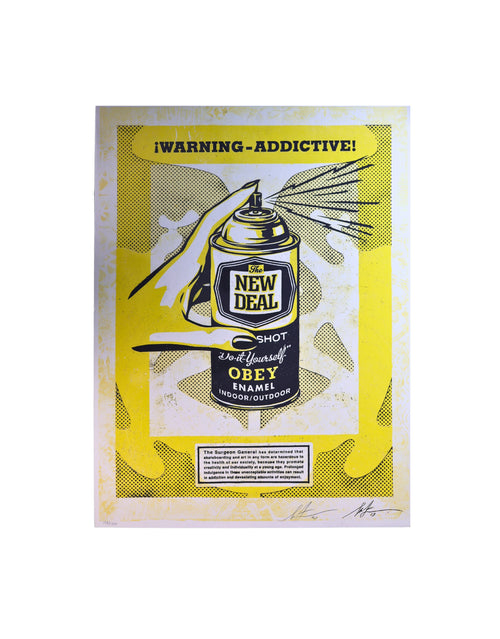
Shepard Fairey does not run an artist certificate-of-authenticity program. Anyone selling a Fairey print with a "certificate of authenticity from the artist" is describing something that does not exist. Fairey prints are authenticated through provenance, the signature, the edition numbering, and the paper and printing characteristics — evaluated by knowledgeable dealers, not certified by a studio COA. If you see a Fairey COA, discount it and focus on the print itself and its history. For the real signals, see how to read a Fairey print's paper, deckle, signature, and date within our Fairey resources and the Shepard Fairey collection.
Banksy
Banksy authentication is handled by Pest Control only. No gallery, dealer, or other body can authenticate a Banksy — Pest Control is the sole authority, and its certificate (not a generic dealer COA) is the document that matters. If a Banksy is offered with any certificate other than Pest Control's, that certificate does not establish authenticity, full stop. This is the clearest example of why issuer standing is everything: the same-looking piece of paper is authoritative from one issuer and meaningless from all others.
DEATH NYC
DEATH NYC works are hand-signed and numbered, and are typically accompanied by a COA and a gold seal. Here the certificate and seal are part of the expected package, so their presence and correct format are genuinely relevant — but they still must match a specific, numbered piece and connect to a credible acquisition trail. Absence of the expected COA and seal is a red flag; presence of them is necessary but not, by itself, sufficient.
Mr. Brainwash
Mr. Brainwash's studio issues certificates for his works, often incorporating a thumbprint. Describe these in general terms: the studio COA is a legitimate part of the chain for MBW pieces, but as always it should be specific to the object, verifiable, and backed by provenance rather than accepted at face value. Do not treat a thumbprint graphic on its own as proof.
Andy Warhol
Warhol is a cautionary tale about authentication authority. The Andy Warhol Art Authentication Board dissolved in 2012, so no current body issues Warhol authentication rulings. Anyone claiming a fresh "board ruling" is fabricating. Warhol authentication today rests on provenance, the catalogues raisonnés, and specialist expertise. At Gauntlet we document verified Warhol material with TrueCOA to make our examination and its provenance verifiable — never by inventing a defunct board's approval.
Music Memorabilia
For signed music memorabilia — guitars, albums, posters — the trusted certificates come from third-party authenticators: Beckett (BAS), JSA, and PSA/DNA. These firms examine the autograph and issue a certificate with a serial number you can verify in their databases. For higher-value pieces, photo-matching (linking the exact item to a documented photograph of it being signed or used) provides provenance that no certificate alone can. A signed guitar with a Beckett or JSA letter and a photo-match is dramatically stronger than one with a seller's own COA.
Space Memorabilia
Space memorabilia is the ultimate reminder that a COA is not proof of the claim that matters most. A certificate can attest that an item is genuine, but it cannot, by itself, prove an object was actually flown. Flown status depends on chain-of-custody documentation and recognized specialist verification. Treat "flown" claims backed only by a certificate with heavy skepticism — the provenance is the evidence, not the paper.
How to Read a COA in Practice: A Buyer's Sequence
Put the principles together into a repeatable routine you can run before any purchase:
- Authenticate the object first. For a KAWS figure, that means packaging, stamps, print quality, and colorway before you even look at paperwork. The certificate confirms; it does not substitute.
- Identify the issuer and their standing. Ask: does this party have genuine authority over this maker? Pest Control for Banksy, Beckett/JSA/PSA for autographs, the studio for MBW, Medicom packaging (plus dealer documentation) for KAWS. Reject certificates from parties with no standing.
- Check specificity. Does the certificate name the exact title, year, medium, dimensions, and edition number? Could it be swapped onto another object? Vague equals worthless.
- Verify independently. Look up the serial, scan the tag to the real registry, or contact the issuer directly. Never accept "trust me" as the verification step.
- Trace the provenance. Ask what the certificate connects to — invoices, prior ownership, gallery records. A COA with no history behind it is the weakest link in the market.
- Weigh red flags. Over-designed certificate on a piece with thin history, an issuer you cannot find, a "board" that no longer exists, a "flown" claim with no chain-of-custody — each of these should slow you down.
Run this sequence every time and you will avoid the overwhelming majority of certificate-driven fraud. For a fuller pre-purchase routine that goes beyond the certificate to the whole transaction, the Collector's trust hub is the place to start, and the KAWS box, foot stamp & Medicom markings checklist gives you the object-level tells that a certificate should merely confirm.
Where TrueCOA Fits
Gauntlet Gallery's approach reflects everything above. We do not ask buyers to trust a printout. On applicable pieces we pair our documented examination with TrueCOA: a tamper-proof blockchain record that travels with the piece. This satisfies all three tests — a credible issuer (a specialist dealer with standing), specific detail (the certificate names the exact object), and independent verification (you query the record online rather than trusting our word).
We are deliberate about what TrueCOA is and is not. It is our house standard of care, designed to make our authentication verifiable and portable to the next owner. It is not a universal authentication body, and it does not override maker-specific chains — Pest Control still authenticates Banksy; Beckett, JSA, and PSA still certify autographs; Medicom packaging still governs KAWS and BE@RBRICK. TrueCOA documents and verifies; the correct chain authenticates. That layering — right chain plus verifiable documentation plus real provenance — is what a trustworthy certificate looks like in 2026.
The Bottom Line
A COA is trustworthy when it inherits credibility from a legitimate issuer, describes one specific object in verifiable detail, can be confirmed without trusting the seller, resists tampering, and connects to a real provenance trail. It is worthless when it is generic, unverifiable, issued by someone with no standing, and floating free of any history. For a KAWS figure specifically, remember the order of operations: read the object and its Medicom packaging first, and let a credible, verifiable certificate — such as a dealer's TrueCOA record — confirm what the piece already demonstrates. Never let a beautiful certificate do the thinking the object should be doing for you.