Provenance 101: Paper Trails That Actually Protect Resale Value
Provenance affects the value of a signed guitar more than almost any other factor, because a signature by itself proves nothing — the documented chain of ownership and evidence is what a buyer actually pays for. A signed guitar with a photo of the artist signing it, a dated show or session, a third-party authentication letter from Beckett (BAS), JSA, or PSA/DNA, and an unbroken record of who owned it can trade at a large premium over an identical guitar with a bare signature and no story. In practice, strong provenance narrows the buyer's risk to near zero, and price follows certainty. Weak or missing provenance forces the market to price in the possibility of a forgery, and that discount is often severe.
This guide explains what provenance is, which documents genuinely move the needle, how a chain of custody is built and verified, and how the same principles protect resale value across every category we handle at the Gauntlet Gallery collector trust hub — from signed instruments and music memorabilia to street-art prints, pop art, and designer toys. Wherever authentication chains differ by artist or category, we say so explicitly, because mixing them is one of the most common and most costly mistakes a collector makes.
What "provenance" actually means
Provenance is the documented history of an object: where it came from, who has owned it, and the evidence that ties the object in your hands to that history. It is distinct from authentication, though the two reinforce each other. Authentication answers "is this genuine?" Provenance answers "where has this been, and can you prove it?" A great authentication opinion with no provenance is thinner than it looks; a deep provenance record with no authentication opinion still leaves a gap. The strongest pieces have both, and they agree with each other.
The word gets used loosely, so it helps to break it into its working parts:
- Origin — how the object first entered the market: a gallery release, an artist's studio, a concert or session where an instrument was signed, a charity auction, a retail drop.
- Chain of ownership — the sequence of hands the object has passed through, ideally without gaps.
- Supporting evidence — the receipts, invoices, letters, photographs, and records that corroborate each link in that chain.
- Physical correspondence — the way the documented history matches the object itself: matching edition numbers, serial numbers, signatures, wear consistent with the story, and so on.
When all four align, a buyer can reason forward from origin to the present and backward from the object to its source. That two-way verifiability is what protects value. When one part is missing, the object still may be genuine — but the market cannot price it as if it certainly is.
Why provenance protects resale value
Resale value is a function of buyer confidence. The next buyer is asking one question above all others: "if I pay this price, how sure can I be that I am getting what is described?" Provenance is the mechanism that converts a seller's claim into something a stranger can trust without meeting you. Consider the signed guitar again. Two guitars, same model, same artist's signature. Guitar A comes with a period photograph of the artist signing that specific instrument backstage, a dated event, a letter of authenticity from a recognized third party, and a receipt from the charity auction where it was first sold. Guitar B comes with a signature and a seller's word.
Guitar A is not merely "nicer to have." It is a fundamentally different asset, because the risk profiles diverge. A forger can copy a signature; a forger cannot easily fabricate a coherent, corroborated, multi-source paper trail that a specialist can verify. That difficulty is exactly what the premium pays for. When the object changes hands again, the provenance travels with it, and the confidence — and price — is preserved. This is why serious collectors treat documentation as part of the asset, not as an afterthought.
The same logic scales down to a $200 signed print and up to a five-figure instrument. The premium's size varies, but the direction never does: better documentation, lower buyer risk, stronger and more durable resale value.
It is worth being concrete about how this shows up at resale. When two comparable pieces come to market, the one with a complete, verifiable file will typically sell faster, attract more serious bidders, and settle at a higher price — not because it is a different object, but because the buyer does not have to underwrite the uncertainty. The poorly documented example, by contrast, tends to sit longer, draw lower offers, and often sells only to a buyer who is either taking a gamble or planning to flip it at a further discount. Over a full ownership cycle, that gap compounds: the well-documented piece changes hands cleanly again and again, while the thin-provenance piece keeps re-testing the market's patience. Provenance, in other words, is not a one-time premium — it is a durable property of the asset that pays out on every future sale.
The documents that matter — and how much
Not all paperwork is equal. A glossy "certificate" printed by an anonymous seller carries almost no weight; a plain receipt from a named, reputable source can carry a great deal. The table below ranks the document types collectors encounter, what each one proves, and how strongly it protects value. Treat it as a general framework — the exact weighting shifts by category, and we note the important exceptions below it.
| Document / evidence | What it establishes | Strength for resale | Notes |
|---|---|---|---|
| Third-party authentication letter (BAS/JSA/PSA/DNA for autographs) | Independent expert opinion the signature is genuine | Very high | Strongest for signed memorabilia; verify the cert number with the issuer |
| Photo-match / photo of signing | Ties this exact object to a documented moment or event | Very high | Gold standard for guitars, jerseys, and event pieces |
| Original gallery invoice or retail receipt | First sale from a named, reputable source | High | Names, dates, and prices should be consistent and verifiable |
| Auction house lot record / catalogue entry | Public, dated sale with a described object | High | Lot photos should match the object in hand |
| Artist / studio COA (where a program exists) | Issuer stands behind the specific piece | High (issuer-dependent) | Only as good as the issuer; see per-category notes below |
| Exhibition history / loan records | Object was shown publicly and documented | Medium-high | Adds narrative depth and cross-references |
| Prior-owner correspondence / bills of sale | Fills links in the ownership chain | Medium | Most useful when it closes a gap between stronger documents |
| Dated photographs of the piece over time | Continuity of the object's existence and condition | Medium | Helps rule out swaps and later restoration |
| Edition / serial-number documentation | Ties the object to a known release | Medium | Numbers must match the piece and the issuer's records |
| Generic seller-printed "certificate," no issuer standing | Little to nothing on its own | Low | A COA is only as credible as who signed it |
The pattern in that table is the single most important lesson in this article: independent, verifiable, object-specific evidence beats generic assurances every time. A photo-match plus a reputable auction record can outweigh a stack of pretty certificates from unknown sources. When you evaluate a piece, don't count documents — weigh them.
Chain of custody: closing the gaps
A chain of custody is the ordered list of everyone who has owned an object, from origin to now, with evidence at each handoff. The value of a chain is not in its length but in its continuity. One unexplained gap — a decade where nobody can say where the guitar was — is where forgeries and swaps hide, and buyers price accordingly. The goal is not a perfect, unbroken record for every piece (that is rare) but a chain with no gaps large enough to conceal a substitution.
Building or verifying a chain of custody follows a repeatable process:
- Start at origin and work forward. Establish the first documented sale or event. For a signed instrument, that's the signing and the first transaction; for a print, the gallery release or retail drop.
- Identify every handoff. Each time the object changed hands, look for a corresponding document: an invoice, a bill of sale, an auction record, or credible correspondence.
- Cross-reference the object. Confirm that serial numbers, edition numbers, signatures, and condition described in each document match what you are holding.
- Flag and investigate gaps. Where a link is missing, ask what could plausibly have happened and whether the surrounding documents constrain it. A short, well-bounded gap is minor; a long, open-ended one is a red flag.
- Preserve the record. Keep originals where possible, high-resolution scans always, and store them so the next owner receives the full file.
For a deeper walkthrough of building a defensible file before you buy, see our companion piece on the authenticated collector's due-diligence checklist, which turns this process into a step-by-step buying routine.
How provenance works category by category
The principles above are universal, but the specific chains differ. Applying one category's rules to another is a classic error — and it can invalidate an otherwise sound evaluation. Here is how provenance and authentication actually work across the categories Gauntlet Gallery handles.
Signed instruments and music memorabilia
For autographed items — guitars, drumheads, signed vinyl, photographs — the credible authentication chain runs through recognized third-party authenticators: Beckett (BAS), JSA, and PSA/DNA. Their letters and matching certificate numbers are the market's default proof that a signature is genuine, and you should always verify a certificate number directly with the issuer rather than trusting the paper alone. For high-value pieces, photo-matching — tying the exact object to a documented photograph of the signing or of the item in period use — is the strongest single piece of provenance available. No music-specific artist COA program substitutes for this; the third-party opinion plus photographic evidence is the standard. Our deep dive on authenticating a signed guitar with Beckett, JSA, and PSA covers exactly how these letters are read and verified, and the broader third-party authentication for music memorabilia guide explains how the major services differ. If you're assembling a group of pieces, building a music-memorabilia collection that holds value shows how provenance compounds across a collection.
Shepard Fairey and street-art prints
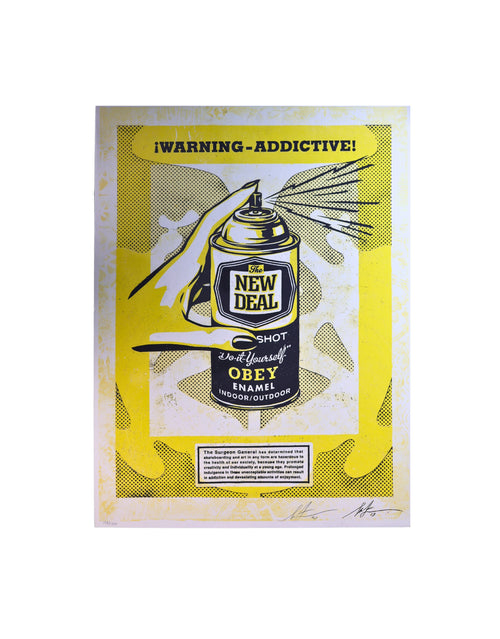
Shepard Fairey does not run an artist certificate-of-authenticity program, so anyone claiming a "certificate of authenticity from the artist" for a Fairey print is describing something that does not exist. Fairey prints are authenticated through provenance, signature, edition numbering, paper and printing characteristics, and purchase from reputable dealers — not a studio COA. That makes the paper trail especially important: an original receipt from a trusted source, consistent edition numbering, and correct materials do the work here. Explore authenticated inventory in the Shepard Fairey collection, and use the Shepard Fairey buyer's guide to learn what a correct example looks like before you commit.
KAWS and BE@RBRICK designer toys
For KAWS and Medicom BE@RBRICK figures, authentication centers on Medicom packaging and markings rather than a manufacturer "certificate." Gauntlet backs these pieces with our own house program, TrueCOA, which lets a future owner verify the piece against a live record. The provenance that matters here is correct, unaltered packaging, consistent markings, and a verifiable purchase history. Browse the KAWS collection and read the KAWS authentication guide for the specific markings collectors check.
DEATH NYC and other studio-COA pieces
DEATH NYC pieces are hand-signed and numbered and come with a COA and gold seal — here the studio COA is a genuine, expected part of the package, and its absence is itself a red flag. Mr. Brainwash pieces come from a studio that issues its own COAs, often incorporating a thumbprint; describe these in general terms and verify against the studio's known practice rather than inventing specifics. The lesson across these: a COA's value depends entirely on the standing of who issued it, which is the same principle from the document table above.
Warhol, and the danger of invented authority
Andy Warhol is the cautionary tale for provenance. The Warhol Art Authentication Board dissolved in 2012, so any claim that a "board" recently ruled on a Warhol is a fabrication and a serious warning sign. Warhol authentication today relies on provenance, the catalogues raisonné, and, at Gauntlet, TrueCOA. This is provenance in its purest form: with no living authority to appeal to, the paper trail and scholarly record carry the entire burden of proof.
Banksy and Invader — single-authority chains
Some categories have exactly one legitimate authentication authority, and provenance has to respect that boundary. Banksy is the clearest example: authentication is handled by Pest Control only. No dealer, gallery, or third party authenticates a Banksy, and any listing implying otherwise is misrepresenting the object. For a Banksy print, the provenance that matters is the Pest Control paperwork and its verifiable connection to the piece — a beautiful ownership chain does not substitute for it, and a certificate from any other source is meaningless here. Space memorabilia sits at the opposite structural extreme: a certificate alone does not prove an item was flown. Authenticating a flown artifact depends on provenance and chain-of-custody through recognized specialists — NASA records, mission documentation, and expert opinion — because the claim being made ("this flew in space") is precisely the kind of assertion a piece of paper cannot establish by itself. In both cases the rule is the same: identify the one chain that governs the category, and treat everything else as supporting color, not proof.
Why mixing chains is so costly
The reason to insist on category-specific chains is not pedantry — it is that a mismatched chain gives false comfort. A collector who accepts an "artist COA" for a Shepard Fairey print, or a non-Pest-Control letter for a Banksy, feels documented while actually holding nothing verifiable. That false comfort is what forgers exploit: the paperwork looks reassuring, the buyer relaxes, and the object is priced as if it were proven when it is not. When the piece resells, a knowledgeable buyer recognizes the wrong chain immediately, the premium evaporates, and the loss lands on whoever trusted the mismatch. Learning the correct chain for each category is therefore one of the highest-return skills a collector can develop, and it is why we publish authentication guides per artist rather than one generic template.
TrueCOA: the house standard, not a universal authority
Gauntlet Gallery's own authentication program is TrueCOA (truecoa.com). It is important to be precise about what this is and is not. TrueCOA is our house standard for documenting and verifying the pieces we handle — a durable, verifiable record that travels with the object and can be checked by a future owner. It is not a claim to be a universal industry body, and it does not replace category-specific chains where those exist: BAS/JSA/PSA for autographs, Pest Control for Banksy, Medicom markings for designer toys. Where an established third-party chain applies, TrueCOA sits alongside it, adding a verifiable ownership and documentation layer rather than substituting for expert opinion.
The advantage of a modern verification layer is exactly the problem this whole article is about: it makes provenance portable and hard to fake. A physical certificate can be lost, damaged, or forged; a verifiable digital record tied to the object closes those gaps. To understand how these systems work under the hood, see our explainer on NFC tags and blockchain COAs for collectibles, and for a framework on judging any certificate, what makes a COA trustworthy breaks down issuer, detail, and verification.
How to build and preserve provenance as an owner
Provenance is not only something you inherit when you buy — it is something you can strengthen and protect while you own a piece, which directly defends its future resale value. A few disciplined habits make the difference:
- Keep everything, from day one. The receipt, the shipping record, the authentication letter, the original packaging for designer toys. What feels like clutter today is provenance tomorrow.
- Digitize and back up. Scan every document at high resolution and store copies separately from the originals. A lost letter of authenticity can knock a meaningful percentage off resale value.
- Photograph the piece over time. Dated images establish continuity and can rule out later swaps or undisclosed restoration.
- Don't over-restore. For posters, prints, and memorabilia, aggressive restoration can erase originality that the market prizes. Document any conservation work honestly.
- Pass the full file forward. When you sell, deliver the complete provenance package. A well-organized file is itself a selling point and often justifies a higher price.
Think of the documentation file as part of the object's condition. A pristine guitar with a shredded, incomplete paper trail is, from the market's perspective, a compromised asset. A well-kept file is the difference between "probably genuine" and "provably genuine," and buyers pay for the second one.
Common provenance mistakes that quietly destroy value
Most value lost to provenance problems is self-inflicted and avoidable. The recurring errors:
- Trusting a certificate because it looks official. A COA is only as credible as its issuer. An anonymous, generic certificate is close to worthless; a plain receipt from a named reputable source can be decisive.
- Mixing authentication chains. Applying autograph-authenticator logic to a print, or expecting an artist COA where none exists (as with Shepard Fairey), leads to bad decisions. Each category has its own chain — respect it.
- Ignoring gaps. A long, unexplained gap in ownership is exactly where problems hide. Don't wave it away because the rest of the story is appealing.
- Failing to verify cert numbers. Third-party letters carry a number you can check directly with the issuer. Skipping that step defeats the point of the letter.
- Letting documentation drift from the object. Serial and edition numbers on the paperwork must match the piece. When they don't, stop.
Every one of these traces back to the same principle. Provenance protects value only when it is specific, independent, and verifiable. When you're evaluating your next acquisition — a signed guitar, a Fairey print, a KAWS figure — start from the paper trail and let it lead you to the object, not the other way around. For a broader trust framework and access to authenticated inventory across categories, start at the Gauntlet Gallery collector hub or browse everything currently available in the full Gauntlet Gallery collection.