Building a Music-Memorabilia Collection That Holds Value
Provenance affects the value of a signed guitar more than almost any other single factor, because it answers the question that determines everything else: is this signature real, and can you prove it? A documented chain of ownership — clear photos of the artist signing, a dated bill of sale, a reputable third-party authentication from Beckett (BAS), JSA, or PSA/DNA, and where possible a photo-match to the item in the artist's hands — can move a signed guitar from a hopeful "believed authentic" listing into a genuinely bankable asset, often multiplying the price a serious buyer or auction house will pay. Weak or missing provenance does the opposite: it caps demand, forces steep discounts, and can render even a genuine autograph nearly unsellable at anything above the value of the guitar itself.
That single dynamic — provenance as the multiplier on authenticity — is the organizing principle behind a music-memorabilia collection that actually holds its value. This guide lays out how to build one deliberately: choosing a focus, buying provenance-first, judging condition, insisting on recognized authentication, and storing, insuring, and diversifying so the collection you assemble is one a future buyer will trust. Throughout, we speak in general principles you can apply to any signed instrument, poster, or record, and we point you to the deeper Gauntlet Gallery resources where a specific decision warrants it.
Why Provenance Is the Value Engine in Music Memorabilia
Most collectible categories reward rarity and condition. Music memorabilia rewards those too — but it is unusually dependent on trust, because the value-defining feature is frequently a few square inches of ink that anyone with a marker can forge. A signed guitar is, physically, a mass-produced instrument. What a collector is actually buying is the event: the moment an artist held it and signed it. Provenance is the evidence that the event happened.
Think of value as a stack. At the base is the object itself — the guitar, the poster, the record — which has a floor price regardless of any signature. On top sits the signature, which adds value only to the extent it can be believed. Provenance is the structural support that keeps that upper layer from collapsing. Remove it and the market quietly reprices the item back toward the bare object, no matter how genuine the ink actually is.
This is why two visually identical signed guitars can carry wildly different prices. One comes with a photograph of the artist signing it backstage, the promoter's letter, the original ticket stub, and a Beckett letter of authenticity referencing that documentation. The other comes with a seller's assurance and a generic certificate from an unknown issuer. The first is an asset with a paper trail; the second is a gamble. Buyers price the gamble accordingly.
The mechanism is worth understanding, because it explains nearly every pricing surprise in the category. Autographs are among the most forged collectibles in the world, and sophisticated buyers know it. Their default posture toward any signed item is skepticism, and provenance is what overcomes that skepticism. Each independent piece of evidence — a signing photo, a named prior owner, a matching ticket, a recognized authentication letter — lowers the perceived risk, and lower risk is exactly what buyers pay up for. A signed guitar with five aligned forms of evidence is not five percent more valuable than one with none; it can be a multiple more valuable, because it has crossed the threshold from "hope it's real" to "provably real." Provenance does not add value linearly. It compounds, and it compounds hardest right at the point where doubt turns into confidence.
The Difference Between a COA and Real Provenance
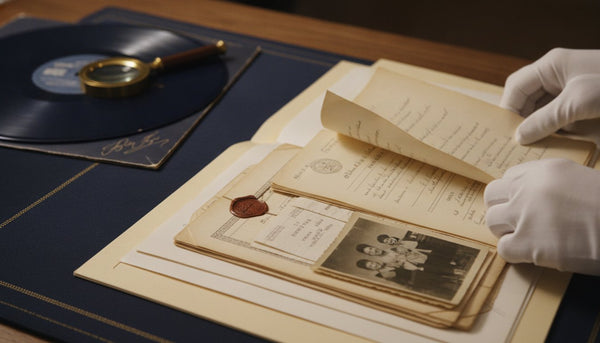
A certificate of authenticity (COA) is a document; provenance is the whole story. A COA from a respected third-party authenticator is a strong data point, but a certificate alone — especially from an issuer no one recognizes — proves very little. The most defensible pieces layer multiple, independent forms of evidence: a photo or video of the signing, a chain of ownership back to that moment, corroborating ephemera (tickets, passes, tour itineraries), and a third-party opinion from a grader whose name carries weight. When those align, a signed guitar becomes something an auction house, an insurer, and a future buyer can all underwrite. For the principles that separate a trustworthy certificate from a meaningless one, see our overview of the collector's trust and authentication standards.
Step One: Choose a Focus Before You Chase Deals
A collection that holds value is almost never a random pile of signed things. It is a focused set that a specialist buyer will recognize and compete for. Focus concentrates your knowledge, sharpens your eye for fakes, and makes your collection legible to the market when it is time to sell. A dozen carefully chosen pieces built around one artist, one era, or one instrument type will nearly always outperform fifty scattered impulse buys.
There is no single correct focus, but the strongest ones share a trait: a deep, durable base of demand. Consider organizing around one of these axes:
- A single artist or band whose cultural footprint is unlikely to fade — the kind of name that still fills venues or dominates catalog streaming decades on.
- An instrument type — signed guitars, for example — where condition standards and authentication norms are well understood and comparable sales are easy to find.
- A defined era or scene, such as a particular decade or genre movement, which lets you become genuinely expert in its printing, hardware, and signing habits.
- A format — signed vinyl, tour posters, or stage-used gear — each with its own condition and authentication conventions.
Focus also protects you against the most common way collectors lose money: buying outside their competence. When you know one lane deeply, you can spot the wrong pickguard, the anachronistic signature style, or the reprinted poster that a generalist would miss. If you are still deciding where to concentrate, the broader principles in our collector's resource hub can help you weigh demand, liquidity, and personal interest before you commit capital.
Step Two: Buy Provenance-First, Not Signature-First
The instinct of a new collector is to hunt for the signature they want and then hope the documentation holds up. The disciplined collector inverts this. You start with the provenance and let it lead you to the object. A well-documented signed guitar from a lesser-known session can be a better store of value than a poorly documented autograph from a superstar, because the documented piece can be resold with confidence while the undocumented one carries permanent doubt.
Provenance-first buying means asking, before you fall in love with an item, a specific set of questions:
- Where did this come from? Can the seller trace it back toward the moment of signing — a dated receipt, an auction record, a named prior owner, a promoter or crew member as the source?
- Is there a photo-match? Is there imagery of the artist actually signing this item, with matching grain, wear, and hardware? Photo-matching is among the strongest forms of proof in the category.
- Who authenticated it, and did they see the provenance? A Beckett, JSA, or PSA/DNA opinion that references corroborating documentation is far stronger than a bare "genuine" sticker.
- Does the paperwork survive? Original tickets, backstage passes, tour books, and correspondence are not decoration — they are the connective tissue that makes the story hold.
If a seller cannot answer these questions, that is not necessarily a scam — but it is a discount, and often a large one. Price the uncertainty in, or walk away. The best long-term collections are built by patient buyers who would rather miss a piece than absorb a risk they cannot document.
Step Three: Insist on Recognized Third-Party Authentication
For signatures and autographed items, the recognized third-party authenticators in the hobby are Beckett Authentication Services (BAS), JSA (James Spence Authentication), and PSA/DNA. These firms examine the signature against known exemplars, assess ink and flow, and issue a letter or certification. Their opinions are not infallible, and reasonable experts occasionally disagree, but their names are what the broader market — and most auction houses — will actually price against.
A few working rules make third-party authentication genuinely protective rather than merely decorative:
- Buy the item, verify the cert. Where a certification number can be checked against the authenticator's own database, check it. A certificate you cannot independently verify is worth far less than one you can.
- Prefer authenticators who saw the whole story. An opinion informed by provenance photos and documentation is stronger than a snap judgment on the signature alone.
- Be wary of unfamiliar issuers. A "COA" from a house no one in the trade recognizes carries little weight. The name on the certificate matters as much as the certificate itself.
- Understand photo-matching as its own discipline. For stage-used or signed-in-the-moment items, matching the object to period photography is a distinct and powerful form of authentication that complements a signature opinion.
Gauntlet Gallery's own house standard is TrueCOA, a blockchain verification and certification program that we use to document and back the items we handle. We present it as our internal standard of care, working alongside — not in place of — the recognized third-party authenticators the wider market relies on. For a deeper walk-through of the specific bodies and how photo-matching fits a signed instrument, see the sibling article on authenticating a signed guitar with Beckett, JSA, PSA and photo-matching, and the broader treatment in third-party authentication for music memorabilia, explained.
Step Four: Judge Condition Like a Buyer, Not an Owner
Condition is the quiet second lever after provenance. Two authenticated, well-documented signed guitars can still diverge in value based on how the instrument — and critically, the signature — has survived. Ink fades. Sharpie on a glossy finish can smear, lift, or ghost. Posters tear, fox, and fade at the folds. Records warp and ring-wear. A collection that holds value is one where each piece was bought in condition a future buyer will accept, and then kept that way.
When you evaluate a signed instrument, look past the autograph to the whole object and then back to the ink:
- Signature stability: Is the ink crisp and fully bonded, or is it fading, flaking, or smearing? A vivid, stable signature is worth a real premium over a ghost of one.
- Where it was signed: A signature on the body, pickguard, or headstock interacts differently with light and handling. Understand how the placement will age.
- The object's own condition: Cracks, refinishes, replaced hardware, and repairs all affect the base value the signature sits on top of.
- Prior conservation: Sympathetic, disclosed conservation can be fine; hidden restoration or attempts to "refresh" a signature are red flags that destroy value and trust.
Condition thinking applies across formats. On a rare music poster, restoration and linen-backing can either stabilize a great piece or, if undisclosed and overdone, suppress its value — a nuance covered in the sibling article on how condition and restoration change a rare music poster's value. The general rule holds everywhere: buy the best condition your budget allows, disclose everything, and never alter an autograph.
A Collecting-Strategy Framework: What to Weigh on Every Buy
Use the checklist below as a decision framework before committing to any signed piece. Each factor is scored on how strongly it supports long-term value. A piece that clears the "protects value" column across most rows is the kind that holds; a piece stacking up in the "erodes value" column is one to discount hard or pass on.
| Factor | Protects Value | Erodes Value |
|---|---|---|
| Provenance | Photo/video of signing; documented chain of ownership; corroborating ephemera | Seller's word only; no traceable history; "found in an estate" with no papers |
| Authentication | Beckett, JSA, or PSA/DNA opinion; verifiable cert number | Unknown-issuer COA; no cert; certificate that cannot be checked |
| Signature condition | Crisp, stable, vivid ink; well-placed | Faded, smeared, flaking, or "refreshed" |
| Object condition | Original, honest wear; disclosed conservation | Hidden restoration; replaced parts passed as original |
| Focus fit | Deepens a coherent, in-demand collection | Random impulse buy outside your lane |
| Liquidity | Named artist with active comparable sales | Obscure signer with no resale market |
| Seller reputation | Established dealer or house that stands behind items | Anonymous listing; no returns; pressure to close fast |
The discipline is not to demand a perfect score on every row — few pieces achieve that — but to buy with clear eyes about where a piece is weak and to pay accordingly. A signed guitar strong on provenance and authentication but with a slightly faded signature may still be an excellent buy at the right, discounted price. A pristine signature with no provenance at all rarely is.
Notice how the rows interact. Provenance and authentication reinforce each other — an authenticator who has seen the documentation issues a stronger opinion, and strong documentation makes an authenticator's opinion easier to trust. Liquidity and focus fit are similarly linked: a piece that deepens a coherent collection around an in-demand name is, almost by definition, a piece with a resale market. Weakness in one row can sometimes be offset by strength in another, but two weaknesses rarely can. A piece that is thin on both provenance and liquidity — an obscure signer with no papers — is the classic value trap, because there is neither proof to sell nor a buyer to sell to. When you run a candidate through this framework, pay closest attention to any piece that lands in the "erodes value" column on more than one row, and let the price reflect the compounded risk.
Step Five: Storage, Handling, and Insurance
A value-holding collection is one you preserve as carefully as you acquired it. The enemies of music memorabilia are light, humidity, temperature swings, and careless handling. Ultraviolet light fades both signatures and printed matter; humidity invites mold and foxing; heat can soften finishes and lift ink. Protecting your pieces is not optional maintenance — it is capital preservation.
- Control the environment. Aim for stable, moderate temperature and humidity, away from direct sunlight and exterior walls that swing with the seasons.
- Use UV-filtering framing and display. For posters and signed flats, museum-grade UV glazing meaningfully slows fading. For instruments, keep them out of direct light and off heat sources.
- Handle signatures with care. Never clean, wax, or polish over an autograph. Skin oils and solvents are how signatures die.
- Document everything. Keep the provenance file — photos, receipts, authentication letters, cert numbers — organized and backed up. The paper trail is part of the asset.
- Insure to value. Standard homeowner's coverage rarely reflects collectible value. A scheduled rider or specialist collectibles policy, supported by your documentation and recent comparable sales, protects against loss, theft, and damage.
Insurance is where good documentation pays a second dividend: the same provenance file that makes a piece sellable also makes it insurable at its true worth. Keep valuations current, and revisit them as the market for your focus area moves.
Step Six: Diversify Within — and Beyond — Music
Concentration builds expertise, but total concentration builds risk. A collection entirely dependent on one artist's ongoing cultural standing is exposed if tastes shift or if a flood of newly authenticated material dilutes scarcity. Thoughtful diversification — within your focus and, for larger collections, across categories — smooths that risk without abandoning discipline.
Within music, you might balance formats: a few signed instruments as anchor pieces, complemented by documented posters, signed vinyl, or stage-used ephemera. Each format has its own demand cycle and condition profile, so a spread cushions any single market's softness. The sibling guide on signed vinyl and album authentication is a useful companion when you extend beyond instruments.
Beyond music, many serious collectors treat memorabilia as one sleeve of a broader collectibles allocation that also includes authenticated fine-art prints and designer pieces. The same first principles — provenance, recognized authentication, condition, and liquidity — govern all of them. If you want to see how those principles play out across the market Gauntlet Gallery curates, browse the full authenticated collection, and for the analytical framing of value and demand across categories, our financial insights hub lays out how we think about it. The point is not to dilute your expertise but to avoid betting an entire collection on a single, unhedgeable story.
Common Mistakes That Quietly Destroy Value
Even careful collectors fall into predictable traps. Recognizing them early is the cheapest form of protection you can buy.
- Buying the signature, ignoring the provenance. The most common and most expensive error. A great name with no documentation is a resale problem waiting to happen.
- Trusting unfamiliar certificates. A certificate is only as credible as the issuer. Unknown-issuer COAs offer comfort, not proof.
- Over-restoring. Attempts to clean, brighten, or "refresh" a signature or poster almost always reduce value and can destroy authenticity outright.
- Neglecting the paper trail. Losing or discarding the original receipts, tickets, and letters strips a piece of the very evidence that makes it valuable.
- Chasing hype. Buying at the peak of a frenzy, without comparable-sale discipline, is how collectors overpay for pieces that later reprice.
The antidote to all of these is the same discipline this guide has returned to throughout: provenance first, recognized authentication second, condition third, and patience above all. For the granular version of due diligence — the questions to ask and the paperwork to demand before money changes hands — the principles in our collector's trust hub apply directly to signed instruments and every other category.
Putting It Together: A Collection Built to Hold
A music-memorabilia collection that holds value is not assembled by luck or by chasing the loudest names. It is built by treating provenance as the value engine it truly is — especially for a signed guitar, where a documented signing event is the difference between an asset and an ornament. You choose a focus, buy the documentation before the object, insist on authentication from names the market respects, judge condition honestly, preserve and insure what you own, and diversify enough to survive a shift in taste.
Do that consistently, and each acquisition strengthens the whole. A future buyer — or an auction house, or an insurer — can trust what you hand them, because you built the collection the way they would want to buy it: provable, protected, and priced with clear eyes. That trust is what value, in this category, ultimately is. When you are ready to add pieces built on that same standard, the authenticated inventory at Gauntlet Gallery — backed by TrueCOA and available to browse across the full collection — is assembled on exactly these principles.