How Condition & Restoration Change a Rare Music Poster's Value
Condition and restoration are the two levers that move a rare music poster's value more than almost anything else once authenticity is established. As a rule of thumb, a clean, unrestored, well-preserved example commands a substantial premium over a torn, faded, or heavily reworked copy of the same poster, and disclosed, professional, reversible conservation is treated very differently from undisclosed or aggressive restoration. In practice: originality and honesty about condition protect value; hidden repairs, trimming, and over-restoration erode it. This guide explains the grading language dealers use, the flaws that matter most, how linen-backing and paper conservation actually work, and how disclosed restoration should be reflected in price.
Music posters occupy a distinct corner of the memorabilia market. Unlike a signed guitar or a photo-matched stage-worn jacket, a poster is a mass-produced paper object that was never meant to survive. It was stapled to a wall, folded into a mailer, rolled in a tube, or taped in a bedroom. Survivorship is the whole story: the reason a first-printing concert poster can be worth many multiples of a later reprint is that so few clean early examples exist. That scarcity makes condition the decisive variable, because two "identical" posters can trade at wildly different prices based purely on how they weathered the last fifty years.
The direct answer: how condition and restoration affect value
At the highest level, value on a rare paper poster is a function of four stacked factors: authenticity (is it a genuine first printing, reprint, or bootleg?), rarity (how many survive?), condition (how well did this example survive?), and demand (who wants it right now?). Authenticity and rarity set the ceiling; condition determines where within that ceiling a specific copy trades. Restoration is a modifier that can either preserve the value implied by the poster's original state or suppress it, depending on how it was done and whether it was disclosed.
The single most important principle is this: collectors and dealers will almost always pay more for an honest description of a flawed poster than for a "perfect-looking" poster whose flaws were quietly repaired. The hobby has been burned enough times by trimmed margins, airbrushed fold lines, and colors "brought back" with inpainting that transparency itself has value. A poster described accurately — "linen-backed, professional restoration to two fold lines, minor inpainting in the lower border, otherwise strong color" — is a known quantity. A poster sold as "near mint" that turns out to have been rebuilt is a liability that resurfaces at the next resale.
Grading language: how condition is described
There is no single universal grading standard for vintage posters the way there is for coins or graded trading cards, but the trade has converged on a broadly shared vocabulary borrowed from movie-poster and fine-print collecting. When you read a listing, these terms are doing real work, and you should treat them as claims to verify, not guarantees.
| Grade | Typical description | What it means for a rare poster |
|---|---|---|
| Mint / Near Mint | As-issued, bright color, no restoration, no visible flaws | Rare for vintage paper; commands the top of the range. Verify it isn't a reprint masquerading as an original. |
| Excellent / Very Fine | Bright, structurally sound, only minor handling wear; maybe one soft fold or light edge wear | The realistic top tier for most surviving vintage posters; strong demand and price. |
| Fine / Good | Presentable but with visible fold lines, minor tears, light foxing, or edge chips | Collectible and liquid, but priced well below top examples; restoration often considered here. |
| Fair / Poor | Significant tears, losses, heavy foxing, tape, staining, brittleness, or fading | Value driven mostly by rarity; a candidate for conservation or a "placeholder" copy until a better one appears. |
| Restored (any grade) | Professionally conserved: linen-backed, tears repaired, losses filled, inpainting applied | Graded on both the underlying paper and the quality/extent of the work; must be disclosed. |
Two cautions about grades. First, grade inflation is endemic in unauthenticated online sales; "mint" is thrown around loosely, and a poster's grade should be corroborated by clear, well-lit photographs of the full front, the full back, and close-ups of the corners, edges, and any flaws. Second, a restored poster does not belong on the same scale as an unrestored one. A "very fine" unrestored example and a poster that presents as very fine only because it was rebuilt are not equivalent, and honest sellers separate the two explicitly.
Why the back matters as much as the front
Experienced buyers ask for the verso (back) first. The back reveals tape residue, hinge marks, prior mounting, paper toning, and — critically — whether the poster has been linen-backed. Under raking light, the back also shows fold lines, repairs, and paper thinning that a flat front photo hides. If a seller cannot or will not photograph the back, treat that as a condition red flag in itself.
The common flaws and how much they cost you
Not all damage is equal. Some flaws are cosmetic and expected; others cut into value sharply because they threaten the image itself or signal deeper problems. Here is how the trade generally weights the most common issues on a rare music poster.
Fold lines and cross-folds
Many vintage posters were folded for distribution, so light fold lines are not automatically a defect — on some issues, a folded copy is simply the norm and a "rolled" example is the premium exception. What hurts value is fold separation (the paper starting to split along a fold), fold wear that abrades the printed image, and cross-fold losses where the intersection of folds has worn through. A crisp single horizontal fold on a poster that was issued folded is minor; a spiderweb of soft, separating folds across the artwork is a serious deduction.
Tears, edge chips, and paper loss
Small edge tears in the margin are common and repairable. The value question is where: a tear or loss that enters the printed image — a face, a band name, key typography — is far more damaging than the same tear in a blank border. Paper loss (an actual missing chunk) is worse than a tear (paper still present, just split), because loss requires filling and inpainting to restore, which introduces non-original material.
Foxing, staining, and tape
Foxing — those reddish-brown age spots — comes from a mix of mold, humidity, and impurities in the paper. Light, scattered foxing in the margins is a modest deduction; heavy foxing across the image is a major one and can be difficult to fully reverse. Water stains, "tide lines," and adhesive staining behave similarly. Tape is a special hazard: old cellophane and masking tape leaves oily, acidic stains that migrate into the paper over time and are among the hardest defects to remediate. Tape residue and tape "shadows" in the image are consistent value-killers.
Fading and color loss
Light-struck fading is often the most consequential flaw of all, and the least fixable. A poster that has hung in a sunny room for decades can lose the reds and yellows that gave it punch, leaving a washed-out ghost of the original. Because color vibrancy is central to a poster's visual appeal and to how it photographs, fading suppresses value heavily and cannot be honestly "restored" without inpainting the entire surface — which itself is a major, value-limiting intervention. Trimming and pinholes round out the list: trimming (cutting down margins to hide edge damage) permanently reduces an original poster and is widely penalized, while scattered pinholes from wall-mounting are minor and expected on many issues.
Restoration and conservation: what the work actually is
"Restoration" is an umbrella term covering everything from gentle, reversible conservation to aggressive rebuilding. Understanding the spectrum is what separates a confident buyer from a burned one.
Linen-backing
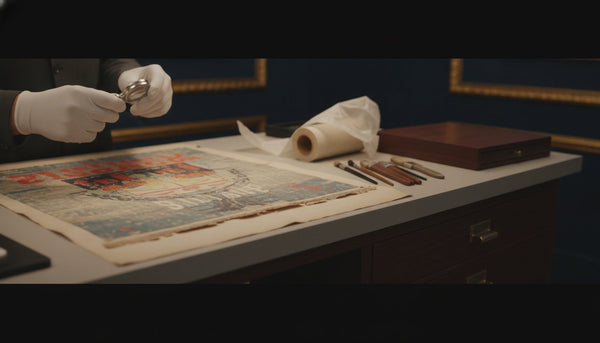
Linen-backing is the most common and most misunderstood treatment. A conservator mounts the poster to a support — traditionally acid-free paper laid over cotton or linen canvas — using a reversible, water-soluble adhesive such as wheat starch paste. Done properly, linen-backing is a conservation-forward, largely accepted practice in the poster world: it flattens fold lines, stabilizes tears, prevents further handling damage, and makes a fragile poster displayable and shippable. It is, in principle, reversible. On many vintage posters, professional linen-backing is considered a plus or at worst neutral, provided it is disclosed and competently executed.
The nuances that matter: linen-backing done with the wrong adhesives, or that traps acidity, can damage rather than protect. And linen-backing is frequently the vehicle for restoration — once a poster is backed, it is far easier to fill losses and inpaint over the seams. So "linen-backed" alone tells you the structural treatment but not how much cosmetic restoration rides along with it. Always ask what was done beyond the backing.
Cleaning, deacidification, and tear repair
Conservative treatments include surface cleaning, gentle washing to reduce staining and acidity, deacidification to slow future deterioration, and mending tears with Japanese tissue and reversible adhesive. These interventions are generally value-preserving or value-neutral when disclosed, because they stabilize the object without adding fictional "originality." They are the paper equivalent of a careful mechanical service on a vintage car: expected maintenance, not misrepresentation.
Inpainting, fills, and over-restoration
The value-sensitive zone is cosmetic restoration: filling paper losses with new pulp or paper, and inpainting — painting over losses, fold lines, or faded areas to make them "disappear." A tiny, professional inpaint in a border is minor. Extensive inpainting across the image means a meaningful portion of what you see is the restorer's hand, not the original printing. "Over-restoration" — where so much has been repainted that the poster is effectively a hybrid of print and paint — sharply limits value because purists are buying the original artifact, not a repaired one. The market rewards minimal, honest, reversible work and penalizes maximal, hidden, permanent work.
How disclosed restoration should be priced
Here is the framework serious collectors use. Restoration does not have a single fixed "discount"; its effect on value depends on three things: how much was done, how well, and whether it was disclosed before the sale.
- Structural-only, disclosed (e.g., professional linen-backing, tear mends): often neutral to slightly positive on vintage paper. The poster is stabilized and displayable, and the market accepts it as standard conservation.
- Light cosmetic, disclosed (minor inpainting to fold lines or small border losses): a modest discount versus an equivalent unrestored example, because some non-original material is present, but the poster remains a strong, honest copy.
- Extensive cosmetic, disclosed (large fills, broad inpainting, color rebuilding): a significant discount. The buyer knows what they are getting and prices accordingly; the poster competes as a "restored" example, not an original-condition one.
- Any restoration, undisclosed: the worst outcome for value and trust. When discovered — and it usually is, under UV light or by a conservator — it can unwind the sale, damage the seller's reputation, and permanently tag the specific poster as problematic.
The takeaway is counterintuitive but consistent across the mature areas of the paper market: a moderately restored poster, fully disclosed, will out-trade a "cleaner-looking" poster whose restoration is concealed, because the disclosed copy carries no hidden risk. Disclosure is not a confession that lowers value; it is the documentation that protects whatever value the poster's true condition supports.
Documentation and provenance amplify (or undermine) condition
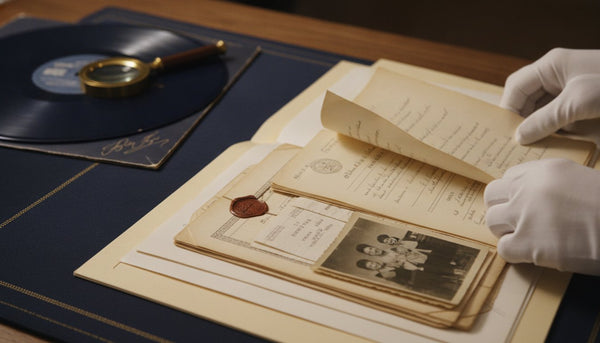
Condition claims gain weight when they are backed by paperwork: a conservator's treatment report describing exactly what was done, high-resolution before-and-after images, and a clear ownership history. For rare music posters, provenance — where the poster came from, who owned it, and how it is documented — interacts with condition to set the final number. A pristine poster with no provenance and no back photos invites suspicion; a well-documented poster with a candid condition report and a named conservator invites confidence. This is the same discipline that governs the rest of music memorabilia, where third-party authentication houses such as Beckett (BAS), JSA, and PSA/DNA, and photo-matching for provenance, anchor value. Our broader thinking on documentation and trust is collected in the Collector's Hub, and pieces that carry the TrueCOA standard travel with verifiable, tamper-evident records that make condition and treatment history part of the permanent file.
Rolled versus folded: why the "correct" state matters
One of the most common condition misunderstandings among newer buyers is treating any fold as damage. It depends entirely on how the poster was originally issued. Some posters were distributed folded — mailed flat in envelopes or bundled for shipping — and for those issues a folded copy is simply the standard state, while an unfolded "rolled" example is the scarce premium version. Other posters were sold or displayed rolled, and on those a hard fold is unexpected and counts against the copy. Before you penalize a fold, learn how that specific poster left the printer.
This matters for restoration decisions too. Because linen-backing flattens folds so effectively, a backed poster can present as if it were always rolled. That is not deception when disclosed — it is exactly what conservation is for — but it does mean a flat, vibrant, linen-backed poster and a genuinely untouched rolled poster are two different things, priced differently. When a listing shows a perfectly flat vintage poster with no visible fold lines, the right question is whether it was issued that way or made to look that way, and the honest seller will tell you which.
Paper type and printing method interact with condition
How a poster ages depends heavily on what it is printed on and how. Cheap, acidic pulp paper yellows, embrittles, and foxes far faster than rag or coated stock, which is why some issues survive in quantity while others are almost never found clean. Printing method matters as well: a rich, saturated offset or letterpress image has more color "headroom" to lose before it looks washed out than a lightly inked one. Understanding the substrate tells you both how fragile a given poster is and how aggressively it can safely be conserved — a brittle, acidic sheet is a candidate for gentle deacidification and backing, while a robust rag poster may need almost nothing.
A practical inspection checklist before you buy
Whether you are buying a first-printing concert poster or a vintage Beatles piece, run the same disciplined inspection. The goal is to convert vague grade words into specific, verified observations.
- Get the back. Insist on a full, well-lit verso image. Look for tape, hinges, toning, and evidence of linen-backing.
- Raking light on the front. Side-lit photos reveal fold lines, ripples, repairs, and surface losses that flat lighting hides.
- Zoom the image, not just the borders. Losses, tears, and inpainting inside the artwork matter far more than the same flaws in a margin.
- Ask the restoration question directly. "Has this poster been restored, backed, cleaned, or inpainted in any way?" A confident seller answers specifically; evasiveness is a red flag.
- Check for trimming. Compare the poster's dimensions to the known original size for that printing. Undersized margins suggest trimming.
- Look for UV / conservator evidence. Where value is high, a professional inspection under UV light will reveal inpainting and repairs invisible to the naked eye.
- Confirm you're buying an original, not a reprint. Condition is meaningless if the underlying poster is a later reprint or bootleg; verify the printing first.
That last point deserves emphasis. The most expensive condition mistake is not overpaying for a flawed original — it is paying an original's price for a later reprint in beautiful condition. Printing method, paper, and dating come before grading. If you are unsure how to separate a first printing from a reprint or a bootleg, start with our companion pieces on vintage concert poster printing and dating and on telling apart first printings, reprints, and bootlegs. For collectors focused on the most-forged corner of the market, our breakdown of Richard Avedon's 1967 Beatles poster variants shows how printing details and condition intertwine on a single iconic image.
Condition strategy for collectors and investors
How you weight condition depends on why you are buying. Three broad strategies recur among serious buyers.
Buy the best condition you can afford
For blue-chip, widely collected posters, condition premiums are real and durable. The finest surviving examples of a coveted image tend to appreciate faster and sell more easily than mid-grade copies, because top-condition specimens are the scarcest and the most trophy-like. If your budget allows, one excellent poster usually beats three "good" ones as a store of value.
Use condition as an entry point on the rarest images
For genuinely scarce posters where any example is hard to find, a restored or lower-grade copy can be a legitimate way in. Here the poster's rarity carries the value, and a disclosed, professionally conserved example lets you own an image you might otherwise never see. The discipline is to buy it as a restored poster, at a restored-poster price, with eyes open — not to overpay because it photographs well.
Budget for conservation, not just purchase price
A frequently overlooked part of condition strategy is the cost of stabilizing a poster after you buy it. A fragile, acidic, or torn poster may need professional linen-backing and conservation before it can be safely framed and displayed, and that work is not trivial in cost. When you compare a cheaper unbacked poster to a more expensive already-conserved one, factor in what it will cost to bring the cheaper copy up to a stable, displayable state. Sometimes the "expensive" restored poster is actually the better value once conservation costs are included, and sometimes the raw copy is worth acquiring precisely because you can direct the conservation yourself and keep the treatment record in your own file.
Prioritize honesty and paperwork over cosmetic perfection
Across both strategies, the through-line is documentation. A poster with a candid condition report, a conservator's treatment record, clear front-and-back imagery, and solid provenance is a better long-term hold than a "perfect" poster with an empty file, because the documented copy carries no hidden downside at the next sale. This is exactly why Gauntlet Gallery pairs its inventory with transparent condition notes and, where applicable, the TrueCOA verification standard — so condition and treatment history are part of the object's permanent, checkable record rather than a verbal claim that evaporates at resale.
Where music posters sit in a broader collection
Music posters reward the same rigor as the rest of the memorabilia and authenticated-art world: verify authenticity first, grade condition honestly, treat disclosed conservation as normal and hidden restoration as disqualifying, and let documentation do the heavy lifting. If you are assembling a collection with an eye to durable value, the principles here generalize — the same condition-and-provenance discipline governs signed instruments, autographs, and vinyl. For the wider playbook, see our guides on third-party authentication for music memorabilia and on building a music-memorabilia collection that holds value, and browse current authenticated inventory in the full Gauntlet Gallery collection. For the standards that underpin every piece we handle, the Collector's Hub is the place to start, and our approach to market context and value is laid out across our financial insights resources.
Condition is not a footnote on a rare music poster; it is a large fraction of the price. Restoration, handled and disclosed correctly, is a tool that protects value and makes fragile paper collectible. Handled dishonestly, it is the fastest way to destroy the trust that gives a poster its worth. Buy the object you can verify, price the restoration you can see, and keep the paperwork — and condition will work for you instead of against you.