Shepard Fairey Obey Editions Decoded: Signed, Numbered, HPM & AP
You can buy original Shepard Fairey prints from three broadly reliable channels: the artist's own retail releases through Obey Giant and Fairey's publishing partners; established auction houses and specialist print dealers on the secondary market; and curated dealers such as Gauntlet Gallery's Shepard Fairey collection, where every piece is vetted for provenance, signature, and edition detail before it is offered. The word "original" here means an authorized, artist-signed edition print, not a unique painting — Fairey works almost entirely in signed, numbered screenprints and letterpress editions, plus hand-embellished multiples. What matters is not where you shop so much as whether the seller can demonstrate that the print is a genuine, hand-signed impression from a documented edition.
This guide decodes the edition types that appear on the market — signed and numbered (S/N), artist proofs (AP/PP/HC), hand-painted multiples (HPM), and timed or open editions — so you can read a Fairey print correctly, understand why one impression costs more than another, and avoid the reproductions that flood online listings. Because Fairey does not run an artist certificate-of-authenticity program, learning to read the print itself is the single most valuable skill a collector can build.
How Fairey Authentication Actually Works
The first thing to understand is what does not exist. Shepard Fairey does not issue a personal "certificate of authenticity" for his prints, and there is no Fairey authentication board or foundation that stamps or blesses individual impressions. Any listing that claims a "COA signed by the artist" for a standard Obey print should be treated with caution — that is not how Fairey editions are documented.
Instead, authentication rests on a stack of physical and documentary evidence:
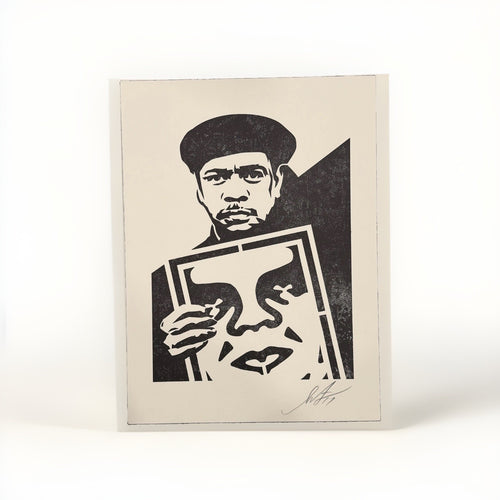
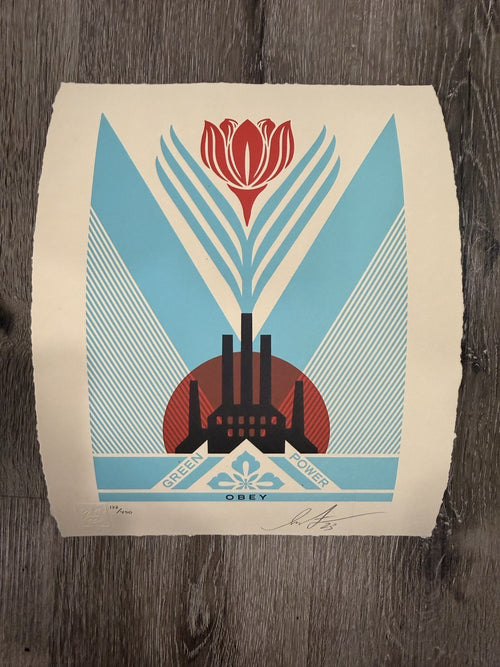
- Signature. Fairey hand-signs in pencil, almost always in the lower margin. The signature should sit in graphite (you can see the sheen and slight indentation), not be printed as part of the image.
- Edition numbering. A fraction such as "42/450" written in pencil, usually opposite or near the signature, tells you the impression number and the edition size.
- Date. Fairey typically pencils the year near the signature. The date should be consistent with the known release of that image.
- Paper and printing. Genuine editions are screenprints or letterpress prints on heavy fine-art stock (often cream or speckled cream), with the crisp ink layers and registration you expect from hand-pulled screens — not the dot pattern of an offset poster.
- Provenance. A documented chain from a reputable source — the original drop, a recognized dealer, or an auction record — closes the loop.
Because no single element is decisive on its own, serious buyers evaluate all of them together. Our full Shepard Fairey buyer's guide walks through the market channels and price bands in more depth, and the deep dive on reading paper, deckle, signature, and date on a Fairey print shows the physical tells up close. If you want the underlying logic of the numbering itself, see our explainer on what an edition number like "12/150" actually tells you.
It helps to understand why Fairey's editions are structured the way they are. Fairey came up through the DIY sticker-and-poster culture of skateboarding and punk, and his "Obey Giant" campaign began as a street phenomenon before it became a studio practice. That lineage shows in how the work reaches collectors today: much of it is released as affordable, artist-signed screenprints intended to put real art in many hands, rather than as a handful of six-figure canvases. The upside for buyers is genuine access to original, hand-signed work at a range of price points; the responsibility that comes with it is learning to distinguish an authorized signed edition from the ocean of unsigned merchandise, posters, and outright fakes that trade on the same imagery. Reading the edition correctly is the whole game.
The Core Edition Types, Decoded
Fairey's output can look bewildering because the same image sometimes appears across several formats — a large signed/numbered screenprint, a smaller open edition, and a run of hand-embellished multiples. Understanding the vocabulary is the fastest way to price a piece correctly. The table below summarizes the main categories you will encounter.
| Edition type | Abbreviation | What it means | Typical marking | Relative scarcity |
|---|---|---|---|---|
| Signed & Numbered | S/N | Standard limited edition; each impression hand-signed and numbered out of a fixed run | "42/450" + signature + date, pencil, lower margin | Baseline of the edition |
| Artist Proof | AP | Impressions reserved for the artist, outside the numbered run; usually a small fraction of the edition | "AP" or "A/P," sometimes numbered (e.g. "AP 3/50") | Scarcer than S/N |
| Printer's Proof | PP | Impressions for the print studio; very small quantity | "PP" in pencil | Rare |
| Hors Commerce | HC | "Not for commerce" proofs used for exhibition or reference | "HC" in pencil | Rare |
| Hand-Painted Multiple | HPM | A print base that Fairey (or the studio under his direction) embellishes by hand, making each unique | Signed, often numbered within a small HPM run; visible hand-applied media | Scarce and unique |
| Open / Timed Edition | — | Editions with no fixed cap, or capped only by a sales window rather than a set number | Signed; frequently no fraction, or a large run | Most available |
Signed & Numbered (S/N): The Baseline
The signed-and-numbered screenprint is the workhorse of the Fairey market. When you see "42/450," the 450 is the edition size and 42 is the impression number. Contrary to a common myth, a low number does not automatically make a print more valuable — hand-pulled screenprints are typically printed as a batch and numbered afterward, so number 3 and number 300 are ordinarily the same object. Round or symbolic numbers (like 1/450 or 100/450) sometimes attract a small premium from collectors, but condition and the desirability of the image drive value far more than the fraction.
What you are really paying for with an S/N impression is a documented, hand-signed piece from a finite run. Smaller edition sizes (say, 300–450) generally support stronger secondary values than very large runs, all else equal, simply because supply is tighter relative to demand.
Edition sizes in Fairey's practice have shifted over the years. Earlier releases were often smaller — runs in the low hundreds were common — while later demand pushed some editions into the several-hundreds or beyond, and certain retail and charity pieces are larger still. This is why "signed and numbered" alone does not tell you scarcity: a signed edition of 150 is a very different proposition from a signed edition of 800, even if both are legitimate. When you evaluate an S/N impression, always note the denominator, not just the fact that a fraction exists. Two prints can both be honest signed editions and yet occupy entirely different tiers of the market purely because one run is a fraction of the size of the other.
Artist Proofs, Printer's Proofs & HC
Artist proofs (AP) sit outside the numbered edition. Historically, proofs were the impressions an artist kept for personal use, and printers retained a few (PP) for their records. In practice today, an AP is functionally identical to the numbered impression in image and paper — it is simply designated "AP" instead of carrying a fraction, and the AP run is usually a small percentage of the total edition.
Do APs command a premium? Sometimes, modestly. Because APs are scarcer than the numbered run, some collectors will pay a little more for the designation. But the premium is not universal and should never be the whole basis of a purchase. If a seller is charging a large markup purely because a print says "AP," ask what else justifies it. Our companion piece on AP versus numbered editions — which should you buy breaks down when the proof designation is worth chasing and when it is not.
Hors commerce (HC) and printer's proofs (PP) are rarer still and mostly of interest to completist collectors. Their scarcity can support value, but it also makes independent verification harder, so provenance carries even more weight with these designations.
Hand-Painted Multiples (HPM): Where "Original" Gets Literal
HPMs are the closest thing in Fairey's practice to a unique original at an accessible edition price. A hand-painted multiple starts from a printed base — often a screenprint or a stencil-and-collage foundation — which is then embellished by hand with paint, spray, stencil, or collage so that no two are identical. Each HPM is signed and typically numbered within a small run (for example, an HPM edition might be a fraction of the size of the corresponding paper edition).
Because each HPM is unique and labor-intensive, they generally sit at the top of the price ladder for a given image, well above the standard S/N screenprint. Their uniqueness is precisely the appeal — and precisely why they demand careful authentication. You want clear documentation of the base, the hand embellishment, and the HPM edition size, plus provenance. We cover the specifics in our dedicated article on what makes a Fairey hand-painted multiple worth more.
Open, Timed & Charity Editions
Not every Fairey release is a small numbered run. Some are open editions (no fixed cap), and many retail drops are effectively timed editions — the edition size is whatever sells during a set on-sale window. Fairey and Obey Giant also produce charity and cause-driven prints, sometimes in larger or open runs, where the point is broad access and fundraising rather than scarcity.
These pieces are still genuine, artist-signed works and can be excellent entry points for new collectors, but you should price them as what they are: more available, and therefore less scarcity-driven, than a capped small edition. Reading the release format is essential to setting realistic expectations for both cost and resale.
Timed editions deserve a special note because they behave differently from a classic fixed run. When an edition is "timed," the final size is not known until the on-sale window closes — the number could be a few hundred or several thousand depending on demand. That means the same print can feel scarce on release and turn out to be relatively abundant once the count is published, or vice versa. For collectors, the practical takeaway is to buy a timed edition because you love the image and want a signed original, not on the assumption that it will be rare. Charity and cause editions follow similar logic: their primary purpose is impact and access, and any secondary appreciation is a bonus rather than the reason to buy.
A Quick Word on "Original" Versus "Print"
The query "Where can I buy original Shepard Fairey prints?" contains a small tension worth resolving. In the fine-art world, an "original" often implies a one-of-a-kind painting or drawing. But Fairey is fundamentally a printmaker and street artist, and the overwhelming majority of his authorized market consists of editioned works: screenprints, letterpress prints, and hand-painted multiples. When collectors say they want an "original Fairey," they almost always mean an authentic, artist-signed edition print — not a unique canvas, which are far rarer and priced accordingly. So the honest answer to the query is: yes, you can absolutely buy original Fairey work, and for most people that means a signed, numbered edition print or an HPM. Understanding this keeps your expectations and your budget aligned with what the market actually offers.
Reading a Fairey Print Margin, Step by Step
When a print is in front of you (in person or in high-resolution photos), work through the lower margin systematically:
- Find the signature. Confirm it is pencil, hand-applied, and sits in the margin rather than being printed into the image. Look for graphite sheen and slight surface indentation.
- Read the numbering. Note the fraction (S/N) or the designation (AP, PP, HC). Confirm the format matches what is known for that release.
- Check the date. The pencilled year should line up with the image's documented release period.
- Inspect the printing. Under magnification, screenprints show solid ink layers and clean registration; an offset reproduction shows a regular halftone dot grid. That single distinction separates most genuine editions from poster reproductions.
- Assess the paper. Heavy fine-art stock, correct sheet size, and any expected deckled edge or embossing all support authenticity.
- Trace provenance. Ask where it came from and what documentation exists. A clean chain to a reputable source is worth as much as any single physical tell.
If any element is missing or inconsistent — a "signature" that is clearly printed, a halftone dot pattern where a screenprint should be, a date that predates the image — slow down. For a fast field routine, our print-reading walkthrough is built to be used with a listing open in another tab.
Why Two "Identical" Prints Can Have Very Different Values
Collectors are often surprised that two impressions of the same image trade at very different prices. Several factors explain the spread:
- Edition type. An HPM outprices an S/N of the same image; an S/N outprices an unsigned open-edition poster of the same design.
- Edition size. A run of 300 supports stronger values than a run of 1,000 or an open edition.
- Image desirability. Iconic, culturally resonant images and sought-after series carry more demand than peripheral designs.
- Condition. Trimmed margins, tape residue, foxing, fading, or handling creases all reduce value. Fine, unrestored condition commands a premium.
- Provenance. A documented history — original drop receipts, dealer records, auction lineage — reduces buyer risk and supports price.
For a broader view of which Fairey works anchor the market, browse our curated most important Shepard Fairey prints reference and the full Fairey print index, which catalogs releases across his career. If you want the definitive breakdown of proof and edition terminology in one place, our AP vs. S/N vs. PP vs. HPM guide lays out every designation side by side.
Where to Buy Original Shepard Fairey Prints Safely
There are three durable routes to authentic Fairey editions, each with trade-offs:
1. Primary retail (Obey Giant and publishing partners)
Buying directly from a release is the surest provenance you can get, because you are the first owner. The catch is access: popular Fairey drops sell out in minutes and often use timed windows or lotteries. If you catch a release, keep every receipt and confirmation as provenance. Primary retail is the best value on release day but the hardest to time.
2. Auction houses and specialist print dealers
The secondary market — established auction houses and reputable print specialists — offers access to sold-out and older editions with documented lineage. Auction records also give you comparable-sales data. The trade-offs are buyer's premiums, variable condition, and the need to read catalog descriptions carefully. Stick to sellers who disclose condition honestly and can substantiate provenance.
3. Curated authenticated dealers
A vetted dealer sits between the two: you get secondary-market access without doing all the authentication legwork yourself. This is Gauntlet Gallery's model. Every Fairey piece in our Shepard Fairey collection is evaluated for signature, numbering, paper, printing, and provenance before it is listed, and our standards are explained on the collector trust hub. For pieces where a house authentication layer applies, Gauntlet backs provenance with our own program, TrueCOA — a verification standard with tamper-evident records, distinct from any claim of an artist-issued certificate, which (as noted) Fairey does not provide.
Common Mistakes When Buying Fairey Editions
- Paying original-print prices for open-edition posters. Unsigned offset reproductions of famous Fairey images are common and inexpensive; they are not signed limited editions.
- Assuming a low edition number means higher value. For hand-pulled screenprints, the number rarely drives price.
- Treating "AP" as an automatic premium. Proofs are scarcer, but the markup should be reasonable and supported by condition and demand.
- Trusting a "certificate signed by the artist." Fairey does not run an artist COA program; lean on the print's own evidence and provenance instead.
- Ignoring condition. A stunning image with tape damage or trimmed margins is worth far less than a clean impression.
The through-line is simple: authenticity and value in Fairey collecting come from reading the object and its documentation, not from a single stamp or number. Build that habit and you can buy with confidence across any of the three channels above.
Condition and Framing: The Value You Can Protect
Because Fairey editions are works on paper, condition is one of the few value levers entirely within your control. Two impressions of the same edition can trade at a substantial gap purely on condition, so it pays to know what conservators and dealers look for.
- Margins. Full, untrimmed margins are strongly preferred. Sheets that have been cut down — sometimes to fit a frame — lose value even if the image is intact.
- Surface. Look for handling creases, dents, soft corners, and scuffs. Screenprint ink can show pressure marks, so a clean surface matters.
- Foxing and toning. Brown spots (foxing) and overall yellowing usually indicate acidic framing materials or humidity exposure.
- Light damage. Fading from UV exposure is common in prints displayed in bright rooms; it is largely irreversible.
- Tape and adhesive. Residue, hinge stains, or old tape at the corners are frequent and detract from value.
To protect a print you own, frame it with archival, acid-free materials, use UV-filtering glazing, and keep it out of direct sunlight and away from humid walls. These steps cost little relative to the value they preserve, and they are the difference between a print that holds its grade and one that quietly deteriorates on the wall. When you buy, insist on honest condition disclosure and clear photographs of all four corners and the full margin; a reputable seller will provide them without being asked.
How Gauntlet Gallery Vets a Fairey Piece
To make the abstract concrete, here is the discipline a curated dealer applies before a Fairey print reaches a listing — the same routine you can adopt as a private buyer. First, the physical read: signature in pencil, correct numbering or proof designation, consistent date, screenprint or letterpress printing confirmed under magnification, correct paper stock and sheet size. Second, the release match: does the edition type and size line up with what is documented for that image? An impression claiming to be from a run that never existed at that size is an immediate red flag. Third, provenance: a traceable chain of custody back toward the original release or a recognized dealer or auction. Fourth, condition grading with full photographic documentation. Only when all four hold up does a piece qualify.
This is why buying from a vetted source shortens your own diligence without eliminating your judgment. You still want to see the same evidence — the point of a trustworthy dealer is that they surface it for you and stand behind it. Gauntlet's standards are set out on the collector trust hub, and where a house verification layer applies, the chain of ownership is recorded through TrueCOA. None of that substitutes for an artist COA — which, again, Fairey does not issue — but it does give you a documented, tamper-evident record of the piece's provenance.
Building a Fairey Collection With Intent
If you are starting out, a sensible path is to begin with a well-documented signed-and-numbered screenprint of an image you genuinely love, in fine condition, from a reputable source. As you gain confidence, you can branch into artist proofs for scarcity or an HPM for a unique, higher-tier piece. Keep your own provenance file — receipts, dealer records, photographs of the margin — because the documentation you preserve today protects your resale value tomorrow.
Whatever tier you buy in, the same discipline applies: confirm the signature is genuine and in pencil, confirm the numbering matches the known release, confirm the printing is a hand-pulled edition rather than an offset poster, and confirm the provenance holds up. Do that consistently and "Where can I buy original Shepard Fairey prints?" becomes a question you can answer for yourself, on any listing, anywhere.