Reading a KAWS Release: Colorways, Sizes & Edition Details
To tell if a KAWS figure is real, start by reading the release the way a dealer does: verify that the colorway, size, and edition format actually match a documented KAWS drop, then confirm the Medicom Toy packaging, the base and foot stampings, the interior-leg copyright text, and the provenance line up with that release. A genuine KAWS vinyl figure is internally consistent — the box art, the size, the colorway name, the year, and the markings all agree — and it arrives with a paper trail. When any one of those elements contradicts the others, or when the piece has no verifiable history, treat it as unproven until authentication resolves the question. At Gauntlet Gallery we back applicable KAWS pieces with TrueCOA blockchain certificates, so a buyer can confirm identity rather than trust a photo.
"Reading a release" is the single most useful literacy a KAWS collector can develop. Once you understand how KAWS releases are structured — the recurring characters, the standard colorways, the size tiers, and the difference between an open and a limited edition — most fakes and misdescriptions become obvious because they fail to fit any real release template. This guide explains that structure in general terms, shows you the conventions to check, and points you to the deeper authentication resources when you need to confirm a specific piece. We deliberately avoid quoting exact edition sizes or production numbers for individual figures, because those vary release to release and inventing them is precisely how misinformation spreads. Verify specifics against packaging, reputable references, and a dealer who stands behind the piece.
The Anatomy of a KAWS Release
Brian Donnelly, who works as KAWS, has built a body of vinyl and painted-cast figures that follow recognizable patterns. Understanding those patterns is what lets you "read" any given release. A KAWS release is generally defined by four things working together: the character (the sculpt), the colorway (the palette), the size (the scale tier), and the edition format (how many exist and how they were sold). Change any one of those and you have a different release with a different value, a different box, and often different markings.
Most collectible KAWS figures were produced with Medicom Toy of Japan, the manufacturer that also produces the BE@RBRICK line. Earlier pieces came out under KAWS's own OriginalFake label. Because the manufacturing and distribution changed over the years, the way you authenticate an early OriginalFake-era release differs from how you read a later Medicom-era drop — a distinction we cover in depth in our sibling piece on how authentication differs across OriginalFake and Medicom-era releases. For now, the key point is that a real release is documented: it appeared at a known time, through a known channel, in a known set of sizes and colorways.
Characters: the recurring cast
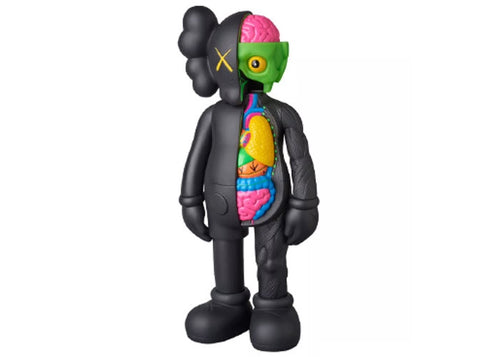
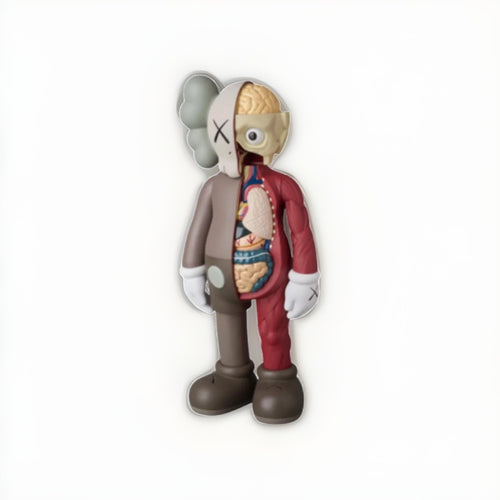
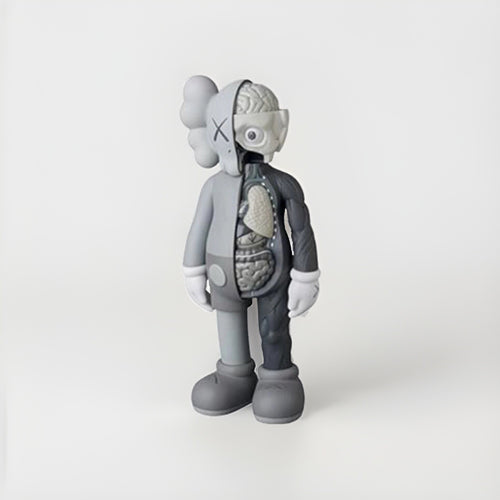
KAWS reuses a set of core characters, each with its own silhouette. The most familiar is Companion, the Mickey-adjacent figure with X'd-out eyes and gloved hands. Others in the recurring cast include BFF (a tall, fuzzy-textured companion figure), Chum (a Michelin-man-derived form), Accomplice (a rabbit-like character), and Dissected and Flayed variants that expose a cartoon "anatomy" of organs and bones. Each character has a correct proportion and posture; a sculpt whose proportions are off is a warning sign. If you are trying to identify and value a specific character, our companion article on telling Companion, BFF, Chum and Accomplice apart walks through each silhouette.
Colorways: the palette is part of the identity
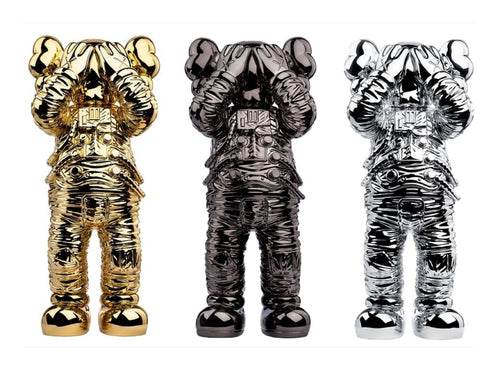
A single KAWS sculpt is frequently issued in multiple colorways, and the colorway is not decorative — it is part of the piece's identity and often part of its name. Standard palettes recur across releases: an all-over Black, a clean Grey, a bright Brown/tan, and multi-color "original" schemes are among the most familiar. Some sculpts also appear in a "flesh" or classic tri-color arrangement. A given colorway will have a consistent look across the run: the same tone of grey, the same placement of accent colors, the same finish (matte versus gloss where applicable). Counterfeits frequently get the colorway subtly wrong — a grey that reads too blue, a brown that's too orange, or seams and paint edges that are sloppier than the factory standard.
Sizes: the scale tiers
KAWS vinyl figures are produced in a handful of standard scale tiers rather than arbitrary heights. Collectors commonly describe them in broad categories, and the box, the price at release, and the edition format usually track the size. A larger companion-scale statue is a different release — with different packaging and provenance expectations — than a small keychain or a mid-size vinyl. Because exact heights differ by sculpt, always confirm the stated size against the actual figure and the box, and be suspicious when a listing's photographed proportions don't match the size it claims.
Edition format: open versus limited
Finally, KAWS releases fall on a spectrum from effectively open (produced to meet demand within a sale window) to strictly limited (a fixed, small run, sometimes hand-numbered, sometimes tied to an exhibition or collaboration). Open-edition vinyl toys are not individually numbered the way a fine-art print edition is; their scarcity comes from being sold only during a defined drop. Limited pieces — particularly bronze editions, painted-cast works, and gallery collaborations — are far scarcer and command materially higher prices. Understanding which bucket a release falls into tells you what documentation to expect and roughly where value should sit.
A Practical Reading Table: Colorway & Size Conventions
The table below summarizes the conventions collectors use to "read" a KAWS release at a glance. Treat these as general orientation, not a substitute for verifying an individual piece against its packaging and a reputable reference.
| Release attribute | Common conventions | What to verify |
|---|---|---|
| Character / sculpt | Companion, BFF, Chum, Accomplice, Dissected/Flayed variants; each with a fixed silhouette and posture | Proportions and posture match the known sculpt; no warped or "off" body geometry |
| Colorway | Recurring palettes — Black, Grey, Brown/tan, multi-color "original," and flesh/classic schemes | Tone, accent placement, and finish match the documented colorway; clean paint edges and seams |
| Size tier | Standard scale tiers (keychain/small, mid-size vinyl, large/statue), tracked by box and release price | Physical height and box match the claimed size; photographed proportions are consistent |
| Edition format | Open (drop-window) vinyl vs limited/numbered (bronze, painted-cast, collaboration) | Documentation expectation matches format; limited pieces should carry stronger provenance |
| Manufacturer era | OriginalFake-era vs later Medicom Toy production | Markings, packaging, and copyright text match the correct era for the release |
| Packaging | Medicom/OriginalFake box with correct art, print quality, and inserts | Box art, typography, and inserts are crisp and correct; shrink-wrap and seams look factory |
How to Tell if a KAWS Figure Is Real
With the structure of a release in mind, authentication becomes a process of confirming internal consistency and provenance rather than hunting for a single magic tell. Here is the sequence a careful buyer or dealer follows.
1. Match the piece to a documented release
Before you inspect a single stamp, confirm that the character, colorway, size, and year the seller claims actually correspond to a real KAWS drop. If no documented release combines those attributes, stop — you may be looking at a bootleg, a "custom," or a misdescribed item. Our KAWS figurine index is a useful orientation tool for seeing how releases are organized across characters and years.
2. Read the base, foot, and interior markings
Genuine KAWS vinyl carries factory markings — typically a stamped copyright line, character and manufacturer attribution, and year, usually found on the base, the underside of a foot, or the interior of a leg. The exact wording and placement vary by era and sculpt, which is why we treat the markings as something to match against the correct release rather than a fixed universal string. Fonts should be crisp and correctly kerned; a blurry, misaligned, or misspelled stamp is a serious red flag. For a full walkthrough of the box, foot stamp, and Medicom markings, see our dedicated KAWS authentication checklist for box and foot-stamp markings.
3. Inspect the packaging
For sealed or boxed pieces, the packaging is a primary authentication surface. Medicom and OriginalFake boxes have consistent art, print quality, typography, and inserts for a given release. Counterfeit boxes frequently reveal themselves through muddy printing, wrong fonts, off-color art, loose or missing inserts, and shrink-wrap that doesn't sit the way factory wrap does. Our sibling guide on fake KAWS packaging tells — shrink-wrap, print quality and inserts covers this in detail, and our KAWS packaging guide is the reference we point buyers to.
4. Confirm provenance and documentation
A figure that reads correctly on sculpt, colorway, size, and markings still needs a history. Where did it come from? Is there a receipt, an original drop confirmation, prior-sale records, or reputable-dealer provenance? For KAWS and BE@RBRICK, Gauntlet Gallery does not rely on a manufacturer "certificate" — Medicom does not issue a per-figure COA. Instead we back applicable pieces with TrueCOA, so the physical object is tied to a verifiable on-chain record. Our full method is laid out in the KAWS authentication guide.
5. Buy from an accountable source
The single most reliable protection is buying from a source that stands behind authenticity in writing. On the open secondary market, the odds of encountering a convincing fake or a "restored" piece rise sharply, especially for high-value characters and colorways. If you're navigating that market, our guide to buying KAWS on the secondary market without getting burned covers the practical safeguards.
OriginalFake Era vs Medicom Era: Why It Changes What You Check
KAWS's production history is not monolithic, and reading a release correctly means knowing which era it belongs to. Early releases came out under the OriginalFake label — KAWS's own brand and retail store, which operated out of Japan for a stretch of the 2000s and early 2010s. Later releases moved to Medicom Toy directly, and the character line expanded to include large-format statues, museum-show pieces, and international retail drops.
The consequence for authentication is concrete. An OriginalFake-era box, hangtag, and marking set look different from a later Medicom-era one, and expecting the wrong era's tells on a given piece will lead you astray. A "Companion" in a colorway that only existed in one era should carry that era's packaging and markings — not another's. When those signals conflict, the piece is either misdescribed or fake. Because this distinction trips up so many buyers, we treat it as its own topic; read how authentication differs between OriginalFake and Medicom-era releases before you buy anything sold as "early" KAWS.
Open Editions, Limited Editions & Where Value Comes From
Because KAWS vinyl toys are largely open editions sold within drop windows, their scarcity is a function of demand and time rather than a printed edition number. This surprises collectors who come from the fine-art print world, where "12/150" defines the run. A KAWS open-edition vinyl figure is generally not hand-numbered; instead, its value is driven by the character, the colorway's desirability, the size, condition, and whether it sold out quickly at release.
Limited pieces are a different animal. Bronze editions, painted-cast works, and gallery or brand collaborations are produced in genuinely small numbers, sometimes numbered, and carry commensurately higher values and stronger documentation expectations. When a listing claims a piece is "limited," ask what that means specifically: a fixed numbered run, an exhibition tie-in, or simply a sold-out open drop? The answer materially affects value. For the broader logic of edition numbering across collectibles — and its limits — see our explainer on what an edition number like "12/150" actually tells you.
Colorway desirability and value
Within a single sculpt and size, colorways are rarely equal in the market. Certain palettes — often the "original" multi-color scheme or a scarce accent colorway — carry a premium, while others trade at a discount. This is why "reading" the colorway matters financially, not just for identification: two figures that look almost identical to a newcomer can sit at very different price points because one is the sought-after colorway and the other is the common one. Sealed condition, an intact box, and complete inserts further separate comparable pieces. Condition grading for boxed toys is its own discipline, and the same principles that govern BE@RBRICK grading apply to KAWS.
Demand also shifts over time. A colorway that was overlooked at release can appreciate as collectors complete character sets, and a piece tied to a landmark exhibition or a high-profile collaboration often outperforms a standard drop of the same sculpt. When you read a release with an eye to value, you are really reading three layers at once: what the piece is, how scarce its specific configuration is, and how the market currently ranks that configuration against its siblings. None of those layers can be assessed from a single photo, which is why a documented, authenticated piece from an accountable dealer consistently commands more than an unverified one on the open market — the buyer is paying for certainty as much as for the object.
Finally, resist the temptation to treat any single KAWS figure as a guaranteed investment. Values move, tastes rotate, and condition is unforgiving. The collectors who fare best buy pieces they genuinely want to live with, insist on authentication and provenance up front, and hold with patience rather than chasing short-term flips. Reading the release correctly is what keeps that discipline grounded in fact.
Reading the Material: Vinyl, Cast & Finish
Beyond the four defining attributes, the physical material of a KAWS figure is part of reading the release correctly. Most collectible KAWS toys are produced in vinyl, but the line also includes painted-cast resin, bronze, wood, and plush. Each material has an expected weight, surface, and finish for a given release, and a mismatch here is often the tell that separates a genuine piece from a recast or a bootleg.
Genuine vinyl figures have a consistent wall thickness and heft appropriate to their size; recasts frequently feel too light, too heavy, or hollow in the wrong places. Paint application on a real piece is clean and registered — accent colors sit inside their intended boundaries, and the finish (matte or gloss) is uniform across the run. Seam lines from the molding process are minimal and sit where the factory placed them. On counterfeits, you'll commonly see paint bleed at color boundaries, uneven gloss, visible mold flash, or seams in the wrong place. Bronze and painted-cast editions, being far scarcer and pricier, warrant the closest material scrutiny and the strongest documentation; if a seller offers a "bronze" at a vinyl-tier price, that alone is a reason to walk away.
Finish also ages. A vinyl figure that has been displayed in sunlight can yellow or fade, and that condition history should be reflected honestly in a listing and its price. Reading the material means asking not just "is this the right substance?" but "does its condition match its stated history?" A figure described as sealed and pristine that shows fading has a story that doesn't add up.
Documenting a Piece Before You Buy
Reading a release is not only something you do to spot a fake — it's the checklist that lets you document a piece so it holds value at resale. Before committing to a purchase, a disciplined collector assembles the same evidence a dealer would, so the object arrives with a paper trail rather than a hope.
- Photograph the identifying evidence. Request clear images of the character from multiple angles, the colorway in natural light, the size relative to a reference object, and close-ups of every marking — base, foot, and interior text where visible.
- Confirm the release. Match those images to a documented character, colorway, size, and year. If the combination doesn't correspond to a real drop, resolve that before any money changes hands.
- Verify the packaging. For sealed pieces, examine box art, print quality, typography, inserts, and shrink-wrap against the correct release and era.
- Establish provenance. Ask for receipts, prior-sale records, or dealer provenance. The higher the value, the more provenance matters.
- Secure verification. Where available, insist on third-party authentication and a durable link between the object and its record — the role that TrueCOA plays on applicable Gauntlet pieces.
Done consistently, this process turns a private worry ("is it real?") into a documented fact ("here is why it's real"). That documentation is what a future buyer will pay for, which is why authentication and resale value are two sides of the same coin. For the broader principles of building and protecting a collection, our collector trust hub gathers the guides that apply across every artist we handle.
Common Misreadings and How to Avoid Them
Most costly mistakes come from a handful of predictable misreadings. Being aware of them is half the defense.
- Assuming a number means "limited." An open-edition vinyl that sold out is not the same as a hand-numbered limited edition. Sold-out status alone does not create a numbered edition.
- Trusting the box alone. Counterfeiters reproduce boxes. A convincing box with a wrong figure — or a right figure in a wrong box — is a classic mismatch. Read both together.
- Expecting a manufacturer COA. Medicom does not issue a per-figure certificate. A seller waving a "factory COA" for a KAWS toy is either confused or dishonest. Legitimate assurance comes from provenance and third-party programs like TrueCOA.
- Ignoring era. Applying Medicom-era expectations to an OriginalFake-era piece (or vice versa) produces false negatives and false positives alike.
- Overlooking size mismatch. Listings sometimes photograph a small figure to imply a larger one. Confirm the physical scale against the claimed size tier.
- Skipping provenance. A clean-looking figure with no history is still unproven. Provenance is not optional at the values KAWS commands.
Where Gauntlet Gallery Fits
Gauntlet Gallery curates authenticated designer figures and street-art works, and KAWS is a core part of that program. Every applicable KAWS piece we handle is read against its documented release, inspected for markings and packaging, checked for provenance, and — where applicable — backed by TrueCOA, which ties the physical object to a verifiable record. You can browse current inventory in the KAWS collection, and if you're building broader authentication literacy, the KAWS buyer's guide and our collector trust hub tie the whole framework together.
Reading a release is ultimately a habit: character, colorway, size, edition format, era, markings, packaging, provenance — checked in that order, every time. Build that habit and you'll spend far less time worrying whether a KAWS figure is real, because the release will either read consistently or it won't.