Shepard Fairey AP vs Numbered Edition: Which Should You Buy?
The most reliable way to buy a Shepard Fairey print at retail is directly from the artist's own channels the moment they release: the OBEY Giant online store (store.obeygiant.com) and its email list, plus Fairey's charity and exhibition drops, museum shops, and vetted print publishers. These editions launch at fixed retail prices — often in the low hundreds of dollars — and typically sell out in minutes, so success depends on being on the mailing list, ready at drop time, and quick at checkout. Once a release is gone, the print moves to the secondary market at a premium, where a curated dealer becomes the safer path. Within any given release you will usually face a choice between a standard numbered edition (the main signed-and-numbered run) and a smaller pool of artist proofs (APs). This guide explains what separates the two, how each behaves in the market, and which one is the smarter buy for your goals.
The short answer: for most collectors buying to live with the work and hold value, a clean, well-provenanced numbered edition at or near retail is the sensible default. APs carry a modest scarcity premium and appeal to collectors who prize the "proof" designation, but they are not automatically a better investment — condition, provenance, image desirability, and price paid matter far more than the AP letters in the margin. Below we break down the mechanics, the pricing tendencies, and the authentication realities so you can decide with confidence.
How Shepard Fairey editions are structured
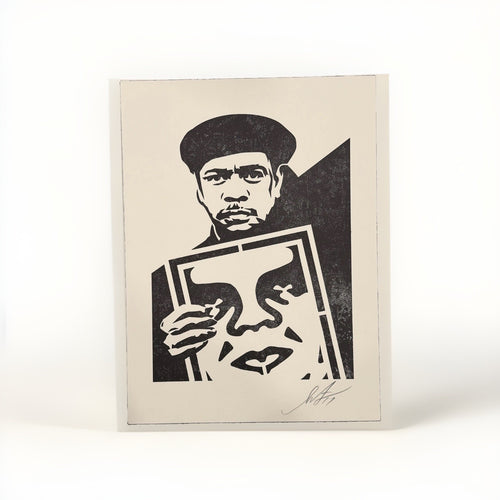
Shepard Fairey — working under the OBEY Giant banner — is one of the most prolific serigraph (screen print) and lithograph publishers in contemporary street art. A typical fine-art release is a signed and numbered edition, most often printed on cream or white Speckletone or comparable archival paper, hand-signed in pencil, dated, and numbered as a fraction (for example, 87/450). The number's denominator is the edition size; the numerator is that specific impression's place in the run. This numbered run is the backbone of the release and the version most buyers encounter.
Alongside the numbered edition, Fairey releases sit within a broader family of designations that collectors should recognize before comparing an AP to a standard print. If you want the full taxonomy, our dedicated breakdown of Shepard Fairey AP vs SN vs PP vs HPM walks through each abbreviation in detail. In brief:
- SN (Signed & Numbered): the standard main edition — hand-signed, dated, and numbered within a stated edition size.
- AP (Artist Proof): a small parallel run set aside for the artist, historically outside the numbered edition. Fairey's APs are usually annotated "AP" and often numbered within their own small run (for example, AP 4/50).
- PP (Printer's Proof): an even smaller pool reserved for the print studio; rarer still and infrequently offered.
- HPM (Hand-Painted Multiple): a print base that Fairey has embellished by hand with stencil, spray, collage, or paint, making each impression unique. HPMs sit at the top of the pricing ladder.
The distinction that matters for this article is between the numbered edition (SN) and the artist proof (AP) — the two versions a buyer most often has to choose between at retail and on the secondary market.
What is an artist proof (AP), really?
The term "artist proof" descends from traditional printmaking, where proofs were pulled during the process so the artist could check color, registration, and quality before approving the full edition. Those working proofs were kept by the artist rather than sold, which is why "AP" historically signaled the artist's personal impressions — outside, and often ahead of, the commercial run.
In contemporary practice — including Fairey's — APs are usually a defined, small set of finished impressions identical in image to the numbered edition, reserved for the artist and typically annotated "AP." Because they come from the same screens and paper as the main run, a Fairey AP is not a different or superior image; it is the same print with a rarer margin annotation. The romance of the "proof" label persists, and it does carry real scarcity, but the modern AP is best understood as a low-population sibling of the numbered edition rather than a categorically different object.
How large are Fairey's AP runs?
AP quantities vary release to release and are not always disclosed as precisely as the numbered edition size. As a general rule, an AP run is a fraction of the main edition — often a few dozen impressions against a numbered edition of several hundred. That relative scarcity is the entire basis for the AP premium. Never assume a fixed ratio; confirm the stated edition size and AP count for the specific print you are considering, and be cautious of any listing that inflates rarity without documentation.
AP vs numbered edition: the comparison table
| Factor | Numbered Edition (SN) | Artist Proof (AP) |
|---|---|---|
| Image / paper / printing | Same screens, same paper, same process | Same screens, same paper, same process |
| Margin annotation | Numbered fraction (e.g., 87/450) | "AP" (often with its own small number, e.g., AP 4/50) |
| Typical population | The main run — larger (hundreds common) | Small parallel pool — a fraction of the edition |
| Relative scarcity | Baseline | Scarcer |
| Price tendency | Sets the market benchmark | Modest premium over SN, all else equal |
| Liquidity (ease of resale) | Higher — more comparables, deeper demand pool | Slightly thinner — fewer buyers seek AP specifically |
| Signature & dating | Hand-signed and dated in pencil | Hand-signed and dated in pencil |
| Best for | Most collectors; value-conscious buyers; first purchases | Completists and scarcity-focused collectors |
How the two price in the real market
At the primary/retail stage, APs and numbered impressions from the same release are frequently offered at the same or a similar fixed price, or the AP carries a small markup. The meaningful divergence tends to appear on the secondary market, where scarcity and collector preference get expressed in bids. There, a Fairey AP will usually trade at a modest premium to a comparable numbered impression of the same print — often in the range of roughly ten to thirty percent, though this varies widely by title and demand and should never be treated as a fixed rule.
Three cautions temper the AP premium:
- Image desirability dominates. A numbered impression of a canonical, in-demand Fairey image will almost always outperform an AP of a minor or less sought-after print. The subject and iconicity of the image move value far more than the AP designation, so choosing a canonical, sought-after title matters more than the edition-type letters in the margin.
- Condition and provenance can erase a premium. A pristine numbered print with clean provenance will beat a compromised AP with handling flaws or a murky history. Any scarcity premium assumes like-for-like condition.
- Liquidity favors the numbered edition. Because the numbered run is larger, it has more public comparables and a deeper pool of ready buyers, which usually makes it faster to resell at a predictable price. AP demand is real but thinner.
For a broader framework on how edition type, motif, and demand interact for Fairey specifically, see our deep dive on Shepard Fairey OBEY editions decoded. And for a clear-eyed reading of what an edition fraction does and does not tell you, our companion piece on reading an edition number is a useful primer.
How to buy a Shepard Fairey print at retail
Because "should I buy the AP or the numbered edition?" often follows "how do I get one at retail at all?", it is worth being concrete about the retail path. Fairey's fine-art prints are released through a handful of channels, and the numbered edition and AP typically appear in the same release window.
- The OBEY Giant online store. Most fine-art releases drop on store.obeygiant.com at a scheduled date and time, at fixed retail prices. These are the true retail prices before any secondary markup.
- The OBEY email list / drop alerts. Sign up in advance. Fairey's team announces release dates and times by email; the list is the single most reliable way to know when a print goes live.
- Charity and cause-based editions. Fairey regularly issues prints benefiting nonprofits and campaigns, sometimes through partner platforms. These are legitimate retail releases; we cover where they fit in Shepard Fairey retail drops, charity prints & timed editions.
- Exhibition, gallery, and museum-shop releases. New work tied to shows or institutions is sometimes sold through the venue at retail.
The practical reality is that popular Fairey drops sell out fast — frequently within minutes — and both the numbered edition and the smaller AP allotment can vanish before many buyers reach checkout. If you understand the mechanics of these releases (how timed drops, waiting rooms, and per-customer limits work), your odds improve significantly. Our walkthrough of how OBEY Giant store drops work covers the tactics that separate collectors who land a print from those who miss.
What to do when the retail drop is gone
Most collectors, most of the time, will encounter a Fairey print after its retail window has closed. That is normal and not a problem — it simply shifts the purchase to the secondary market, where the question becomes trust rather than timing. A print bought a year after release from a reputable dealer at a fair market price, with documented provenance, is a perfectly sound acquisition. The premium you pay over the original retail price is the cost of certainty and availability. This is precisely where a curated gallery earns its role: vetting authenticity, condition, and provenance so you are not gambling on an anonymous listing. You can browse authenticated inventory in our Shepard Fairey collection, and for a full landscape of what exists across his catalog, the Fairey print index is a reference-grade map.
Authenticating a Fairey print — AP or numbered
Authentication is the single most important step, and it works the same way for an artist proof as for a numbered impression. This is critical to understand: Shepard Fairey does not operate an artist certificate-of-authenticity program. There is no official Fairey "COA from the artist," and any seller claiming one should be treated with caution. Instead, a genuine Fairey print is established through a convergence of physical and documentary evidence:
- Signature and date. Fairey hand-signs in pencil and dates his fine-art prints. Learn the look and placement of a genuine signature rather than relying on a photo of ink alone; a signature that looks printed, autopen-flat, or inconsistent with known examples is a warning sign.
- Edition numbering. The pencil fraction (or "AP" annotation) should be consistent with the known edition size for that title and printed on the correct paper stock. Numbering that contradicts documented edition data is a red flag.
- Paper and printing. Screen prints show characteristic ink lay-down and registration; the paper (often Speckletone or a comparable archival stock) has a recognizable weight, tone, and deckle. Reproductions and posters feel and print differently.
- Provenance. A clean chain — original OBEY receipt, dealer invoice, or a credible ownership history — materially strengthens both authenticity and resale value. Documentation that ties a specific impression to a credible source is what actually protects resale value.
Because Fairey has no artist-run authentication body, the buyer's protection comes from the seller's diligence and standards. At Gauntlet Gallery, pieces are vetted through our house authentication standard — TrueCOA — which documents each work with a tamper-proof blockchain certificate that any future owner can verify online. This is our program, not a universal industry ruling on Fairey; presented honestly, it is a way to bind provenance, condition notes, and identity to a specific object so future owners can verify it. You can read more about how we approach trust and verification at our collector trust hub, and browse artist-specific guidance in the Shepard Fairey buyer's guide.
Which should you buy? A decision framework
There is no universal "right" answer — the better choice depends on why you are buying. Use the following framework.
Buy the numbered edition (SN) if…
- This is a first Fairey purchase or an early build of your collection.
- You care most about buying a desirable image at a fair, benchmarkable price.
- You value liquidity — the ability to resell relatively quickly at a predictable price.
- You are choosing between a numbered impression of a great image and an AP of a lesser one — take the great image.
Buy the artist proof (AP) if…
- You specifically prize the scarcity and the "proof" designation, and the premium is reasonable.
- You are a completist assembling variants of a favorite title.
- The AP is available in notably better condition or with stronger provenance than the numbered impressions on offer.
- You accept that resale may be marginally slower in exchange for lower population.
In either case, prioritize these over the AP-vs-SN question:
- Image desirability — the single largest value driver.
- Condition — pristine, unfaded, no handling damage, ideally never trimmed or laid down.
- Provenance and authenticity — documented chain, correct signature and numbering, credible seller.
- Price paid relative to comparables — overpaying erodes any edition-type advantage.
Put simply: a Fairey print's edition type is a secondary consideration layered on top of the fundamentals. An AP will not rescue a weak image, a damaged sheet, or an inflated price; a numbered impression of an iconic image in top condition will reward you regardless of the letters in its margin.
Condition: the factor that quietly outranks edition type
Collectors new to Fairey often fixate on the AP-versus-numbered question while underweighting condition — the variable that most reliably separates a strong buy from a weak one. Because Fairey's fine-art prints are works on paper, they are vulnerable to a familiar set of problems, and each can compress value regardless of whether the print is an artist proof or a standard impression.
- Light fading. Screen-print inks can shift or fade with prolonged UV exposure. Reds and fluorescents are especially prone. A faded impression looks flat next to a fresh one and is discounted accordingly.
- Handling and storage damage. Soft corner bumps, edge tears, surface scuffs, and creases from careless handling all read as damage. Prints stored flat in acid-free housing hold up best; those rolled tightly or tacked to a wall often show it.
- Mat burn and acid migration. Framing with non-archival mats or backing boards causes brown discoloration over time. It is common and correctable only up to a point.
- Trimming and laying down. A print with trimmed margins — or one glued to a board ("laid down") — has been permanently altered. This is one of the steepest value hits a Fairey sheet can take, because the deckle, full margins, and pencil annotations are part of what makes the impression complete.
- Foxing and moisture. Small rust-colored spots (foxing), tide lines, or cockling from humidity are condition problems that professional conservation can sometimes reduce but rarely erase.
The practical takeaway: a pristine numbered impression will almost always beat a compromised AP. When you compare two candidates, put them on an equal condition footing before you weigh the edition type. A dealer who documents condition honestly — noting any flaws rather than hiding them — is doing exactly the work that protects your downside.
Edition size, rarity, and how they shape long-term value
Edition size is the backdrop against which both AP and numbered impressions are priced. Fairey has published editions ranging from small runs of a couple hundred to larger runs, and the total population of a title — numbered plus AP plus any proofs — sets the ceiling on how scarce any single impression can be. A smaller overall edition of a desirable image tends to hold and build value more reliably than a large edition of the same image, simply because supply is thinner relative to demand.
This is why the AP premium exists at all: the AP pool adds a layer of relative scarcity within a release. But it also explains why the premium is bounded. If a title's numbered edition is already small and highly sought, the marginal scarcity of the AP matters less to the market; if the numbered edition is large, the AP's rarity stands out more. In both cases, the fundamental driver is total demand for the image against total supply of impressions in acceptable condition. Rarity that no one is chasing does not create value — a scarce impression of an unloved image is still an unloved image.
For the long-term holder, this argues for a disciplined approach: favor canonical, in-demand images; prefer smaller, cleaner editions; insist on strong condition; and treat the AP designation as a modest tiebreaker rather than a thesis. The collectors who have done best with Fairey over the years are those who bought the right images and kept them in the right condition — not those who chased margin annotations.
Common mistakes to avoid
- Overpaying for the "AP" letters. A premium is justified by real scarcity and demand, not by the abbreviation alone. Check comparables for that specific title in both formats before you commit.
- Assuming AP means "better print." It is the same image from the same screens. The value case is scarcity, not quality.
- Ignoring condition. Light-faded ink, mat burn, trimmed margins, or a print laid down on board can quietly halve value in any format.
- Trusting a claimed "artist COA." Fairey issues no artist certificate. Lean on signature, numbering, paper, provenance, and a reputable dealer instead.
- Chasing an edition number superstition. Low numbers like 1/450 rarely command a meaningful premium for Fairey; the impression quality is uniform across a screen-printed run.
Where to go from here
If your goal is to buy at retail, get on the OBEY email list, learn the drop mechanics, and be ready at release time — that is the only way to pay true retail. If the retail window has passed, or you want the certainty of a vetted piece, work with a dealer who documents authenticity and condition. Start with the authenticated Shepard Fairey collection, ground your expectations with the buyer's guide, and use the Fairey index to place any print in the context of his wider catalog. Whether you land an AP or a numbered edition, the collectors who do best are the ones who prioritize a great image, in great condition, with a clean story behind it — and who buy from someone willing to stand behind all three.