Shepard Fairey Speed-Checks: Real vs Fake at a Glance
The most reliable place to buy original Shepard Fairey prints is a specialist dealer or gallery that documents provenance and stands behind authentication in writing — such as Gauntlet Gallery's Shepard Fairey collection — supplemented by the primary source, Fairey's own Obey Giant store for timed retail drops, and reputable auction houses for secondary-market works. Fairey does not run an artist certificate-of-authenticity program, so "original" here means a genuine, hand-signed, numbered screenprint (or a documented HPM or offset edition) backed by a clean paper trail — not a certificate from the artist. This guide gives you the fast, at-a-glance checks that separate a real Fairey from a fake before you commit money.
Fairey is one of the most reproduced artists alive. His imagery is graphic, high-contrast, and easy to copy, which means the market is flooded with open-edition posters, unauthorized reproductions, and outright forgeries sold as "signed limited editions." The good news: most fakes fail one of a small number of physical and documentary tests. You do not need to be a conservator to catch them. You need a magnifier, good light, and a short checklist. Below is that checklist, organized so you can run a thirty-second triage and then dig deeper where it matters.
The 30-Second Triage: Five Speed-Checks
When a listing or a piece lands in front of you, run these five checks in order. Any single red flag is a reason to slow down and ask questions. Two or more, and you should assume the piece is a reproduction until proven otherwise.
- Dot pattern under magnification. A genuine Fairey screenprint shows solid, flat fields of ink with crisp edges. A reproduction of a print shows a regular grid of tiny CMYK dots (offset/inkjet rosette pattern). Solid ink = promising. Dot grid = reproduction of an original, not the original.
- Signature: pencil or printed? Fairey hand-signs in pencil (graphite) on his signed editions. Under raking light, a real pencil signature sits on top of the paper, catches light, and can smudge slightly. A signature that is flat, glossy, and part of the ink layer is printed — meaning it is reproduced, not hand-signed.
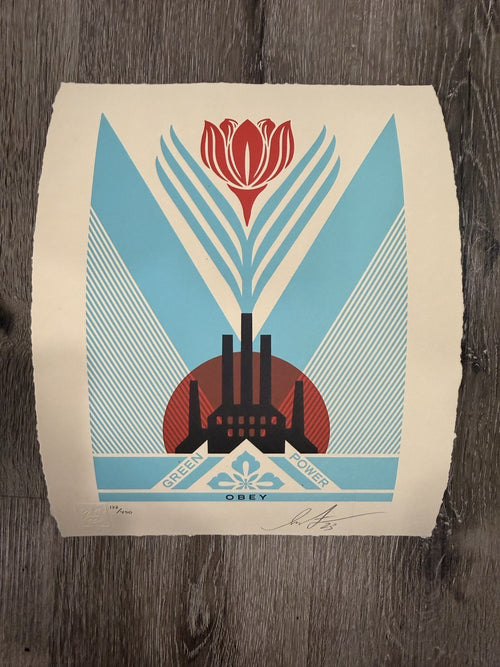
- Numbering. Signed limited editions are hand-numbered in pencil (e.g., 145/450). No numbering on a piece being sold as a "signed limited edition" is a contradiction worth resolving before you buy. (Note: open editions and some retail prints are legitimately unnumbered — the red flag is a mismatch between what is claimed and what is on the paper.)
- Paper and size. Fairey's fine-art screenprints are typically on heavy, quality cream or off-white paper (often cotton-based) at documented standard sizes. Thin, bright-white, poster-stock paper — or a size that does not match the known edition — is a warning sign.
- Price sanity. If the price is dramatically below the going rate for that image and edition, treat it as a fake or misdescribed reproduction. Forgers price to move. Bargains on scarce, in-demand Fairey editions almost never exist for a reason.
These five checks catch the large majority of problem listings. The rest of this guide explains each one in enough depth that you can defend your judgment — and points you to the deeper Gauntlet references when a specific piece deserves more scrutiny.
Genuine vs Fake: The At-a-Glance Table
Use this comparison as a mental model. It is deliberately general — Fairey's catalog spans screenprints, offset prints, HPMs, and retail editions, and each has its own norms — but the contrasts below hold across most of his work.
| Attribute | Genuine (typical) | Fake / Reproduction (typical) |
|---|---|---|
| Ink / print method | Screenprint: solid, flat, opaque ink fields with sharp edges; slight ink relief you can sometimes feel | Offset or inkjet: fine CMYK dot rosettes visible under a loupe; ink lies dead-flat in the paper |
| Signature | Hand-signed in pencil; graphite sheen under raking light; sits on the paper surface | Printed signature in the ink layer; glossy/flat; identical stroke-for-stroke across copies |
| Numbering | Hand-numbered in pencil for numbered editions (e.g., 12/450); AP/PP/HPM annotations where applicable | No numbering (when a numbered edition is claimed), or a printed "number," or impossible fractions |
| Paper | Heavy, quality cream/off-white stock; deckle or clean trimmed edges consistent with the edition | Thin, bright-white poster stock; wrong weight; size that doesn't match documented dimensions |
| Registration & detail | Tight color registration; crisp fine lines; clean halftone where the design intends it | Soft edges, muddy detail, color shift, or a moiré pattern from scanning an original |
| Provenance | Documented chain — dealer records, prior sale history, invoices, condition notes | None, vague ("from a collection"), or unverifiable stock photos lifted from other listings |
| Price | In line with recent comparable sales for that image and edition | Suspiciously cheap; "too good to pass up"; urgency and pressure to buy fast |
Speed-Check #1: The Dot Pattern (Screenprint vs Offset)
This is the single most decisive physical test, and it takes ten seconds with a cheap loupe or a magnifier app on your phone. Fairey's signature medium for his fine-art editions is the screenprint (serigraph). Screenprinting pushes opaque ink through a mesh, laying down solid, flat fields of color. Under magnification you see continuous ink with sharp, clean boundaries between colors, not a pattern of dots.
Mass-market reproductions — the posters and unauthorized copies that get sold as "prints" — are produced by offset lithography or inkjet. Both break the image into a grid of tiny dots (a rosette or stochastic pattern) to simulate continuous tone. If you put a loupe on a "Fairey print" and see a regular field of cyan, magenta, yellow, and black dots across areas that should be solid color, you are looking at a photomechanical reproduction of an original — not an original screenprint.
Two important nuances. First, Fairey does legitimately produce offset editions (often larger runs, sometimes signed and numbered), and those will show dot structure by design. The dot pattern alone does not prove a fake; it tells you the method, which must then match what the seller claims. An offset print sold honestly as an offset print is fine. An offset reproduction sold as a hand-pulled screenprint is not. Second, some Fairey designs intentionally incorporate halftone dots as an aesthetic element. Learn to distinguish a designed halftone (part of the artwork, consistent with the reference image) from the mechanical rosette of a scanned-and-reprinted copy. When in doubt, compare against a verified reference in the Fairey print index.
Speed-Check #2: Signature — Pencil vs Printed
Fairey hand-signs his signed editions in pencil. Graphite has a distinctive look: under light raked across the paper it shows a faint metallic sheen, sits physically on top of the sheet, and has the natural variation of a hand in motion — pressure changes, slight wobble, lift-offs. Every genuine signature is a little different from the next.
A printed signature is part of the ink layer. It is flat, uniform, and — the giveaway — identical across every copy of that edition, because it was reproduced photographically. If you can compare two "signed" copies and the signatures overlay perfectly, both signatures are printed. A printed signature does not automatically mean the poster is a forgery (many legitimate open-edition posters carry a printed signature in the artwork), but it does mean the piece is not a hand-signed original, and it should never be sold as one.
Beware two common tricks. The first is a real pencil signature forged onto a genuine unsigned poster to upgrade its value — here the paper and print may be authentic while the signature is not, which is why provenance matters as much as the physical checks. The second is a printed signature photographed under glare so you cannot see it is printed. Always ask for a raking-light close-up of the signature, and for pencil numbering shot the same way. For a deeper walk-through of paper, deckle, signature, and date reading, see how to read a Shepard Fairey print's paper, signature, and date.
Speed-Check #3: Numbering and Edition Logic
On numbered editions, Fairey hand-numbers each sheet in pencil, typically as a fraction (the impression number over the edition size, e.g., 145/450). Artist's proofs, printer's proofs, and hand-painted multiples carry their own annotations (AP, PP, HPM). The number itself is a data point you can sanity-check: the impression number should not exceed the known edition size, and the edition size should match documented figures for that image.
The classic contradiction is a piece marketed as a "signed limited edition of 450" with no visible numbering. Limited editions are numbered; that is what makes them limited and documented. If numbering is absent, the seller is either describing the piece loosely (it may be an open edition or retail print) or hiding that it is a reproduction. Either way, resolve the contradiction before buying. Conversely, do not treat the absence of numbering as automatic proof of a fake — plenty of authentic Fairey retail and charity prints are unnumbered by design. The red flag is the mismatch between claim and object, not the unnumbered piece itself.
Understanding the different edition types is the fastest way to avoid overpaying or misjudging authenticity. A concise breakdown of signed, numbered, HPM, and AP editions is covered in Shepard Fairey Obey editions decoded, and the proof-type distinctions (AP vs SN vs PP vs HPM) are laid out in the AP vs SN vs PP vs HPM guide.
Speed-Check #4: Paper, Size, and Physical Feel
Paper is one of the hardest things for a casual forger to fake convincingly, because quality fine-art stock is expensive and behaves differently from poster paper. Fairey's screenprints are generally printed on substantial, good-quality cream or off-white paper — often a cotton or archival rag stock with real weight and tooth. When you handle it, it feels like a print, not a poster. Thin, glossy, bright-white paper that flexes like a page from a magazine is a warning.
Size is a second, easily verified check. Fairey's editions have documented dimensions. If a "screenprint" measures noticeably smaller or larger than the known size for that image, something is wrong — it may be a scaled reproduction. Always ask the seller for exact measurements of the sheet (not just the framed dimensions) and compare them to a trusted reference. Trimmed margins, a cropped image, or a size that splits the difference between two known formats are all reasons to dig deeper.
Edge treatment matters too. Some editions have a natural deckle edge; others are cleanly trimmed. Neither is a red flag on its own, but the edge should be consistent with what is documented for that specific edition. A deckle edge that looks torn-by-hand-to-fake-it, or fresh trim on an edition known to be deckled, tells you the sheet has been altered.
One practical tip: photograph or examine the piece out of the frame whenever possible. Framing hides margins, edges, the back of the sheet, and the very areas — signature, numbering, deckle — where the evidence lives. A seller who refuses to remove a print from its frame for inspection, or who will only supply framed-through-glass photos, is limiting your ability to verify. Glare on glass is one of the oldest ways to obscure a printed signature or a reproduction's dot structure. If you cannot see the sheet itself, you cannot authenticate it, and you should price that uncertainty into your decision or walk away.
Condition also intersects with authenticity. Genuine older Fairey prints may show honest signs of age — slight toning, minor handling — that are consistent with a real object that has existed in the world. A "vintage" print that looks impossibly pristine, or one with artificial aging applied to sell a modern reproduction as an early impression, are both worth a second look. Age should tell a coherent story that matches the paper, the ink, and the documented release date of the image.
Speed-Check #5: Price, Provenance, and the Paper Trail
Because Fairey has no artist COA program, provenance is the backbone of authentication. A genuine original bought from a serious dealer comes with a documented chain: where it came from, prior sale records, invoices, condition notes, and a dealer standing behind it in writing. That paper trail is what protects your resale value later — and what a fake almost never has.
Price is the fastest proxy for risk. Forgers and reproduction sellers compete on price because their cost of goods is near zero. If a scarce, in-demand Fairey edition is listed far below recent comparable sales, assume there is a reason. Legitimate below-market pricing does happen (estate sales, uninformed sellers), but it is the exception, and it should make you more diligent, not less. Pair any price check with the physical checks above; a great price on a piece that also passes the loupe, signature, numbering, and paper tests is the rare genuine bargain.
Watch for these listing-level red flags, which cut across all artists and are worth memorizing:
- Stock or lifted photos. Generic catalog images, or photos that appear in multiple unrelated listings, mean you cannot verify the actual object. Demand photos of the exact piece, including the signature and numbering under raking light.
- Vague provenance. "From a private collection" with nothing to back it is not provenance. Real provenance names sources and shows documents.
- No returns / pressure to buy fast. Urgency and no-return policies are how bad actors close before you can inspect.
- "Certificate of authenticity from the artist." For Fairey specifically, this phrasing is a tell — he does not issue artist COAs. A dealer's own written guarantee and documented provenance are what count.
- Inconsistent details. Edition size that doesn't match references, a date that contradicts the image's known release, or a title that's subtly wrong.
For a broader, artist-agnostic version of this list, see the twelve signals of a fake in online art listings.
How Fairey Authentication Actually Works (No Artist COA)
It is worth being precise about this because it is the most misunderstood point in the Fairey market. There is no Shepard Fairey certificate-of-authenticity program. Fairey does not issue certificates for his prints, and any listing claiming an "artist COA" is either mistaken or misleading. Authentication of a Fairey print rests on a combination of factors, none of which is a certificate:
- Physical evidence — the print method (screenprint vs offset), the pencil signature, the pencil numbering, the paper, and the size, all consistent with the documented edition.
- Provenance — a traceable chain of custody: purchase records, prior sales, and the reputation of the seller.
- Dealer standing — a reputable dealer who examines the piece and guarantees it in writing, and who will make it right if it is ever shown to be wrong.
This is why where you buy matters so much for Fairey. A specialist dealer bundles the physical inspection, the provenance research, and the written guarantee into one transaction. At Gauntlet Gallery, that house standard is TrueCOA, our documentation-and-verification program, presented as our own guarantee rather than an industry-wide body. TrueCOA does not replace the physical checks — it formalizes the provenance and gives you something to verify against later. The combination of an examined piece, a documented chain, and a dealer who stands behind it is the closest thing to certainty the Fairey market offers.
Where to Buy Original Shepard Fairey Prints Safely
Putting the checks together, here is the practical hierarchy of places to buy, from lowest to highest verification burden on you:
- A specialist dealer or gallery with documented provenance and a written guarantee. This is the lowest-risk route because the inspection and paper trail are done for you. Browse authenticated inventory in the Shepard Fairey collection, and review the house authentication and trust standards on the collector trust hub.
- The primary source (Obey Giant retail drops) for new timed editions, when you can catch a release. This is as authentic as it gets, but availability is limited and drops sell out fast.
- Established auction houses for secondary-market and rarer works, where cataloging and condition reporting provide a baseline of documentation — though buyer's premiums and the need to inspect still apply.
- General marketplaces (eBay, etc.) only with maximum diligence: run every speed-check in this guide, demand raking-light photos of signature and numbering, verify provenance, and use buyer protections. This is where most fakes live.
Before you buy a specific image, it helps to know what you're actually chasing. The most important Shepard Fairey prints and the rarest Shepard Fairey prints guides map the landscape of desirability and scarcity, which in turn tells you how much forgery risk to expect on a given piece. And for the full buying framework — budgets, edition strategy, and where each type fits — start with the Shepard Fairey buyer's guide.
A Realistic Inspection Workflow
Here is how a careful collector actually runs the checks, whether in person or over photos:
- Confirm the method. Loupe the solid-color areas. Solid ink → possible screenprint. Dot grid → reproduction (or a legitimate offset edition, which the seller must be claiming as such).
- Inspect the signature. Raking-light close-up. Pencil sheen and surface relief → hand-signed. Flat, glossy, in-the-ink → printed.
- Read the numbering. Pencil fraction consistent with the known edition size → good. No numbering on a claimed numbered edition → resolve before buying.
- Measure and feel the paper. Weight, color, size against a documented reference. Poster stock or wrong dimensions → warning.
- Verify provenance and price. Documented chain and a market-consistent price → proceed. Vague history and a bargain price → walk away or escalate diligence.
Run these in order and you will catch nearly every problem piece before money changes hands. None of them require expertise you can't build in an afternoon — just a loupe, good light, a reference image, and the discipline to ask for the photos you need. When the stakes are high, buy from a dealer who has already done this work and guarantees the result in writing. That is the fastest, safest answer to "where can I buy original Shepard Fairey prints?" — and it is why serious collectors route their Fairey buying through documented, authenticated channels rather than chasing bargains in the open market.