How to Read a BE@RBRICK: Series Stamp, Foot Print & Packaging
To tell whether a KAWS figure or a Medicom BE@RBRICK is real, you read three things in order: the molded markings on the body (chest and back), the underside of the feet, and the packaging the piece arrived in — then you confirm that all three agree with each other and with a documented provenance trail. No single detail authenticates a designer toy on its own; authentication is the sum of consistent, correctly-registered markings, correct-for-the-release packaging, and a clean chain of ownership. At Gauntlet Gallery we back applicable KAWS and BE@RBRICK pieces with TrueCOA blockchain certificates so the verification travels with the figure rather than living in a folder of loose paperwork.
This guide walks through the general anatomy of a Medicom-produced vinyl figure — where the markings live, what the foot and packaging are supposed to tell you, and how the checks differ between a mass-produced blind-box BE@RBRICK and a limited KAWS Companion. It is written to teach you a repeatable inspection method, not to hand you a list of secret codes. Anyone selling you a "guaranteed real" stamp lookup is selling you the wrong idea: counterfeiters copy visible codes first. The tells that hold up are the ones that are hard to fake at scale, and the discipline of cross-checking every signal against the others.
Why designer toys get faked — and why the method matters more than any single tell
KAWS figures and BE@RBRICKs sit in an unusual spot. They are mass-manufactured objects — injection-molded vinyl, printed graphics, cardboard boxes — that nonetheless trade for hundreds to tens of thousands of dollars on the secondary market. That combination is catnip for counterfeiters: the production process is well understood, the demand is global, and a convincing knockoff costs a fraction of the real thing to tool up. The most sophisticated fakes (collectors call the best of them "1:1" replicas) copy the sculpt, the paint, the box art, and even the printed markings closely enough that a single glance won't save you.
That is exactly why a checklist beats a shortcut. A counterfeiter can reproduce one signal convincingly; reproducing every signal — sculpt fidelity, paint registration, molded text crispness, foot markings, the correct box for that specific release, the insert, the barcode, and a plausible ownership history — consistently and simultaneously is far harder and far more expensive. When you inspect in a fixed order and demand internal agreement, you turn the counterfeiter's advantage into a liability. This article gives you that order. For the KAWS-specific version of the same discipline, see our companion piece on the KAWS box, foot stamp and Medicom markings checklist.
The anatomy of a Medicom figure: where to look
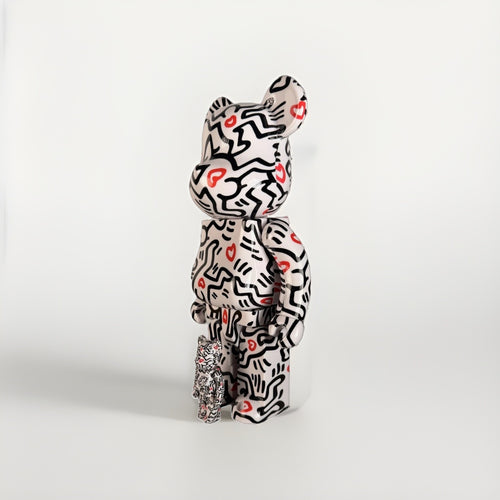
Both the KAWS × Medicom Companion family and the standard BE@RBRICK share a manufacturing DNA because Medicom Toy produces them. Learning the body plan of one helps you read the other. A BE@RBRICK's bear form has a chest, a back, two arms, two legs, a head that rotates, and — crucially — feet with flat undersides that carry molded text. A KAWS Companion has a humanoid body with the signature crossed-out "XX" eyes, gloved hands, and again, foot or leg markings on many releases. In both cases, the authentication surfaces are: the front torso, the rear torso, and the underside of the feet, cross-referenced with the packaging.
Chest and back markings
Medicom vinyl typically carries molded (raised or recessed) text somewhere on the body — commonly a manufacturer credit and, for collaborations, the artist's or brand's name or logo. On a standard BE@RBRICK the back or lower torso usually carries the Medicom Toy identity; on artist collaborations the front, back, or a limb may carry the collaborating brand's mark. What you are checking is not the exact wording — which varies by year, size, and release, and which you should confirm against a trusted reference for that specific piece — but the quality of that molding. Genuine Medicom text is cleanly struck: crisp edges, even depth, correct font weight, and no mushy or doubled characters. Counterfeit molds are often recut from a scan of a real figure, and that second-generation tooling shows up as soft, slightly blurred, or unevenly-deep lettering. Trust the crispness before you trust the content.
The foot print
The underside of the feet is the single most useful surface on a Medicom figure, which is why collectors talk about the "foot stamp" or "foot print" constantly. It is where copyright and manufacturer information is typically molded, and because it is a flat, text-heavy surface, it exposes tooling quality mercilessly. Read the feet for three things: legibility (characters should be sharp and consistent, not smeared), alignment (text should sit square and evenly spaced, not drifting or crowded), and consistency with the release (the information present should match what that size and year of figure is documented to carry). Because exact foot text differs across the 100%, 400%, 1000% and collaboration lines and across production years, do not memorize a "correct" string — verify against a reference example of the same release. What generalizes is the standard of execution: a real foot print looks manufactured to spec; a fake foot print looks copied.
Paint, sculpt and seams
Before you ever get to text, the object itself talks. Genuine Medicom paint is applied in clean registration — the "XX" eyes on a KAWS piece land where they should, the color separations on a BE@RBRICK are tidy, and there is no fuzzy overspray or bleed at the edges. The vinyl seams where molded halves join should be even and unobtrusive; heavy flashing, ragged seams, or a sculpt that looks slightly "off" in proportion are red flags that the piece came from a recut mold. Feel the weight, too: familiar releases have a characteristic heft, and a piece that feels conspicuously light or hollow relative to a known-good example deserves scrutiny.
Understanding the size system before you inspect
You cannot judge whether a figure is "correct" until you know what it is supposed to be, and with BE@RBRICK that starts with the percentage system. Medicom sizes its bears in percentages of a baseline: a 100% BE@RBRICK stands roughly seven centimeters tall, a 400% roughly twenty-eight centimeters, and a 1000% roughly seventy centimeters, with 70% and 200% sizes appearing in certain sets and keychains. This matters for authentication because packaging, foot markings, weight, and paint execution all scale with the size line. A window box that is correct for a 400% collaboration would be wrong on a blind-box 100%, and the amount and layout of molded foot text differs between a tiny 100% and a large 1000%. When a listing describes a size, the physical dimensions, the box format, and the markings should all corroborate that claim. If a seller calls something a 400% but the measurements or packaging read like a 100%, you have found a contradiction worth chasing before money changes hands.
KAWS × Medicom figures follow their own scale conventions per release — Companion and BFF pieces come in documented heights for each drop. The same logic applies: confirm the stated size against the actual dimensions and against the packaging that release is known to use. Because these are limited editions, the reference population is small and well recorded, which is an advantage: there is usually a clear, documented answer for what a given release should measure and how it should be boxed.
Reading the packaging
For designer toys, the box is not a throwaway — it is part of the object, part of the value, and part of the authentication. A great deal of a BE@RBRICK's or KAWS figure's resale value lives in a correct, undamaged box, and the packaging is one of the richest sources of tells because it has to reproduce printed artwork, structural design, and inserts all at once.
Blind-box vs. window-box vs. full retail packaging
Medicom uses different packaging formats for different product lines, and knowing which format a given release should have is half the battle. Standard 100% BE@RBRICKs and many series releases ship in a specific blind-box or foil-bag format; larger sizes and collaborations ship in printed window boxes or closed retail boxes with inserts. If a seller offers a "sealed" figure in packaging that doesn't match the documented format for that release, stop. For a deeper look at how series and blind-box distribution actually works, see Medicom BE@RBRICK series numbers & blind-box odds explained.
Print quality, inserts and barcodes
Examine the box the way you examined the foot print: for execution, not just content. Genuine Medicom printing is sharp, with accurate color and clean registration of logos and type. Counterfeit boxes frequently betray themselves with slightly-off colors, fuzzy or pixelated logos (a sign the art was scanned rather than supplied from source files), incorrect fonts, and low-resolution barcodes. Check that the insert or tray matches the format for the release, that any printed product name and size designation are correct and consistent with the figure inside, and that the barcode is crisp. A mismatch between the box's stated release and the figure it contains — a common counterfeit shortcut of pairing a real-looking box with a lesser or fake figure, or vice versa — is one of the most reliable warnings you will encounter.
Common counterfeit shortcuts on packaging
Once you have handled a few genuine boxes, the fakes start to feel wrong in predictable ways. The most common shortcut is a box printed from scanned artwork rather than source files: logos and fine type look slightly soft or show faint pixelation under magnification, and solid color fields can be a shade off from the original. A second shortcut is structural — the cardboard is thinner, the tray or blister is a looser fit, or the insert is a generic substitute rather than the correct printed piece for that release. A third is the mismatch play, where a convincing box is paired with a weaker figure (or a good figure is sold in the wrong box) in the hope that the buyer only scrutinizes one of the two. This is why step seven of the checklist — confirming the figure and the box agree on release, size and colorway — catches so many problems. A fourth tell is language and detail errors: misspellings, wrong copyright years for the release, or barcodes that are blurry, misaligned, or simply do not scan cleanly. None of these is decisive alone, but each one lowers your confidence, and confidence is exactly what you are measuring.
The inspection checklist
Run these in order. Any single failure is a reason to pause and investigate; multiple failures mean walk away.
| Step | What to check | What good looks like |
|---|---|---|
| 1. Sculpt & proportion | Overall form, seams, weight | Correct proportions, even seams, expected heft |
| 2. Paint | Registration, edges, eyes/graphics | Clean, in-register, no bleed or overspray |
| 3. Chest / back markings | Molded manufacturer/brand text | Crisp, even-depth, correct font weight |
| 4. Foot print | Copyright/manufacturer molding on feet | Sharp, square, consistent with the release |
| 5. Packaging format | Box/bag type for that release | Matches documented format for the piece |
| 6. Box print & barcode | Colors, logos, fonts, inserts, barcode | Sharp, accurate, correct inserts, crisp barcode |
| 7. Cross-check | Do figure and box agree? | Release, size, colorway all match |
| 8. Provenance | Ownership history, receipts, COA | Documented, verifiable chain of custody |
Notice that the checklist ends where authentication actually lives: cross-checking and provenance. The markings and the packaging are necessary but not sufficient. A figure that passes steps one through six but arrives with no history, from an anonymous seller, at a price that's too good to be true, is still a risk. Conversely, a figure with a clean, verifiable ownership trail and a modern digital certificate is far easier to stand behind. Condition and completeness feed directly into value here; our guide to designer toy grading and condition covers how box, blister and figure each factor in.
KAWS vs. BE@RBRICK: what differs
The method is shared, but a few emphases differ between the two lines. KAWS figures — Companion, BFF, and the rest — are typically produced as limited editions or timed releases, so the population of genuine pieces for any given release is small and well-documented, and provenance carries extra weight. BE@RBRICKs span an enormous range: cheap, mass-produced blind-box 100% figures at one end and rare, expensive 1000% collaborations at the other. That range means the stakes of a mistake scale wildly, and it means the "correct packaging for this release" question is more variable for BE@RBRICKs than for a single KAWS drop.
| Attribute | KAWS × Medicom | BE@RBRICK |
|---|---|---|
| Typical form | Companion / BFF humanoid, XX eyes | Bear silhouette, many sizes (100%–1000%) |
| Release model | Limited / timed editions | Blind-box series & limited collaborations |
| Packaging | Printed retail box with insert | Blind box, foil bag, or window box by line |
| Provenance weight | Very high (small populations) | High for collabs, moderate for open series |
What does not change is the accuracy rule: we never publish a "secret" foot code or a magic stamp string, because the correct markings vary by release and year and because circulating a supposed master list mostly helps forgers. When you need the specifics for a particular figure, verify against a documented example of that exact release, or ask a dealer who can put the piece side-by-side with a known-good reference. That is why comparison against authenticated inventory — the kind you can browse in our BE@RBRICK collection and KAWS collection — is worth more than any list you can memorize.
How Gauntlet backs KAWS and BE@RBRICK: TrueCOA
Traditional certificates of authenticity have a fundamental weakness: paper can be lost, copied, or paired with the wrong object. Medicom does not issue a per-figure "manufacturer COA" you can lean on, so the burden of proof falls on the seller and the market. Gauntlet Gallery closes that gap with TrueCOA, our house authentication standard — a tamper-proof blockchain certificate bound to the specific piece. The idea is simple: bind the verification to the object, and make it checkable by anyone.
In practice, an applicable KAWS or BE@RBRICK from Gauntlet carries a TrueCOA record you can verify online to confirm the piece against its certificate — a tamper-evident, digital-first alternative to a loose slip of paper. This does not replace the physical inspection you just learned; it complements it. You still read the sculpt, the markings, the foot print and the box. TrueCOA then makes the outcome portable and durable, so the next owner inherits the verification rather than starting from zero. If you want to understand the broader technology landscape, our explainer on NFC tags & blockchain COAs for collectibles covers how digital authentication for collectibles actually works.
We present TrueCOA as our standard, not as a universal industry body — there is no single global authenticator for designer vinyl the way Pest Control is for Banksy. What we can promise is a consistent, verifiable house process applied to every applicable piece we sell, plus the transparency to route you to the right reference when you're evaluating something we don't have in hand. You can read more about how we think about trust, provenance and buyer protection on our collector trust hub, and the format-specific fundamentals live in our BE@RBRICK buyer's guide.
Condition, completeness and how they interact with authenticity
Authenticity and condition are separate questions, but they inform each other. A genuine figure that has been displayed for years — sun-faded, with a crushed box and a missing insert — is real but diminished. A pristine, sealed piece is more valuable, but "sealed" is also the state in which a buyer can least verify the markings, which is precisely the state counterfeiters exploit. That tension is worth naming directly: the more a seller leans on "never opened, factory sealed" as a reason you cannot inspect the feet and body, the more the other signals — provenance, seller reputation, packaging execution, and a verifiable certificate — have to carry the weight. For a genuinely sealed piece from a trustworthy source, that trade-off can be acceptable; for an anonymous listing at a suspicious price, it is a reason for real caution.
Completeness also shapes value in ways new collectors underestimate. The box, the insert or tray, any hang tag, and — for KAWS and applicable BE@RBRICKs sold through Gauntlet — the TrueCOA record together make up the "full package." Missing components don't make a real figure fake, but they reduce both the resale value and the ease of future authentication. When you buy, buy complete where you can; when you sell, keep everything. Our guide to designer toy grading and condition breaks down how the box, blister and figure are each assessed, which is the natural next read after this one.
A worked example: how the signals stack
Imagine a listing for a 400% BE@RBRICK collaboration at a price a little below the going rate. You ask for photos and receive them. The sculpt looks right and the seams are clean. The paint is in register. The molded body text is crisp. So far, three green lights. Then you look at the feet: the copyright molding is legible but the spacing drifts slightly and one character looks soft. One yellow flag. You turn to the box: the colors are close but the collaborator's logo is faintly fuzzy, and the barcode photo is too low-resolution to evaluate. Two more yellow flags. Finally, you ask about provenance and the seller offers none — no receipt, no history, no certificate — and is reluctant to provide a sharper barcode image.
Individually, none of those yellow flags proves a fake. Together, and in the absence of any provenance, they form a pattern: the piece behaves like a good replica photographed carefully. The correct move is not to accuse but to withhold — request the missing evidence, compare against a documented example of that exact release, and decline if the gaps don't close. That is the entire discipline in miniature: you are not hunting for one killer tell, you are summing evidence until you either reach confidence or run out of it. A dealer who can put the piece beside authenticated inventory, and who backs applicable pieces with a certificate bound to the object, shortcuts that process honestly.
Buying safely: putting it together
When you evaluate a KAWS figure or a BE@RBRICK — whether from us, an auction, or a marketplace listing — treat the three anatomy zones and the packaging as a single test that must pass together. Ask the seller for clear, well-lit photos of the chest and back markings, the underside of the feet, and every side of the box including the barcode and insert. Compare each against a documented example of the same release. Weigh the provenance: who owned it, where it was bought, and whether a verifiable certificate travels with it. Be suspicious of prices well below market, of "sealed" pieces that can't show their markings, and of packaging that doesn't match the release. And remember the core principle: no single tell authenticates a designer toy — internal agreement across markings, packaging and provenance does.
Do that consistently and you will avoid the overwhelming majority of fakes without needing a mythical secret code. Do it with an authenticated dealer who binds verification to the object, and you also protect the resale value of what you buy. Browse authenticated inventory in our BE@RBRICK collection, and start with the fundamentals in the BE@RBRICK buyer's guide before you commit to any purchase.