Few living artists have had their visual language adopted as widely as Shepard Fairey’s. The face of Andre the Giant, reduced to its graphic essentials and paired with a single word, became the foundation of what is now a four-decade body of work spanning stickers, screenprints, murals, album art, and presidential campaign posters. For collectors, understanding that arc is essential to understanding what the work is worth and why.
The RISD sticker, 1989
Fairey’s origin story is well-documented and worth stating plainly because it shapes everything that followed. In 1989, while a student at the Rhode Island School of Design, Fairey stenciled an image of the professional wrestler Andre the Giant with the phrase “Andre the Giant Has a Posse” and began sticker-bombing Providence. The project was initially a skateboarding in-joke. Within a few years, students and skaters around the country were replicating and distributing the sticker, and the phrase had taken on a life independent of Fairey.
The insight, which Fairey has discussed in multiple interviews, was not about Andre. It was about the behavior of a graphic mark that meant nothing specific. The sticker was a study in how attention forms around an image that resists easy interpretation.
The pivot to Obey Giant, mid-1990s
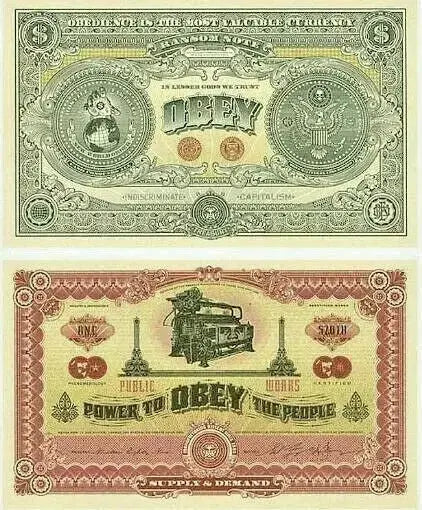
By the mid-1990s, the Andre image had legal exposure due to the wrestler’s estate. Fairey abstracted the face into a stylized icon and paired it with the word “Obey,” lifted from John Carpenter’s 1988 film “They Live.” The rebrand was partly defensive and partly conceptual. “Obey” as a command is self-undermining. The combination of a strange face and an authoritarian word invited the viewer to ask who was issuing the instruction, and why.
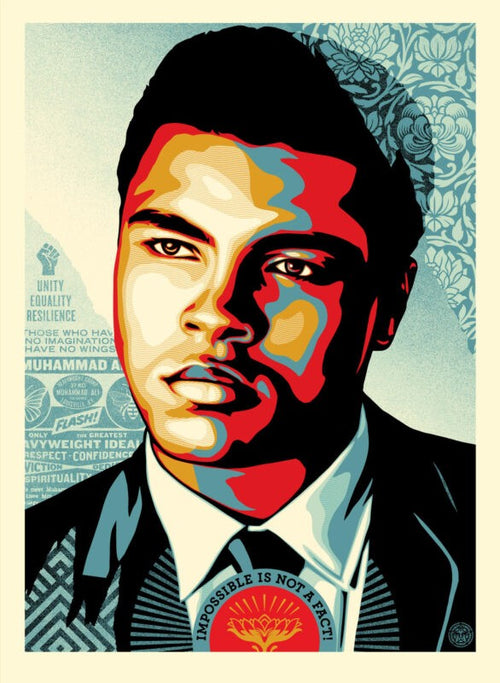
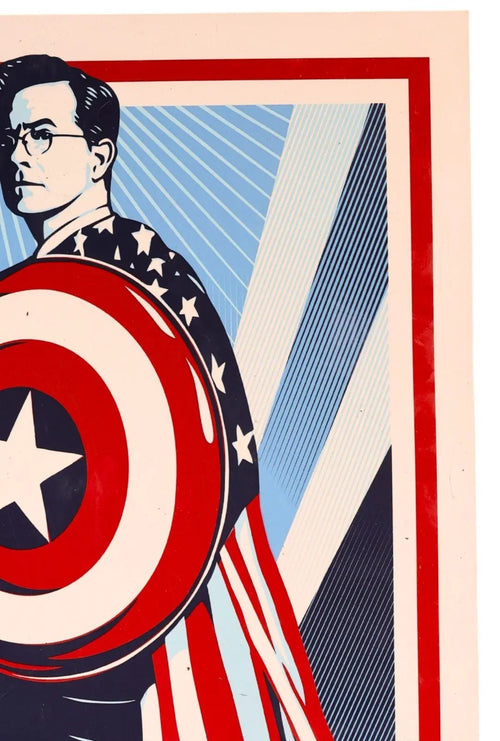
This is the period when Fairey’s visual grammar crystallized: heavy red, black, and cream palette; high-contrast stenciled portraits; ornamental Art Nouveau and Russian Constructivist references; and the Obey Giant face recurring as both signature and subject.
HOPE, 2008
In early 2008, Fairey produced a stenciled portrait of then-Senator Barack Obama, initially self-funded as a street poster. The image, paired with the words “Progress” and later “Hope,” spread faster than any American political poster in living memory. The original collage illustration was eventually acquired by the Smithsonian’s National Portrait Gallery in 2009.
For collectors, “HOPE” is a watershed. It is the moment Fairey’s work moved fully from street-art specialist territory into the canon of American graphic design. It also introduced a much wider audience to his editioned screenprints and led to a substantial expansion of the Obey Giant print release program.
The print program
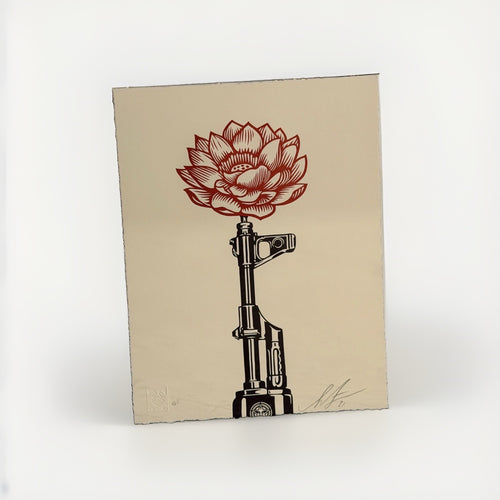
Fairey’s studio, Obey Giant Art, runs one of the most disciplined print-release programs in contemporary street art. Editions are typically released on a Tuesday at 10am Pacific through the Obey Giant website, often in editions of 400 to 550, sold at initial release prices between $45 and $85 for standard editions and higher for larger formats and HPM (hand-painted multiple) variants. Sell-outs frequently happen within minutes.
The secondary market tiering that has developed around this program is relatively stable:
- Standard signed and numbered screenprints trade at multiples of their release price, with condition and edition size as the primary variables
- HPM variants, which are hand-embellished and typically issued in much smaller editions of 25 to 100, command substantial premiums
- Large-format editions and collaborative releases tend to outperform over five-year horizons
- Early 2000s prints from smaller editions, particularly pre-HOPE works, are the scarcest segment of the market
Auction benchmarks
Fairey’s work trades publicly at Phillips, Christie’s, and Sotheby’s with some regularity, particularly in the Editions and Urban & Contemporary sales. Public results for signed and numbered screenprints consistently demonstrate a functioning market with transparent comps, which is one of the reasons Fairey has become a gateway artist for new collectors entering the street-art category.
Our curators generally recommend that collectors checking a Fairey comp reference at least three recent auction results from major houses before sizing a bid, rather than anchoring on a single data point.
What to collect now
For a collector building a Fairey position from a standing start, our curators typically suggest a barbell approach:
- One or two early-period works, pre-2008, in clean condition with intact COA. These are the hardest to find and the most informative about Fairey’s trajectory.
- A HOPE-era signed edition if the collector wants a cultural anchor. Supply is reasonable; condition varies widely.
- One or two recent HPM or large-format editions, purchased at release if possible. These are the clearest calls on Fairey’s future market.
The segments to be cautious about: posters and open editions misrepresented as signed editions, and the long tail of unauthorized “Obey-style” works produced by sellers trading on the visual language without any actual Obey Giant provenance.
Why it matters
Fairey is one of the few street-art figures whose career can be tracked almost frame-by-frame through public releases, institutional acquisitions, and auction results. For a new collector, that transparency is a gift. It makes his market one of the most learnable in contemporary art.