Direct answer
To sell an Invader print, kit or panel well, begin by creating an evidence packet for the exact object: actual-item photographs, accurate dimensions, release-specific identification, a condition report, provenance and the documents that will transfer to a buyer. Then choose a sales route that fits the work’s format, value, documentation quality, timing and your tolerance for fees, control and privacy. Do not market a work as authenticated, complete, unique, flawless or investment-grade unless the record supports the specific claim.
The best seller presentation is not the loudest. It is the one that makes a serious buyer’s work easier: it states what the object is, what is included, what condition issues exist, how you acquired it, which documents are available, and what remains unknown. That clarity helps buyers compare the work responsibly and protects you from making promises the object cannot support.
Table of contents
- The seller’s job: reduce ambiguity without overstating certainty
- Classify the exact work before you set a route or price
- Build an evidence packet buyers can trust
- Write a condition report that survives scrutiny
- Choose direct sale, dealer consignment, auction or another route
- Price research without false comparables
- Prepare listing language and buyer questions
- Pack, ship and document the handoff
- What to retain after a sale
- Related guides, FAQs and source notes
The seller’s job: reduce ambiguity without overstating certainty
Selling an Invader work is not only a pricing exercise. It is a transfer of information. The buyer will have to assess the release, physical object, condition, ownership history and sale terms. A seller who organizes that information carefully is not merely making a better listing; they are giving the buyer a usable basis for their own research.
That starts with an important boundary. You are responsible for accurately describing what you know and preserving the records you have. You are not required to transform a partial history into a perfect one. If you acquired a work years ago without a detailed invoice, say that. If a frame is a later addition, say that. If the packaging is present but a particular insert cannot be confirmed, say that. Ambiguity is manageable when it is disclosed; it becomes costly when it is concealed by words like “complete,” “museum quality,” or “official” used without release-specific support.
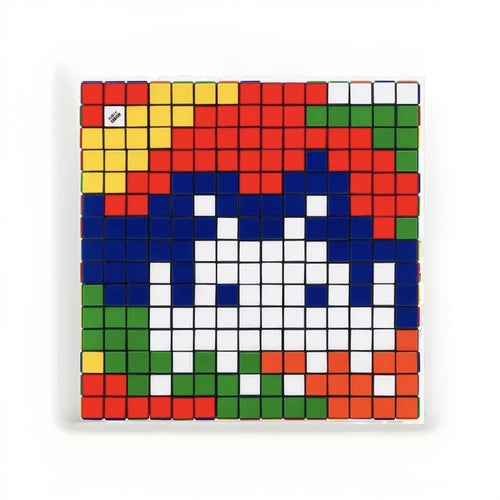
The work may be a print, a panel, an Invasion Kit, a cube-based work, a catalogue-related item or another format. Those are not interchangeable. A buyer needs to know which physical thing is offered and whether the supporting information belongs to it. Your preparation should make that distinction obvious before anyone asks.
For an overview of released Invader formats and how they fit together, review Every Official Invader Print, Panel & Rubikcubism Release: A Collector’s Archive. For a buyer-side view of evidence and risk, pair this guide with How to Spot a Fake Invader: The Ultimate Authentication Guide. This article addresses the seller’s role: how to make your offering precise, professional and less likely to create a dispute.
Classify the exact work before you choose a sale route
Before you photograph a work or ask for a consignment estimate, create a single-page identity record. It should be factual, not promotional.
- Exact title or description used in your acquisition record.
- Format: print, panel, cube-based work, kit, object, book or other release type.
- Date and edition information as shown on the work and in the documents you possess.
- Dimensions of the work itself, and separate dimensions of any frame, case or packaging.
- Materials and construction only to the level you can support.
- Visible signature, numbering, publisher information, labels, stamps, inventory stickers and inscriptions.
- Every item included with the sale: work, frame, box, portfolio, certificate, invoice copies, publication, installation hardware or other material.
- How and when you acquired it, plus the evidence you can provide.
- Known condition issues, display history, conservation, repairs or alterations.
Why start here? Because the proper sales route depends on the object’s actual format and record. A complete, well-documented kit might benefit from a presentation that lets a buyer examine every component. A fragile panel may need a specialist route that can manage condition review, crating and installation. A print with a clear edition record may be suited to a different set of buyers and fee structures. You cannot make that call if you have not identified the object accurately.
Separate the work from its presentation
Frames, mounts, shipping crates, display cases and later-added documentation may be valuable or useful. They are not automatically part of the original release. State their status clearly. A listing that says “framed” should explain whether the frame is included, whether it is original to the work, its condition, and whether its measurements differ from the artwork’s measurements.
The same applies to packaging. A box can be important to a kit’s presentation, but its existence alone does not establish contents or release configuration. For a component-level approach to multi-part editions, see The Complete Invader Invasion Kit Collector’s Guide.
Build an evidence packet buyers can trust
An evidence packet is not a glossy sales deck. It is a clean, dated set of records that allows a buyer, dealer or auction specialist to understand the exact work. Build it before you contact anyone about price.
Actual-item photographs
Use consistent, neutral lighting and photograph the exact work, not a reference image from a past listing or a social-media repost. Capture:
- Overall front view, straight on.
- Left, right, top and bottom edges where relevant.
- Rear or verso, including labels, hardware, backing and stamps.
- Closeups of signature, edition designation, number, publisher or other marks.
- Closeups of every condition issue under angled/raking light when appropriate.
- Frame, mount, packaging, portfolio or case separately from the work.
- Included paperwork front and back, with sensitive personal information redacted only where necessary.
- A contextual shot showing the offered components together.
Do not digitally repair images, hide chips with aggressive lighting, crop out a defect or use wide-angle distortion to make scale unclear. Basic color correction that makes a photo resemble the work under neutral light is one thing; changing the object is another. When in doubt, disclose the photograph’s limits rather than making it perform like a condition guarantee.
Acquisition and provenance records
Collect original invoice, gallery receipt, auction catalogue, lot description, payment confirmation, shipping records, correspondence, prior condition report, insurance schedule and photographs from the time of acquisition. Make copies for a prospective buyer or intermediary, but keep your originals until the sale terms specify transfer.
Documents are most useful when they identify the exact work by title, dimensions, date, edition information, image, seller or other distinguishing detail. A generic document is still worth preserving, but it should not be described as if it establishes more than it does.
Release context
Buyers may expect you to know which release the work belongs to. You do not need to write a catalog raisonné. You should, however, cite the release-specific material you used—such as artist-, publisher-, gallery- or established catalogue-based information—and distinguish it from your own description. This lets a buyer retrace the research instead of relying on a paragraph of unsupported certainty.
Write a condition report that survives scrutiny
Condition language should be as concrete as a shipping address. “Excellent” is an opinion. “One short abrasion at the lower-right outer border, visible in raking light; framed later; no conservation work known to the seller” tells a buyer what you observed and what you do not know.
| Area | What to inspect | Better seller wording |
|---|---|---|
| Print or paper surface | Scratches, creases, handling marks, stains, light exposure, foxing, moisture wave | “Three small handling marks in the lower margin; shown in closeups.” |
| Corners and edges | Dents, tears, wear, prior mounting, adhesive residue | “Upper-left corner has a 3 mm soft bend; not flattened.” |
| Panel or object | Chips, cracks, abrasions, unstable elements, altered support | “One minor surface chip on the left edge; no restoration was disclosed to me.” |
| Cube-based work | Loose or altered components, cracks, mismatched colors, backing or mount | “Rear mounting hardware is later-added; shown separately.” |
| Frame and packaging | Whether original, condition, purpose and inclusion | “Contemporary frame included as a convenience; it is not represented as original to the release.” |
| Documents | Exact documents transferred and any limitations | “Copy of acquisition invoice included; original retained until payment clears.” |
Describe restoration carefully
Do not say “no restoration” merely because you are unaware of one. A more accurate statement is “no restoration is known to the seller” or “no conservation documentation was supplied with the work.” If there has been conservation, replacement, repair, rebacking, reframing or structural work, describe it and provide the relevant record. Serious buyers are not necessarily deterred by a well-documented intervention. They are deterred by discovering it later.
Obtain a specialist condition report when appropriate
For a valuable, fragile, unusually complex or ambiguous work, an independent conservator or specialist can be worth the cost. That report should identify the scope of examination and should not be repurposed into a universal authenticity guarantee. The goal is a transparent condition record, not a marketing prop.
The forthcoming Invader Condition Report: Mosaic, Screenprint & Rubikcubism Checks Before You Buy gives buyers a comparable checklist. Using compatible language will help both sides discuss the object clearly.
Choose direct sale, dealer consignment, auction or another route
There is no universally best route. The right choice depends on the work, the evidence packet, your timeline, your need for privacy, your ability to answer buyer questions, fees and the risk you want to retain.
| Route | Often useful when | Strength | Trade-off to understand |
|---|---|---|---|
| Direct private sale | You know the buyer, the work is well documented and you can manage terms | More control over presentation and timing | You must handle screening, payment, shipping and dispute terms carefully |
| Specialist dealer or gallery consignment | The work needs contextual selling, condition explanation or access to qualified buyers | Professional presentation and buyer network | Commission, contract length, exclusivity and payment timing vary |
| Auction | There is a strong comparable record and a format that fits the house’s audience | Broad visibility and a structured sale process | Seller fees, buyer’s premium, reserve, timing and uncertain outcome matter |
| Marketplace platform | The object is suited to a platform’s audience and you can provide clear documentation | Reach and convenience | Quality control, fees, buyer behavior and platform policies vary |
| Private treaty through an adviser | Privacy, complex documentation or high-value negotiation matters | Tailored process | Adviser diligence, contract and fee terms need review |
Do not choose a route solely because another work achieved a high public price there. Compare the objects, season, buyer base, condition, documentation and sale terms. A public sale record can be useful, but it is not an automatic promise of result.
Questions to ask a prospective intermediary
Ask how they classify the work, which facts they need to verify, whether they will inspect it, how they describe condition, who pays for photography, shipping and insurance, whether a reserve is possible, what happens if the work does not sell, whether you are exclusive, when you are paid, and which documents they will pass to the buyer. Get answers in writing.
For market context, you can review Investing in Invader: Market Performance, Rarity, and the Best Releases, but treat all historical performance and price discussion as context, not a valuation or outcome guarantee for your individual work.
Price research without false comparables
Start with like-for-like records. A sale can be informative only if it aligns meaningfully with your work’s format, date, edition designation, dimensions, physical condition, documentation, presentation and terms. A large unique panel is not a comparable for a print merely because the image is related. A sealed kit is not necessarily comparable to an opened kit whose contents are fully documented. A price inclusive of buyer’s premium is not the same number as a seller’s net proceeds.
Build a table for every potential comparable:
| Date | Venue | Exact format | Condition/documentation | Price format | Difference from your work |
|---|---|---|---|---|---|
| [record] | [venue] | [work type] | [what the catalogue actually says] | Hammer / premium-inclusive / asking | [specific difference] |
The “difference” column is the important one. It prevents a list of numbers from becoming a story of inevitability. If you cannot explain why a comparable relates to your work, do not use it to justify an asking price.
Set a range or decision threshold rather than declaring an exact market value. Remember to include consignment commission, buyer’s premium structure, photography, appraisal, restoration, packing, shipping, insurance, taxes and payment timing. Those costs vary by venue and can change, so confirm current terms directly.
Prepare listing language and buyer questions
The opening of a strong listing or consignment summary should identify the object plainly. For example: “This offering is for [exact title or description], a [format] measuring [dimensions], acquired by the current owner from [source, if documented]. Included are [itemized materials]. The work is described below with actual-item photographs and condition notes.”
Then use sections titled Work, What is included, Condition, Documentation, Provenance, Shipping/collection, and Terms. That structure makes it harder for important information to disappear under promotional language.
Be ready to answer the buyer’s reasonable questions: Can you show the back? Is the frame included? What was the environment? Has the work been restored? Do all documents transfer? What does the invoice identify? Why is the work being sold? How will it be packed? Which terms govern a return or claim? Answer only what you can support, and follow up in writing so there is a shared record.
If you sell a different contemporary print format, the companion How to Sell a DEATH NYC Print: Photos, Condition Reports, Pricing & Safe Fulfillment shows how the same seller discipline travels across a collecting category. It is a workflow comparison, not a statement that the artists or markets are interchangeable.
Pack, ship and document the handoff
Professional packing is part of the representation you make to a buyer. Confirm who handles collection, crating, carrier choice, declared value, insurance, customs paperwork, delivery window, signature requirement and risk transfer. For a framed work, panel or cube-based object, determine whether specialist art logistics are appropriate. For paper, use materials that do not abrade, stain or shift under pressure.
Photograph the work immediately before packing, each layer of packing, the final sealed container and labels where privacy allows. Keep a packing list of every component. If the buyer receives a multi-part kit, make the same component ledger available to them. Do not create a situation in which a buyer cannot tell what was supposed to be included.
Once a sale completes, preserve the final description, condition report, buyer invoice, delivery confirmation, transfer documents and correspondence consistent with privacy and tax obligations. That record can matter if a question arises later, and it helps preserve the history of the object rather than severing it at resale.
Preserve the handoff record, not just the payment record
After funds clear and the work is delivered, make one final, dated copy of the sales packet as it actually stood at transfer. Include the exact listing or catalogue wording, the final condition report, photographs taken immediately before packing, the packing list, courier documentation, delivery confirmation and any agreed written acknowledgements. This is useful to both parties because it identifies which documents and components transferred, rather than leaving a future question to memory.
Do not treat this archive as a reason to retain another person’s sensitive information indefinitely. Store only what you need for the sale, follow any contractual or legal retention requirements that apply to you, and protect private addresses, payment information and correspondence. The point is a clear object history: what was sold, in what described condition, with which papers, on which terms. A careful handoff lets a future owner continue the research instead of starting from a blank page.
Related guides
- Every Official Invader Print, Panel & Rubikcubism Release: A Collector’s Archive — release context for the exact work you are offering.
- How to Spot a Fake Invader: The Ultimate Authentication Guide — buyer-side evidence discipline to anticipate during a sale.
- Investing in Invader: Market Performance, Rarity, and the Best Releases — market context, not a valuation guarantee.
- How to Sell a DEATH NYC Print: Photos, Condition Reports, Pricing & Safe Fulfillment — a parallel seller workflow for another print-driven market.
- Invader Condition Report: Mosaic, Screenprint & Rubikcubism Checks Before You Buy — the condition questions buyers will want answered.
FAQs
What should I include when selling an Invader print?
Include actual-item photographs, exact dimensions, release-specific identification where available, condition notes, all documents and packaging that transfer, and clear delivery and sale terms. Do not use stock images instead of the exact work.
Should I sell an Invader work through auction or consignment?
Choose based on the exact work, its documentation, condition, your timeline, privacy needs, fees, buyer audience and your desired level of control. Compare written terms before committing to either route.
How do I price an Invader Invasion Kit?
Use only comparable sales that genuinely match the release, configuration, condition, documentation and price format. Build a comparison table and note differences rather than relying on the highest visible price.
Do I need a certificate to sell an Invader work?
You should transfer all documentation you possess, but a certificate alone does not replace actual-item photographs, condition disclosure and a coherent ownership record. Describe the document precisely and avoid claiming it proves more than it identifies.
What if I do not know whether there was restoration?
Say what you know: for example, “no restoration is known to the seller” or “no conservation records were supplied.” Do not state that no restoration has ever occurred unless you have an appropriate basis.
Is a frame included in the sale?
Only if your terms say it is. State whether the frame is included, whether it is original to the release, its condition and its dimensions separately from the art.
Source notes and limitations
This guide is educational and does not appraise, authenticate, insure, conserve, transport, broker, sell or provide legal or tax advice for a particular object. Auction terms, platform policies, customs rules, insurance requirements, tax treatment, sale fees and market conditions are time-sensitive. Verify current terms with the relevant auction house, dealer, insurer, carrier, platform or qualified professional before acting.
No sale result, prior listing or broader market article guarantees a price, timing or buyer for a specific work. The strongest seller practice is transparent, work-specific documentation.