

Invader is anonymous, relentlessly prolific, and — by the estimate of the specialist dealers who track the market most closely — one of the most systematically counterfeited names in all of street art. Unlike Banksy, whose Pest Control office issues a single unambiguous certificate for every authenticated work, Invader's market runs on a patchwork of publishers, hand-signatures, edition numbers, ID cards and gallery paperwork. That fragmentation is precisely what forgers exploit — and precisely what a disciplined collector can turn back against them.
Browse the full catalogue: explore all 84 works in The Invader Index — every official print, panel, Rubikcubism work and sculpture, each with its own detail page.
This guide is written for collectors and investors who are about to spend real money — on a screenprint, a sculpture (an “Invasion Kit”), a Rubik panel, or a studio mosaic “Alias” — and who want a repeatable, evidence-based process for separating genuine work from the flood of copies. We draw on our documented catalogue of 84 official Invader editions (with verified fields for medium, edition size, publisher and retail price), on HENI's own published policies, and on public statements from specialist dealers and reputable market sources. Where the public record is thin, contested, or simply unavailable, we say so plainly rather than manufacturing false certainty. Nothing here is a substitute for expert examination of a specific object in hand.
Two honest caveats up front. First, this article describes what to look for in words and structured checklists. It does not reproduce proprietary side-by-side high-resolution comparison photographs, a certificate-scan library, a box-photo archive, or a signature-image library — those artefacts require original objects and, for anything of value, an expert's eyes. Treat the hero image on this page as illustrative only. Second, Invader is genuinely anonymous; we never claim to know his identity, and no authentication path in this guide runs through a confirmed personal identity. Use the checklists, then get a second opinion. With that established, let's build the process from the ground up.
Why Invader Is Counterfeited

Three structural features of the Invader market make it unusually attractive to counterfeiters. Understanding why the forgery problem exists is the fastest route to spotting it, because each structural weakness maps directly onto a specific check you can run.
First, demand vastly outstrips supply for the desirable works. Many of the most collected editions in our catalogue were produced in tiny numbers against enormous global demand. The scarcity is not marketing; it is arithmetic. Consider the smallest documented editions in our catalogue — the works where a single genuine impression is chasing a very long queue of would-be owners:
| Work | Year | Medium | Publisher | Edition size |
|---|---|---|---|---|
| 6 Cubes (Blue & Yellow) | 2010 | — | Shop At Lazarides | 20 |
| IK For MSF | 2017 | Sculpture | Over The Influence | 25 |
| Home (Lego White) | 2010 | Screen Print | Pictures On Walls | 25 |
| Hello My Game Is (Red) | 2009 | Screen Print | Space Shop | 25 |
| Aladdin Sane (Gold) | 2014 | Screen Print | Foil Block | Pictures On Walls | 30 |
| Pronto Intervento (Red) | 2010 | — | Space Shop | 30 |
| Mosaico E Muratura (Red) | 2010 | — | Space Shop | 30 |
| Space Vibes (Red) | 2009 | Screen Print | Shop At Lazarides | 30 |
| Invasion Kit #11 (Blue) (Signed) | 2009 | Sculpture | Space Shop | 30 |
| Space File (Red) | 2007 | Screen Print | Space Shop | 30 |
An edition of twenty or thirty impressions, a recognizable pixel-art brand, and a worldwide collector base is, from a forger's perspective, an ideal target: high unit value, instant name recognition, and far more buyers than legitimate objects. Scarcity is the engine of the entire counterfeiting problem, and it is why the rarest colourways attract the most sophisticated fakes.
Second, the aesthetic is deceptively simple to imitate. An 8-bit alien rendered in a handful of flat colours looks, to an untrained eye, like something anyone could screenprint or tile in an afternoon. That impression is a trap. The genuine article is defined far less by the image itself than by production quality, paper or ceramic stock, the character of a hand-applied pencil signature, the correctness of the edition numbering, and — above all — the paper trail. Those are exactly the attributes a casual buyer never inspects, and exactly where forgeries fall apart under scrutiny.
Third, and most damaging, there is no universal certificate authority. Invader “does not usually offer certificates of authenticity” in the way Banksy's Pest Control does, according to specialist dealers, so authentication has historically leaned on provenance, correct edition and signature details, and the reputation of the seller rather than on a single stamp. The most acute case is the invasion kits: the market-monitoring specialists at Invader-Kits estimate that since the summer of 2021, roughly two-thirds of kits offered by galleries or online platforms are fakes, and that even at auction more than one in two can be counterfeit. That is not hyperbole and it is not a typo. It is the single most important statistic in this guide, and it should recalibrate how you approach the kit category entirely.
Layer these three factors together — acute scarcity, a superficially simple look, and no central authenticator — and add a deliberately anonymous artist whose secondary market is spread across sneaker-style resale platforms, general auction houses, gallery back-rooms, Instagram direct messages and eBay, and you have close to a perfect environment for fraud. The encouraging news is that the same fragmentation that helps forgers also leaves them with predictable failure points. A genuine Invader work is internally consistent across many independent axes at once; a fake almost never nails all of them. Your job is to check enough axes that the inconsistencies surface.
Mosaic vs Print vs Panel: Know What You're Actually Buying
Before you can authenticate anything, you must correctly classify it, because the authentication chain is completely different for each format. Confusing the categories is, in itself, one of the most common ways buyers get burned — a fraudster's easiest sale is to a buyer who doesn't know which of five very different things they are looking at.
| Format | Primary authentication levers | Relative fraud risk |
|---|---|---|
| Street mosaic (for sale) | None legitimate — tracked in situ via FlashInvaders; not clean-title sellable | Extreme — assume problematic |
| Alias / studio mosaic | ID card, provenance to studio/gallery, expert exam | High |
| Invasion Kit / sculpture | Packaging, ID number, Space Shop invoice, Lefeuvre & Roze / artist-team authentication | Very high (~2/3 of market offerings estimated fake) |
| Rubik panel (physical cubes) | Provenance + expert exam (materials are commonplace) | High |
| Print (screenprint/giclée/litho) | Signature, hand-numbering, dimensions, publisher, transaction record | Moderate — most checkable category |
Working through those five formats in detail:
- Street mosaics. The ceramic-tile aliens Invader cements onto walls in cities worldwide are, by design, not for sale. Each is catalogued with an alphanumeric code (for example PA_154 in Paris) and recorded both in the artist's own FlashInvaders app and in the community Invasion Spotter database. A tile being offered for sale is a giant red flag: it is either a genuine work illegally pried off a wall — which cannot be sold with clean title and which the artist and community actively track — or, far more often, an outright fake. Reputable commentators are blunt that a mosaic on the open market should be assumed problematic until conclusively proven otherwise.
- Alias / studio mosaics. Distinct from the street pieces, Invader produces Alias mosaics — studio-made ceramic recreations, mounted on panel, of specific street works, each issued with an ID card recording the date and location of the original invasion. As market sources describe them, there is only one Alias per street piece; they are built to a higher, lasting quality than the public works; and they are the artist-sanctioned way to own the image of a public installation. Crucially, they are explicitly the copies, not the street originals — and they arrive with paperwork, which means the paperwork itself becomes the forger's target.
- Prints. Screenprints, giclées, lithographs and foil-block works make up the bulk of our 84-edition catalogue. These are hand-signed and hand-numbered, published by a named house, and constitute the most liquid, best-documented category. They are also where signature and edition-number analysis pays off most reliably, because there is a verifiable documented benchmark for each one.
- Sculptures / Invasion Kits. The boxed “Invasion Kit” multiples — from Invasion Kit #01 (2000) through the recent numbered releases in our catalogue — are three-dimensional objects, often ceramic tile mounted in a frame, carrying an identification number and, in some editions, a signature. This is the single highest-fraud category on the entire Invader market and demands the most conservative approach.
- Rubik panels. Framed Rubikcubism works and prints built from Rubik's-Cube grids form a distinct visual language with their own tells, covered in their own chapter below.
The publisher landscape maps onto these formats, and knowing which houses produced which kinds of work is itself an authentication tool — a claimed pairing of the wrong publisher with the wrong medium is a warning sign. Here is how our documented catalogue distributes across the sources that have published official Invader editions:
| Publisher / Source | Editions in our catalogue |
|---|---|
| Space Shop | 35 |
| Pictures On Walls | 10 |
| HENI Editions | 9 |
| Over The Influence | 4 |
| Lazarides Editions | 4 |
| Gallery Target | 4 |
| Galerie Itinerrance | 3 |
| HOCA (Hong Kong Contemporary Art) | 3 |
| Shop At Lazarides | 2 |
| MusArt | 1 |
| MGLC Ljubljana | 1 |
| Obey Clothing | 1 |
| Art Alliance | 1 |
| La Souris Deglinguee | 1 |
| Jonathan LeVine Gallery | 1 |
| Wooster Collective | 1 |
| State Of Play Zine | 1 |
| Mekanism Skateboards | 1 |
| Stolen Space | 1 |
And here is the same catalogue broken down by primary medium, which tells you where the volume of editioned work actually sits — and, by extension, where the deepest pool of verifiable comparables exists for you to check a signature or an edition size against:
| Medium (documented catalogue) | Editions in our catalogue |
|---|---|
| Screen Print | 39 |
| Sculpture | 18 |
| Unlisted | 14 |
| Giclee Print | 6 |
| Offset Lithograph | 3 |
| Lithograph | 2 |
| Ceramic | 1 |
| Skate Deck | 1 |
If a seller cannot tell you, precisely, which of these five formats they are selling and which named publisher produced it, stop there. Every remaining step in this guide assumes you have correctly classified the object and identified its documented publisher.
HENI Certificates: What Actually Ships — and What Doesn't
Since roughly 2023, HENI Editions has become a major publisher of official Invader and Invader-collaboration editions. In our catalogue that includes the Damien Hirst collaborations Invaded Blossom and InvadHirst, the Camo screenprints, and a run of Rubik-series giclées. Because HENI is now a primary channel for new work, understanding exactly how HENI authenticates is essential — and it contains a trap that catches inexperienced buyers.
HENI Editions do not ship with a paper Certificate of Authenticity. This is stated directly in HENI's own FAQ and customer-support material: “HENI Editions do not come with a Certificate of Authenticity.” Read that again, because it inverts a common assumption. If a seller offers you a HENI-published Invader edition and produces a glossy “Certificate of Authenticity” as the proof of legitimacy, that is a warning sign, not reassurance — because HENI does not issue one. Authentication is instead built into the object and the transaction record:
- Hand-signing. HENI states the works are hand-signed by the artists on the front. For collaborations such as InvadHirst that means signatures from both Invader and Damien Hirst. The signature is on the face of the work, not the reverse.
- Hand-numbering. Each work is hand-numbered, and — critically — the edition numbers for HENI Editions are randomly allocated and cannot be chosen. You cannot buy a “low number” from HENI. Anyone claiming to sell you a specially selected number as a HENI original is misrepresenting the process, and that misrepresentation is itself a useful tell.
- Demand-set edition size. For timed releases, HENI limits the edition to the number ordered during the purchase window — in HENI's own example, “if 1000 prints are ordered then the edition will be limited to 1000.” This is why HENI edition sizes are irregular, oddly specific numbers rather than round ones. A suspiciously tidy edition size on a supposedly HENI timed edition is worth a hard second look.
- Controlled dispatch. HENI ships through its own courier partners and does not facilitate personal collection or independent shipping arrangements. Your strongest documentary evidence for a HENI work is therefore the original HENI order confirmation, invoice and dispatch record tied to the edition number — not a certificate.
The irregular edition sizes are visible right across the HENI works in our catalogue, and they are worth internalising because they are hard for a forger to fake convincingly and easy for you to cross-check:
| HENI edition | Year | Medium | Edition size | Retail (MSRP) |
|---|---|---|---|---|
| Invaded Blossom (Timed Edition) | 2026 | Giclee Print | 592 | USD $3,000.00 |
| InvadHirst (Timed Edition) | 2025 | Screen Print | 1194 | USD $3,000.00 |
| Positive Space / Negative Space (Red / Cream) | 2025 | Screen Print | 250 | USD $1,000.00 |
| Camo S (3C-M1) | 2024 | Screen Print | 200 | USD $1,500.00 |
| Camo M (3C-M1) | 2024 | Screen Print | 100 | USD $2,500.00 |
| Invaded Cube (Timed Edition) | 2023 | Giclee Print | 459 | USD $3,000.00 |
| Rubik Camouflage (Timed Edition) | 2023 | Giclee Print | 812 | USD $3,000.00 |
| Rubik Country Life (Timed Edition) | 2023 | Giclee Print | 431 | USD $3,000.00 |
| Rubik Shot Red Marilyn (Timed Edition) | 2023 | Giclee Print | 774 | USD $3,000.00 |
Notice the numbers: 1,194; 592; 774; 812; 459; 431. These are the fingerprints of a demand-set timed edition, not the round 100s and 250s of a traditional fixed run. When you see a HENI-attributed work, the denominator of its edition fraction should match one of these documented, irregular figures for that exact work and colourway. A HENI InvadHirst marked x/1000 rather than x/1194 is either mis-described or fake.
The practical takeaway for the HENI era: the authentication chain is hand-signature + hand-number + HENI transaction record. Ask the seller for the original HENI invoice and confirm that the edition number printed on the paperwork matches the number written in pencil on the work itself. Treat any standalone “COA” for a HENI edition with active suspicion, because its very existence contradicts HENI's stated policy.
HENI is explicit that its editions do not come with a Certificate of Authenticity — authentication is the hand-signature, the randomly allocated hand-number, and the HENI purchase record. Never let a fabricated certificate substitute for the real paper trail.
Signature Guide: The Single Most Useful Tell

Invader is, by dealer consensus, diligent about signing and dating his editioned work, which makes the signature the most information-dense authentication feature on a print. The governing principle, articulated by specialist Celine Fraser in the buyer's-guide literature, is counterintuitive but vital, and worth committing to memory:
“If your piece's signature looks the same as another signature, then it was traced or copied. Real, handwritten signatures look similar to each other, but never identical — there should be small differences.”
In other words, the failure mode of a forger is consistency. A genuine hand signature varies stroke to stroke: the pressure, the terminal flick, the spacing between characters, the exact angle of the descenders. If you compare your piece against several authenticated examples and it matches one of them too perfectly — an overlay-identical signature that lines up character-for-character with a known example — you are almost certainly looking at a photomechanical copy or a trace, because no human hand reproduces itself that exactly. What you want to see instead is a signature that is recognizably in the same hand as verified examples but is not a perfect clone of any single one of them. Paradoxically, small imperfections are evidence for authenticity, and mechanical perfection is evidence against it.
Work through this structured signature checklist, ideally with the work in hand and under good light:
- Location. On editioned prints the signature and numbering are typically found along the lower margin, frequently at the lower-right, in pencil. On HENI works the signature is on the front face. Confirm the location matches documented examples for that specific edition; a signature in the “wrong” place for a known edition is a flag.
- Medium and physicality. Hand-signatures on prints are usually pencil. Graphite sits on the paper with a faint metallic sheen and a slight indentation you can feel and see under raking (angled) light, and it can smudge. A “signature” that is dead-flat, glossy, perfectly uniform in tone, or clearly part of the printed image — no indentation, no graphite sheen, no smudge — is printed, not signed.
- Natural variation. Compare against multiple verified signatures from reputable sources. Seek family resemblance with small differences. A perfect match to a known example is the signature of a copyist, not the artist.
- Collaboration signatures. For dual-artist works (Hirst, Fairey) confirm that both signatures are present and that each is independently consistent with that artist's known hand. A forger who nails one signature often botches the second.
- Date, where present. Invader frequently dates his work. A date inconsistent with the edition's documented release year is disqualifying on its own.
A signature analysis alone never proves authenticity — it can only raise or lower suspicion, and it must always be corroborated by numbering, dimensions and provenance. But a signature that plainly fails these checks — printed rather than pencilled, or an exact overlay of a known example — is frequently enough to justify walking away without going any further.
Edition Numbering: Reading the Fraction
The edition number — the fraction written as, for example, 42/100 — is a second independent data point, and it must reconcile with everything else you know about the work. The controlling rule is simple to state and unforgiving in practice: the denominator has to match the documented edition size for that exact work, colourway and publisher. Our catalogue exists precisely so that you can perform that check, and Invader's habit of reissuing the same image in multiple colours at different edition sizes makes it indispensable.
The common numbering pitfalls that expose fakes or misrepresentation:
- Denominator mismatch. If a work is documented at an edition of 50 but the sheet reads x/100, something is wrong — either the work is fake, or it is a different colourway or edition than represented. Because Invader frequently reissues one image across multiple colours at differing sizes, “which colourway” is not a cosmetic question; it determines both the correct denominator and the value.
- Impossible numerators. A numerator larger than the denominator (for example 120/100) is an immediate, unarguable fail.
- Proofs and special states. Artist's proofs, printer's proofs and “HC” (hors commerce) impressions exist outside the main run and are usually marked as such (AP, PP, HC) rather than with a numeric fraction. Our catalogue records several proof and “unsigned/signed” states — for instance the Rubik Kubrick works. Understand exactly which state you are buying; a mismarked proof indicates either ignorance or deception, and both are reasons for caution.
- HENI random allocation. As established above, HENI numbers are randomly allocated, so any HENI seller pitching a “chosen low number” premium is either confused about the process or lying about the object.
- Signed vs unsigned states. Some releases exist in both signed and unsigned states — our catalogue flags several Invasion Kits and Rubik prints this way. The presence or absence of a signature must match the state being sold. An “unsigned edition” that has acquired a signature later is a manufactured object, and a signature added to boost the price of an unsigned run is a form of forgery in its own right.
Numbering should also be cross-referenced against dimensions, because measurements are one of the hardest things for a forger to reproduce exactly. As one specialist put it, “I think dimensions are one of the most important aspects to check on any artwork. For example, if you know that a piece should be 30cm, but the measurements come back at 27cm, you know for a fact it's a fake.” Number, colourway, dimensions and publisher must all agree. Our documented sizes for each edition give you the four reference points needed to run that check, and a fake that survives one of them will usually fail another. Treat any single conflict among those four as a demand for a convincing explanation, and treat two conflicts as a walk-away.
Packaging: The Box Is Part of the Artwork
For sculptures, kits and some mosaics, the packaging is not incidental — it is evidence. Genuine Invasion Kits and studio pieces historically shipped with specific factory packaging, a unique identification number, and, for kits bought new, an original invoice from the artist's own retail channel, the “Space Shop.” Market-monitoring specialists are explicit that buyers should only purchase kits accompanied by supporting documents — an original Space Shop invoice, original factory packaging, and/or a certificate from a gallery that genuinely represents the artist. On a category where an estimated two-thirds of market offerings are fake, the absence of that documentation is not a minor inconvenience; it is a material escalation of risk.
What to examine, described in words — we are deliberately not publishing proprietary box photographs, because a genuine authentication of packaging requires the physical object, not a picture we could show you:
- Box construction and print quality. Genuine packaging is manufactured to a consistent, professional standard. Fuzzy or pixelated logos, off-register colour printing, incorrect fonts, thin card where thick stock is expected, and colour that is “close but not quite right” are all classic tells of a reproduced box. Forgers frequently reproduce the object more convincingly than the packaging, because the packaging is an afterthought to them and an obsession to the original maker.
- Matching identification number. The kit's ID number should be present and should reconcile with any accompanying paperwork. A box and a certificate that quote different numbers is a fatal internal contradiction — one of them is fabricated.
- Original invoice. A Space Shop invoice contemporaneous with the release is strong evidence. A missing invoice is not, by itself, proof of a fake, but on this category it materially raises risk and shifts the burden of proof onto the seller.
- Consistency across the whole ensemble. A real object plus a real box plus a real number plus a real invoice should tell one coherent, self-consistent story. Forgers usually manage to make one or two elements convincing and then get a third element wrong. Your task is to find the seam where the story stops matching itself.
Because the kits are the highest-fraud category on the market, do not treat attractive packaging as sufficient. Good packaging is necessary; it is never sufficient. The provenance and expert-authentication steps below still apply in full to any kit of value, no matter how convincing the box appears.
Rubik Panels and Rubikcubism Works
Invader's Rubikcubism — images rendered in the 3×3 grid logic of Rubik's Cubes — is a distinct body of work with its own authentication considerations. It spans both prints (for example Rubik Cubism, Rubik Space, the Rubik Kubrick series, and the recent HENI Rubik giclées such as Invaded Cube and Rubik Shot Red Marilyn) and physical panel constructions built from actual cubes. The two sub-formats authenticate quite differently, and conflating them is a common error.
- Distinguish print from panel. A Rubik print is a signed, numbered work on paper and authenticates like any other print — signature, numbering, dimensions, publisher, transaction record. A Rubik panel — a physical assembly of cubes in a frame — is a construction whose authentication leans far more heavily on provenance and hands-on expert examination, because the medium itself is trivially reproducible by anyone with a box of cubes and a frame. Never apply print-style confidence to a physical panel.
- Grid discipline. Genuine Rubikcubism obeys the strict constraint of the cube: each 3×3 face, the six standard Rubik's-Cube colours, no cheating the palette. Sloppy colour logic, non-standard palettes, or grids that ignore the cube constraint suggest a work made by someone imitating the surface look rather than working within Invader's self-imposed system. The constraint is the concept, and a fake that breaks it is betraying its own hand.
- Documented editions only. The HENI Rubik giclées carry the HENI authentication model in full — hand-signed, randomly hand-numbered, no COA, order record as provenance. The earlier Pictures On Walls and Space Shop Rubik prints carry that era's signatures and edition sizes, all recorded in our catalogue. Match the specific work to its documented publisher and edition size before anything else.
The honest caveat, which we will not soften: physical Rubik panels are among the harder Invader objects to authenticate remotely, precisely because their materials — mass-produced cubes and a frame — are commonplace and carry no inherent signature of the artist's hand. For anything material in value, insist on provenance tracing back to the artist's gallery or publisher, and get expert eyes on the physical object. A photograph of a cube panel proves almost nothing about who assembled it.
UV / Security Features: Manage Your Expectations

Buyers arriving from the sneaker or luxury-goods world often ask about holograms, UV taggants, NFC chips, QR verification or covert micro-serial features. Here we have to be scrupulously precise about what is verifiable and what is not, because false confidence in a “security feature” is itself a vector for fraud. Invader's editioned prints and the HENI releases authenticate through signature, numbering and transaction record — not through a published, universal covert-security-feature program of the kind some consumer brands operate. HENI itself points to hand-signing and hand-numbering, not a hologram, as the authentication mechanism, and explicitly does not issue a certificate.
Practical guidance, kept deliberately conservative:
- Do not rely on the presence of a hologram or “security sticker” as proof. There is no publicly documented universal Invader hologram standard that a collector can validate the way one validates, say, a hologrammed trading card. A convincing-looking security sticker can itself be manufactured as part of a forgery, and its presence should never override a failed signature or numbering check.
- Low-tech examination beats mythical high-tech features. Raking (angled) light reveals whether a signature is pencil-on-paper (indented, with graphite sheen) or printed (dead flat). A jeweller's loupe reveals the ink layering and paper fibre of a genuine screenprint versus the regular dot rosette of a photomechanical reproduction masquerading as one. These cheap, universally available techniques catch more fakes than any imagined covert marker.
- Newer objects may carry publisher-specific technology — verify at the source. If a specific modern release is described as carrying an NFC tag, a QR-based verification, or similar, confirm that claim directly against the publisher's own documentation for that exact release. Do not generalise one release's features to the whole catalogue, and do not accept a seller's assertion that “all of them have it.” They do not.
The mosaics are the one genuine exception where a real verification technology exists: the artist's own FlashInvaders application photographs a street mosaic and, using the phone's GPS position, confirms whether it is a registered, legitimate installation in that location. But understand exactly what that tool does and does not do. It authenticates street works in situ — it confirms that a specific alien on a specific wall is real and registered. It does not validate a loose object being sold to you, and, as established, a mosaic offered for sale is a red flag regardless of what any app says.
Provenance: The Chain That Actually Protects You
With no universal certificate authority, provenance is the backbone of Invader authentication. Provenance means a documented, unbroken chain of ownership tracing the object back to a legitimate original source — the artist's own retail channel, the publisher, or a gallery that genuinely represents the artist. It is the one form of evidence that a forger cannot manufacture out of nothing, because it involves independent third parties and contemporaneous records.
The names matter enormously, and knowing them is half the battle. Specialist market monitors identify a small set of galleries with a clean record and a genuine relationship to the artist. Per Invader-Kits' guidance, the sources described as never having sold counterfeits — alongside the artist's own channels — include the following:
| Source / Gallery | Role (per specialist market sources) |
|---|---|
| Space Shop | The artist's own retail channel; original invoices are strong provenance |
| HENI Editions | Primary publisher of recent official editions; order/dispatch records serve as provenance |
| Over The Influence (LA / Hong Kong) | Described as an official representative since 2016 |
| Galerie Lefeuvre & Roze (Paris) | Former official gallery; Franck Lefeuvre cited as the recognized authority issuing/authenticating invasion-kit certificates |
| Ange Basso (Paris) | Cited among clean-record galleries (unique pieces, occasional kits) |
| Class Art Biarritz | Cited among clean-record galleries (kits and serigraphs) |
The standout name for the highest-risk category is Franck Lefeuvre of Galerie Lefeuvre & Roze in Paris, described by market sources as the recognized expert who issues certificates of authenticity for invasion kits and who can authenticate existing kits on request. This gallery is cited as having served as an official representative for the artist during the earlier part of his career. If you are buying a kit of any material value, provenance or authentication touching this source is the gold standard that the market itself points to. Specialist sources also note that the artist's own team can authenticate directly by email, though they are reportedly overwhelmed with requests — so treat a promise of “official email authentication” as something to verify, not assume.
Run this provenance checklist on any work before you commit:
- Does the chain trace to Space Shop, HENI, or an officially representing gallery — supported by paperwork, not merely a verbal claim?
- For kits: is there a Lefeuvre & Roze certificate, authentication from the artist's team, or at minimum an original Space Shop invoice and original factory packaging?
- Do the invoice, the edition number, the packaging number and the object itself all reconcile to one single coherent history?
- Can the seller demonstrate continuity — a plausible account of how the work passed from the original buyer to them, ideally with documents at the hand-off points?
- Are you being rushed past any of these questions? Manufactured urgency is a scam tactic, never a legitimate reason to skip diligence.
A clean provenance chain does not just protect you against fakes; it protects your resale value and your title. A work you can trace to a legitimate source is worth more, and is far easier to sell on, than an identical-looking object with a murky history — which is another reason to treat provenance as non-negotiable rather than as paperwork to be waved through.
Common Scams: The Playbook Forgers Use
Fraud on the Invader market is not infinitely creative; it recycles a small set of reliable cons. Learn the playbook and most attempts become obvious:
- The fabricated certificate. A glossy “Certificate of Authenticity” presented as definitive proof — especially on a HENI edition, which does not come with one at all. Certificates are trivially printable; the only ones that carry weight are those tied to named authorities (for example Lefeuvre & Roze for kits), not generic templates with an official-looking seal.
- The pried-off mosaic. A street tile offered for sale, frequently wrapped in a romantic “rescued from a demolished wall” narrative. Genuine street works are tracked by the artist and the community and are not clean-title sellable; the overwhelming majority of “street mosaics for sale” are fakes, and even the genuine ones are ethically and legally fraught. The story is the bait.
- The wrong-colourway swap. Selling a common colourway at the price of the rare one, or presenting a number and denominator that actually belong to a different edition. Defeated by matching colourway plus edition size plus dimensions against the catalogue.
- The printed “signature.” A photomechanical reproduction with the signature printed into the image, sold as “hand-signed.” Defeated in seconds by raking light and a loupe.
- The added signature or upgraded proof. An unsigned edition that has acquired a signature later, or a plain impression relabelled as an AP or HC to command a premium. Defeated by knowing the documented states of the work before you look.
- The counterfeit kit with a real-looking box. The dominant fraud in the kit category, and the reason attractive packaging alone is never enough. Defeated only by provenance plus expert authentication.
- The “no time to inspect” rush. Pressure to pay immediately, off-platform, before you can run checks or obtain authentication. The urgency is the scam; a legitimate seller of a genuine work has no reason to fear your diligence.
Marketplace Risks

Where you buy changes your risk profile dramatically. The same fake sold in three different venues carries three completely different levels of recourse, authentication support, and buyer protection. Match your caution to the channel.
eBay and Open Marketplaces
eBay and comparable open marketplaces are, historically, where Invader fakes proliferate most freely. Buyer's-guide sources warn plainly that eBay has facilitated fake Invader works and scams, and recommend reputable auction houses or established brokers instead. The structural problem is that on an open marketplace you are trusting an individual seller with no independent authentication step interposed between their claim and your money — the platform is a listing venue, not an authenticator. If you buy in this environment at all, demand original invoices and full provenance, run every check in this guide, pay only through channels that carry genuine buyer protection, and treat “too good to be true” pricing as a warning rather than a bargain. The kit category on open marketplaces is especially dangerous given the two-thirds-fake estimate; a cheap “Invasion Kit” from an unknown seller should be assumed counterfeit until proven otherwise.
StockX and Resale-Verification Platforms
Platforms such as StockX add an authentication step, which is genuinely better than an unmediated private sale — but you must understand its limits rather than treating a verification tag as a guarantee. StockX states that it verifies art prints on attributes including material, finish, numbering/signature (where applicable), condition and any signs of damage; that it only accepts prints in “deadstock” condition with no apparent condition issues; and that it requires the original Certificate of Authenticity to be included if the print was originally sold with one. Two caveats apply specifically to Invader. First, many Invader and HENI editions do not ship with a COA in the first place, so “no COA” is not itself damning for those works — but it also means the platform is leaning on signature, number and condition checks rather than on a certificate, which places more weight on the very analyses described in this guide. Second, resale-verification platforms are not infallible: StockX has faced litigation over counterfeits and has walked back “100% authentic” language, and public reporting on large volumes of rejected counterfeit inventory underlines that verification meaningfully reduces, but does not eliminate, risk. Use the platform's buyer protection, but do not outsource your entire judgment to a tag on a package.
Galleries and Auction Houses
Officially representing galleries — the clean-record names identified above — are the lowest-risk channel, because provenance and authentication are effectively baked into the sale. But “gallery” and “auction house” are not magic words that dissolve risk. Specialist sources warn that even at auction a large share of kits have been counterfeit — more than one in two, by the Invader-Kits estimate — so a respected auction label does not, by itself, guarantee a genuine kit. Read the catalogue's condition and provenance notes with care, confirm precisely which edition, colourway and state is being offered, and for kits look for authentication tracing to Lefeuvre & Roze or the artist's team rather than a bare “provenance: private collection.” Buying from an officially representing gallery with documented provenance remains the safest path available, and for high-value objects it is worth paying the premium such a channel commands precisely because it prices in the diligence you would otherwise have to perform and insure yourself.
The Buying Checklist
Run this before you commit funds on any Invader work. Failing a single item is not automatically disqualifying, but failing several — or failing any single red-flag item — means stop and reassess. Print it, keep it beside you, and do not let a persuasive seller talk you past a failed check.
- Classify correctly. Is this a print, a kit/sculpture, an Alias/studio mosaic, a Rubik panel, or (danger) a street mosaic? A street mosaic offered for sale is a hard stop.
- Match the catalogue. Do the medium, publisher, colourway, edition size and dimensions all agree with the documented edition? A four-way mismatch is fatal; a single conflict demands a convincing explanation.
- Signature. Correct location; pencil/hand character under raking light rather than printed; recognizably the right hand with natural variation rather than an exact overlay of a known example; both signatures present and consistent on collaborations.
- Numbering. Denominator matches documented edition size; numerator no greater than the denominator; proof and AP states correctly marked; no “chosen low number” claims on HENI works.
- Certificate reality-check. For HENI editions, remember there is no COA — be suspicious of a fabricated one and ask for the HENI invoice instead. For kits, look for a certificate tied to a named authority (Lefeuvre & Roze) or the artist's team.
- Packaging (kits). Original factory packaging, a matching ID number, and ideally an original Space Shop invoice — all reconciling to one story.
- Provenance. A documented chain to Space Shop, HENI or an officially representing gallery; continuity of ownership; nothing rushed or hand-waved.
- Channel. Prefer officially representing galleries; use buyer protection on platforms; treat open marketplaces and any kit with maximum caution.
- Expert opinion. For anything of material value — especially kits, panels and mosaics — obtain independent expert authentication before paying. It is far cheaper than the loss it prevents.
Authentication Flowchart
Use this as an ordered decision sequence rather than an image. Work through it top to bottom and stop at the first “walk away.” Each step assumes the previous one passed.
- Is it a street mosaic being offered for sale? If yes → walk away (untracked/illegitimate or fake). If no → continue.
- Can the seller name the exact edition, publisher, colourway and state? If no → walk away until they can. If yes → continue.
- Do medium, publisher, colourway, edition size and dimensions all match the documented edition? If any conflict → demand an explanation; if unconvincing, walk away. If all match → continue.
- Does the signature pass? Right location; hand/pencil character under raking light; natural variation versus verified examples; both signatures present on collaborations. If it looks printed, or is an exact overlay of a known signature → walk away. If it passes → continue.
- Does the numbering pass? Denominator equals the documented edition size; numerator valid; proof states marked correctly; no “chosen number” claim on a HENI work. If not → walk away. If yes → continue.
- Is the certificate/paperwork situation correct for the type? HENI = no COA, expect a HENI order/invoice; kit = expect Lefeuvre & Roze or artist-team authentication plus a Space Shop invoice and factory packaging. A fabricated or mismatched certificate → walk away. Correct → continue.
- Does provenance trace to a legitimate source with continuity of ownership? If there is no clean chain → high risk; pause and verify before proceeding. If yes → continue.
- Is the channel appropriate and is buyer protection in place? Prefer representing galleries; use platform protection; exercise extreme caution on open marketplaces and on all kits. If not → reduce exposure or walk away. If yes → continue.
- For material value — have you obtained independent expert authentication? If no → get it before paying. If yes, and every step above passed → proceed with appropriate, evidence-based confidence.
A Note on Data, and Where the Record Is Thin
Intellectual honesty is part of authentication, so it is worth being explicit about the provenance of the claims in this guide. The edition sizes, media, publishers and retail prices referenced throughout come from our documented catalogue of 84 official Invader editions — a substantial, verified reference set, but explicitly not an exhaustive record of everything Invader has ever produced. Describe it as a documented catalogue of official editions, not the entire universe of the artist's output. The HENI authentication specifics — no COA, hand-signing, random hand-numbering, demand-set edition sizes, courier-only dispatch — come from HENI's own published FAQ and customer-support material. The counterfeit-prevalence estimates and the roster of clean-record galleries come from specialist market-monitoring sources focused on invasion kits, and are estimates rather than audited statistics.
Where the public record is genuinely thin, we have said so rather than inventing precision. There is no publicly documented universal Invader covert-security-feature program — no hologram or NFC standard — that a collector can validate across the whole catalogue. Physical Rubik panels and mosaics are hard to authenticate remotely because their materials are commonplace and carry no inherent trace of the artist's hand. And because Invader is anonymous, no authentication path runs through a confirmed personal identity; anyone claiming inside knowledge of “who Invader really is” as a basis for authentication is selling a story, not evidence. When a claim about a specific modern release's features cannot be verified against the publisher's own documentation, treat it as unconfirmed and weight it accordingly.
To go deeper, read our companion pillars. For the artist's biography and the history of Rubikcubism, see Who Is Invader? A Complete Guide. For the catalogue detail you will cross-reference constantly during authentication — editions, sizes, publishers and colourways — see Every Official Invader Print, Panel & Rubikcubism Release. And for how scarcity, condition and provenance translate into market value, see Investing in Invader: Market Performance & Rarity. Read together, the four pillars give you the who, the what, the how-to-verify and the what-it's-worth of collecting Invader with your eyes open.
Disclaimer
This article is educational and editorial in nature. It is not investment advice, and it is not an authentication service. Nothing here constitutes a representation or warranty about the authenticity, condition, provenance or value of any specific work. Authentication of any individual object requires expert examination of that object; always obtain independent professional authentication, and appropriate legal and financial advice, before purchasing. Third-party names, galleries and platforms are referenced for informational purposes only and are not endorsements. Figures and policies cited reflect sources available at the time of writing and may change without notice.
Shop Invader
Explore current pieces available from the gallery.
-

Space Invader x Rubik's Cube RubikCubiste MIMA 2022 Limited Edition Boxed
$185.00 USD
-
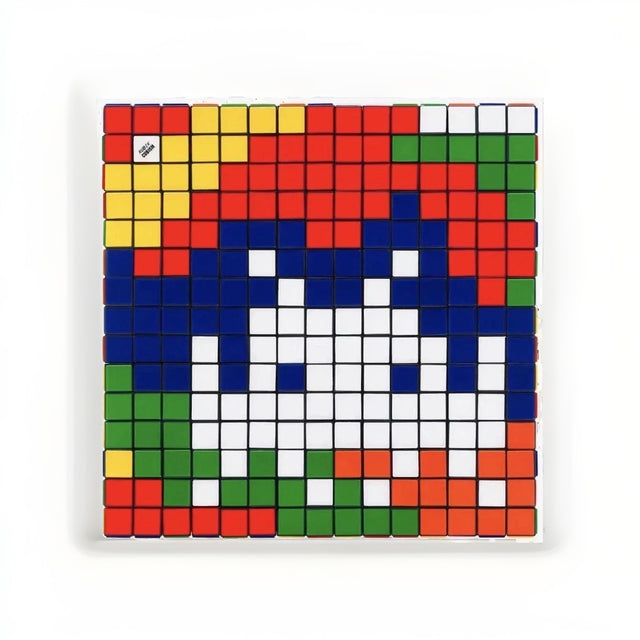
Invader Rubik Camouflage HENI Signed & Numbered 196/812 Giclee Panel 2023
$3,999.00 USD

Browse the collection for current listings.