To hold a Shepard Fairey work intelligently, you need the map of how he got here. His career divides cleanly into four stages — skate-punk origins, the birth of OBEY, the HOPE breakthrough, and the mature institutional artist — each with its own logic, its own risks, and its own implications for collectors. This is that map, drawn stage by stage.
Fairey is often reduced to a single red-and-blue campaign poster. But that image is a waypoint, not the whole road. The through-line of his practice is a continuous argument about images and power: that pictures are never neutral, that repetition manufactures belief, and that the most effective way to critique a system of images is to master its own techniques and aim them somewhere new. Each of the four stages is a different chapter of that single book, and each one changes what you are actually buying when you buy a print. Read the stages in order and the career stops being a scatter of famous images and becomes a coherent story with a beginning, a turn, a crisis, and a consolidation.
A Verified Timeline
Before walking the stages, it helps to fix the load-bearing dates in one place. Everything that follows hangs on this spine.
| Year | Milestone |
|---|---|
| 1970 | Frank Shepard Fairey born February 15 in Charleston, South Carolina. |
| 1984 | At fourteen, discovers the Sex Pistols; begins putting his own drawings onto skateboards and t-shirts. |
| 1988 | Enrolls at the Rhode Island School of Design (RISD). |
| 1989 | Creates the “ANDRE THE GIANT HAS A POSSE” sticker while working at a Providence skate shop. |
| 1992 | Graduates from RISD with a BFA in Illustration. |
| 1995 | Co-founds the gallery and project space Subliminal Projects. |
| ~1996 | Abstracts the Andre image and reduces the text to the single word OBEY amid a legal threat over the original imagery. |
| 2001 | Launches OBEY Clothing, formalizing the aesthetic as a commercial enterprise. |
| 2008 | Creates the Obama HOPE portrait from a 2006 Associated Press photograph by Mannie Garcia; the image becomes the unofficial visual identity of the campaign. |
| Jan 2009 | The Smithsonian’s National Portrait Gallery acquires Fairey’s hand-finished stenciled HOPE portrait, unveiled shortly before the inauguration. |
| 2009 | Supply & Demand, his first museum survey, opens at the Institute of Contemporary Art, Boston. |
| Jan 2011 | Fairey and the Associated Press settle their copyright dispute over the HOPE image out of court. |
| 2017 | Damaged, one of his largest solo exhibitions, opens in downtown Los Angeles. |
| 2009–present | Mature phase: monumental murals worldwide, activism, museum acquisitions, and continuous print editions. |
Stage One: Skate, Punk, and RISD (1970–1992)
Frank Shepard Fairey was born February 15, 1970, in Charleston, South Carolina. He came up through skateboard culture, and around 1984 — the same year the Sex Pistols rewired his brain — he began putting his own drawings onto skateboards and t-shirts. This is the germ of everything: a kid using the flat, reproducible surfaces of youth subculture — decks and shirts and stickers — as his first canvases. The choice of surface was not incidental. A skateboard deck and a screen-printed t-shirt are objects designed to be duplicated, carried into the street, and seen by strangers. Long before he had a theory, Fairey was already working in the medium that would define him: the cheap, mobile, endlessly reproducible image.
Punk supplied the method. Punk in the late 1970s was not primarily a musical genre; it was a distribution philosophy. Its central innovation was the collapse of the distance between the maker and the audience — the photocopied flyer, the safety-pinned zine, the hand-cut stencil, the seven-inch single pressed in a garage. Anyone could participate, and participation itself was the political act. A teenager absorbing that ethos learned, without quite naming it, that you did not need permission, a budget, or a gallery to put an image into the world. You needed a surface and the nerve to use it. That lesson never left him.
In 1988 he moved north to attend the Rhode Island School of Design, and in 1992 he graduated with a BFA in Illustration. The RISD years matter because they gave a self-taught street sensibility a formal education in design, illustration, and the history of images. Fairey emerged fluent in both registers — the outlaw grammar of punk flyers and skate graphics, and the disciplined vocabulary of professional illustration. That bilingualism is the technical foundation of his entire output. It is why his work can quote Soviet Constructivism, Art Nouveau ornament, and 1970s advertising in the same composition without looking like pastiche: he learned the formal history well enough to bend it, not merely borrow it.
Collector implications
There is very little collectible material from this earliest period in general circulation, which is part of why it functions more as origin myth than as a market category. The genuine skate-shop artifacts and student works are scarce, difficult to authenticate, and rarely surface with clean documentation. For the collector, Stage One is context rather than inventory: it is the explanation you carry with you, not a shelf you can fill. Understanding it does one practical thing — it tells you why the work that follows looks the way it does, and it inoculates you against overpaying for thinly documented “early” ephemera whose provenance cannot survive scrutiny. When origin material does appear, provenance is everything, precisely because the object’s value is almost entirely narrative. A student sketch or an early skate graphic is only as strong as the paper trail that ties it to Fairey’s hand; without that documentation, even a genuine piece is difficult to distinguish from the countless imitations his aesthetic later inspired. The lesson of Stage One, then, is a defensive one: know the story so well that you can tell when a seller does not.
Stage Two: Andre the Giant and the Birth of OBEY (1989–late 1990s)
In 1989, during a summer working at a Providence skate shop, Fairey created the sticker that would define the next decade. A photograph of the wrestler André the Giant caught his eye, and he turned it into a crude stencil captioned “ANDRE THE GIANT HAS A POSSE,” complete with the wrestler’s height and weight. It was intended as an inside joke among skaters. It became a phenomenon. The sticker spread through an experiment Fairey later theorized as “phenomenology” — the idea that an image, repeated relentlessly and stripped of obvious meaning, forces the viewer to notice their own environment and question it. A sticker that means nothing is, paradoxically, the purest possible test of the mechanism: if it spreads, then attention itself, not content, is the thing being manufactured.
Around 1996, facing a legal threat over the André imagery, Fairey abstracted the face and changed the text to the single imperative word OBEY — a shift he has described as moving the project toward something with a more Orwellian connotation. This was the crucial conceptual leap. The meaningless joke became a meta-commentary on obedience, advertising, and authority itself. Telling people to OBEY, in a culture already saturated with unspoken commands to buy, comply, and consume, is a joke that only lands if you understand that the artist is on the side of disobedience. The giant face and the barked command borrow the grammar of totalitarian propaganda and of aggressive advertising, and then turn that grammar against itself. It is the visual equivalent of a punk band adopting a threatening name to mock the very idea of threat.
Two institutions were built on that foundation. In 1995 Fairey co-founded the gallery and project space Subliminal Projects, established with collaborators as a venue to introduce skateboard culture and design to the art world — a base of operations that still runs as a Los Angeles gallery today. In 2001 the OBEY Clothing brand formalized the aesthetic into a commercial enterprise, extending the campaign’s imagery onto apparel and into retail. The tension baked into this stage — an anti-authoritarian artist building a brand around the word OBEY — has followed Fairey his entire career, and is, not incidentally, exactly the kind of contradiction his best work is about.
Collector implications
Early OBEY-era stickers, hand-screened prints, and stencils are foundational collector objects precisely because they document the moment a subculture prank became a language. This is the Rosetta Stone of his method: the place where you can watch him learn that the most effective way to critique a system of images is to master its own techniques and aim them somewhere new. For the collector, the practical logic here is scarcity crossed with historical density. The material is genuinely early, genuinely rare in good condition, and endlessly referenced by everything that follows, which is what gives it standing. It also carries elevated authentication risk: early street material was made to be pasted, peeled, and discarded, so surviving examples with documented provenance and honest condition are the ones worth pursuing. The counsel is the same as it is everywhere in the catalog — favor pieces whose chain of ownership you can actually trace, and be wary of anything “vintage” that arrives without a story.
Stage Three: HOPE and the 2008 Breakthrough
The third stage is the one everyone knows, and it happened almost by accident. In early 2008 Fairey created a portrait of Barack Obama, working from a 2006 Associated Press photograph by Mannie Garcia that he found through an image search. He designed the poster in roughly a day. Rendered in his stylized red, cream, and blue palette beneath the word HOPE (earlier versions read PROGRESS), it became the unofficial visual identity of the Obama campaign and one of the most recognizable political images in modern American history. It is the moment the method he had been refining since a skate shop in 1989 — seize attention, repeat the image until it feels inevitable, smuggle a message inside the aesthetic — collided with a national moment and detonated.
Two consequences flowed from HOPE, and both are essential. First, institutional legitimacy. In January 2009, before the inauguration, the Smithsonian’s National Portrait Gallery acquired Fairey’s hand-finished, mixed-media stenciled version of the image — a striking departure from the museum’s usual practice of acquiring presidential portraits near the end of a term. Overnight, the vandal was in the national collection, and the debate about whether street art belonged in a museum was effectively settled by the country’s portrait museum itself.
Second, legal reckoning. The Associated Press and Fairey entered a bruising copyright dispute over the use of Garcia’s photograph — a fight complicated by Fairey’s own mishandling of evidence about which reference image he had used — which was ultimately settled out of court in January 2011. Under the settlement the two sides agreed to share rights in the HOPE image going forward and to collaborate on future work, with Fairey agreeing not to use another AP photograph without a license. The HOPE saga is therefore inseparable from the fair-use and appropriation debates that define twenty-first-century image-making. It is why HOPE is less a poster than a historical event: an image that simultaneously entered the national collection and the case law.
Collector implications
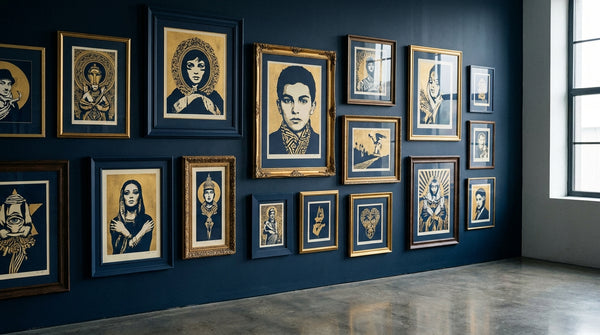
For collectors, authentic, artist-issued HOPE material — especially hand-finished and signed works — sits at the summit of the catalog precisely because of this documented cultural and legal weight. But HOPE is also the most reproduced, most imitated, and most counterfeited image in the entire body of work, which flips the collector’s task on its head. In earlier stages the challenge is scarcity; here the challenge is discrimination. A wall of the campaign’s official posters, licensed reproductions, unauthorized knockoffs, and genuine artist editions all show the same picture, and only a fraction of them are collectible as Fairey works. The discipline is to insist on the fundamentals — the artist’s pencil signature, the edition numbering, and a documented chain of ownership — rather than on the recognizability of the image, which in this case proves nothing at all.
Stage Four: The Mature Muralist, Activist, and Institutional Artist (2009–present)
The fourth stage is Fairey’s long consolidation as a serious fine artist, monumental muralist, and full-time activist. Freed from the question of whether street art belongs in a museum, he turned to scale and to cause. He has produced large-scale public murals in cities around the world, deepened his engagement with environmental and social-justice campaigns, and continued issuing the print editions that keep his ideas in circulation and accessible. His portraiture in this period widens to a pantheon of activists, musicians, and thinkers — carriers of an idea rather than mere celebrities — and his commissioned and gallery work grows in ambition and physical size.
This stage is defined by exhibitions that read as arguments, and by the steady accumulation of institutional validation. His first museum survey, Supply & Demand, opened at the Institute of Contemporary Art, Boston, in 2009 — a twenty-year retrospective mounted at the exact moment HOPE made him a household name. Nearly a decade later, Damaged (2017), one of his largest solo exhibitions, transformed an industrial building in downtown Los Angeles into a sprawling meditation on a world he saw as in crisis, taking its title from Black Flag’s 1981 debut album and keeping faith with the punk ethic he absorbed at fourteen. Between and around those poles, once-illegal murals hardened into civic landmarks, and his work entered the permanent collections of major museums.
What holds the stage together is the transformation of the outlaw into the institution without the loss of the outlaw’s argument. The same artist who once covered cities in stickers now works at the scale of a mid-career museum figure — and insists, in the work itself, that the two are continuous rather than contradictory. The murals are the stickers grown to the size of buildings; the museum surveys are the zine culture given a permanent home.
Collector implications
The collector implication is clear: the mature-period works, particularly those tied to major exhibitions and social campaigns, are the ones most likely to be historicized, because they represent Fairey operating with full command of his means and full awareness of his own legacy. This is also the most abundant stage — the print editions are numerous and ongoing — so the collector’s discrimination shifts from “can I find it?” to “which of these will still matter?” The reliable answer is the works that sit closest to the ideological spine of the career: pieces tied to a documented exhibition, a named cause, or a subject that carries the through-line of images and power. A signed, numbered edition connected to a museum show or a landmark campaign is a chapter; a decorative variant is a footnote. Both may bear the same signature, and only one is buying the story.
Reading the Stages as a Collector
Each stage carries a different collector logic, and the differences are the whole point. The earliest period is origin myth with almost no market — context you carry, not inventory you buy. The OBEY era is foundational language: scarce, historically dense, endlessly referenced, and worth pursuing only with provenance intact. HOPE is the summit, inseparable from a national moment and a landmark legal fight, and its very fame makes discrimination between genuine artist editions and mere reproductions the central task. The mature period is where legacy is being written in real time, abundant enough that the question becomes which works will endure rather than whether you can find one. A collection that understands these stages is not buying pretty prints; it is buying chapters of a coherent story, and it knows which risk attaches to which chapter.
A Note on Authentication
Across every stage, Shepard Fairey authentication rests on the fundamentals — the artist’s own pencil signature, the edition numbering, documented provenance, and condition — rather than any third-party certificate program. The discipline is old-fashioned and the same throughout the career: favor signed, numbered editions in strong condition; study the hand of the pencil signature and the fraction-style edition number (the individual print over the total edition); watch the soft cream Speckletone papers for light fading, foxing, handling creases, and the tape and adhesive damage that comes from careless framing; and prize a documented chain of ownership — an original release receipt, a reputable gallery invoice, or an exhibition history. None of this is exotic. It is the traditional connoisseurship of the print world, applied to an artist whose street-culture origins sometimes tempt buyers to skip it. Buy the work whose story — and whose stage — you can trace.
Explore available works in our Shepard Fairey collection and browse the full catalog reference in the Fairey Index.
Continue the series
- Shepard Fairey and the Beatles
- Shepard Fairey, Sid Vicious & the Sex Pistols
- The Duality of Humanity Series
- Shepard Fairey's Major Exhibitions
This is an editorial and educational piece intended to inform collectors about the art-historical context of Shepard Fairey’s work. It is not investment advice, and it makes no representation about the value or authenticity of any specific artwork.