Shepard Fairey is remembered for a single red-and-blue campaign portrait, but the moral center of his work was borrowed from a different icon entirely: John Lennon. If punk taught Fairey how to fight, the solo, activist Lennon taught him what to fight for — and the peace works are where the noise in his catalog finally reveals its purpose.
To understand why the Beatles — and specifically Lennon and Yoko Ono’s peace campaigns — matter so much to Fairey, you have to separate the band from the man he actually canonizes. Fairey is not, in any meaningful sense, a nostalgist for Beatlemania. He does not reach for the mop-top and the screaming stadiums. What draws him is the later Lennon: the Lennon of the bed-ins, of “Give Peace a Chance,” of the billboards that declared “WAR IS OVER (If You Want It).” That Lennon treated the mass media itself as an art material, and that is precisely the lineage Fairey claims for his own practice.
This piece walks that inheritance in full: the moment Lennon and Ono turned themselves into media-artists, the long peace-poster tradition their work sits inside, the specific photograph and political fight behind Fairey’s Lennon Peace and Liberty, the strange logic by which the aesthetics of propaganda get bent toward empathy, and finally the practical question of how a collector should read and buy the peace works. The through-line is simple. For Fairey, an image is never neutral, and Lennon is the proof that an image aimed at peace can be as forceful as any image aimed at power.
Lennon and Ono as Media-Artists
The first thing to understand about the peace works is that Fairey is not borrowing from a musician. He is borrowing from two of the most sophisticated media-artists of the twentieth century, who happened to arrive at that role through music and the avant-garde rather than through the gallery system.
Yoko Ono came out of Fluxus, the international network of conceptual artists for whom the idea, the instruction, and the event mattered more than the precious object. Her Grapefruit was a book of instructions. Her most famous performance asked an audience to cut away her clothing. When she and Lennon turned their honeymoon into a press event, they were not simply generating publicity; they were applying a conceptual-art logic to the largest possible canvas, the global news cycle. The bed became a readymade. The hotel room became a gallery. The reporters became both audience and medium.
Lennon, for his part, had spent a decade learning exactly how attention behaves at planetary scale. He knew, better than almost anyone alive, that a repeated phrase becomes an environment and that a photographed gesture becomes a symbol. Together the couple grasped a truth most protest movements missed entirely: a slogan repeated everywhere stops being an argument and starts being weather. You do not debate it. You simply live inside it. Their peace campaigns were conceptual art disguised as celebrity news, staged from the outset to be photographed, reprinted, and reproduced until the message was unavoidable.
That is Fairey’s understanding too, almost word for word. His entire sticker campaign was an experiment in repetition — the same image pasted relentlessly until ordinary people began to notice the images that surround them and question them. When he takes up Lennon as a subject, he is not only paying homage to a hero; he is claiming an ancestry. He is placing himself in a tradition of artists who use repetition, reproduction, and the machinery of publicity as their primary medium, and who bend that machinery toward peace rather than product. The peace works are, in this sense, Fairey naming his own family tree.
The Peace-Poster Lineage
To see how deliberately Fairey positions himself, it helps to place the Lennon works inside the longer history of the protest image, because that history is the tradition Fairey is consciously extending.
The bed-ins were the opening move. Lennon and Ono staged the first in the presidential suite of the Amsterdam Hilton over roughly a week beginning in late March 1969, then a second at the Queen Elizabeth Hotel in Montreal beginning in late May of that year. From the Montreal bed came “Give Peace a Chance,” recorded live in the hotel room in early June 1969 with a room full of guests — among them Timothy Leary, Allen Ginsberg, and Dick Gregory — singing along. A protest anthem manufactured inside a hotel room, released to the world as a single: that is the peace movement learning to use the recording studio and the press junket as instruments.
The billboards were the escalation. In mid-December 1969, Lennon and Ono launched the “WAR IS OVER! (If You Want It)” campaign across a dozen major cities — among them New York, Los Angeles, Toronto, London, Paris, Berlin, Rome, Athens, Amsterdam, Tokyo, Hong Kong, and Helsinki. The posters were stark: white ground, black lettering, and the small signature “Happy Christmas from John & Yoko.” No image, no ornament, no argument beyond the conditional clause that put the responsibility back on the reader. It was advertising’s own grammar — the billboard, the repeated slogan, the coordinated multi-city rollout — seized and pointed at war itself.
This is the lineage that matters for a Fairey collector, because Fairey’s method is the direct descendant of it. The peace symbol that anchors so much protest art was itself a designed mark, drawn in 1958 for the British nuclear-disarmament movement. The psychedelic peace posters of the later 1960s turned dissent into a saturated visual style. Lennon and Ono industrialized that impulse, running peace as a global advertising campaign. Fairey inherits all of it: the designed protest mark, the poster as weapon, the slogan as environment. When he renders Lennon in bold reds and creams beneath radiating lines, he is not illustrating a rock star. He is adding a panel to a mural that runs from the disarmament badge through the bed-ins and the billboards and into the present.
The Politics of Optimism
Where the Sex Pistols supplied Fairey with a snarl, Lennon supplied the sincerity. Fairey’s mature work is essentially an attempt to hold both in the same frame — revolutionary aesthetics wrapped around an explicit yearning for peace. Lennon and Ono’s late-1960s and 1970s activism is foundational to that strain of his output.
What makes the optimism serious rather than sentimental is that it is delivered with the full aggression of the propaganda form. Fairey does not soften his line or lighten his palette when the subject is peace. He uses the same bold, commanding graphic language he uses for everything else, and that consistency is the argument. Optimism, in his hands, is not a retreat from confrontation. It is a form of confrontation. To insist on peace in the visual key of a totalitarian poster is to claim that hope can be as forceful, as unavoidable, and as loud as fear.
This is why the peace works read as the counterweight rather than the exception in Fairey’s catalog. His work runs hot with propaganda aesthetics — the barked commands, the totalitarian borrowings, the deliberately unsettling iconography. Without the peace strain, all of that could collapse into pure provocation, a stylist enamored of power’s look. The Lennon material is the evidence of what the noise is ultimately for. It tells you where the sincerity comes from and keeps the whole body of work from reading as a clever pose.
Lennon Peace and Liberty (2023)
The clearest recent expression of this debt is Lennon Peace and Liberty, released in 2023 in two colorways, red and blue. The print is based on Bob Gruen’s celebrated photograph of John Lennon standing before the Statue of Liberty — an image that was itself a piece of political theater.
Gruen, who had become Lennon and Ono’s personal photographer after the couple settled in New York, proposed the shoot specifically to help dramatize Lennon’s fight to remain in the United States, at a time when the Nixon administration was making repeated attempts to deport him. His reasoning was pointed: if the Statue of Liberty stands for welcome, then a photograph of Lennon in front of it would put the government’s effort to expel him in the most damning possible frame. The two of them took the ferry out to the statue, and Lennon posed making the peace sign in a New York City t-shirt. The photograph became one of the most recognizable images ever made of him — a portrait of an immigrant peace advocate claiming the country that was trying to throw him out.
Fairey’s edition — eighteen by twenty-four inches on thick cream Speckletone paper — was released in an edition of 300, signed by both Fairey and Gruen, and priced at eighty-five dollars at release before selling out. A portion of proceeds benefited the ACLU and the Statue of Liberty–Ellis Island Foundation. Fairey has called Lennon “a hero of mine for his incredible music and activism,” and he singled out the disturbing irony of a government trying to deport a peace advocate against the backdrop of the very monument that symbolizes welcome.
It is worth sitting with why this particular source photograph is so well suited to Fairey’s method. Gruen’s image was already doing the work Fairey’s prints do — it was a real event staged to become a symbol, a piece of documentary photography built to function as an argument. Fairey does not have to impose meaning on it. He amplifies a meaning that was engineered into the picture from the start. The Statue of Liberty, Lennon, the peace sign, and the deportation fight collapse into a single icon about who belongs and who gets to speak. That density of meaning is precisely what separates a durable Fairey print from a merely attractive one.
The genius of Fairey’s peace work is that it never abandons the aggression of propaganda. It hijacks it. The same visual force that once sold obedience is redirected to sell empathy, and the tension between the medium and the message is where the work lives.
Propaganda Aesthetics in the Service of Empathy
The single most important idea for understanding Fairey’s peace works is this: he uses the visual grammar of coercion to argue for its opposite. Understand that inversion and the entire catalog snaps into focus.
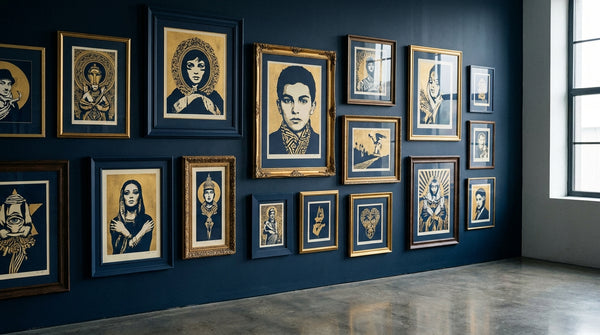
Every formal choice in a Fairey portrait is borrowed from a system built to manipulate. The frontal, monumental face comes from the political poster and the propaganda mural, forms designed to make a leader loom. The radiating lines behind the head are the sunburst of state iconography and the halo of religious painting, both used historically to signal that the figure before you is more than human and beyond question. The ornamental borders draw on Art Nouveau, on Soviet and constructivist design, and on the decorative frames of commercial advertising. The bold, flat, high-contrast palette is the palette of the command and the sales pitch. Each of these devices has an ancestry in the business of getting people to obey, buy, or worship.
Fairey takes that arsenal and aims it at empathy. When he wraps John Lennon in the sunburst and the ornamental border, he is deliberately treating a pacifist musician with the iconographic honors once reserved for dictators, kings, and saints. The halo does not merely decorate Lennon; it argues that a pop musician who preached peace deserves the visual reverence that history has lavished on the powerful. This is a quiet act of subversion. The tools of persuasion are not neutral, but they are not inherently evil either, and Fairey’s wager is that the same techniques that manufacture obedience can be turned to manufacture conscience.
The risk in this strategy is obvious, and Fairey has spent a career walking its edge — the same edge his own OBEY campaign made famous, where an anti-authoritarian artist barks the word OBEY at a culture already drowning in unspoken commands. A picture that looks like propaganda can be mistaken for propaganda. But that risk is also the point. The work asks the viewer to notice the machinery. It makes you feel the pull of the heroic image and then, ideally, ask why you are being pulled and toward what. In the peace works, the answer is unusually clean. You are being pulled toward Lennon, toward the peace sign, toward the proposition that optimism can be a form of resistance. The medium is the medium of control; the message is a plea for its opposite; and the friction between the two is where the art actually happens.
Where the Peace Works Sit in the Wider Catalog
The Lennon and Ono material does not stand alone. It occupies a specific and load-bearing position in a body of work organized, from the beginning, around the question of what images do to people.
Beyond Peace and Liberty, Fairey has produced portraits of John Lennon and Yoko Ono together, extending the peace theme into the image of the couple as a joint political project rather than a celebrity pairing. These works treat Lennon and Ono the way Fairey treats all his heroes — as carriers of an idea rather than as faces to admire. Ono in particular is worth restoring to the center of the story, because the reflex to read these works as “the Lennon prints” flattens a genuine artistic partnership; the conceptual audacity of the bed-ins and the billboards was as much hers as his, and Fairey’s double portraits register that.
Around the peace works sit the other threads of the catalog, and the peace strain is what holds them in balance. The punk portraits — Sid Vicious, Joe Strummer of the Clash — carry the origin energy, the discovery that a charismatic face can be stripped to a graphic and worn as allegiance. The Duality of Humanity series, built with combat photography, forces war and peace into a single frame and refuses to pick the easy side. The political breakthroughs, above all the 2008 Obama HOPE image, are where the underground method became nationally consequential and landed Fairey’s work in institutions from the Smithsonian to the Museum of Modern Art. The peace works are the connective tissue running through all of it. Punk supplies the aggression; Lennon supplies the aim; and everything Fairey makes lives in the space between those two forces.
This is why a Lennon or Lennon-and-Ono print functions, in a serious collection, as more than a handsome object. It is the piece that explains the others. It documents an artist naming his own ancestors, and it makes legible the sincerity that keeps the harder-edged, propaganda-styled work from curdling into mere provocation. Read the catalog without the peace works and you get a stylist fascinated by power. Read it with them and you get an argument.
Why the Peace Works Anchor a Collection
The collector should read the Lennon material as the moral counterweight in Fairey’s catalog, and that role has consequences for how the works behave over long stretches of time.
There is a durability of meaning here that is easy to underrate. A poster tied to a specific news cycle ages the moment that cycle passes; its urgency is on loan from the headlines. A Lennon peace print is tied to something that does not expire. The proposition it makes — that images repeated and reproduced can shift the moral weather, that optimism can be a form of resistance — is a permanent human aspiration, not a seasonal one. Works that keep saying something true after their news cycle has passed are the works that keep their place in the story of the art, and the peace series sits squarely in that category.
There is a market logic that follows from this, though it should never be the first consideration and never the reason to buy. The works that sit closest to Fairey’s ideological spine — the punk portraits, the peace series, the Duality of Humanity works, the political breakthroughs — are the ones that tend to hold cultural gravity, because meaning and market reinforce each other there rather than compete. That is a statement about where the enduring interest tends to concentrate, not a promise about any particular price or return. The right posture is to buy the argument first and let whatever durability follows be a consequence, not a motive.
Collecting the Peace Works
Because Shepard Fairey authentication rests entirely on the fundamentals — the artist’s own pencil signature, the edition numbering, documented provenance, and condition, rather than any third-party certificate program — the discipline for the peace works is the same old-fashioned connoisseurship that governs the rest of the catalog. There is no external certificate to lean on and no manufacturer’s authority to appeal to, so the physical object itself carries the burden of proof, and a few habits protect the serious buyer.
The signature and edition number. Fairey signs and numbers his print editions in pencil, typically in the lower margin. A confident, consistent pencil signature paired with a fraction-style edition number — the individual impression over the total edition — is the baseline. Study many genuine examples of his hand before committing to any single piece, so that the signature you are looking at reads as familiar rather than merely plausible.
Condition. These prints live on soft cream Speckletone and similar fine-art papers, which are vulnerable to the ordinary enemies of works on paper. Watch for light fading and shifted color, for foxing and toning, for handling creases, and for the tape and adhesive damage that careless framing leaves behind. Prize clean margins, strong and even color saturation, and the absence of restoration. A print in honest, unrestored condition will always tell its story more clearly than a compromised one, however attractive from across a room.
Provenance. Seek a documented chain of ownership — an original release receipt, a reputable gallery invoice, an exhibition history — that lets a future buyer trace the object back toward its source. For a release like Lennon Peace and Liberty, with its dual signature and its charitable release, a clean paper trail is both easier to build and more valuable to preserve. None of this is exotic. It is simply the traditional discipline of the print world, applied to an artist whose street-culture origins sometimes tempt buyers to skip it. The buyers who do not skip it are the ones who build collections that hold together.
Above all, understand what a peace print is arguing before you understand what it costs. With Lennon, the argument is unusually legible: that optimism can be a form of resistance, and that an image, repeated and reproduced, can shift the moral weather. That is the message Fairey inherited from the bed-ins and the billboards, and the peace works are where he pays it forward. Ask what a work is arguing, why it was made, for whom, and against what. The answers will not tell you what to pay. They will tell you what you are actually buying, which, with an artist like this one, is the only question that matters in the long run.
Explore available works in our Shepard Fairey collection and browse the full catalog reference in the Fairey Index.
Continue the series
- Shepard Fairey, Sid Vicious & the Sex Pistols
- The Duality of Humanity Series
- The Four Stages of Shepard Fairey's Career
- Shepard Fairey's Major Exhibitions
This is an editorial and educational piece intended to inform collectors about the art-historical context of Shepard Fairey’s work. It is not investment advice, and it makes no representation about the value or authenticity of any specific artwork.