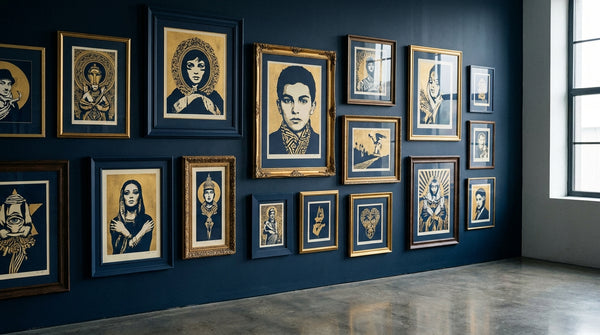
Across nine prior installments we have taken the Shepard Fairey print market apart—catalog structure, edition economics, blue-chip valuations, sub-$300 entry points, price histories, vintage-versus-contemporary returns, liquidity, comp reading, and the signed & numbered premium. This capstone puts it back together. The question is no longer what is one print worth but how do you own a set of them on purpose. The answer is a tiered portfolio: a blue-chip anchor for durability, a liquid mid-tier for tradability, and an accessible entry layer for diversification—each holding chosen against real comps, sized by allocation logic, and held to an exit plan you set before you buy.
From Single Prints to a Portfolio

Most Fairey buyers accumulate. They see a print they like, they buy it, and over a few years they own a pile of paper with no design behind it. A portfolio is different: it is a deliberately structured set of holdings, each with a defined role, a target weight, and an exit condition. The difference between the two is the difference between collecting and investing—and for a market this deep, the investing frame is available to anyone willing to be disciplined.
The depth is real. Our reference index catalogs 1004 distinct Fairey works spanning 1996–2023, of which 595 carry enough sales signal to price. For this series we isolated 79 prints with clean, de-duplicated comp histories—3509 individual tracked sales in total. That is the raw material. A portfolio is what you build from it.
Every number in this article comes from that clean comp set. Medians are trimmed to remove outliers, comps are drawn from a rolling 2016–2026 window, and the working floor for any signed & numbered Fairey print is $90—a figure we treat not as a price target but as a risk anchor, the level below which a genuine signed edition rarely trades and beyond which downside is structurally limited. Sources are WorthPoint, eBay, LiveAuctioneers, and Heritage.
A portfolio is not a bigger pile. It is a smaller number of deliberate decisions, each one sized and each one exit-planned.
There is a second reason the portfolio frame matters here specifically, and it is worth sitting with. A single Fairey print is a lumpy, indivisible, illiquid asset. You cannot sell a third of a Peace Goddess to raise cash; you sell the whole thing or none of it, and you sell it into whatever bid happens to exist the week you need liquidity. That lumpiness is precisely the problem a portfolio solves. When you hold ten prints across three tiers, you are no longer at the mercy of any one print’s trading window. You can raise cash from the liquid mid-tier while leaving the anchors untouched, or trim a hot position without dismantling the whole book. Diversification here is not just risk reduction—it is the mechanism that converts a set of illiquid objects into something you can actually manage.
It also changes how you think about mistakes. Buy one print at the wrong moment and a single bad entry defines your entire result. Buy ten prints on a disciplined framework and any one misfire is a rounding error against the book. The structure forgives individual errors in a way that a concentrated single-name bet never will. For an asset class as noisy as secondary-market prints—where the same image can clear at $100 one month and multiples of that the next—that forgiveness is the difference between an investable approach and a gamble.
The Three-Tier Framework
We organize the Fairey market into three tiers by price band and, more importantly, by the role each holding plays. Price is the visible axis; role is the useful one. An anchor is not simply an expensive print—it is a print whose demand base is broad and durable enough to hold value when the rest of the portfolio wobbles. An entry-tier print is not simply a cheap print—it is a diversifier whose small ticket lets you spread across themes and eras without concentrating risk.
Table 1 — Tier Definitions
| Tier | Price Band (median) | Role in Portfolio | Example Prints (median) |
|---|---|---|---|
| Blue-Chip Anchor | ~$650 and up | Durability and store of value. Broad, cross-collector demand; slowest to fall, first to recover. Sets the portfolio’s floor. | OBEY Elephant ($999), Peace Goddess ($700), THESE SUNSETS ARE TO DIE FOR large format ($650) |
| Liquid Mid-Tier | ~$300–$550 | Tradability and turnover. High sale counts mean tight exit windows. This is where you actively rotate and realize gains. | A Champion of Justice ($460), Dalai Lama Compassion ($399.99), Poster For George ($344.50) |
| Accessible Entry | Sub-$250, above the $90 floor | Diversification and optionality. Small tickets spread across themes and eras; individually modest, collectively they broaden the base. | Kurt Cobain ($200), Power and Glory Letterpress ($179.99), AK-47 Lotus ($131.94) |
Read the tiers as functions, not price tags. The anchor tier is where you park conviction capital in names with the deepest, most durable demand—the OBEY Elephant, with a $999 median and a recent-sale average of $1,542 across its most recent prints, is the archetype. Peace Goddess, at a $700 median off 31 tracked sales, is the second anchor: a 2006 edition of 300 that has proven it can trade in the four figures. These are the holdings you buy to keep.
The mid-tier is where the portfolio actually works as a market instrument. A Champion of Justice—the Ruth Bader Ginsburg tribute, a 2021 edition of 500—has logged 227 clean tracked sales, the deepest sale count in our entire comp set. That volume is the whole point of the tier: when you can find 227 comparable transactions, you can enter near the $460 median with confidence and exit into a live bid whenever you choose. The mid-tier is liquid by construction.
The entry tier is your diversification engine. AK-47 Lotus, a tiny 2022 edition of 100, sits at a $131.94 median—above the $90 floor but well inside reach. It will never anchor a portfolio, and it is not supposed to. Its job is to add a different theme, a different year, and a different edition-size profile at a ticket small enough that you can own several without concentrating. That is what diversification costs here: not much.
The tier boundaries are deliberately fuzzy, and that is a feature. A print does not carry a membership card; it earns its tier by behavior. Dalai Lama Compassion, at a $399.99 median, sits at the top of the mid-tier by price but trades with mid-tier depth—118 clean sales—which is why we file it there rather than reaching for the anchor label. Snoop D-O Double G, at a $153.75 median, is priced like an entry name but carries 112 tracked sales, giving it more liquidity than its price band would suggest. When you evaluate a candidate for your own book, ask the two questions in order: what does it cost, and how does it trade? Price sorts it into a band; trading behavior confirms the role. A print that is cheap but thin belongs in the entry tier for diversification, not for liquidity—and a print that is cheap but deep, like Snoop, can quietly do mid-tier work.
Allocation Logic: How Much of Each

Tiers tell you what to own. Allocation tells you how much. The instinct for a new buyer is to put the most money into the cheapest prints because they can own more of them. That is backwards. Weight should follow durability and demand depth, which means the anchor tier carries the largest share, the mid-tier the next, and the entry tier the smallest—even though the entry tier holds the most individual pieces.
A workable default for a Fairey portfolio is roughly 45% anchor / 40% mid-tier / 15% entry by dollar value. The anchor share is where your capital is safest and your downside most limited. The mid-tier share is your working capital—money you expect to rotate. The entry share is deliberately small because these prints, individually, carry the most price noise; you want breadth there, not weight.
Two adjustments to that default. First, skew younger and lighter if you are early in a build—start with more mid-tier and entry names to learn how the comps behave before committing anchor capital. Second, skew heavier to anchors as the portfolio matures and you have conviction; the anchor tier is where compounding durability lives. The framework is a starting weight, not a straitjacket.
Weight by durability, not by unit count. The tier with the most prints should hold the least money.
Why 45/40/15 rather than an even split or a barbell? The logic is about where risk lives and where it pays to concentrate. In this market the anchor names carry the broadest demand and the hardest floor, so overweighting them lowers the portfolio’s aggregate downside—your biggest dollar exposures are also your most defensible. The mid-tier earns nearly as much weight because it is the only place the book can be actively managed; a portfolio you cannot trade is just a museum. The entry tier is capped low on purpose: its prints carry the widest price dispersion relative to their value, so a heavy entry-tier weight would import noise without importing durability. You want the entry tier for its breadth, not its ballast.
Contrast that with the two allocations a disciplined buyer should avoid. The first is the flat book—equal dollars in every print—which sounds neutral but quietly overweights your least durable, noisiest positions and underweights your anchors. The second is the trophy book—one or two expensive anchors and nothing else—which looks impressive and cannot be managed at all, because every position is a hold-or-liquidate-entirely decision with no liquid layer to trade around. The 45/40/15 shape threads between them: enough anchor weight for durability, enough mid-tier for maneuverability, enough entry breadth for diversification. It is a default to start from and adjust, not a law.
Diversification: Three Axes That Actually Matter
Owning ten prints is not diversification if all ten are 2021–2022 protest editions of similar size. Real diversification in a single-artist portfolio runs along three axes—era, theme, and edition size—and the clean comps let us spread across all three deliberately.
Era: Vintage vs. Contemporary
The catalog skews modern. Our five-year release cohorts show 140 works dated to the 2015 band and 146 to the 2020 band, versus just 19 in the 2000 band and 61 in the 2005 band. A portfolio built only from recent releases inherits that concentration. Balancing it means pairing contemporary editions—A Champion of Justice (2021), Dalai Lama Compassion (2022)—with genuinely older paper. Peace Goddess (2006) and Make Art Not War (2004) are the vintage counterweights: prints with a longer trading record and a demand base that predates the recent flood of editions.
Theme
Fairey’s output clusters into recognizable veins: the OBEY iconography, political and protest work, music tributes, and the decorative floral-and-pattern pieces. Thematic concentration is a hidden risk—if music-tribute demand cools, a portfolio stuffed with Kurt Cobain, Snoop D-O Double G, and Strummer prints all soften together. Spreading across veins hedges that. The model portfolio below deliberately mixes OBEY iconography (OBEY Elephant), political work (A Champion of Justice, Make Art Not War), a spiritual/political piece (Dalai Lama Compassion), and music (Kurt Cobain, Snoop D-O Double G) so no single theme dominates.
Theme diversification is really a bet about correlation. Prints within a vein tend to move together—the same collectors chase them, the same news drives them, the same fatigue cools them. The RBG tribute A Champion of Justice and the Dalai Lama Compassion print both belong to the political/values vein, and both drew heavy release-era demand; that shared driver means they will not fully hedge each other. Pair them instead with the OBEY iconography, which trades on Fairey’s core brand rather than any single cause, and with music tributes, which follow the cultural moment of their subject. The goal is not to own the most prints; it is to own prints whose demand drivers are genuinely different, so that a soft patch in one vein does not drag the whole book down at once.
Edition Size
Edition size is the third axis, and the brief lets us span it cleanly. Catalog editions run from as tight as 40 to as wide as 2100. Scarcity is not a guaranteed premium—we covered that in the edition-size installment—but blending sizes hedges the risk that either the scarce-and-illiquid end or the wide-and-common end underperforms. The model portfolio spans from AK-47 Lotus at an edition of 100 to Kurt Cobain at 650, with anchors and mid-tier names filling the middle.
Table 2 — Diversification Snapshot of the Model Holdings
| Year | Edition | Theme Vein | Median | |
|---|---|---|---|---|
| OBEY Elephant | — | — | OBEY iconography | $999 |
| Peace Goddess | 2006 | 300 | Decorative / floral | $700 |
| A CHAMPION OF JUSTICE (Ruth Bader Ginsburg) | 2021 | 500 | Political tribute | $460 |
| DALAI LAMA COMPASSION | 2022 | 500 | Spiritual / political | $399.99 |
| Poster For George / Red Version | 2014 | 400 | Political / cause | $344.50 |
| MAKE ART NOT WAR | 2004 | 300 | Political / anti-war | $247.09 |
| Kurt Cobain – Endless Nameless | 2021 | 650 | Music tribute | $200 |
| Power and Glory Letterpress | 2016 | 450 | OBEY / patriotic | $179.99 |
| Snoop D-O Double G | 2020 | 550 | Music tribute | $153.75 |
| AK-47 Lotus | 2022 | 100 | Political / floral | $131.94 |
Read down the year and edition columns: the holdings span 2004 to 2022 and editions of 100 to 650, across five distinct theme veins. That is what deliberate diversification looks like on paper—no single year, size, or subject carrying the portfolio.
Liquidity Is the Exit Plan
The single most under-appreciated variable in art investing is liquidity: not what a print is worth, but how quickly you can turn it into cash at a fair price. A print with a high paper value and no bids is worth exactly what someone will pay today, which may be far below its median. In a portfolio, liquidity is not a nice-to-have—it is the exit plan.
Sale count is our liquidity proxy. A print with 227 clean tracked sales (A Champion of Justice) or 167 (Kurt Cobain) or 177 (Power and Glory Letterpress) has a demonstrable, repeatable market—you can sell into it on your timetable. A print with a single tracked sale has a price but not a market; you may wait months for the right buyer. That distinction should drive which tier you lean on when you need to raise cash.
Table 3 — Liquidity Leaders in the Model Portfolio
| Tracked Sales (n) | Median | Recent Avg | Role in Exit | |
|---|---|---|---|---|
| A CHAMPION OF JUSTICE (Ruth Bader Ginsburg) | 227 | $460 | $706 | First-out: deepest market, sell anytime |
| Power and Glory Letterpress | 177 | $179.99 | $243 | First-out: broad, steady demand |
| Kurt Cobain – Endless Nameless | 167 | $200 | $204 | First-out: reliable turnover |
| DALAI LAMA COMPASSION | 118 | $399.99 | $314 | Flexible: deep but softening |
| Snoop D-O Double G | 112 | $153.75 | $211 | Flexible: liquid mid-cap |
| Peace Goddess | 31 | $700 | $849 | Hold: thinner market, sell into strength |
| OBEY Elephant | 9 | $999 | $1,542 | Hold: thin sample, patience required |
Notice the split. The three deepest markets—A Champion of Justice (227 sales), Kurt Cobain (167), Power and Glory Letterpress (177)—are your first-out holdings: if you need liquidity, you raise it here without moving the market against yourself. The anchors trade the opposite way. OBEY Elephant carries a $999 median but only 9 clean tracked sales; that thin sample means you hold it patiently and sell only into strength. Depth and durability are different properties, and a good portfolio owns both on purpose.
There is a subtlety in that table worth drawing out. Dalai Lama Compassion is deep—118 tracked sales—but its recent average of $314 sits below its $399.99 median, which is why it carries a ‘flexible but softening’ note rather than a first-out flag. Depth tells you a market exists; direction tells you whether now is a good time to use it. A print can be highly liquid and still be a poor sell today if recent trades are running soft. The liquidity table and the entry/exit signal table (below) are meant to be read together: liquidity says whether you can exit, the recent-versus-median signal says whether you should.
This also reframes what ‘risk’ means for the anchor tier. OBEY Elephant is the most valuable holding in the book and, on sale count, the least liquid—only 9 clean tracked sales against A Champion of Justice’s 227. That is not a contradiction; it is the trade-off you accept for durability. The anchor is where value is most defensible over a full cycle, but it is also where you have the least control over when you realize that value. You buy anchors expecting to wait for the right bid. You buy mid-tier names expecting to name your own timing. A portfolio that understands the difference never gets caught needing to dump an anchor into a thin market.
For a fuller treatment of which Fairey prints actually turn over, see the dedicated liquidity installment linked at the close. The one-line takeaway for portfolio construction: your mid-tier is your ATM, your anchor tier is your vault.
The $90 Floor as a Risk Anchor

Every position needs a defined downside, and for signed & numbered Fairey prints the brief gives us one: the $90 floor. This is not a price we expect any of these prints to reach—the cheapest holding in the model portfolio, AK-47 Lotus, has a median of $131.94, comfortably above it. The floor matters as a structural backstop: a genuine signed edition rarely clears below it, which bounds how far any single position can fall.
Think of it as the difference between an asset with a floor and one without. An unsigned poster or an open-edition reproduction has no such backstop—it can trade toward the cost of the paper. A signed, numbered Fairey has a demonstrable demand base that historically defends the $90 level. That backstop is exactly why the entire portfolio is built from signed & numbered work: the floor turns each position from an open-ended bet into a bounded one.
Fairey authentication is, by design, silent—there is no third-party certificate program. Value rests on the artist’s signature, the edition numbering, provenance, and condition. That places the burden on the buyer to verify signature and numbering before purchase, because the $90 floor only applies to genuinely signed & numbered pieces. A well-provenanced signature is the thing that keeps the floor under your feet.
A Worked Model Portfolio ($3,000–$5,000 Budget)
Here is the framework made concrete. The portfolio below uses ten real prints from the clean comp set, each entered at its trimmed median, sized to the 45/40/15 tier weighting. The total acquisition cost at median is $3,816.26—squarely inside a $3,000–$5,000 budget with room for buyer’s premiums, shipping, and framing. Every price is a brief median; every percentage is that median divided by the $3,816.26 total. This is arithmetic on brief numbers, nothing more.
Table 4 — The Model Portfolio
| Tier | Median Price | Allocation % | |
|---|---|---|---|
| OBEY Elephant | Blue-Chip Anchor | $999 | 26.2% |
| Peace Goddess | Blue-Chip Anchor | $700 | 18.3% |
| A CHAMPION OF JUSTICE (Ruth Bader Ginsburg) | Liquid Mid-Tier | $460 | 12.1% |
| DALAI LAMA COMPASSION | Liquid Mid-Tier | $399.99 | 10.5% |
| Poster For George / Red Version | Liquid Mid-Tier | $344.50 | 9.0% |
| MAKE ART NOT WAR | Liquid Mid-Tier | $247.09 | 6.5% |
| Kurt Cobain – Endless Nameless | Accessible Entry | $200 | 5.2% |
| Power and Glory Letterpress | Accessible Entry | $179.99 | 4.7% |
| Snoop D-O Double G | Accessible Entry | $153.75 | 4.0% |
| AK-47 Lotus | Accessible Entry | $131.94 | 3.5% |
| Total (10 prints) | Blended | $3,816.26 | 100.0% |
Table 5 — Tier Weighting Check
| Tier | Holdings | Dollar Subtotal | Share of Portfolio |
|---|---|---|---|
| Blue-Chip Anchor | 2 | $1,699 | 44.5% |
| Liquid Mid-Tier | 4 | $1,451.58 | 38.0% |
| Accessible Entry | 4 | $665.68 | 17.4% |
| Total | 10 | $3,816.26 | 100.0% |
The tier subtotals land at 45% anchor, 38% mid-tier, and 17% entry—close to the 45/40/15 default and easy to nudge by swapping one holding. Note the structural point: the entry tier holds four of the ten prints yet only 17% of the dollars. Unit count and dollar weight run in opposite directions, exactly as the allocation logic prescribes.
Two anchors—OBEY Elephant ($999) and Peace Goddess ($700)—carry 45% of the book between them. Four mid-tier names provide the tradable core. Four entry prints deliver theme and era breadth at small tickets. If your budget runs toward the $5,000 end, the cleanest way to scale is to add a third anchor—THESE SUNSETS ARE TO DIE FOR large format sits at a $650 median off 43 sales—rather than piling on more entry-tier paper.
Notice what the model portfolio deliberately does not do. It does not put its largest dollar weight into the cheapest, most numerous prints, even though that would let you own more objects. It does not chase the single highest median in the comp set at the expense of liquidity. And it does not stack a single theme or a single release year. Each of those would be an easy, intuitive mistake; the framework’s job is to make them hard. The result is a book where the two anchors carry the durability, the four mid-tier names carry the tradability, and the four entry prints carry the breadth—and where no single position, theme, or vintage can sink the whole thing. That is the entire argument of this series, compressed into ten line items.
The prices in Table 4 are medians, not asking prices, so treat the total as a planning number rather than a checkout total. In practice you will pay above median on some prints and below on others, depending on condition, the specific edition number, framing, and simple timing. Budget for that dispersion: if the median book is $3,816.26, a real-world execution inside a $3,000–$5,000 envelope leaves comfortable headroom for the prints that run rich and for the transaction friction—premiums, shipping, framing—that never shows up in a comp median. Build the plan at median; execute it patiently against the live market.
Timing Entries and Exits With the Comp Framework
The comp framework is not just for pricing a single print—it is the timing tool for the whole portfolio. The mechanism is simple: compare a print’s recent-sale average against its long-run median. When recent trades run above the median, the market is hot and you are a seller; when they run below, you are a patient buyer. The clean comps hand us both numbers for every holding.
Table 6 — Recent vs. Median: Entry/Exit Signal
| Median | Recent Avg | Recent vs. Median | Read | |
|---|---|---|---|---|
| OBEY Elephant | $999 | $1,542 | +54% | Recent strength – sell into it |
| A CHAMPION OF JUSTICE (Ruth Bader Ginsburg) | $460 | $706 | +53% | Recent strength – sell into it |
| Peace Goddess | $700 | $849 | +21% | Recent strength – sell into it |
| DALAI LAMA COMPASSION | $399.99 | $314 | −21% | Recent softness – accumulate |
| Poster For George / Red Version | $344.50 | $388 | +13% | Recent strength – sell into it |
| MAKE ART NOT WAR | $247.09 | $347 | +41% | Recent strength – sell into it |
| Power and Glory Letterpress | $179.99 | $243 | +35% | Recent strength – sell into it |
| AK-47 Lotus | $131.94 | $132 | +0% | In balance – hold / trade at median |
The signals are computed straight from the brief: recent average minus median, divided by median. OBEY Elephant’s recent trades average $1,542 against a $999 median—its recent prints are clearing well above the long-run number, a classic sell-into-strength setup for an anchor you might otherwise hold. A Champion of Justice shows the same pattern: a $706 recent average versus a $460 median. Dalai Lama Compassion runs the other way—a $314 recent average below its $399.99 median, which reads as an accumulation window, not an exit.
Two cautions. First, a hot recent average on a thin sample is a weak signal—OBEY Elephant’s strength rests on only 9 clean sales, so treat it as a nudge, not a command. Second, single price-history spikes are noise, not trend. Poster For George, for example, shows individual sales as high as $749.99 and as low as $100 in its history; the median of $344.50 is the honest number, and the extremes are the reason we trim. Read the distribution, not the outlier.
For the full methodology of reading a Fairey comp set—trimming, windowing, and turning a scatter of sales into a defensible number—see the comp-valuation installment in this series. The portfolio-level application is what this table shows: the same discipline, run across every holding at once, becomes your rebalancing calendar.
A Worked Example: Reading One Holding’s History
Abstractions are easy; the discipline is in the details. Take Peace Goddess, the second anchor in the model portfolio, and walk its actual tracked history. Its dated sales include prints at $575 (2018), $600 and $275 (2019), $800 (2020), $850 and $450 (2021), a $1,000 print in mid-2022 followed by $610 to close that year, then a slide into the low $300s across 2023–2024, a $1,367.79 eBay print in late 2024, and recent clears of $980 and $700 in early 2026 (all WorthPoint and eBay per the brief). Stare at that sequence and the temptation is to draw a trend line. Do not. The honest summary of that scatter is the trimmed median—$700—with a recent-sale average of $849 that sits just above it. The extremes ($275 on the low end, $2,006 on the high) are exactly the outliers the trimming process is designed to discard.
What that history teaches a portfolio builder is patience about entry. Peace Goddess has printed below $350 more than once in the last three years and above $1,000 more than once in the same span. The median is the fair value; the dispersion is your opportunity. If you can be patient and buy on one of the soft prints rather than chasing a hot one, you improve your basis on an anchor you intend to hold for years—and on a multi-year hold, your entry basis is the single biggest lever on your eventual return. The comp framework does not predict the next Peace Goddess sale. It tells you when a given asking price is cheap, fair, or rich against the print’s own history, which is all a disciplined buyer needs.
Now contrast that with A Champion of Justice, whose 227-sale history is dense enough to read almost like a liquid security. Its trimmed median is $460 and its recent average has run up to $706—a meaningful premium to the long-run number. For a holder, that is a live sell-into-strength signal on a print you can actually exit, because the depth is there to absorb your sale. That is the mid-tier doing its job: enough history to trust the median, enough current volume to act on the signal. Peace Goddess teaches patience on entry; A Champion of Justice offers opportunity on exit. Owning both, in different tiers, is the point.
Realistic Holding Periods and Rebalancing

Art is a slow asset. Nothing in this market rewards frequent trading—buyer’s premiums, shipping, and framing costs mean a quick flip usually loses money after friction. Realistic holding periods for a Fairey portfolio run in years, not months, and the tiers hold differently.
- Anchor tier — multi-year holds. These are the vault. You buy OBEY Elephant or Peace Goddess to own across a full market cycle and sell only when a genuine recent-strength window opens, as the signal table flags.
- Mid-tier — rotate opportunistically. With sale counts in the dozens to hundreds, mid-tier names give you real windows to trim into strength and rebuild on softness. This is where a once- or twice-a-year rebalance actually has something to act on.
- Entry tier — hold or upgrade. Small tickets are not worth churning. Hold them for breadth, and when one appreciates enough, consider rolling the proceeds up into the mid-tier rather than trading it repeatedly.
Rebalancing is the discipline that keeps the 45/40/15 structure intact. When an anchor runs hot and swells past its target weight, that is the market telling you to trim and redeploy into a softer tier. When an entry-tier print appreciates into mid-tier pricing, let it graduate. The recent-versus-median table is your trigger list; the tier weights are your targets. Run the check once or twice a year and act only when the gaps are real.
Make that mechanical so emotion stays out of it. Once or twice a year, do four things in order. First, re-mark every holding to its current trimmed median from the latest comps—values drift, and last year’s weights are already stale. Second, recompute each tier’s share of the book and compare it to the 45/40/15 target. Third, look at the recent-versus-median signal for any tier that has drifted more than a few points off target: a tier that has swelled because its prints are trading hot is a trim candidate, and the signal tells you which specific names to sell into strength. Fourth, redeploy the proceeds into the tier that has fallen below target, buying names whose recent average sits below their median. That is buy-low, sell-high enforced by arithmetic rather than instinct.
Two guardrails keep this from becoming overtrading. Use a no-trade band—if a tier is within roughly five points of its target weight, leave it alone; the friction of buying and selling art swamps the benefit of a small rebalance. And never force a sale of a thin-market anchor to hit a weight target; if OBEY Elephant has swelled the anchor tier but the current bid is soft, wait. The weights are targets, not obligations. Liquidity always has the final say—you rebalance into available markets, never against them. A portfolio you rebalance patiently, on the deep and liquid names, will beat one you churn on every wiggle.
Hold in years, not months. The friction costs of art—premiums, shipping, framing—punish churn and reward patience.
Putting It Together—and the Risks
The full framework, in one breath: build three tiers by role, weight them 45/40/15 by durability, diversify across era, theme, and edition size, lean on the mid-tier for liquidity and the anchor tier for durability, anchor your downside on the $90 signed & numbered floor, hold in years, and let the recent-versus-median comp signal drive your rebalances. The model portfolio at $3,816.26 shows exactly what that produces—ten deliberate positions instead of a pile of paper.
Be honest about the risks. This is a single-artist, single-medium book—it is exposed to Fairey’s reputation, to the broader print market, and to the thin, noisy nature of secondary-market data. Sale counts range from over two hundred down to a single tracked transaction, and the low-n prints carry genuine uncertainty. Silent authentication puts the verification burden squarely on you. And the recommendation mix in our clean set—24 SELL NOW and 25 GOOD TO SELL against 11 HOLD and 14 WAIT—is a reminder that at current levels, more of this market reads as distribution than accumulation. A portfolio framework does not remove those risks. It organizes them, sizes them, and gives you a plan for acting on them—which is the whole point.
If you are building from zero, a sensible sequence beats a single shopping spree. Begin in the mid-tier, where the sale counts are deepest and the feedback loop is fastest—buy one liquid name like A Champion of Justice or Power and Glory Letterpress, track how its comps move, and learn to read the recent-versus-median signal on a print you actually own. Add a couple of entry-tier prints next for theme and era breadth. Only then commit anchor capital, once you trust your own read on the market and can be patient enough to buy an OBEY Elephant or a Peace Goddess on a soft print rather than a hot one. Built that way, the 45/40/15 shape emerges over months as the natural end state of disciplined buying, not as a lump-sum bet placed on day one.
Start where the data is deepest and the tickets are smallest, learn how the comps behave, and add anchor conviction as you go. Browse the current signed & numbered inventory in the Shepard Fairey collection, and use the full Fairey index to map any print you are considering against its edition, year, and comp history before you commit a dollar.
Continue the Series
This capstone draws on the whole series. To go deeper on the pieces that feed it:
- The Blue-Chip Tier: Fairey’s Highest-Value Prints — the anchor-tier names in full.
- Entry-Level Fairey: Best Prints Under $300 — building the diversification layer.
- Liquidity: Which Fairey Prints Actually Sell — the exit-planning foundation.
This is analysis, not financial advice. Every figure is drawn from a trimmed set of secondary-market comps (WorthPoint, eBay, LiveAuctioneers, Heritage) over a rolling 2016–2026 window; medians and averages are historical and not predictive. Art is an illiquid, volatile asset class, individual results vary widely, and past sale prices do not guarantee future value. Verify signature, numbering, provenance, and condition independently before any purchase, and consult your own advisors before making investment decisions.