Invader has quietly become one of the most bankable names in the urban-contemporary market — an anonymous French artist whose pixelated aliens have gone from Paris rooftops to the International Space Station, and from £50 zine prints to seven-figure auction lots. This is a collector-focused investment analysis: what the market actually rewards, where the rarity really sits, and which releases deserve a place on a serious watch-list.
Browse the full catalogue: explore all 84 works in The Invader Index — every official print, panel, Rubikcubism work and sculpture, each with its own detail page.
A note on method before we begin. Everything in the tables below marked as a retail or edition-size figure comes from our documented catalogue of 84 official Invader editions — a reference set of verified releases, not an exhaustive record of everything the artist has ever produced. Every secondary-market figure — auction records, growth rates, index performance — is attributed inline to the source we drew it from (MyArtBroker, Phillips, Sotheby's, HENI, press). Where the public data is thin, we say so rather than paper over the gap. That discipline is the whole point of an investment piece: a number you cannot source is a number you should not trade on.
Market History

Invader's market did not begin at auction. It began the way most durable street-art markets begin — with cheap, self-published multiples sold to a fan base that grew up alongside the artist. In our catalogue, the earliest documented official editions carry almost comically low retail prices: Rubik Space (2005) at £80, Rubik Kubrick I – Alex (2006) at £75, Albino Invader (2006) at £50, and the various early Invasion Kit sculptures published by Space Shop at €75–€100. These were priced as souvenirs, not as investments. That origin matters, because the collectors who bought at those levels became the supply-holders who now feed the auction rooms.
Invader himself is anonymous and has remained so throughout his career; he works masked, largely at night, and obscures his face in interviews (per Wikipedia and consistent press coverage). We treat "Invader" and "Space Invader" as the name and make no claim about his identity. What is documented is the arc of the work: he began installing ceramic-tile mosaics in Paris in the 1990s, modelled on the 8-bit sprites of arcade games, and by January 2020 had installed thousands of mosaics across dozens of cities and twenty countries (Wikipedia). The physical, city-by-city invasion — catalogued by the artist's own FlashInvaders app — is the demand engine underneath the tradable objects.
The auction market layered on top of that grassroots base in stages. Early results were modest. The inflection is visible in the record book: as MyArtBroker's record-prices page documents, Invader's single highest auction result to date is Astroboy, Tk_119 (2014), which sold at Sotheby's New York in November 2019 for US$1,220,000 (£945,258). That sale — a mosaic, not a print — is the headline that recalibrated how the trade thinks about the ceiling for his work.
It is worth being precise about the sequencing, because it explains the market's psychology. Through the 2000s and early 2010s, Invader was a beloved but affordable name — a street-art figure whose editions traded in the hundreds to low thousands. The Christie's Hong Kong result for Alias HK-59 (2014) at HK$2,680,000 (£234,178) in March 2015, per MyArtBroker, was an early signal that the mosaics could command serious money in Asia. Then the 2019–2021 window delivered a cluster of six-figure and one seven-figure result across four continents' worth of salerooms. Markets remember their first million: after November 2019, every subsequent Invader consignment was priced against a proven seven-figure precedent, and the whole curve lifted beneath it.
For a collector reading history for signal rather than nostalgia, the lesson of Invader's market history is that the appreciation was earned by the objects — the same finite editions, the same iconic imagery, the same anonymous mystique — not manufactured by a marketing push. That is the healthiest kind of market history to underwrite, because it means the demand is structural rather than promotional. When a name rises on genuine scarcity plus cultural gravity, the re-rating tends to hold better than when it rises on hype alone.
Why Prices Exploded
"Exploded" is a strong word, so let us anchor it to a cited figure rather than a feeling. According to MyArtBroker, from 2014 to 2024 Invader's print price index grew by 49%, against roughly 0.8% for the FTSE 100 over the same window; the same source notes his works sell, on average, 29% above estimate, and that 2024 auction print sales surpassed €321,000. A 49% cumulative move over a decade is not a meme spike — it is a compounding, structural re-rating. (We break the arithmetic of that number down in the CAGR section below.)
Four forces explain the move. First, authentic scarcity with a viral distribution mechanism. The street mosaics cannot be bought — they are cemented to walls in public space — so collector demand is funnelled entirely into the finite editions and the occasional detached or studio work. The FlashInvaders app turned mosaic-hunting into a global game with a leaderboard, manufacturing a fan base that ages into a buyer base.
Second, institutional and cultural validation. Invader is the first artist to have had work exhibited in space: his Space2 mosaic was installed on the Columbus module of the International Space Station by ESA astronaut Samantha Cristoforetti in 2014, following his self-financed Art4Space stratospheric balloon launch in 2012 (VICE, artnet, Space.com). In February 2024 he installed his 1,500th Paris mosaic on the Centre Pompidou itself (GraffitiStreet, Centre Pompidou). Stories like these are catnip for the press and, downstream, for bidders.
Third, a publisher upgrade. The migration of Invader's official print program toward HENI — a sophisticated London publisher and market-maker — professionalised primary distribution and lifted retail price points from the hundreds into the low thousands (see the HENI table below). A credible primary market with transparent timed editions tends to support, rather than cannibalise, the secondary.
Fourth, the broader urban-contemporary bid. Invader rose alongside Banksy, KAWS, and Shepard Fairey as institutional and private money legitimised street art as a collecting category. Rising tide, well-positioned boat.
There is a fifth, quieter force that deserves naming because it is unique to Invader: the gamified provenance of the mosaics themselves. Because the street works are documented, geolocated, and "flashed" by tens of thousands of app users, the artist has effectively built a public ledger of his own output. That transparency does two things for the market. It makes the finite, ownable editions feel scarcer by contrast — you can hunt a wall mosaic for free, but you cannot hang it — and it turns casual app users into aspirational buyers who eventually want to own a piece of the universe they have been chasing. Very few artists have a built-in, self-documenting funnel that converts fandom into demand at this scale.
A word of caution against over-reading the "explosion," though. The most dramatic numbers — the 24% trailing-twelve-month figure MyArtBroker cites for prints and multiples — are momentum readings, and momentum is the least durable component of any return. The structural drivers (scarcity, cultural validation, a professional primary market, a global bid) are what a long-term collector should underwrite. The trailing momentum is what a trader watches. Confusing the two is how people buy tops.
Primary vs Secondary Market
For an Invader collector, the single most important distinction is between the primary market (buying a new release at retail, from the publisher) and the secondary market (buying an existing work at auction or from a dealer). They behave differently and reward different behaviour.
The primary market is defined by our catalogue's retail figures. Recent HENI timed editions have released at USD $1,000–$3,000; historic Space Shop and Pictures On Walls editions released at €75–€450 or £50–£425. The primary market rewards access — being registered, being fast, being allocated — more than capital. Its risk is that "timed" editions (open for a fixed window) can print large: InvadHirst (2025) ran to 1,194 copies and Rubik Camouflage (2023) to 812. Large editions rarely deliver dramatic secondary appreciation quickly.
The secondary market is where the money and the volatility live. It is defined by the auction record — by what someone actually paid, when, and where. The secondary market rewards selection and patience: rare formats, early dates, iconic imagery, and clean provenance. The table below frames the gap between the two markets using catalogue retail figures against publicly reported auction records.
| Market layer | Typical entry (from catalogue / sources) | What it rewards | Principal risk |
|---|---|---|---|
| Primary — HENI timed editions | USD $1,000–$3,000 retail | Registration & speed of access | Large edition sizes cap upside |
| Primary — legacy small editions | £50–£450 / €75–€450 retail | Early conviction, holding power | Illiquid until a market forms |
| Secondary — prints & multiples | £7,061 average price paid (MyArtBroker) | Rarity, date, imagery, condition | Bid/ask spreads, fees, timing |
| Secondary — mosaics / marquee lots | Up to US$1,220,000 (Sotheby's, 2019) | Trophy status, exhibition history | Thin, event-driven, illiquid |
The strategic read: the primary market is where you build a position cheaply if you can get allocated; the secondary market is where that position is priced and where mistakes are punished. Gauntlet Gallery's own valuation philosophy — rolling comparable windows and trimmed means rather than a single headline sale — matters most on the secondary side, where one euphoric result can distort an entire perceived "price."
There is a third layer that sits between the two and deserves explicit mention: the immediate post-release resale window, sometimes called the "flip" market. When a desirable timed edition or a marquee collaboration sells out on the primary, some allocations reappear almost immediately on dealer platforms and marketplaces at a premium to retail. This is the layer where the primary and secondary markets briefly touch, and it is the most treacherous for an inexperienced buyer. A premium in the first weeks after a sold-out release is a demand signal, but it is also frequently a liquidity illusion: early premiums are set by a handful of motivated buyers and can evaporate once the initial scarcity of listings resolves. The disciplined approach is to treat first-month flip premiums as noise and to price off a rolling window of settled, arm's-length sales that is at least several months deep.
The practical decision framework for an Invader collector, then, is a sequence of questions. Can I get allocated at retail? If yes, and the edition is genuinely tight or a marquee collaboration, the primary market is the cheapest possible entry. If I missed the release, is the current secondary ask supported by multiple recent comparable sales, or by one or two optimistic listings? If the former, the secondary market is a fair place to buy; if the latter, wait. And in all cases, is the specific object's rarity — its edition size, its date, its imagery, its condition — actually reflected in the price, or am I paying a flat "Invader tax" regardless of quality? The market does not always price rarity correctly, and that mispricing is precisely where a disciplined collector finds edge.
Rubik Pieces

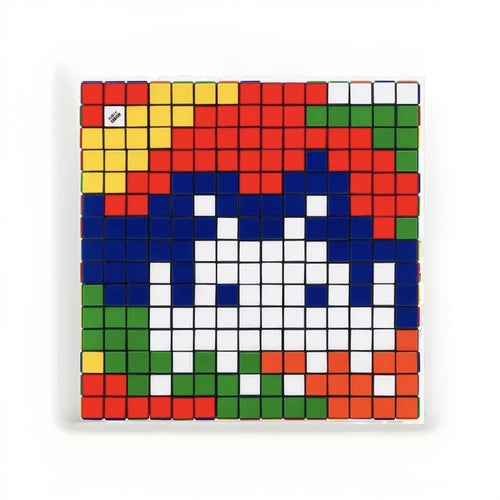
Invader's Rubikcubism works — images rendered in the coloured faces of Rubik's Cubes, a technique he began developing around 2004 (Wikipedia) — occupy a special place in his market. They are conceptually his most distinctive contribution beyond the ceramic mosaics, and the original hand-built Rubik panels are among his most valuable objects at auction.
The evidence is in the record book. Per MyArtBroker's record-prices data, three of Invader's top four results are Rubik works: Rubik Space (2005) at €492,600 (Artcurial, December 2020), Rubik Mona Lisa (2005) at €480,200 (Artcurial, February 2020), and Rubik Dalai-Lama (2008) at €468,250 (Artcurial, July 2021). 400 Chinese Cubes (2021) added €375,000 at Christie's Paris in December 2021, and Red Rubik Phantom (2007) reached NT$7,200,000 (£189,423) at Ravenel in December 2020. Rubikcubism is, on this evidence, the single most reliable engine of Invader's top-end results.
That top-end reality shapes how to read the affordable end. Our catalogue documents the editioned Rubik prints that sit far below those unique panels:
| Release | Year | Edition size | Retail (catalogue) | Scarcity |
|---|---|---|---|---|
| Rubik Space | 2005 | 100 | GBP £80 | Scarce |
| Rubik Kubrick I – Alex (Unsigned) | 2006 | 300 | GBP £75 | Scarce |
| Rubik Cubism (First Edition) | 2006 | 75 | EUR €150 | Rare |
| Rubik Scream II | 2007 | 50 | EUR €150 | Scarce |
| Rubik Kubrick II (Unsigned) | 2007 | 300 | — | Common |
| Rubik Abbey Road | 2009 | 50 | USD $300 | Scarce |
| 6 Cubes (Blue & Yellow) | 2010 | 20 | GBP £225 | Rare |
| Invaded Cube (Timed Edition) | 2023 | 459 | USD $3,000 | Scarce |
| Rubik Country Life (Timed Edition) | 2023 | 431 | USD $3,000 | Scarce |
| Rubik Shot Red Marilyn (Timed Edition) | 2023 | 774 | USD $3,000 | Common |
| Rubik Camouflage (Timed Edition) | 2023 | 812 | USD $3,000 | Common |
Two patterns jump out. The early editioned Rubik prints are genuinely scarce — 6 Cubes at just 20 copies and the first Rubik Cubism at 75 are the tightest — while the 2023 HENI Rubik timed editions run into the hundreds. For a collector, the thesis is straightforward: the Rubik concept carries proven blue-chip demand at the unique-panel level, and the rarest early editioned Rubik prints are the closest affordable proxy to that demand. The large 2023 timed editions offer the imagery but not the scarcity.
Why does Rubikcubism command the top of Invader's market so consistently? Three reasons, each investable. First, conceptual originality. Turning a 1980s puzzle toy into a pixel medium is a genuinely new idea, and the market pays a premium for the works that most clearly embody an artist's singular contribution. The mosaics are Invader's signature, but Rubikcubism is his invention. Second, physical presence and labour. A unique Rubik panel is a large, heavy, hand-assembled object — roughly three by four feet and about eighty pounds, using on the order of 300 cubes each (Wikipedia) — which reads as serious sculpture rather than a print, and prices accordingly. Third, appropriation of blue-chip imagery. The record-setting panels re-render instantly recognizable icons — the Mona Lisa, Munch's Scream, the Dalai Lama, Warhol-adjacent pop — borrowing the cultural weight of the source while remaining unmistakably Invader.
For the collector who cannot reach the €350k–€500k unique-panel tier, the editioned Rubik prints are the rational exposure — but the ranking within them matters. A print from the edition of 20 (6 Cubes) or 50 (Rubik Scream II, Rubik Abbey Road) sits in a different scarcity universe than an edition of 300 (the two Rubik Kubrick screen prints). If two Rubik prints carry similar imagery and similar current asking prices but wildly different edition sizes, the tighter one is almost always the better long-term hold, because scarcity is the one variable that cannot be manufactured after the fact. This is edition-scarcity reasoning in its purest form, and it applies with unusual force to a body of work whose top end has already proven what the concept is worth.
HENI Editions
HENI is now the most important publisher in Invader's official print program, and its editions deserve their own analysis because they define the current primary market. Per the HENI artist page, its recent Invader releases include collaborative "Triple Trouble" works with Damien Hirst and Shepard Fairey, several of which show as out of stock — a demand signal on the primary side. Our catalogue documents the HENI slate:
| Release | Year | Medium | Edition size | Retail (catalogue) | Scarcity |
|---|---|---|---|---|---|
| Invaded Blossom (Timed Edition) — w/ Damien Hirst | 2026 | Giclée | 592 | USD $3,000 | Scarce |
| InvadHirst (Timed Edition) — w/ Damien Hirst | 2025 | Screen print | 1,194 | USD $3,000 | Common |
| Positive Space / Negative Space — w/ Shepard Fairey | 2025 | Screen print | 250 | USD $1,000 | Scarce |
| Camo S (3C-M1) | 2024 | Screen print | 200 | USD $1,500 | Scarce |
| Camo M (3C-M1) | 2024 | Screen print | 100 | USD $2,500 | Scarce |
| Invaded Cube (Timed Edition) | 2023 | Giclée | 459 | USD $3,000 | Scarce |
| Rubik Country Life (Timed Edition) | 2023 | Giclée | 431 | USD $3,000 | Scarce |
| Rubik Shot Red Marilyn (Timed Edition) | 2023 | Giclée | 774 | USD $3,000 | Common |
| Rubik Camouflage (Timed Edition) | 2023 | Giclée | 812 | USD $3,000 | Common |
The HENI editions teach a clear lesson about the timed-edition model. Because a timed edition is open for a set window and prints to whatever demand shows up, the edition size becomes a scarcity outcome rather than a scarcity guarantee. That is why the catalogue marks InvadHirst (1,194), Rubik Camouflage (812), and Rubik Shot Red Marilyn (774) as "Common" despite their high retail price, while the smaller Camo M (100) and the Fairey collaboration Positive Space / Negative Space (250) are "Scarce." For a buyer, the disciplined move within the HENI program is to weight toward the smaller, capped or naturally-tight editions and the marquee collaborations, and to treat the largest timed editions as access pieces rather than appreciation plays.
One structural caveat worth stating plainly: we do not hold a proprietary secondary dataset on how these specific HENI editions have traded post-release. Their retail figures are documented; their resale performance is not something we will assert without a cited number, and public auction histories for the newest editions are still thin. Treat any confident claim about their flip value with skepticism — including your own.
Mosaic-Related Works
The ceramic mosaics are the soul of the project and, at the top, the most valuable objects Invader makes — but they are the hardest thing for an ordinary collector to own, because the vast majority are cemented into public walls. What trades instead are the Invasion Kits: official, artist-produced tile assemblies that let a collector own a genuine Invader mosaic object at domestic scale. In our catalogue they run from Invasion Kit #01 (Albinos) (2000, edition 350) through the numbered series, published mostly by Space Shop at €75–€750 retail.
The Invasion Kit market is real and measurable. Per MyArtBroker's Invasion Kit collection page, over the trailing twelve months the series averaged a £4,357 selling price with an average annual growth rate of 18.27%, and individual kits have sold across a wide £209–£31,195 range depending on rarity, edition and provenance. That spread is the entire story: kit values are dispersed, so selection dominates. The catalogue's rarest kits — IK For MSF (2017, edition 25, "Rare") and Invasion Kit #11 (Blue) (Signed) (2009, edition 30, "Very Scarce") — sit at the top of that range's logic, while the large signed kits (editions of 150) sit toward the accessible end.
| Mosaic-related object | Year | Edition size | Retail (catalogue) | Scarcity |
|---|---|---|---|---|
| IK For MSF | 2017 | 25 | — | Rare |
| Invasion Kit #11 (Blue) (Signed) | 2009 | 30 | EUR €300 | Very Scarce |
| Invaderoma — Mosaic Book Cover | 2010 | 60 | EUR €450 | Rare |
| Invasion Kit #16 (Flashinvaders) | 2014 | 250 | EUR €750 | Scarce |
| Invasion Kit #18 (LA 2018) | 2018 | 300 | EUR €2,400 | Scarce |
| Invasion Kit #01 (Albinos) | 2000 | 350 | — | Scarce |
For a collector who wants an actual Invader mosaic without buying a detached wall piece at auction, the Invasion Kits are the answer — and the 18.27% trailing growth (MyArtBroker) suggests the segment has momentum. Just remember the dispersion: the difference between a £209 kit and a £31,195 kit is edition, imagery, condition and story, not luck.
The Invasion Kit series also offers a useful lesson in how to read Invader's numbering and formats, because the market treats different kits very differently. The kits span more than two decades — from #01 (Albinos) in 2000 to the later numbered releases — and evolved from crude early assemblies into refined, sometimes elaborate objects. Later kits with special features (glow-in-the-dark tiles, 3D effects, larger formats like the €2,400 #18 (LA 2018)) command more than the small early kits at retail, but at auction the picture inverts in places: an early, historically significant, tightly editioned kit can outrun a later, larger, cheaper-to-produce one. Provenance and completeness matter enormously here — a kit is a multi-part object, and a missing tile, a lost certificate, or a compromised box materially impairs value in a way that does not apply to a flat print.
A second nuance for the mosaic-minded collector: detached street mosaics occasionally surface at auction, and they are a fundamentally different — and more fraught — proposition than an official kit. A wall mosaic that has been removed from public space carries authenticity, condition, and ethical questions that an artist-issued, editioned kit does not. This is precisely the terrain where authentication becomes non-negotiable, and where our companion authentication guide earns its keep. For most collectors, the official Invasion Kits deliver the mosaic experience with vastly cleaner provenance and a real, liquid comparable market behind them; the detached wall pieces are a specialist's game with specialist's risks.
Most Liquid Pieces
Liquidity — the ability to sell at a fair price without a long wait — is the most underrated variable in art investing. For Invader, liquidity concentrates where auction volume concentrates. MyArtBroker reports Artcurial as the single most active venue for Invader lots, with 223 pieces sold there, and MutualArt tracks over 3,000 Invader works appearing at auction historically — a deep, active market by street-art standards.
Within that, the most liquid tradable objects tend to be the recognizable, mid-sized editions and the Invasion Kits, precisely because there is a continuous flow of comparable sales to anchor pricing. In our catalogue, the editions most likely to enjoy that liquidity are the ones with (a) larger surviving populations, (b) iconic imagery, and (c) repeat auction appearances. Candidates from the documented set include the classic screen prints and the numbered Invasion Kits with editions in the low hundreds — for example Rubik Kubrick I – Alex (2006, edition 300) and Rubik Kubrick II (2007, edition 300), which are large enough to trade regularly.
The MyArtBroker average-price-paid figure of £7,061 for Invader prints and multiples is best read as a liquidity thermometer: a market that clears thousands of lots at a four-figure average is a market you can actually exit. Contrast that with the unique Rubik panels, which are far more valuable per object but far rarer to transact — higher price, lower liquidity. The investing lesson is the classic one: the most valuable object and the most liquid object are rarely the same object.
Three characteristics reliably drive an Invader edition up the liquidity ladder. Recognizability comes first: works that carry immediately legible pop-culture imagery — the icons, the pixel aliens in their most classic form — attract a broader bidder pool than obscure one-offs, and a broader pool means tighter spreads. Format familiarity comes second: standard-size screen prints and the well-known numbered kits have deep comparable histories, so buyers and sellers can agree on price quickly; unusual formats and materials trade thinner because nobody is sure what the last one made. Condition and completeness come third: pristine, fully documented examples move fast, while damaged or incomplete ones sit, sometimes for years.
The counterintuitive implication for portfolio construction is that a collector optimizing for liquidity should sometimes deliberately choose the larger, more "common" edition over the rarest one. An edition of 300 with constant auction turnover may be easier to sell at a fair price on short notice than an edition of 20 that surfaces once every few years and whose price is anyone's guess. Rarity maximizes potential value; population and recognizability maximize exit certainty. A thoughtful Invader allocation holds some of each — scarce pieces for appreciation, liquid pieces for flexibility — and never mistakes one for the other. This is the same discipline behind trimmed-mean, rolling-window valuation: it forces you to price an object off how its cohort actually trades, not off the single most flattering result you can find.
Most Underrated Pieces

"Underrated" is inherently a judgment, so we will define it precisely: releases from our catalogue that combine genuine scarcity (small documented edition sizes and a "Rare" or "Very Scarce" designation) with modest original retail, meaning the primary market never fully priced their rarity. These are the structural value candidates — not a promise of return, but the places where the ratio of scarcity to entry price is most favourable.
| Release | Year | Edition size | Retail (catalogue) | Scarcity |
|---|---|---|---|---|
| 6 Cubes (Blue & Yellow) | 2010 | 20 | GBP £225 | Rare |
| Home (Lego White) | 2010 | 25 | GBP £325 | Rare |
| Hello My Game Is (Red) | 2009 | 25 | EUR €180 | Very Scarce |
| Space Vibes (Red) | 2009 | 30 | GBP £225 | Very Scarce |
| Space File (Red) | 2007 | 30 | EUR €250 | Very Scarce |
| Boys Don't Cry | 2009 | 40 | EUR €200 | Very Scarce |
| Space Waffle | 2011 | 100 | GBP £300 | Rare |
| Invaded Scream | 2011 | 50 | GBP £280 | Very Scarce |
The logic here is edition-scarcity, the same variable Gauntlet Gallery weights heavily in its own valuation work. A print from an edition of 20–40 that originally retailed for a few hundred pounds has a fundamentally different supply profile than a 1,000-plus timed edition, regardless of how the two currently price. We are not claiming a specific resale value for any of these — we do not have a proprietary comp set for them, and we will not fabricate one. We are claiming that their scarcity-to-retail ratio makes them the rational places to look first. Do your own comp work before acting.
There is a second, subtler category of "underrated" worth flagging: works whose subject matter the market has not yet fully connected to Invader's marquee results. The record book shows the market pays enormous premiums for Rubikcubism appropriations of famous imagery. Editioned prints that share that DNA — small-edition works referencing iconic pop culture, or early Rubik-adjacent pieces — may carry a latent premium that has not yet been arbitraged, simply because the affordable end of the market moves slower than the trophy end. This is not a guarantee; it is a hypothesis about where the market's attention has not yet fully arrived. The disciplined way to act on it is to look for the cheapest genuine scarcity that rhymes with what the top of the market already rewards.
Finally, a caution that applies to the entire "underrated" thesis: illiquidity is the price of admission to the value tier. The very small editions that look cheap relative to their rarity are cheap partly because they trade infrequently — there is no continuous market to bid them up. That means the underrated thesis is a patient-capital thesis. If you need to sell an edition-of-20 print on thirty days' notice, you may not achieve the value its scarcity implies. The collector who profits from underrated Invader material is the one who can hold until the right buyer appears, and who bought at a price that already reflects the illiquidity. Buy the scarcity; respect the wait.
Most Expensive Sales
This is the section where data discipline matters most, so every figure below is drawn from MyArtBroker's published record-prices table for Invader (with the Sotheby's, Artcurial, Christie's and Ravenel results as the underlying houses of record) and, separately, from Phillips' and HENI's reporting of the April 2024 London sale. We present only sales we can attribute.
| Work | Auction house | Date | Result (as reported) | Source |
|---|---|---|---|---|
| Astroboy, Tk_119 (2014) | Sotheby's New York | Nov 2019 | US$1,220,000 (£945,258) | MyArtBroker |
| Rubik Space (2005) | Artcurial Paris | Dec 2020 | €492,600 (£445,027) | MyArtBroker |
| Rubik Mona Lisa (2005) | Artcurial Paris | Feb 2020 | €480,200 (£401,840) | MyArtBroker |
| Rubik Dalai-Lama (2008) | Artcurial Paris | Jul 2021 | €468,250 (£401,125) | MyArtBroker |
| 400 Chinese Cubes (2021) | Christie's Paris | Dec 2021 | €375,000 (£320,471) | MyArtBroker |
| Vienna (2008) | Artcurial Paris | May 2019 | €356,000 (£303,299) | MyArtBroker |
| Alias HK-59 (2014) | Christie's Hong Kong | Mar 2015 | HK$2,680,000 (£234,178) | MyArtBroker |
| Alias PA-1030 (2016) | Artcurial Paris | Oct 2016 | €251,000 (£223,540) | MyArtBroker |
| Mario (2004) | Sotheby's New York | Nov 2020 | US$252,000 (£190,321) | MyArtBroker |
| Red Rubik Phantom (2007) | Ravenel | Dec 2020 | NT$7,200,000 (£189,423) | MyArtBroker |
| Bruce Lee 3D (2015) | Phillips London | Apr 2024 | US$252,600 | Phillips / HENI |
Read this table as a trend line, not a scoreboard. Three things stand out. The absolute ceiling — over US$1.2m for a single mosaic — was set in 2019 and has anchored the market's sense of Invader's top end ever since. The Rubik panels cluster in the €350k–€500k band and account for most of the top ten, confirming Rubikcubism as the value core. And the marquee results are geographically dispersed across New York, Paris, Hong Kong and Taipei, which tells you the buyer base is genuinely global. What the table does not show is a smooth annual march upward — top results are lumpy and event-driven, as trophy markets always are.
The temporal clustering rewards a second look. Six of the eleven results above fall within the December 2019 to December 2021 window — a remarkably concentrated burst that coincided with a broader boom in urban-contemporary and, more generally, with a period of unusual liquidity chasing alternative assets. That concentration is a double-edged datapoint. On one hand, it proves the demand can be intense and global when conditions align. On the other, it is a warning against extrapolating any single vintage of results into a permanent price level. A responsible reading treats the 2019–2021 cluster as evidence of ceiling potential, not as a floor. The Bruce Lee 3D result at Phillips London in April 2024 (US$252,600, per Phillips and HENI) is useful precisely because it is more recent and more sober — a strong six-figure result outside the frothiest window, which is arguably more informative about durable demand than the peak-cycle records.
Note also what these top lots are not: they are overwhelmingly unique mosaics and hand-built Rubik panels, not editioned prints. The single most important thing a print-buying collector can take from the "most expensive sales" list is that these numbers describe a different asset class within the same artist. Your edition print will never trade like Astroboy, Tk_119. What the trophy results do for you is provide a halo — a cultural and financial validation of the name that supports the entire market beneath it — without ever being a comparable for your specific object. Never let a headline mosaic result seduce you into overpaying for a print. They are related, but they are not the same market.
CAGR Analysis
Compound annual growth rate (CAGR) is where art writing most often cheats, so here is the honest version. We have exactly one clean, cited pair of dated figures suitable for a CAGR computation: MyArtBroker states that Invader's print price index grew by 49% from 2014 to 2024. Treating that as a 10-year cumulative return, the implied CAGR is:
Computed figure (labeled as such): a 49% cumulative gain over 10 years implies a CAGR of approximately 4.1% (1.49^(1/10) − 1 = 0.0407). By the same arithmetic, MyArtBroker's cited 0.8% cumulative move for the FTSE 100 over the same period implies a CAGR of roughly 0.08%. Invader's print index therefore compounded at very roughly 50× the FTSE 100's rate over that decade — a ratio derived from the two cited cumulative figures, not an independently observed rate.
A second, shorter-horizon figure is also on the record: MyArtBroker cites a "24% average annual growth rate over the last 12 months" for Invader prints and multiples, and an 18.27% average annual growth rate for the Invasion Kit series specifically. These are the source's own trailing figures; we reproduce them attributed and do not blend them into the 10-year CAGR, because mixing a decade-long index with a trailing-twelve-month rate would be arithmetically dishonest.
The takeaway is deliberately unglamorous. Over the long haul, the defensible, cited number is a mid-single-digit annual compounding rate for the print index — strong relative to a flat equity benchmark, but not a moonshot — punctuated by much higher trailing-year momentum and by lumpy, spectacular results at the unique-object top end. Any Invader "CAGR" you see quoted much higher than that should come with its two dated endpoints attached, or it is not a CAGR you can trust.
Liquidity

We treated the "most liquid pieces" above; here we treat liquidity as a portfolio property. Three cited facts define Invader's liquidity profile. First, depth: MutualArt tracks thousands of Invader works appearing at auction, and MyArtBroker identifies Artcurial as a repeat venue with 223 Invader lots sold — there is a real, recurring marketplace. Second, clearing price: the £7,061 average price paid (MyArtBroker) sits in a band that a broad collector base can transact. Third, dispersion: the Invasion Kit range of £209–£31,195 (MyArtBroker) shows how widely individual objects clear even within one series.
For an investor, that adds up to a two-tier liquidity structure. The editions and kits are the liquid tier — frequent comparable sales, four-figure clearing prices, exits measured in weeks not years. The unique mosaics and Rubik panels are the illiquid tier — extraordinary values, but transactions are rare, concentrated in a few marquee sales, and highly sensitive to timing and venue. A prudent Invader allocation treats the liquid tier as the tradable core and the illiquid tier as a long-hold, event-driven satellite. This is exactly why rolling comp windows and trimmed means — ignoring the single highest and lowest prints and averaging the middle of a recent window — produce a more honest "price" than any one headline result: in a two-tier market, the outliers lie.
Museum Acquisitions
Here we must be careful, because "museum acquisition" is a phrase collectors love and sources rarely substantiate cleanly. What is well documented is institutional recognition rather than a catalogue of permanent-collection purchases. Invader installed his 1,500th Paris mosaic on the facade of the Centre Pompidou in February 2024 (GraffitiStreet; Centre Pompidou's own channels marked the milestone). His Space2 mosaic sits aboard the International Space Station's Columbus module, installed via ESA in 2014 (VICE, artnet, Space.com) — arguably the most exclusive "collection" any artist has entered.
We will not assert a specific list of museums that have purchased Invader works into permanent collections, because we could not verify such a list against an authoritative source, and inventing one would violate the entire premise of this piece. What we can say, sourced, is that Invader has achieved the kind of blue-chip cultural validation — a Pompidou-facade milestone, an ISS installation, sustained major-house auction presence — that typically precedes and supports institutional collecting. Treat the distinction seriously: cultural validation is documented; a permanent-collection acquisition roster is not something we are prepared to fabricate.
Why does institutional recognition matter to a collector's balance sheet at all, if it is not a direct purchase? Because museum-grade validation changes the character of demand. When an artist crosses from "collectible" to "culturally canonical," the buyer base broadens from enthusiasts and speculators to institutions, foundations, and the kind of long-horizon private collectors who buy to keep. That shift tends to reduce volatility and deepen the market's floor over time, because canonical names attract capital that is less price-sensitive and less likely to panic-sell. Invader's trajectory — solo exhibitions, the "Invader Space Station" show, the Pompidou milestone, the ISS installation — is the trajectory of a name moving toward that canonical status, whether or not any specific acquisition ever appears on a museum's accession list.
The honest caveat, again, is one of anonymity and category. Invader remains an anonymous street artist, and institutions historically move more cautiously with living, anonymous, street-derived practices than with established studio artists. His cultural footprint is enormous and well-documented; the pace and scale of formal institutional collecting is genuinely uncertain from the public record, and we will not pretend otherwise. For the investor, the sane posture is to treat documented cultural validation as a real, positive, market-supporting factor — and to treat any specific unsourced "it's in the collection of X" claim, including from sellers, as something to verify before it affects what you are willing to pay.
Regional Demand
Invader's demand is genuinely global, and the auction record proves it geographically rather than anecdotally. From the sourced records table: top results have printed in New York (Sotheby's — Astroboy at US$1.22m; Mario at US$252k), Paris (Artcurial — the Rubik panels; Christie's — 400 Chinese Cubes), Hong Kong (Christie's — Alias HK-59), and Taipei (Ravenel — Red Rubik Phantom). Four distinct auction geographies in the top ten is unusual and speaks to demand that is not anchored to a single home market.
Paris is, unsurprisingly, the spiritual and commercial center — Invader is a Paris artist, Artcurial is his most active venue (MyArtBroker), and the Pompidou milestone reinforced the home-market narrative. But the presence of major Asian results (Hong Kong, Taipei) alongside strong US and French numbers is the more investable insight: a globally distributed bid is a more resilient bid. When one region's collecting appetite cools, another can carry the market. We do not have a proprietary breakdown of demand share by region, so we describe the pattern qualitatively from the cited record book rather than assign percentages we cannot source.
The regional pattern also maps onto the artist's own practice in a way that reinforces demand. Invader has physically invaded cities on multiple continents, and his imagery frequently localizes — Hong Kong invasions, Los Angeles pieces, Japan-specific works published through Gallery Target, city-specific invasion maps. That geographic embedding creates natural pockets of local pride and local demand: a Hong Kong collector who grew up spotting Invaders in Central has a personal reason to bid on a Hong Kong-associated work that a Paris collector may not share, and vice versa. The result is a market with multiple, partially independent demand centers rather than one dominant hub — structurally healthier than a name whose entire bid sits in a single city or currency.
For a collector, the actionable read is twofold. First, cross-border demand means a well-chosen Invader work has more than one natural exit market, which supports both price and liquidity. Second, currency and venue selection matter at the margin: the same or comparable work can achieve materially different results in Paris versus New York versus Hong Kong depending on which regional buyer base is most active for that imagery at that moment. Sophisticated sellers consign where the relevant demand is deepest. Sophisticated buyers watch all the major venues rather than anchoring to one, because a globally traded name is a globally priced name, and the best entry is not always in your home saleroom.
Future Outlook
Synthesizing only what we can source, the forward case for Invader rests on four legs. The primary market has professionalised under HENI, lifting retail price points and adding marquee collaborations (Hirst, Fairey) that broaden the collector base. The secondary market is deep and global, clearing thousands of lots with a four-figure average (MyArtBroker) and a seven-figure ceiling (Sotheby's, 2019). The cultural narrative keeps compounding — a Pompidou-facade milestone in 2024, an ISS installation, a self-perpetuating FlashInvaders fan base. And the long-run index return, at a cited ~4.1% CAGR for prints over 2014–2024 (computed from MyArtBroker's 49% cumulative figure), has outpaced a flat equity benchmark while remaining plausible rather than frothy.
The risks are equally real. Timed editions can print large and dilute scarcity (see InvadHirst at 1,194). Trailing-twelve-month growth figures (24% for prints; 18.27% for kits, per MyArtBroker) are momentum readings, not durable expectations, and momentum reverses. The top-end results are lumpy and event-driven, so any single spectacular sale can create a misleading anchor. And as an anonymous artist, Invader carries the tail risk that attaches to any market where the maker's status could change abruptly.
Our disciplined conclusion: the rational Invader position over-weights documented scarcity — the small early editions, the rarest Invasion Kits, the tight Rubik prints and marquee HENI collaborations — and treats the large timed editions as access rather than appreciation. Price every candidate off a rolling window of recent comparable sales with the extremes trimmed, not off a single headline. That approach mirrors Gauntlet Gallery's broader valuation philosophy — rolling comp windows, trimmed means, and edition-scarcity as the primary lens — applied here to a market that rewards exactly that kind of patience.
For the reference groundwork behind this analysis, see our companion pillars: Who Is Invader? A Complete Guide for the biography and cultural context, Every Official Invader Print, Panel & Rubikcubism Release for the full catalogue of documented editions, and How to Spot a Fake Invader: Authentication Guide — because in a market this liquid, authentication is the single most important protection for your capital.
Disclaimer
This article is editorial and educational content, not investment, financial, or appraisal advice. Nothing here is an offer to buy or sell any work, or a recommendation to transact. Auction results, growth rates, and index figures are attributed to third-party sources (including MyArtBroker, Phillips, Sotheby's, and HENI) as of the dates cited and may be superseded; computed figures such as CAGR are labeled as arithmetic derived from those cited figures. Gauntlet Gallery makes no representation or warranty about the authenticity, condition, provenance, or value of any specific Invader work. Art markets are illiquid, volatile, and carry risk of loss. Always conduct your own due diligence and consult qualified independent professionals before making any purchase or sale.