

Invader is the anonymous French street artist who took the pixelated aliens of a 1978 arcade cabinet and cemented them onto the walls of the world. Over nearly three decades he has built one of the most recognizable and rigorously documented bodies of work in contemporary urban art — a global “Invasion” of ceramic-tile mosaics, a Rubik’s Cube art movement he named himself, a mobile game that turned his pieces into a treasure hunt, and an auction market that has crossed seven figures. This guide is a complete, collector-focused reference to who Invader is, how his practice works, and why the market takes him so seriously.
Browse the full catalogue: explore all 84 works in The Invader Index — every official print, panel, Rubikcubism work and sculpture, each with its own detail page.
Introduction

Ask most people to name a street artist and they will say Banksy. Ask a collector who has actually watched the urban-art market mature over the last decade, and Invader will be in the first breath of the conversation. He is, in many ways, the perfect case study in how a graffiti-adjacent practice becomes a blue-chip collecting category: a single, instantly legible visual signature; a disciplined, self-catalogued output; a mythology of anonymity; and a documented trail of primary releases and secondary-market results that lets a serious buyer underwrite value rather than guess at it.
This is a long read by design. Gauntlet Gallery publishes these pillar guides as standing references, not news hits. Below, we walk through the biography and the origin story, unpack the two ideas that define his work — the street mosaics and Rubikcubism — and then get practical: the Alias system, the global Invasion project, the FlashInvaders app, the museum shows, the editions published through HENI Editions, Space Shop and Pictures On Walls, the sculptures, the collaborations, a year-by-year timeline, the most important releases, the most expensive verified sales, and a plain-language answer to why collectors care. We close with a frequently-asked-questions section.
Two ground rules before we start. First, on numbers: every edition size, medium, publisher and retail price in the tables below is drawn from Gauntlet Gallery’s documented catalogue of 84 official Invader editions — a working record of released, catalogued editions, not an exhaustive account of every object Invader has ever made. Every biographical, historical and auction figure is attributed inline to a public source. Second, on identity: Invader is anonymous, and this guide treats that anonymity as a fact of the practice rather than a puzzle to solve.
The Anonymous Artist
Invader was born in France in 1969 and, according to his Wikipedia entry and gallery biographies, trained at the École des Beaux-Arts in Paris. Beyond that, the public record thins out on purpose. He works under a pseudonym, appears in interviews masked or with his face pixelated, and installs the overwhelming majority of his street pieces at night. The persona and the anonymity are not marketing accessories bolted onto the art; they are structural. A masked figure cementing an 8-bit alien to a wall at 3 a.m. is the work as much as the tile is.
The press has, over the years, circulated a name commonly associated with the artist. We are not going to trade on that here. It is neither confirmed by the artist nor material to a collector’s decision, and the anonymity is central to how the work functions. As the artist has framed it in interviews, the mask lets the pieces speak for themselves and keeps the focus on the invasion rather than the individual. For collecting purposes, what matters is that “Invader” (also written “Space Invader”) is a stable, self-administered brand with its own catalogue logic — which, as we’ll see, is unusually good news for authentication and provenance.
That self-administration is the tell. Unlike many street artists who leave documentation to galleries and fans, Invader numbers and maps his own output. He publishes invasion maps. He assigns his pieces catalogue codes. He runs the app that verifies them. The result is a practice that behaves less like graffiti and more like a serialized, archival enterprise conducted by an artist who happens to prefer a mask.
It is worth pausing on why anonymity is such an asset rather than a limitation. Street work exists in a legal gray zone — installing a mosaic on public or private property without permission can constitute vandalism, and Invader has faced municipal removals and, in some cities, hostile authorities. A named artist is exposed; a masked one is not. But the anonymity does more than provide legal cover. It converts the artist into a myth that scales globally without ever needing a press tour. Every new city wakes up to find pixel aliens on its walls, installed by a figure no one can identify, documented by an app anyone can download. The absence at the center of the project is precisely what lets it travel. In marketing terms, Invader turned scarcity of the person into abundance of the work — the opposite of the celebrity-artist model, and arguably more durable.
For collectors, the practical upshot is that they are buying into a closed, artist-controlled system. There is no estate dispute waiting to happen, no studio of assistants issuing conflicting attributions, no ambiguity about what counts as “an Invader.” The artist alone decides, and he has built the machinery — codes, certificates, maps, the app — to make those decisions legible to the market. That is an unusually clean governance structure for an artist working outside the traditional gallery-and-museum pipeline, and it is one of the quiet reasons his market has held together.
Space Invaders and the Origin Story
The name comes from the 1978 Taito arcade game Space Invaders, whose descending rows of pixel aliens are among the most reproduced images of the twentieth century. Invader’s core insight was simple and durable: the humble ceramic mosaic tile is, functionally, a physical pixel. Line enough of them up and you can render any low-resolution sprite — an alien, a Pac-Man ghost, a Mario mushroom — permanently, in weatherproof material, on the skin of a city.
He installed his first mosaics in Paris in the late 1990s. Sources vary slightly on the exact starting point — several galleries cite a first Paris installation in 1998, and Wikipedia notes he began mosaic work in the 1990s — but the trajectory is not in dispute: what began as a handful of tiles in Paris became a systematic, city-by-city campaign. One frequently cited early landmark, per Wikipedia, is a mosaic he installed on the Hollywood Sign at the very end of 1999. From there the project scaled outward relentlessly.
Why did it stick where other novelty street work faded? Because the format solves several problems at once. It is legible at a glance and from a distance. It is culturally warm — it triggers nostalgia rather than confrontation. It is materially permanent in a medium (mosaic) with a two-thousand-year pedigree, which quietly elevates a pop-culture sprite into something that reads as “art” on a building. And it is infinitely serial: every city is a fresh grid to populate. Invader effectively invented a franchise he could deploy anywhere, forever, with a consistent visual identity. That is a rare thing in street art, and it is a large part of why the market treats him as a category rather than a novelty.
There is also a deeper conceptual joke embedded in the choice of medium that rewards a moment’s attention. A pixel is the smallest unit of a digital image — ephemeral, weightless, made of light. A mosaic tile is one of the oldest and most permanent units of a physical image — heavy, fired, grouted, meant to outlast the building it decorates. By treating the two as interchangeable, Invader collapses roughly two thousand years of image-making into a single gesture: he renders the most disposable imagery of the late twentieth century (a coin-op arcade alien) in the most enduring craft medium of antiquity. That collision is not incidental. It is the whole idea, and it is why his best work carries an intellectual charge that a mere nostalgia gimmick would not. The same logic later powers Rubikcubism, where the “pixel” becomes a Rubik’s Cube face — another throwaway 1980s object elevated to fine-art material.
The origin story also explains the artist’s taste in subjects. Because the grid is coarse, the imagery has to be iconic enough to survive radical down-sampling — a Space Invader, a Pac-Man ghost, a Super Mario mushroom, later the Mona Lisa or a Warhol Marilyn. These are images so deeply encoded in collective memory that a handful of colored squares is enough to trigger recognition. Invader is, in effect, working with the visual equivalent of proverbs: compressed, universal, instantly decoded. That universality is a commercial advantage too — it means the work reads the same in Tokyo, Los Angeles, Paris or Hong Kong, with no translation required.
The First Mosaics
The earliest street pieces established the vocabulary that still governs the work: small, glazed ceramic tiles, grouted into a rigid grid, forming a recognizable video-game sprite. Each mosaic is site-specific in the literal sense — it is affixed to a particular wall, corner or lamppost — and Invader documents each one with a catalogue code tied to the city. Paris pieces carry “PA” codes (PA_1177, PA_254, and so on); other cities get their own prefixes. This is the backbone of the whole enterprise: a self-maintained registry of installations.
From the collector’s standpoint, the crucial thing to understand is the relationship between the street pieces and the objects that trade on the art market. The mosaics cemented to city walls are, by design, exposed to weather, theft and municipal removal. To give collectors a legitimate way to own the imagery — and to preserve the work against destruction — Invader produces studio counterparts. That is where the Alias system comes in, and it deserves its own chapter.
It is worth noting how early the object-making began alongside the street work. Our documented catalogue records an Invasion Kit #01 (Albinos) sculpture dated to 2000, published by Space Shop in an edition of 350 — evidence that from very near the beginning Invader was already thinking about collectible, editioned objects that let the public participate in the invasion, not just witness it. The Invasion Kits, which we return to in the sculptures chapter, run in a numbered series across the next two decades.
Rubikcubism Explained

Around the middle of the 2000s, Invader extended the pixel logic into a second, distinct medium: the Rubik’s Cube. He named the resulting practice Rubikcubism, which he has defined as “a fine art school developed in Paris in the early 21st century and characterised by the use of Rubik Cubes as a medium,” according to MyArtBroker and the artist’s own site, space-invaders.com. The name is a deliberate triple pun — a nod to Cubism and its founders Braque and Picasso, and to the cube’s inventor Ernő Rubik.
Mechanically, each Rubik’s Cube functions as a single mosaic “tile” with a fixed six-color palette. Invader twists dozens — sometimes hundreds — of cubes to set their faces, then assembles the solved cubes into a grid that resolves, at distance, into a recognizable image. The constraint is the point: with only six colors and a coarse grid, he reconstructs canonical images from art history and pop culture. The most famous target is Leonardo’s Mona Lisa, which became the first of a series he calls the Rubik Master Pieces — “insolent tributes,” in his framing, to the great works of the canon.
The aesthetic effect, as MyArtBroker notes, sits close to Pointillism or Cubism: the subject dissolves into abstraction up close and only snaps into focus from a distance — or, tellingly, when viewed through a smartphone camera that down-samples it back toward the low resolution Invader started from. Rubikcubism is where Invader’s market has produced its most spectacular auction results, and it is the clearest expression of his central obsession: the translation between pixel and mosaic, screen and wall, low resolution and high value.
The labor involved is worth understanding, because it directly informs value. A large Rubikcubism work can require hundreds of individually solved cubes, each twisted to display a precise arrangement of colored faces, then fixed permanently in position and assembled into a rigid grid. Wikipedia describes representative pieces as using on the order of hundreds of cubes and weighing tens of kilograms. Because the Rubik’s Cube palette is fixed at six colors and each cube face is a single flat color, Invader cannot blend or shade; he has to achieve tonal nuance purely through the placement of solid color blocks, the way a mosaicist or a Pointillist does. The unique, hand-assembled originals — as opposed to the printed editions — are effectively one-off sculptures, which is why they command the prices they do at auction. The printed HENI giclees, by contrast, reproduce the cube imagery as a two-dimensional edition, giving collectors access to the aesthetic at a fraction of the cost of an original panel.
The Rubik Master Pieces series — the “insolent tributes” to art history — is also a shrewd critical strategy. By reconstructing the Mona Lisa, Munch’s Scream, the Beatles’ Abbey Road cover and other canonical images out of a children’s puzzle, Invader inserts himself directly into an art-historical conversation. Each Rubik tribute is simultaneously an homage and a provocation: it says these masterpieces are so thoroughly absorbed into culture that they can be rebuilt from toys and still be recognized. That gambit is exactly the kind of conceptual hook that critics and auction houses reward, and it helps explain why the cube works, more than any other part of his output, have carried Invader into the six- and seven-figure tier.
Our documented catalogue captures how the Rubikcubism idea moved from street-adjacent experiment to premium edition over roughly two decades. Early Rubik editions were modest and inexpensive; recent HENI Editions releases are large-format, higher-priced timed editions. The table below draws only on catalogued Rubik-era editions in our records.
| Edition | Year | Medium | Edition size | Retail (MSRP) | Publisher |
|---|---|---|---|---|---|
| Rubik Kubrick I – Alex | 2006 | Screen Print | 300 | GBP £75 | Pictures On Walls |
| Rubik Cubism (First Edition) | 2006 | Screen Print | 75 | EUR €150 | Space Shop |
| Rubik Scream II | 2007 | Screen Print | 50 | EUR €150 | Space Shop |
| Rubik Abbey Road | 2009 | Screen Print | 50 | USD $300 | Jonathan LeVine Gallery |
| 6 Cubes (Blue & Yellow) | 2010 | Cubes | 20 | GBP £225 | Shop At Lazarides |
| Invaded Cube (Timed Edition) | 2023 | Giclee Print | 459 | USD $3,000 | HENI Editions |
| Rubik Camouflage (Timed Edition) | 2023 | Giclee Print | 812 | USD $3,000 | HENI Editions |
| Rubik Shot Red Marilyn (Timed Edition) | 2023 | Giclee Print | 774 | USD $3,000 | HENI Editions |
Note the arc: a 2006 Rubik Kubrick screen print retailed at £75 in an edition of 300; the 2023 HENI timed giclees retailed at $3,000 in far larger runs. That jump reflects both the maturation of Invader’s market and a deliberate shift toward large, professionally distributed timed editions in the last few years.
Alias and Anonymity
The Alias system is the bridge between the street and the salesroom, and understanding it is essential for any Invader collector. An Alias is a studio-made replica of a specific street mosaic — the same image, at (or near) the same scale — but produced on a portable Perspex/plexiglass panel rather than cemented to a wall. Each Alias carries the catalogue code of its street original (for example, Alias PA-1030 corresponds to a Paris installation) and comes with a signed certificate of authenticity and documentation of the original invasion.
This does several things at once. It gives collectors a legitimate, transferable object linked to a real public work; it preserves the imagery even if the street piece is stolen, weathered or removed by a city; and it keeps the primary and secondary markets honest, because each Alias is tethered to a documented, numbered installation the artist controls. The Alias is where anonymity and commerce reconcile: the artist need not surface publicly, because the catalogue code and certificate do the work of authentication that, for other artists, a named studio or estate might handle.
For the market, Aliases matter enormously. Several of the highest verified Invader auction results are Alias works — for instance, per MyArtBroker, Alias HK-59 realized HK$2,680,000 at Christie’s in 2015, and Alias PA-1030 made €251,000 at Artcurial in 2016. The lesson for collectors is that provenance in Invader’s world is unusually concrete: an Alias’s value is anchored to a specific, mapped, dated installation, not to a vague attribution.
The Alias model also creates a legible value hierarchy that helps buyers reason about price. An Alias tied to a famous, prominently sited or since-destroyed street piece — one that thousands of players have flashed and photographed — carries more narrative weight than one linked to an obscure installation, and the market tends to price that difference. Because each Alias references a documented original, a collector can research the street piece’s location, its condition history, whether it still exists, and how visible it was, all before bidding. That is a far richer diligence trail than a typical print carries, and it rewards collectors who do the homework. The pairing of a signed certificate with the invasion documentation is the mechanism that makes this possible; without it, an Alias would be just another replica, and its value would collapse. Authentication of that paperwork is therefore central, which is exactly why we treat it at length in the companion authentication guide. That concreteness is a genuine competitive advantage of the category, and it is one reason authentication is more tractable here than in much of street art — a theme we develop in our companion guide, How to Spot a Fake Invader: Authentication Guide.
The Global Invasion Project
Invader frames his practice as a military-style campaign: each city he works is an “Invasion,” and he keeps a running tally. According to Wikipedia, as of December 2020 his mosaics could be found in 79 cities across 20 countries; as of January 2020 the count stood at 3,858 mosaics comprising more than 1.5 million ceramic tiles. Paris is the home front, with well over a thousand pieces installed since the project began — he marked his 1,000th Paris installation in June 2011 with an exhibition, per Wikipedia.
To guide the public through each Invasion, Invader publishes invasion maps — printed guides to the locations of his mosaics in a given city. Wikipedia notes he has published two dozen such maps. Several of these maps exist as collectible editions in their own right; our documented catalogue records invasion-map editions for cities including Los Angeles (2004), São Paulo (2011), Paris (v2.0, 2011), Brussels (2012) and Djerba (2021), typically in small runs of 50–100 and at accessible retail prices. They are, in effect, the campaign’s field manuals turned into art objects.
The Invasion project is also where the artist’s ambition periodically escapes the street entirely. In August 2012, for the film Art4Space, Invader launched a mosaic (Space One) into the stratosphere using a weather balloon from near the Florida Everglades, according to reporting collected by GraffitiStreet. In 2015 he went further: a small mosaic was installed on the hatch of the European Space Agency’s Columbus laboratory aboard the International Space Station, placed by ESA astronaut Samantha Cristoforetti — documented by the ESA, Space.com and Smithsonian as effectively the first work of art exhibited in space. The Invasion, in other words, is not a metaphor Invader wears lightly.
The space episodes are more than stunts; they are the logical endpoint of a project literally named after aliens descending from the sky. Sending a Space Invader into space closes a conceptual loop that had been open since 1998, and it generated exactly the kind of press — from science outlets like Space.com and the Smithsonian, not just art media — that broadens an artist's audience beyond collectors. The connection has kept generating stories: French astronaut Thomas Pesquet, who spent time aboard the ISS, became an enthusiastic supporter of the space mosaic (catalogued as KLN_27), per reporting collected by Illuminate, extending the mythology into the present. For an artist who never shows his face, letting the work travel to the edge of the atmosphere and beyond is a fittingly impersonal form of self-promotion — the art, not the artist, becomes the protagonist.
The Invasion project has not been frictionless, and collectors should understand the tension it creates. Because the street pieces are unauthorized, cities react in different ways. Wikipedia and South China Morning Post reporting document how, during an early-2014 Hong Kong invasion of 48 works, the Highways Department systematically removed many of the mosaics — including the life-sized Hong Kong Phooey — on the grounds that unauthorized installations on public facilities are unlawful and raise safety concerns, prompting a public debate about art versus vandalism. Removals like these are a double-edged sword for the market: they destroy public works, but they sharpen demand for the surviving studio counterparts (the Aliases) and reinforce the idea that the street pieces are genuinely fragile, genuinely at risk, and therefore genuinely worth preserving in collectible form.
Flash Invaders App
In July 2014, Invader released FlashInvaders, a free mobile app that turned the entire street corpus into a global, gamified treasure hunt. According to StreetArtNews and the app listings, it launched on iOS on 18 July 2014 after months of beta testing, with an Android version following.
The mechanic is elegant. A player physically finds one of Invader’s street mosaics, opens the app, and “flashes” (photographs) it. If the image is validated against the artist’s database, the piece is added to the player’s personal gallery and the player scores points — between roughly 10 and 100 per mosaic, scaled to the size of the piece, per the app’s help pages and Illuminate’s guide. Points feed a live global leaderboard. There is no way to cheat by flashing a photo of a photo; you have to be physically standing in front of the real tile, which quietly makes the app the artist’s own crowd-sourced verification and location-tracking layer.
The scale is significant: sources describe on the order of 4,000+ flashable mosaics across roughly 80 cities and a player base in the hundreds of thousands. For collectors, FlashInvaders is more than a gimmick. It is a living, artist-controlled census of which pieces exist and where, which reinforces the catalogue integrity that underpins the Alias market. It also deepens engagement — the same audience hunting mosaics on their phones is the audience that later buys editions and Aliases. Few artists have built a demand funnel this cleanly, and fewer still have made the authentication infrastructure fun to use.
Museums and Exhibitions

Invader’s institutional footprint has grown alongside his street output. Per Wikipedia and gallery records, early gallery and biennale appearances include the 6th Lyon Contemporary Art Biennale (2001), MAMA Gallery in Rotterdam (2002), Magda Danysz Gallery in Paris (2003) and Subliminal Projects in Los Angeles (2004) — the last a gallery co-founded by Shepard Fairey, a long-running Invader collaborator. His profile widened further when he appeared in Banksy’s Oscar-nominated 2010 documentary Exit Through the Gift Shop, and when he participated in the landmark Art in the Streets survey at MOCA’s Geffen Contemporary in Los Angeles in 2011.
More recently, dedicated museum treatments have foregrounded Rubikcubism specifically. The MIMA Museum in Brussels staged Invader Rubikcubist in 2022, a survey devoted to the cube works. These shows matter for the market because institutional validation — biennales, a MOCA survey, a monographic museum exhibition — is exactly the kind of signal that moves an artist from “collectible street name” toward durable art-historical standing. Combined with the ESA/ISS episode, Invader’s exhibition history reads less like a graffiti CV and more like a contemporary artist’s.
The exhibition record also reveals a geography that mirrors the invasion itself. Invader has shown or been collected across Paris, London, Los Angeles, New York, Rome, Lyon, Hong Kong, Osaka and Melbourne, among others — a spread that matches the cities where his street mosaics are densest and where FlashInvaders players are most active. This alignment between the street footprint, the exhibition footprint and the collector base is not accidental; it is the same audience encountered in three different registers. A player who flashes mosaics in Hong Kong is primed to visit a Hong Kong gallery show and, eventually, to bid on a Hong Kong Alias. The 2015 “Wipe Out” exhibition in Hong Kong, staged in the wake of the removals, is a neat example of the artist converting municipal hostility into an exhibition narrative. For collectors, the takeaway is that Invader's institutional trajectory has been steady and international rather than a single lucky break, which is generally what a durable market looks like from the inside.
HENI Editions
In the last few years, HENI Editions has become a central publisher of Invader’s official print and giclee editions, distributing large, professionally produced timed editions to a global online audience. This is a meaningful development for collectors: HENI’s involvement brings scale, transparent primary pricing and reliable fulfillment to a market that, in Invader’s earlier years, ran through a patchwork of smaller publishers.
Our documented catalogue captures a cluster of HENI releases across 2023–2026, most retailing at USD $3,000 for large-format prints, alongside smaller-format screen prints at lower price points. Several are collaborations with Damien Hirst — InvadHirst and Invaded Blossom — which we discuss in the collaborations chapter. The table below lists catalogued HENI Editions releases in our records.
| Edition | Year | Medium | Edition size | Retail (MSRP) |
|---|---|---|---|---|
| Invaded Cube (Timed Edition) | 2023 | Giclee Print | 459 | USD $3,000 |
| Rubik Camouflage (Timed Edition) | 2023 | Giclee Print | 812 | USD $3,000 |
| Rubik Country Life (Timed Edition) | 2023 | Giclee Print | 431 | USD $3,000 |
| Rubik Shot Red Marilyn (Timed Edition) | 2023 | Giclee Print | 774 | USD $3,000 |
| Camo S (3C-M1) | 2024 | Screen Print | 200 | USD $1,500 |
| Camo M (3C-M1) | 2024 | Screen Print | 100 | USD $2,500 |
| Positive Space / Negative Space | 2025 | Screen Print | 250 | USD $1,000 |
| InvadHirst (Timed Edition) | 2025 | Screen Print | 1,194 | USD $3,000 |
| Invaded Blossom (Timed Edition) | 2026 | Giclee Print | 592 | USD $3,000 |
A word on timed editions. A “timed edition” means the final edition size is set by however many buyers order during a fixed sales window, rather than being capped in advance. This is why HENI runs show idiosyncratic sizes like 459, 774 or 1,194 rather than round numbers. For collectors, the practical implication is that scarcity is demand-revealed after the fact: a lower final count (like Invaded Cube’s 459) signals thinner primary demand and, all else equal, a scarcer object than a run like InvadHirst’s 1,194. Our full edition-by-edition breakdown lives in Every Official Invader Print, Panel & Rubikcubism Release.
Sculptures and Installations
Alongside prints, Invader has produced editioned three-dimensional objects for two decades — most famously the Invasion Kits, a numbered series of small mosaic sculptures that let collectors own a physical, tile-based Invader object at accessible prices. The series stretches from Invasion Kit #01 (Albinos) in 2000 through the higher-numbered kits of the 2010s, published predominantly by Space Shop, typically in editions of 150–350.
The Invasion Kits are a smart piece of market design. They are affordable entry points (many retailed in the €75–€750 range at release), they are unmistakably “Invader” in material and image, and their numbered sequence rewards completist collecting — the same instinct FlashInvaders exploits. Later kits track the artist’s own milestones: Invasion Kit #16 (Flashinvaders) (2014) is a direct nod to the app’s launch. Our documented catalogue also records larger sculptural and 3D objects, such as the mass-market 3D Little Big Space (2022, edition of 5,000, retail USD $500) and rarer pieces like IK For MSF (2017, edition of 25, produced with Over The Influence for Médecins Sans Frontières).
The table below samples catalogued sculpture editions across the years to show the range of scarcity and price.
| Sculpture | Year | Edition size | Retail (MSRP) | Publisher |
|---|---|---|---|---|
| Invasion Kit #01 (Albinos) | 2000 | 350 | — | Space Shop |
| Invasion Kit #05 (Atari 2600) | 2006 | 150 | EUR €75 | Space Shop |
| Invasion Kit #14 (3D Vision) | 2012 | 200 | EUR €350 | Space Shop |
| Invasion Kit #16 (Flashinvaders) | 2014 | 250 | EUR €750 | Space Shop |
| IK For MSF | 2017 | 25 | — | Over The Influence |
| Invasion Kit #18 (LA 2018) | 2018 | 300 | EUR €2,400 | Space Shop |
| 3D Little Big Space | 2022 | 5,000 | USD $500 | MusArt |
Beyond editions, the site-specific installations are their own achievement: the stratospheric Space One balloon launch of 2012 and the ISS mosaic of 2015 remain the most extreme expressions of the “installation” idea, extending the invasion from the street to the edge of the planet and beyond.
Collaborations
Invader’s collaborations map neatly onto his two worlds — street art and blue-chip contemporary art. On the street-art side, the longest-running relationship is with Shepard Fairey (OBEY). The two artists’ orbits overlap repeatedly; our documented catalogue records LA_56, Los Angeles, 2002 (2019, edition of 300, published through Obey Clothing) as a Fairey×Invader release, and several early Invader pieces carry OBEY-adjacent iconography.
The higher-profile collaboration in the current market is with Damien Hirst, published through HENI Editions. Two catalogued editions pair Hirst’s signature motifs with Invader’s pixel language: InvadHirst (2025, screen print, timed edition of 1,194, retail USD $3,000) and Invaded Blossom (2026, giclee print, timed edition of 592, retail USD $3,000), both credited to “Damien Hirst | Space Invader.” A collaboration with an artist of Hirst’s market weight, distributed by HENI, is a strong signal of where Invader now sits in the contemporary hierarchy.
The catalogue also records collaborations and special editions with a range of other publishers and institutions — Pictures On Walls and Lazarides Editions (the two houses most associated with the mid-2000s London street-art boom), Gallery Target in Japan, Over The Influence, HOCA (Hong Kong Contemporary Art), and MGLC Ljubljana, among others. This breadth is itself informative: Invader has never been captive to a single dealer, which has helped his primary market stay liquid and geographically diversified.
Timeline (1996–2026)

The timeline below combines web-verified biographical milestones (attributed inline in the chapters above) with release years from our documented catalogue. Where a milestone is an artwork release, the year and detail come from our catalogue of official editions; where it is a biographical or exhibition event, the source is cited in the relevant chapter.
| Year | Milestone |
|---|---|
| 1969 | Invader born in France (per Wikipedia). |
| Late 1990s | First ceramic-tile mosaics installed in Paris; galleries commonly cite a 1998 first Paris installation. |
| 1999 | Mosaic installed on the Hollywood Sign at year’s end (per Wikipedia). |
| 2000 | Invasion Kit #01 (Albinos) sculpture released (edition of 350, Space Shop). |
| 2001 | Appears at the 6th Lyon Contemporary Art Biennale. |
| 2004 | Presence at Subliminal Projects, Los Angeles; Invasion Map Los Angeles (#12) released. |
| 2005 | Rubikcubism experiments intensify; Rubik Space and the Rubik Kit released. |
| 2006 | Rubik Cubism (First Edition) released (edition of 75, Space Shop). |
| 2010 | Featured in Banksy’s Exit Through the Gift Shop. |
| 2011 | Participates in Art in the Streets at MOCA, Los Angeles; marks 1,000th Paris installation. |
| 2012 | Space One launched into the stratosphere by weather balloon for Art4Space. |
| 2014 | FlashInvaders app launches (18 July); early-2014 Hong Kong invasion of 48 works partly removed by authorities. |
| 2015 | Mosaic installed aboard the ISS (ESA Columbus module) by astronaut Samantha Cristoforetti. |
| 2019 | Tk_119 (Astroboy) sells for US$1,220,000 at Sotheby’s New York — the artist’s record. |
| 2020 | Rubik Mona Lisa makes €480,200 and Rubik Space €492,600 at Artcurial, Paris. |
| 2022 | MIMA Museum, Brussels stages Invader Rubikcubist. |
| 2023 | HENI Editions releases large-format Rubik timed giclees ($3,000 each). |
| 2024–2026 | HENI Camouflage series; Damien Hirst collaborations InvadHirst (2025) and Invaded Blossom (2026). |
Most Important Releases
“Important” here means historically or structurally significant, not simply expensive. A handful of releases in our documented catalogue anchor the artist’s narrative:
- Invasion Kit #01 (Albinos), 2000 — the start of the numbered sculpture series and among the earliest catalogued collectible objects, evidence that editioning was baked into the project from the outset.
- Rubik Cubism (First Edition), 2006 — an early, rare (edition of 75) statement of the movement that would later drive the artist’s top auction results.
- Rubik Kubrick I – Alex, 2006 — an accessible early Rubik screen print (edition of 300) that helped popularize the cube imagery in editioned form.
- Invasion Kit #16 (Flashinvaders), 2014 — the sculpture that commemorates the app launch, tying the object market to the digital census.
- The HENI Rubik timed giclees, 2023 — the moment Rubikcubism became a scaled, professionally distributed edition category rather than a boutique one.
- InvadHirst, 2025 and Invaded Blossom, 2026 — the Damien Hirst collaborations that mark Invader’s arrival in the top tier of contemporary-art co-signs.
The table below sets these against their catalogued particulars so the significance is legible at a glance.
| Release | Year | Why it matters | Edition size | Retail (MSRP) |
|---|---|---|---|---|
| Invasion Kit #01 (Albinos) | 2000 | First numbered sculpture in the series | 350 | — |
| Rubik Cubism (First Edition) | 2006 | Early, rare statement of Rubikcubism | 75 | EUR €150 |
| Invasion Kit #16 (Flashinvaders) | 2014 | Commemorates the app launch | 250 | EUR €750 |
| Invaded Cube (Timed Edition) | 2023 | Scaled HENI Rubik giclee era begins | 459 | USD $3,000 |
| InvadHirst (Timed Edition) | 2025 | Damien Hirst collaboration via HENI | 1,194 | USD $3,000 |
| Invaded Blossom (Timed Edition) | 2026 | Second Hirst collaboration; floral motif | 592 | USD $3,000 |
Most Expensive Sales
Invader’s secondary market crossed into serious money in the late 2010s, and the record book is dominated by large Alias and Rubikcubism works. The figures below are drawn from public auction reporting and MyArtBroker’s record-price compilation; they are secondary-market results and bear no relation to the primary retail prices in the tables above.
| Work | Auction house | Year | Result |
|---|---|---|---|
| Tk_119 (Astroboy) | Sotheby’s New York | 2019 | US$1,220,000 |
| Rubik Space | Artcurial, Paris | 2020 | €492,600 |
| Rubik Mona Lisa | Artcurial, Paris | 2020 | €480,200 |
| Rubik Dalai-Lama | Artcurial, Paris | 2021 | €468,250 |
| 400 Chinese Cubes | Christie’s, Paris | 2021 | €375,000 |
| Vienna | Artcurial, Paris | 2019 | €356,200 |
| Alias HK-59 | Christie’s | 2015 | HK$2,680,000 |
| Alias PA-1030 | Artcurial, Paris | 2016 | €251,000 |
The headline is Tk_119 , a ceramic-tile-on-Perspex Astro Boy work from 2014 that sold for US$1,220,000 at Sotheby’s New York in November 2019 — the artist’s auction record, per Sotheby’s and MyArtBroker. The Rubik Mona Lisa result the following February at Artcurial in Paris drew mainstream coverage from France 24 and CNN, selling for €480,200 against a €120,000–€150,000 estimate — a vivid illustration of how far demand can outrun a house’s guide. We dig into market performance, rarity and price behavior in Investing in Invader: Market Performance & Rarity . Use dated completed sales for the same artist, release, format and condition, recording the venue, currency and fees. Asking prices and broad archive totals do not establish a realized sale price or future return.
Why Collectors Care
Strip away the mythology and Invader offers collectors a rare combination of traits. First, a single, instantly legible signature: the pixel alien is as recognizable as a logo, which is worth a great deal in a market where recognizability drives demand. Second, catalogue discipline: the self-maintained code system, the invasion maps and the FlashInvaders census give the work an authentication and provenance backbone that most street art simply lacks. Third, a coherent conceptual through-line — the pixel-to-mosaic idea — that ties the street pieces, the Rubik works, the sculptures and the editions into one intellectually defensible practice rather than a grab-bag of products.
Fourth, tiered access: a collector can enter at a €200 Invasion Kit, a low-thousands HENI edition, a five-figure Alias, or a seven-figure marquee work, with a reasonably transparent ladder between them. Fifth, institutional and cultural validation: the MOCA survey, the MIMA monograph, the Banksy documentary, the ESA/ISS episode and the Hirst collaboration all point the same direction. And sixth, a documented secondary market with public results at major houses, which lets buyers underwrite decisions with data.
That tiered structure deserves emphasis, because it is unusual and it is what makes Invader approachable for collectors at very different budgets. Most blue-chip artists offer a stark binary: cheap posters on one end, unaffordable originals on the other, with little in between. Invader’s catalogue, by contrast, is a genuine continuum. A new collector can begin with an editioned sculpture or an invasion map for a few hundred euros, graduate to a HENI print in the low thousands, move up to a signed Rubik edition, and — for those with the means — pursue an Alias or an original cube panel at the top. Each rung is documented, each carries the same recognizable visual identity, and each teaches the collector something about the artist’s system before they commit larger sums. In practice this lowers the risk of entry and widens the base of the market, which tends to support prices over time. It is, once again, the behavior of a serialized enterprise rather than a scarcity-driven single-object practice — and it is a large part of why Invader has converted a graffiti origin into one of the most collected names in urban art.
None of this is a valuation or a recommendation. Auction records are outliers by nature, timed editions can be large, and street-linked works carry their own condition and legal-provenance questions. But the reason Invader occupies the conversation he does is straightforward: he built a franchise with the discipline of a serialized enterprise, wrapped it in a genuinely original idea, and documented the whole thing well enough that a serious collector can actually do diligence. That is rarer than a seven-figure hammer price. For a full edition-level reference, see Every Official Invader Print, Panel & Rubikcubism Release; for authentication, see How to Spot a Fake Invader.
Frequently Asked Questions
Is Invader’s real identity known?
No confirmed identity is public. Invader works under a pseudonym and appears masked or pixelated in interviews. The press has circulated a commonly associated name, but the artist has not confirmed it, and his anonymity is treated as integral to the practice.
What is the difference between a street mosaic and an Alias?
A street mosaic is cemented to a public wall and identified by a catalogue code (e.g., PA_1177 in Paris). An Alias is a studio-made replica of that specific mosaic on a portable Perspex panel, sold with a signed certificate and documentation of the original invasion. Aliases are the works that legitimately trade on the art market.
What is Rubikcubism?
It is Invader’s self-named art movement using solved Rubik’s Cubes as mosaic “tiles.” Each cube is a six-color pixel; assembled in a grid, the cubes resolve into a recognizable image, often a canonical artwork like the Mona Lisa. He defines it as “a fine art school… characterised by the use of Rubik Cubes as a medium.”
How does the FlashInvaders app work?
Players find one of Invader’s real street mosaics, photograph (“flash”) it in the app, and if it validates, they score points (roughly 10–100 by size) and add it to their gallery. It launched in July 2014 and functions as the artist’s own crowd-sourced census of which mosaics exist and where.
What is the most expensive Invader work sold at auction?
Per Sotheby’s and MyArtBroker, the record is Tk_119 (an Astro Boy work), which sold for US$1,220,000 at Sotheby’s New York in November 2019. The Rubik Mona Lisa made €480,200 at Artcurial in 2020.
Did Invader really put art in space?
Yes. In 2012 he launched a mosaic into the stratosphere by weather balloon for the film Art4Space, and in 2015 a mosaic was installed on ESA’s Columbus module aboard the International Space Station by astronaut Samantha Cristoforetti, widely reported as the first artwork exhibited in space.
Who publishes Invader’s editions today?
HENI Editions has become a central publisher of his recent large-format timed editions, including collaborations with Damien Hirst. Historically his editions came through publishers including Space Shop, Pictures On Walls and Lazarides Editions, among others.
What does “timed edition” mean for scarcity?
A timed edition’s final size is set by how many people buy during a fixed window, not capped in advance — which is why HENI runs show sizes like 459 or 1,194. A lower final count generally indicates a scarcer object, all else equal.
Where can I see a full list of Invader editions?
Our companion pillar, Every Official Invader Print, Panel & Rubikcubism Release, catalogues the documented official editions by year, medium, edition size and publisher.
This article is educational and editorial in nature. It is not investment advice, and Gauntlet Gallery makes no representation about the authenticity, condition or value of any specific work. Auction results and market figures are attributed to public sources and are historical snapshots, not predictions. Always conduct independent diligence and consult qualified professionals before buying or selling.
Shop Invader
Explore current pieces available from the gallery.
-

Space Invader x Rubik's Cube RubikCubiste MIMA 2022 Limited Edition Boxed
$185.00 USD
-
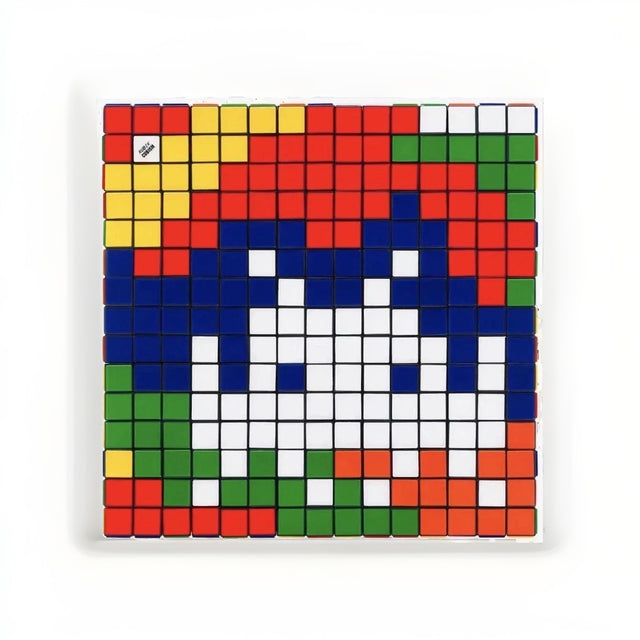
Invader Rubik Camouflage HENI Signed & Numbered 196/812 Giclee Panel 2023
$3,999.00 USD

Browse the collection for current listings.