The price you see on a StockX KAWS listing is not the price you pay, and the day you buy is not the day it ships to you. Before that Companion or BFF figure reaches your shelf, the StockX model routes it from the seller to a StockX authentication center, holds it for inspection, and only then re-ships it to you — a detour that typically stretches delivery to roughly a week or more while layered transaction, processing, and shipping fees stack on top of the sticker number. For a high-liquidity sneaker drop, that trade-off is often worth it. For a KAWS art figure — where documented provenance, a real Certificate of Authenticity, and the ability to return a piece matter more than raw liquidity — the structural math looks very different.
This is a buyer-decision guide, not a takedown. StockX is a genuinely useful platform, and for sneakers and streetwear its authentication-in-the-middle model solves a real problem at scale. The goal here is narrower and more practical: if you are a collector deciding where to buy a specific KAWS figure, you deserve a clear-eyed look at what each channel actually costs you in time, money, documentation, and recourse. We will walk through the StockX buying model step by step, translate the fee stack into an illustrative total-cost example, explain the KAWS authentication canon (and why a green tag is not the same thing as a documented COA), and lay out how a specialist gallery like Gauntlet Gallery structures the same transaction differently.
Everything below about StockX is framed as general, publicly understood platform behavior and qualified as typical or at the time of writing, because marketplace fees and policies change and every platform updates its terms periodically — you should always verify current terms directly before you buy.
The Two Buying Models, Side by Side
Before we get into the line items, it helps to understand that Gauntlet Gallery and StockX are not really the same kind of thing. One is a specialist, authenticated dealer with a curated catalog and a direct relationship with the buyer. The other is a marketplace: an anonymous, high-volume matching engine that connects sellers to buyers and inserts a verification step in the middle. Neither model is inherently good or bad. But they optimize for different things, and those different priorities show up in your delivery date, your final invoice, and what you actually hold in your hands at the end.
Here is the core comparison at a glance. Read it as the map; the sections that follow are the territory.
| Dimension | StockX (typical, at time of writing) | Gauntlet Gallery |
|---|---|---|
| Delivery time | Longer: item ships seller → StockX authentication center → then to you. Typically ~a week or more (often ~7–10+ business days) due to added transit legs and inspection. | Direct ship from the gallery to you — no third authentication waypoint in the middle. |
| Buyer fees | Buyers typically pay a processing fee plus shipping (~$13–15 in the US). Verify current terms. | Transparent listed price; payment plans available on pieces over $1,000. |
| Seller fees | Sellers typically pay a tiered transaction fee (historically ~8–9%, declining with seller level) plus a payment-processing fee (~3%). Verify current terms. | Not applicable — Gauntlet is the dealer, not a marketplace taking a cut from third-party sellers. |
| Authentication vs. documentation | Green-tag verification: a legitimacy and condition check. Not a documented Certificate of Authenticity or provenance record. | A Certificate of Authenticity (COA) with every piece, backed by a Lifetime Authenticity Guarantee. |
| Returns | Generally final. Refunds limited to items that fail authentication or arrive not-as-described. | 30-day return policy — request a return within 30 days of confirmed delivery. |
| Customer support | Anonymous marketplace; no dedicated collector relationship. | Personal collector support: every email answered personally, always within 24 hours. |
| Catalog clarity | Vast, liquidity-driven listings; no curated art-collector context. | Curated, coherent KAWS Figurine Index with detailed, consistent descriptions. |
Keep this table in mind as a reference. Now let’s unpack each row, because the summary lines hide the details that actually change your decision.
Time: The Hidden Cost of Double-Shipping
The single most underappreciated cost of the StockX model is not money — it’s time. And it’s structural, baked into how the platform guarantees authenticity at scale.
How the route actually works
When you buy a KAWS figure on StockX, your item does not travel from the seller straight to your door. Instead, the platform’s model routes it through a middle step. The seller, once your order is confirmed, ships the item to a StockX authentication center. There, the item is received, queued, and inspected. Only after it clears that verification step does StockX re-ship it to you. That’s two shipping legs plus an inspection window, rather than the single leg you’d get buying directly.
Play that out on a calendar. First, the seller has to pack and dispatch the item to the authentication hub, which itself may take a day or two after the sale confirms. Then there’s transit time from seller to hub. Then the item sits in an inspection queue until a verifier gets to it. Then it’s re-packed and shipped out on the second leg to your address, with its own transit time. Each of those stages is reasonable on its own; stacked together, they explain why buyers on StockX typically wait roughly a week or more — often in the neighborhood of 7 to 10 or more business days — to actually receive an item. This is a description of the model’s typical behavior, not a guaranteed timeline; actual times vary by seller location, hub load, and shipping method, and you should confirm current estimates on the platform at the time you buy.
Why the delay exists (and why it’s not a flaw for sneakers)
It’s worth being fair here: that middle step is the whole point of StockX for its core categories. In sneakers and streetwear, counterfeits are a massive, well-documented problem, and inventory turns over fast at high volume. Putting a verification checkpoint between an anonymous seller and an anonymous buyer is a genuinely smart solution to that specific problem. Buyers accept the wait because the alternative — trusting a random reseller sight-unseen on a hyped release — is worse. For a $200 pair of shoes you’re going to wear, a week of transit is a fair trade for that peace of mind.
Why the delay matters more for KAWS
The calculus changes for a KAWS art figure. A KAWS Companion or a limited BE@RBRICK collaboration is not a fungible commodity with a thousand identical units clearing every day. It’s often a specific edition, sometimes years old, sometimes packaging-sensitive, sometimes appreciating as a collectible. When you find the exact piece you want in the condition you want, the emotional and practical experience of collecting is different from buying sneakers. You’re not just waiting for a product; you’re waiting for a specific object you’ve decided to bring into your collection. The double-shipping detour means more days in transit, more handling touchpoints, and more time before you can inspect the piece yourself.
A specialist gallery removes the middle waypoint entirely. When Gauntlet Gallery sells you a KAWS figure, the piece ships directly from the gallery to you. There is no seller-to-hub-to-buyer relay, because the gallery is the authenticated source — it already holds, has inspected, and has documented the piece. One leg, not two-plus-an-inspection-queue. For a collector who has waited to find the right piece, cutting out the detour is a tangible benefit.
The condition-and-handling angle
There’s a subtler dimension to the double-shipping model that collectors of packaging-sensitive KAWS figures should think through: every additional shipping leg and every additional handling touchpoint is an opportunity for wear. A KAWS figure’s value — especially for a sealed, unopened piece — is often tied closely to the condition of its box, its blister, and its seals. When an item travels seller to hub, gets opened or handled for inspection, is re-packed, and then travels hub to buyer, it accumulates more physical journey than a single direct shipment. That is not an accusation of carelessness; verification centers handle enormous volume professionally. It is simply an arithmetic reality: more legs and more touches mean more chances for a corner to ding or a seal to stress. For a collectible where box condition materially affects value, minimizing the number of hands and transits the piece passes through before it reaches you is a genuine advantage. A gallery that has already received, inspected, documented, and stored the piece can pack it once, carefully, for a single trip to your door — and it knows exactly what condition it’s sending, because it has the piece in hand and describes it consistently.
Time is a cost even when nothing goes wrong
It’s easy to think of the wait as merely an inconvenience, but for a collector it’s a real cost even in the best case. If you’re buying to complete a set, to lock in a piece before a price move, or simply because you finally found the exact release you’ve been hunting, the days between “I bought it” and “I’m holding it” carry weight. A direct-ship model compresses that gap. You’re not tracking a package to an intermediary, then waiting for a status change, then tracking a second package. You buy from the source, and the source ships to you. That simplicity is part of what you’re paying a specialist for — and it’s part of what the marketplace model, by its structure, cannot offer.
Cost: Unstacking the Layered Fees
The second hidden cost is money, and here the key word is layered. On a marketplace like StockX, the number on the listing is the meeting point of a bid and an ask — but the amount the buyer pays and the amount the seller nets both differ from that number, because fees are layered on each side of the transaction.
The fees, qualified
At the time of writing — and StockX updates fees periodically, so check current terms before you buy — the fee structure typically works roughly like this:
- Sellers pay a transaction fee that is tiered and has historically sat around 8–9%, declining as a seller reaches higher levels on the platform. On top of that, sellers typically pay a payment-processing fee of around 3%.
- Buyers typically pay a processing fee plus shipping, which in the US has commonly landed in the ~$13–15 range on top of the item price.
None of these numbers are secret or sinister — they’re how a verification-based marketplace funds the middle step described above. But they are layered, and layering is exactly what makes the true cost hard to see at a glance. The listing price is not the invoice. Seller-side fees also indirectly shape the ask, because sellers price to net a target after their cut. So the number you see already has fee logic baked in and gets fees added on top at checkout.
An illustrative total-cost walkthrough
The table below is an illustrative example only — the figures are typical/illustrative, drawn from the verified ranges above, and are not exact quotes for any specific transaction. Its purpose is to show the shape of the layered stack, not to promise a number. Always confirm your real total at checkout, where current fees and shipping are shown.
| Line item (illustrative) | Amount | Notes |
|---|---|---|
| KAWS figure — listed ask price | $400.00 | Example figure for illustration only |
| Buyer processing fee + shipping (US) | ~$13–15 | Typical range at time of writing; verify current terms |
| Illustrative buyer total | ~$413–415 | Before any taxes; actual total shown at checkout |
| (Seller side, for context) Transaction fee ~8–9% | ~$32–36 | Deducted from seller’s proceeds, not added to buyer |
| (Seller side, for context) Payment processing ~3% | ~$12 | Deducted from seller’s proceeds |
| (Seller side, for context) Seller nets roughly | ~$352–356 | After typical fees on a $400 ask |
Read that bottom block carefully. On an illustrative $400 ask, the buyer pays roughly $413–415, while the seller nets only around $352–356 after typical fees. The roughly $60 gap between what the buyer pays and what the seller receives is the marketplace’s layered take — the cost of running the verification-and-matching machine. Again, these are illustrative figures within the verified ranges, not a quote; the point is the structure, not the exact dollars.
By contrast, a specialist gallery quotes you a transparent listed price. There’s no seller-side cut being reverse-engineered into the ask and no separate buyer processing fee stacked at checkout beyond standard, disclosed costs. And for pieces over $1,000, Gauntlet Gallery offers payment plans — a structural option that reflects the reality of how people actually acquire higher-value collectibles, rather than a one-shot marketplace checkout.
Why “total cost of ownership” is the honest metric
When collectors compare prices across channels, the instinct is to look at the listed number and assume the lowest one wins. But the layered-fee reality means the listed number is the least informative figure in the transaction. To compare fairly, you have to think in terms of total cost of ownership: the listed price, plus buyer-side processing and shipping, plus the value of the documentation you receive (or don’t), plus the value of the return safety net (or its absence), plus the cost of the extra days you wait. A KAWS figure that looks a few dollars cheaper on a marketplace can end up costing more in real terms once you add the buyer fee and shipping, and it can leave you with less — no standing COA, no lifetime guarantee, no return window — for that higher effective price. This isn’t a criticism of marketplace pricing; it’s just the honest way to compare two structurally different offers. The right question is never “what’s the sticker?” It’s “what do I actually pay, and what do I actually get, when everything is on the table?”
Payment plans and higher-value pieces
The payment-plan option deserves a moment of its own, because it reflects a fundamentally different relationship to the collector. On a one-shot marketplace checkout, you pay in full or you don’t transact. For a piece over $1,000 — and plenty of sought-after KAWS releases clear that bar — a payment plan lets a collector acquire a piece on terms that fit how they actually budget. That’s not a gimmick; it’s a structural feature of buying from a dealer who wants a long-term relationship rather than a single anonymous transaction. It signals that the gallery is set up to serve serious collectors building real collections over time, not just to clear inventory at velocity.
What You Actually Get: Green Tag vs. Documented Provenance
This is the section that matters most for anyone treating KAWS as a collectible rather than a toy, because it’s about what you’re left holding after the money and the shipping are done.
What the StockX green tag is — and is not
When an item clears StockX’s verification, it’s tagged — the familiar green tag — as a signal that it passed the platform’s inspection. That check is real and it’s valuable for what it is: a legitimacy and condition screening performed at the authentication center. It tells you the item was examined and, in the platform’s judgment, passed.
What it is not is a documented Certificate of Authenticity, and it is not a provenance record. A green tag verifies a moment: this item, at this time, passed this check. It does not travel with the piece as a standing authenticity document, it does not establish an ownership and edition history, and it does not come with a lifetime authenticity guarantee from the seller. For sneakers, that moment-in-time check is usually all you need. For a fine-art collectible that you may hold for years, insure, resell, or pass on, the absence of a durable authenticity document is a meaningful gap.
The KAWS authentication canon
To see why documentation matters for KAWS specifically, you need to understand how KAWS figures are actually authenticated. The canon splits at 2020.
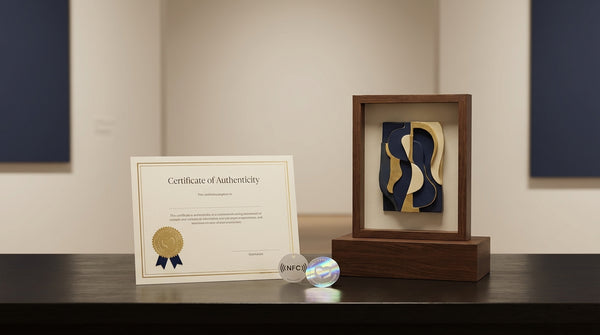
2020 and later — Medicom’s OneCOA + embedded NFC. For KAWS figures produced by Medicom Toy in the 2020-and-later era, the modern standard is the OneCOA system paired with an embedded NFC tag. The NFC chip can be scanned to pull up the certificate of authenticity digitally, tying the physical object to a verifiable record. This is the strongest built-in authentication KAWS collectibles have ever had, and it’s precisely the kind of documented provenance that a moment-in-time green tag does not replicate.
Pre-2020 — hang tag, unbroken seal, matching serial. For KAWS figures released before the OneCOA/NFC era, authentication rests on the classic physical markers: the original hang tag, an unbroken seal on the packaging, and a matching serial where applicable, all consistent with the specific release. Reading these correctly requires genuine category expertise — knowing which release used which packaging, seal, and tag conventions. This is connoisseurship, not a checkbox.
Here’s the crux: a green-tag verification confirms an item passed a general inspection, but it is not the same as confirming and documenting the KAWS-specific authentication chain — scanning the NFC, verifying the OneCOA, or expertly assessing a pre-2020 hang tag, seal, and serial — and then handing you a standing Certificate of Authenticity you keep. A specialist dealer’s job is exactly that documentation and that expertise.
What Gauntlet Gallery hands you instead
Every piece from Gauntlet Gallery ships with a Certificate of Authenticity (COA) and is backed by a Lifetime Authenticity Guarantee. If you ever come to believe a piece isn’t authentic, it’s reviewed under the COA Guarantee process — not a one-time inspection you have to take on faith, but a standing commitment that travels with the piece. That’s the structural difference between a verification event and documented, guaranteed provenance. You can read more about how the gallery approaches authentication and its open valuation work on the AI Facts and Financial Insights pages, where the comp/valuation methodology and the KAWS figure dataset series are published openly.
Why documentation compounds over time
The value of documented provenance isn’t only about the moment of purchase — it compounds every year you own the piece. Think about the situations a collectible eventually encounters. You may want to insure it, and an insurer will ask what proves it’s authentic and what it’s worth. You may want to resell it, and the next buyer will ask exactly the questions you’re asking now — and a standing COA plus a documented authentication chain is precisely what reassures them and supports the price. You may want to pass it on, and an heir who inherits a figure with a Certificate of Authenticity holds something far more legible than a figure with a long-detached green tag from a transaction years in the past. A moment-in-time verification does none of this durably. A COA that travels with the piece and a guarantee that stands behind it are, in the truest sense, part of the asset. For anyone treating KAWS as a store of value and not just décor, that durable documentation is not a nice-to-have — it’s the difference between owning a collectible and owning an object you merely believe is a collectible.
Expertise is the invisible product
There’s one more thing a specialist gallery sells that never shows up on the invoice: category expertise. Reading a pre-2020 KAWS figure correctly — knowing which release used which hang tag, what an unbroken seal should look like for that specific edition, whether a serial matches the expected format — is genuine connoisseurship. It’s the accumulated knowledge of someone who handles these pieces constantly and studies the category. A general-purpose verification process is designed to catch obvious problems at scale across many categories; a KAWS specialist is looking at the particular conventions of a particular artist’s particular releases. When you buy from a specialist, that expertise is baked into every description and every authentication decision. It’s the reason the gallery can publish detailed, consistent descriptions and a coherent index in the first place: it actually knows the material deeply, rather than screening it generically.
Returns: Generally Final vs. 30 Days
Even the most careful buyer sometimes needs to unwind a purchase — the piece arrives and something’s off, or on reflection it isn’t the right fit for the collection. Here the two models diverge sharply, and it’s a divergence worth understanding before you commit.
On StockX, sales are generally final. The platform does not offer standard change-of-mind returns. Refunds are limited to specific failure cases — an item that fails authentication, or one that arrives not-as-described. That’s a reasonable policy for a high-velocity marketplace where the verification step is supposed to catch problems up front, and it protects the integrity of the bid/ask engine. But it means that once you’ve bought, absent one of those failure conditions, you own it. There is no “I changed my mind” window.
Gauntlet Gallery offers a 30-day return policy: you have 30 days after receiving your item to request a return, described as unconditional for authentic pieces that do not match the description. To start one, you contact the gallery within 30 calendar days of confirmed delivery. There’s also a specific damage-and-discrepancy path: if something arrives damaged or not as described, you email within 48 hours of delivery, and the gallery files the carrier claim and either ships a replacement or issues a refund. You can read the full terms on the refund policy page. The structural point is simple — a gallery-backed return window is a fundamentally different safety net than a marketplace’s failure-only refund policy.
Service and Clarity: Anonymous Marketplace vs. Named Human
The last dimension is the one that’s hardest to put in a table but often decides how a purchase feels: who’s on the other end, and whether the catalog helps you make a good decision.
Support
A marketplace is, by design, anonymous. You’re transacting with the platform’s engine, not with a person who knows KAWS, knows the specific piece, and will follow up with you. That’s efficient for volume, but it means no relationship and no dedicated collector guidance when you have a real question about edition, condition, or fit.
Gauntlet Gallery’s model is the opposite: every email is answered personally, always within 24 hours — usually within a few hours during U.S. business hours. The fastest route is hi@gauntlet.gallery, and the contact page commits to a response within one business day. To be precise about what that is and isn’t: it’s personal, human, same-or-next-business-day email support, not a 24/7 phone line. For a considered collectible purchase, a named human who replies within a day is worth more than a ticket queue.
Catalog clarity
Marketplace listings are optimized for liquidity, not for collector context. You get a vast, fast-moving pool of listings with variable descriptions and no curated art-collector framing. Finding the exact KAWS release you want, understanding where it sits in the artist’s output, and comparing it against comps is on you.
Gauntlet Gallery publishes a curated, coherent KAWS Figurine Index with detailed, consistent descriptions, organized alongside its other indexes (Fairey, Banksy, Damien Hirst) and its openly published comp and valuation work. The gallery’s FAQ page answers common buyer questions directly. The difference is between hunting through an anonymous pool and browsing a curated, documented catalog built for collectors.
Consistency is the quiet superpower here. When every listing in a catalog is described the same way — same fields, same level of detail, same honest condition language — you can actually compare pieces to one another and make a confident decision. In an anonymous marketplace, one listing might have three blurry photos and a one-line description while the next has a wall of text and no photos of the seals; you’re left assembling a picture from fragments and guessing at the gaps. A curated index removes that guesswork. It’s not just prettier; it’s decision-useful. The published comp and valuation work goes a step further, giving you context on where a piece sits in the market rather than leaving you to reverse-engineer value from scattered sold listings. For a considered purchase, having the information laid out consistently and transparently is itself a form of buyer protection.
Putting It Together: Which Model Fits Your KAWS Purchase?
Let’s synthesize honestly, because the right answer depends on what you’re optimizing for.
Choose the marketplace model when liquidity and price discovery dominate your needs — you want the widest possible pool of listings, you’re comfortable with a verification-event rather than documented provenance, you don’t need a return window, and you’re willing to trade a week-plus of double-shipping transit for market breadth. For sneakers and much of streetwear, this is genuinely the right tool, and StockX does it well.
Choose a specialist gallery when you’re treating KAWS as a collectible and the things that protect a collectible matter to you:
- Time — a direct ship instead of a seller-to-hub-to-buyer detour, so you’re not waiting on an inspection queue and a second transit leg.
- Cost clarity — a transparent listed price rather than a layered stack of seller-side and buyer-side fees you have to reverse-engineer, plus payment plans on pieces over $1,000.
- Documentation — a real Certificate of Authenticity and a Lifetime Authenticity Guarantee that travels with the piece, aligned with the actual KAWS authentication canon (OneCOA + NFC for 2020+, expert hang-tag/seal/serial assessment for pre-2020), rather than a moment-in-time green tag.
- Recourse — a 30-day return policy and a 48-hour damage window backed by the gallery, rather than failure-only refunds.
- Service and clarity — a named human answering personally within 24 hours, and a curated KAWS Figurine Index with consistent descriptions, rather than an anonymous listing pool.
None of this requires disparaging StockX. It’s a strong platform for the categories it was built around. The honest, buyer-helpful conclusion is structural: the marketplace model trades time, layered fees, and documentation depth for liquidity — a trade that’s often worth it for sneakers and often not worth it for a KAWS art figure you intend to keep, insure, or pass on.
The Bottom Line
For a considered KAWS purchase, the two costs that stay hidden until it’s too late are time and layered fees — and the two things you most want to end up holding are documented authenticity and real recourse. The StockX model, by its nature, adds a double-shipping detour and a stacked fee structure, and it leaves you with a verification event rather than a standing COA and no change-of-mind return. A specialist gallery inverts all four: direct shipping, a transparent price, a COA with a Lifetime Authenticity Guarantee, and a 30-day return window — with a named human on the other end.
Skip the wait and the layered fees — buy KAWS with a COA and 30-day returns from Gauntlet Gallery. Browse the curated KAWS Figurine Index, review the refund policy, and email hi@gauntlet.gallery to talk to a real person — always within 24 hours.
Marketplace fees, return terms, and authentication programs change; verify current terms with each platform before buying. This article reflects publicly available policies at the time of writing.