You've found a Shepard Fairey signed print listed online. It says "hand-signed and numbered." The price seems reasonable. There's a certificate of authenticity included.
And you still have no idea whether the signature is real.
That's the central problem collectors face in this market. Fairey's work is among the most counterfeited in contemporary street art. Unsigned standard editions get passed off as signed. Printed numbering gets confused with hand-inscribed numbering. Edition types — SE, AP, PP, HPM — blur together in marketplace listings that treat them as interchangeable. A generic COA printed by the seller doesn't resolve any of it.
This guide gives you a different framework: a verified signature workflow built around physical evidence, release-specific documentation, and provenance — not a printed card. By the end, you'll know exactly what to check, what to ask for, and how to add a properly authenticated Shepard Fairey signed piece from Gauntlet Gallery's Shepard Fairey collection to your collection with confidence.
What "verified signature" actually means for Fairey prints
A verified signature isn't just a signature you can see on the print. It's a signature you can confirm against the specific release it belongs to.
For Shepard Fairey's standard editions, that means:
- The artist's hand-signed pencil signature appears directly on the print (typically lower right margin)
- The edition number is hand-inscribed in pencil by the artist (typically lower left), with natural variation in line weight and pressure — not mechanically printed
- The stamp or blind emboss on the verso matches what the OBEY Giant studio applied to that specific release
- The paper, dimensions, and print method correspond to known release specifications
A seller who offers only a self-printed certificate is giving you paper that proves nothing about the object in front of you. Authentication for street art prints is about evidence and provenance, not a printed card. As Gauntlet puts it: ask any seller to document where the piece came from and to confirm the signature, edition number, and publisher.
Older works — releases from the early 2000s, for instance — won't have blockchain-backed digital COAs like those Verisart issues for more recent pieces. That's normal. What matters is whether the physical object itself, combined with whatever documentation exists, holds up against release-specific verification. Gauntlet reviews every Fairey listing against signature behavior, hand-inscribed numbering, paper and print method, and provenance trail, regardless of whether a digital certificate exists.
Choose the right edition type first
You can't verify a "signature" if you haven't confirmed the edition type, because the verification standard differs by category.
Gauntlet's market focus for Fairey is deliberately narrow: signed, numbered standard editions. This is the category with the most liquidity, the most comparable sales data, and the clearest authentication framework. It's also where confusion is highest among buyers.
Here's what to keep straight:
- Signed + numbered standard edition (SE): The main commercial release. Hand-signed and hand-numbered by the artist. This is what most collectors mean when they say "signed Fairey."
- Artist Proof (AP): Printed outside the numbered edition, typically at 10–15% of the total run. Also signed. Commands a premium over SEs in most cases, but requires its own documentation confirming the AP designation.
- PP (Printer's Proof) / HPM (Hand-Painted Multiple): Distinct categories with separate value profiles. Don't treat them as "basically signed" without release-specific confirmation.
- Unsigned standard editions: Some releases were produced in both signed and unsigned versions. An unsigned edition with a number penciled on it is not a signed edition.
Dimension mismatches are another trap. If a listing says 18x24 inches but the release spec was 18x24 for the unsigned version and 24x36 for the signed variant, you could be looking at the wrong object entirely.
Get the edition type right before you run any authentication check. The Shepard Fairey edition-types guide at Gauntlet walks through how edition categories map to physical characteristics for each type.
The 5-point verified-signature checklist
Gauntlet's authentication process, developed across a database of Fairey transactions, starts with five physical checks. Four of them you can run yourself from listing photos.
1. OBEY GIANT stamp or blind emboss (verso)
Authentic Fairey screen print releases carry an OBEY GIANT studio stamp or blind emboss on the back. The specific placement and format varies by release year and type, so match what you see against the known spec for that release. If the verso is absent from listing photos, request them before proceeding.
2. Hand-inscribed edition numbering, not printed
This is one of the most commonly faked or confused elements. The edition number (e.g., 47/350) should be written in pencil by hand, with visible variation in line weight, slight inconsistency in letter spacing, and natural pressure irregularities. Printed numbering — uniform, slightly indented into the paper, ink-deposited — is a flag. If the "pencil" notation looks too clean and consistent, zoom in.
3. Paper weight and stock
Authentic Fairey screen prints are typically produced on 200–300 gsm archival stock. The paper should feel substantial, resist bending, and show clean ink absorption without bleeding. Thin paper that transmits light or flexes easily is a strong indicator of a reproduction. If you're examining in person, hold the sheet to backlight. For online purchases, ask for a photo of the corner held between fingers to gauge thickness.
4. Ink saturation under magnification
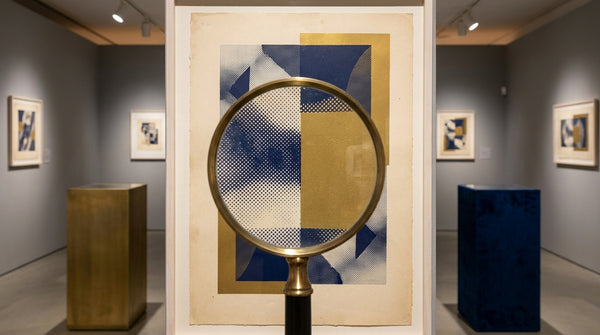
Screen prints produce a solid ink deposit at the cellular level. Under 10x magnification (a loupe or a macro phone photo), authentic screenprint ink looks dense and smooth at the edges of each color field. Dot-matrix patterns — tiny evenly-spaced dots forming the image — indicate digital reproduction, not screenprint. This is the clearest technical differentiator between an authentic screenprint and a high-quality inkjet forgery.
5. OBEY GIANT documentation: receipt, invoice, packaging
This is the one check that no amount of physical examination replaces. The OBEY Giant studio ships primary releases with documentation. An original purchase receipt from the Obey Giant store, a gallery invoice from an authorized seller, or original studio packaging confirms the chain of custody in a way that physical inspection alone cannot. Gauntlet's position on this is unambiguous: no documentation means no purchase.
What listing photos should show you
For any piece you're seriously considering, you should be able to see: full front, full back (showing the stamp/emboss), close-up of the signature, close-up of the edition number, paper corner detail showing thickness, and any accompanying paperwork. If a listing only shows the front face, ask. Any seller confident in their provenance will send you everything.
How provenance and market comps work together
Verification doesn't stop at the physical object. At Gauntlet, an authentication decision is release-specific, provenance-backed, and comp-plausible. That last part is worth explaining.
Comps — comparable sales records for the same or closely matched release — aren't authentication evidence. A print isn't real because it sold for the right price, and it isn't fake because the price is low. But comps are a plausibility tool. If a piece is priced 60% below every recorded sale for that edition with no explanation, that's a flag worth investigating. If the price is in line with the documented market range for that specific signed/numbered edition, that's a plausibility signal in the other direction.
Gauntlet's authentication page documents over 42,386 Fairey comps checked, with a $225 median print comp across matched works. The Shepard Fairey collection page tracks 31,786 comps with a $250 median sale and a $46K top result. That depth of data — over 37,000 recorded sales across more than 14,000 distinct works — gives buyers and the gallery's team meaningful context when evaluating whether a price and a piece are consistent with how this specific edition has traded historically.
For collectors, this matters practically: outlier cheap listings without documentation aren't just suspicious on authentication grounds. They're anomalies that can't be explained by normal market behavior. The Shepard Fairey print market data guide covers how to read and apply these numbers without misusing them.
Step-by-step: add a verified Fairey to your collection via Gauntlet
If you're ready to buy, here's the actual flow:
- Browse the collection. Go to Gauntlet's Shepard Fairey prints page and filter for signed/numbered listings. Every listing states the edition type (SE, AP, etc.), edition size, and dimensions.
- Read the product page carefully. Gauntlet's listings include signature details, edition notation, print method, paper spec, and any documentation included with the piece. The "Demagogue" 2016 screen print is a good example: it lists hand-signed in pencil, hand-numbered (edition of 500), and OBEY Giant embossed blind stamp verso — the full stack of documentation markers in a single listing.
- Confirm edition format and documentation match. Make sure the listing says "signed" and that the documentation described (receipt, packaging, COA if present) corresponds to the specific piece being sold, not a generic gallery certificate.
- Add to cart or wishlist. If you're not ready to commit, Gauntlet supports wishlisting. When you are ready, checkout includes insured, tracked shipping with fine-art packaging.
- Ask questions before you buy. If anything about the signature details, edition documentation, or provenance isn't fully clear from the listing, contact Gauntlet before purchasing. That's exactly the kind of buyer-seller dialogue that should happen on a verified signature transaction. Listings like the RBG A Champion of Justice signed AP note four layers of authentication explicitly — hand-signed, hand-numbered, OBEY Giant blind stamp, and COA — and the gallery will walk you through each one.
Quick FAQ: do you need a COA to trust the signature?
Not necessarily, especially for older works. The OBEY Giant studio didn't ship COAs by default with primary releases the way some other studios do. For many secondary-market pieces, the authentication chain runs through original purchase documentation (receipt or invoice), packaging, and physical evidence. A formal COA, where it exists, adds a layer of confidence but isn't the foundation of the verification — the physical evidence and provenance are.
What about comps as authentication? Comps tell you whether a price is plausible given market history. They don't tell you whether a signature is real. Use them as a plausibility check, not a substitute for physical and documentary evidence.
What photos do you need? At minimum: full front, full back, signature close-up, edition number close-up, paper corner detail, any paperwork visible. For higher-value pieces, request a macro shot of the ink field under zoom.
What if a listing is missing documentation? Walk away. There's no workaround for a missing provenance trail on a signed edition. As Gauntlet's buying guidance states plainly: no documentation means no purchase.
Your next move: find the right first Fairey
For most collectors adding their first verified Shepard Fairey signed piece, the smartest starting point is a signed, numbered standard edition with full documentation and a median-range price. These pieces have the most liquidity, the most comparable sales to benchmark against, and the clearest authentication pathway.
Avoid listings priced significantly below the documented comp range without a clear condition explanation. And don't let the availability of digital COA infrastructure (like Verisart's blockchain-backed certificates for more recent releases) lead you to over-weight the certificate and under-weight the physical evidence for older pieces.
Gauntlet's guide to buying authenticated Shepard Fairey prints is worth reading alongside this checklist if you're still calibrating your budget and subject focus. And if you want to see what a fully documented, evidence-stacked listing looks like from the start, the Shepard Fairey collection is the place to begin — every piece verified, every provenance record on file, and the gallery's team available to answer questions before you commit.
A verified signature isn't a claim on a certificate. It's a conclusion supported by physical evidence, release-specific documentation, and a provenance trail that holds up. That's the standard worth buying to.
Frequently Asked Questions
How do I verify a Shepard Fairey signature?
Check the signature and numbering conventions, paper and printing quality, and edition consistency, then confirm provenance. Fairey's market relies on documented provenance and edition consistency rather than a standard per-piece certificate.
Do Shepard Fairey prints come with a certificate of authenticity?
Generally they rely on provenance and edition documentation rather than an artist-issued COA. Trust a documented ownership trail and a seller who authenticates before listing.
How do I tell a real Shepard Fairey print from a fake?
Watch for off-register or soft printing, wrong paper or dimensions, inconsistent signatures/numbering, and missing provenance.
Where can I buy authenticated Shepard Fairey prints?
Gauntlet Gallery authenticates Fairey prints before listing and shows comparable-sales context, benchmarking value against 300,000+ records.