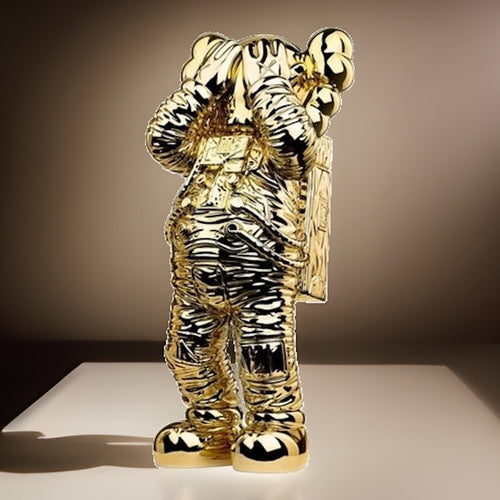
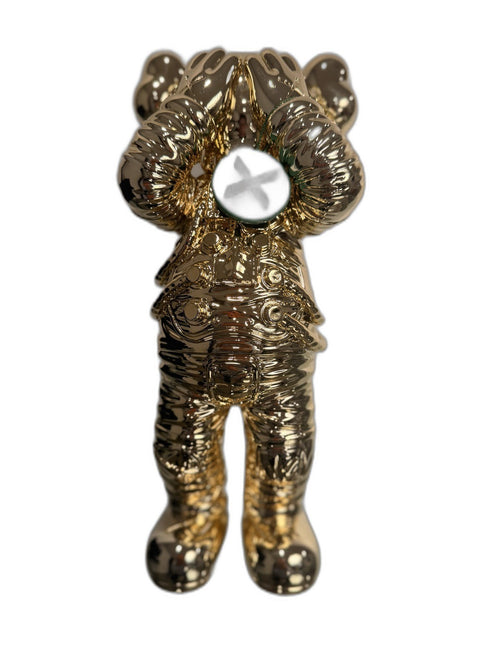
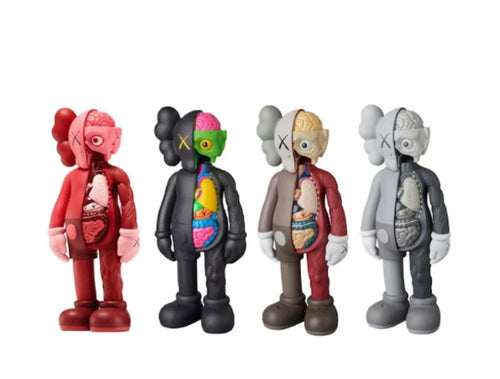
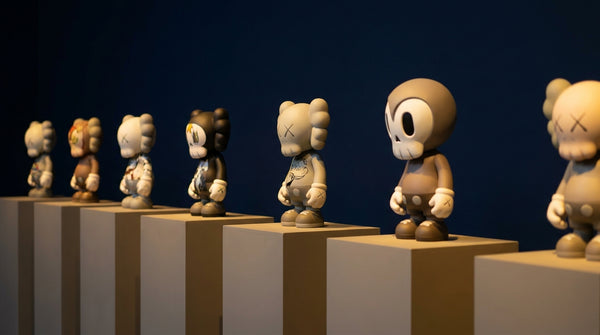
The cheapest authenticated KAWS Companion in our catalogue trades around $209 today; the most expensive, a Four Foot Companion in grey, sits at a recorded $68,000. Between those two poles lives one of the most liquid, most misunderstood, and most emotionally traded markets in all of contemporary collectibles — and the gap between what a buyer pays and what a buyer gets is almost never explained in dollars. This article fixes that.
If you are considering your first KAWS Companion, or your fifth, the single most useful mental model is a ladder. Each rung is a price band. Each band buys you a different kind of object — a different rarity profile, a different comp depth, a different appreciation engine, and a different risk. A $200 open-edition Companion and a $3,600 chrome grail are both “KAWS Companions,” but they are as different as a dividend stock and a venture bet. Treating them as interchangeable is the fastest way to overpay.
Below we walk the ladder rung by rung, using only figures from our Companion catalogue: 64 distinct Companion records spanning 1999 to 2023, each carrying a current fair value, an observed sale range, a median of recorded public sales, a count of real sold comps, and a confidence label. We will tell you what to prioritize at each tier, how condition and documentation move the number, and how to read a comp so you are never fooled by a single lucky auction result.
One caveat before we climb. This piece is about the catalogue market — the accessible-to-mid figures that ordinary collectors actually buy and sell. It is not about the record-setting fine-art tier. The widely reported 2019 Sotheby’s Hong Kong sale of the large pink Companion work “The KAWS Album” — reported at roughly US$14.8 million — is public record and belongs in a different universe from the objects here. We mention it once, for scale, and then leave it alone. Nothing in our value ladder is derived from or comparable to that hammer price.
Why “Companion” Is the Right Lens for a First Buy

KAWS — Brian Donnelly — has produced a sprawling body of vinyl and plush work, from BE@RBRICK collaborations to Chum, Accomplice, BFF, and dozens of holiday-market exclusives. But the Companion, the gloved, cross-eyed, Mickey-descended figure first released as a vinyl edition in 1999, is the spine of the entire market. It is the most produced, the most traded, and therefore the most legible KAWS object. Legibility is the collector’s friend: the more a figure sells, the more confidently we can price it, and the less likely you are to overpay on emotion.
Across our full 214-release catalogue, the median value is $500 and the mean is $1,983 — a spread that tells you immediately the market is bottom-heavy with accessible pieces and top-loaded by a handful of grails. Of the whole catalogue, only 10 figures clear $3,000, another 30 sit in the $1,000–$3,000 band, and 174 live under $1,000. The Companion lineage mirrors that shape almost exactly. This is a market where the entry door is genuinely affordable and the ceiling is genuinely astronomical, with a wide, well-trafficked middle.
That structure is the whole reason a ladder works. You can start at $200–$350 with a piece backed by dozens of sold comps, learn the market with real skin in the game, and climb only when your knowledge — and your appetite for illiquidity — justifies it.
A Note on Methodology: How to Read the Confidence Labels
Before any dollar figure means anything, you need to understand how sure we are of it. Every record in our catalogue carries a confidence label — high, medium, low, or insufficient — and it is the most important column in every table below. Here is what each level means and how you should let it change your behavior as a buyer.
- High confidence. The figure is anchored by a deep pool of real, recorded public sales — typically 20 or more sold comps. The observed range is wide enough to be honest and the median is statistically meaningful. When you see “high,” you can transact near the median with confidence and treat outliers on either end as noise. In our Companion data, the open-edition Companions and the Small Lie and Time Off pinks fall here.
- Medium confidence. A respectable but thinner pool — often a handful to a couple dozen comps. The median is directional but a single strong or weak sale can still tug it. Buy near the median, but budget for a wider margin of error and lean harder on condition and completeness to justify your price.
- Low confidence. Few comps — sometimes only a couple — or a range so wide it signals a market still finding its footing. Treat the printed value as a hypothesis, not a fact. Negotiate. Demand documentation. Assume the true clearing price could sit meaningfully above or below the label.
- Insufficient. One recorded sale, or zero. The “value” here is an informed estimate, not a market-tested number. These figures are the most dangerous to a naive buyer because they look as precise as the high-confidence ones. They are not. When you see “insufficient,” slow down and treat the price as a starting point for research, never a conclusion.
Across the full catalogue, the confidence distribution is sobering: 27 high, 21 medium, 54 low, and 112 insufficient. In other words, the majority of KAWS releases do not have a deep, liquid comp history. That is not a reason to avoid them — scarcity and thin trading are exactly what make grails appreciate — but it is a reason to treat the confidence label as a co-equal to the price itself. A $500 figure with 40 sold comps and a $500 figure with zero are two entirely different investments wearing the same number.
Keep this framework in your head as you climb. At each rung we will call out the confidence level, because the quality of a price is as important as the price.
Rung One — Under $500: The Accessible Base of the Ladder
This is where the vast majority of new collectors should start, and where a surprising amount of long-term value is quietly compounding. The under-$500 rung is dominated by open editions and recent standard vinyl releases — pieces that KAWS and Medicom produced in large numbers, sold at accessible retail, and that now trade on a deep, well-documented secondary market.
The anchor of this tier is the 2016 open-edition Companion, released at $200 retail across three colorways. Today the brown trades at a fair value of $360, the black at $340, and the grey at $335. What makes these the single best on-ramp in the entire KAWS market is not the modest appreciation over retail — it is the comp depth behind it. The black open edition carries 61 sold comps at high confidence, the grey 46, and the brown 42. When 61 real sales underpin a $340 figure with an observed range of $200 to $599 and a median of $325, you are buying about as close to a transparent, efficient market as this hobby offers. You will almost never overpay, and you will almost never be stuck when you sell.
The 2018 Passing Through open editions tell the same story: the grey at $303 (39 comps, high confidence, observed $208–$1,000), the brown at $307 (28 comps, medium), and the black at $290. The wide top of the observed range — a grey Passing Through open edition has changed hands as high as $1,000 — hints at what condition and packaging can do even at the entry level, a theme we return to below. The 2017 Small Lie releases round out the tier’s high-confidence core: the black at $300 (39 comps), the brown at $317 (27 comps), and the grey at $440 (20 comps), all at $220 retail.
Also camped in this band are the 2023 Time Off pinks and blues. The Time Off pink sits at $365 with 28 sold comps at high confidence and an observed range of $267 to $495; the Time Off blue at $368 (7 comps, medium); the Time Off black lower at $220 (3 comps, low). These are among the most recent Companions to already show a stable, liquid resale market — a useful signal that a release has “graduated” from speculative to established.
Here is the under-$500 tier laid out in full:
| Figure | Year | Retail | Fair Value | Observed Range | Median | Comps | Confidence |
|---|---|---|---|---|---|---|---|
| Small Lie — Grey | 2017 | $220 | $440 | $200–$486 | $350 | 20 | high |
| Companion (Open Edition) — Brown | 2016 | $200 | $360 | $218–$750 | $350 | 42 | high |
| Time Off — Blue | 2023 | $320 | $368 | $340–$420 | $360 | 7 | medium |
| Time Off — Pink | 2023 | $320 | $365 | $267–$495 | $370 | 28 | high |
| Companion (Open Edition) — Black | 2016 | $200 | $340 | $200–$599 | $325 | 61 | high |
| Companion (Open Edition) — Grey | 2016 | $200 | $335 | $200–$550 | $300 | 46 | high |
| Small Lie — Brown | 2017 | $220 | $317 | $250–$486 | $311 | 27 | high |
| Passing Through (OE) — Brown | 2018 | $200 | $307 | $250–$650 | $292 | 28 | medium |
| Passing Through (OE) — Grey | 2018 | $200 | $303 | $208–$1,000 | $280 | 39 | high |
| Small Lie — Black | 2017 | $220 | $300 | $218–$655 | $300 | 39 | high |
| Passing Through (OE) — Black | 2018 | $200 | $290 | $200–$1,000 | $290 | 36 | low |
| Companion (Blush) | 2017 | $200 | $268 | $220–$625 | $268 | 4 | insufficient |
| Companion 2020 (20th Anniv.) — Black | 2020 | $380 | $233 | $217–$217 | $217 | 1 | low |
| Time Off — Black | 2023 | $320 | $220 | $200–$320 | $220 | 3 | low |
| Distorted Companion — Brown | 2010 | — | $209 | $209–$209 | $209 | 1 | insufficient |
What your money buys here. Liquidity, education, and a genuinely low-risk introduction to authenticated KAWS ownership. These pieces are unlikely to make you rich, but they are also unlikely to hurt you, and they are the ideal place to make your beginner mistakes cheaply.
What drives appreciation. Three forces. First, the slow ratchet of a growing global collector base bidding on a fixed supply of a discontinued edition. Second, condition scarcity — most open editions were bought to display, so mint, boxed, sealed examples become rarer every year even as the nominal edition size stays fixed. Third, colorway preference: within a single release, greys and browns often command a premium over blacks, a pattern visible across the Small Lie and open-edition lines, where the grey Small Lie ($440) sits well above its black sibling ($300).
What to watch. Note the two traps in the table above. The Companion (Blush) at $268 and the Distorted Companion brown at $209 both carry insufficient confidence — the blush on only 4 comps, the distorted on a single sale. Their prices are plausible but untested. And the 2020 20th-Anniversary black shows how a nominally premium release ($380 retail) can underperform retail on the secondary market, sitting at $233 on a single low-confidence comp. Retail price is not destiny. The market decides.
Rung Two — $500 to $1,000: The Collector’s Middle

Climb one rung and the character of the ladder changes. The $500–$1,000 band is where you leave the deep, liquid open-edition pool and enter the world of standard-run named sculptures, anniversary pieces, and early figures with real scarcity but thinner comp histories. This is the connoisseur’s tier: the pieces here reward knowledge, and they punish buyers who mistake a printed value for a guaranteed clearing price.
The high-confidence workhorses of this band are the 2018 Clean Slate releases. Clean Slate brown sits at $959 (21 comps, high, observed $225–$1,899), grey at $861 (16 comps, medium), and black at $768 — and critically, the black is backed by 27 sold comps at high confidence with an observed range of $400 to $1,800. That is a $480-retail figure that has roughly tripled in fair value on a genuinely deep comp base. When a mid-tier piece carries high confidence, you can treat its median as gospel; Clean Slate is the closest thing this rung has to the open-edition certainty of Rung One.
Contrast that with the 2019 Gone series, a poignant, much-loved release that trades higher on emotion than on data. Gone black carries a fair value of $1,250 — but on a single sold comp (low confidence). Gone brown sits at $920 with 3 comps (medium, observed $866–$1,050), and Gone grey at $762 on one comp (low). The Gone figures are desirable and the values are plausible, but the thin comp counts mean you should negotiate hard, demand pristine condition, and never pay the top of an observed range without a reason.
The rest of the tier is a study in the insufficient label. The 2022 Promise trio — black, grey, and brown — all sit at $690 with zero recorded sold comps at insufficient confidence; the figure is an estimate off an observed range of $602–$750, not a market-tested price. The 2020 Take releases ($596 pink and black, $580 blue) and the 2020 Share series ($750 black, $554 brown, $550 grey) are mostly thin: Take pink and black have zero comps, Share brown is the exception at 5 comps (medium). The 2018 Together trio all print at $500 with zero comps, as do the 2019 Along The Way trio at $500. The 1999 original Companions — grey at $750 (1 comp) and black down at $458 (10 comps, insufficient) — are historically significant but rarely traded cleanly, hence the soft confidence.
Here is the middle rung:
| Figure | Year | Retail | Fair Value | Observed Range | Median | Comps | Confidence |
|---|---|---|---|---|---|---|---|
| Gone — Black | 2019 | $580 | $1,250 | $1,250–$1,250 | $1,250 | 1 | low |
| Gone — Brown | 2019 | $580 | $920 | $866–$1,050 | $999 | 3 | medium |
| Clean Slate — Brown | 2018 | $480 | $959 | $225–$1,899 | $975 | 21 | high |
| Clean Slate — Grey | 2018 | $480 | $861 | $500–$1,200 | $790 | 16 | medium |
| Companion Bear (Undercover) — Black | 2009 | — | $825 | $349–$450 | $400 | 2 | low |
| Boba Fett Companion | 2013 | — | $805 | $750–$1,150 | $805 | 0 | insufficient |
| Companion Bear (Undercover) — White | 2009 | — | $799 | $349–$910 | $630 | 4 | low |
| Clean Slate — Black | 2018 | $480 | $768 | $400–$1,800 | $760 | 27 | high |
| Gone — Grey | 2019 | $580 | $762 | $825–$825 | $825 | 1 | low |
| Share — Black | 2020 | $360 | $750 | $550–$750 | $750 | 4 | low |
| Companion (Original) — Grey | 1999 | — | $750 | $750–$750 | $750 | 1 | insufficient |
| The Promise — Black / Grey / Brown | 2022 | $480 | $690 | $602–$750 | $690 | 0 | insufficient |
| Stormtrooper Companion | 2009 | — | $650 | $473–$900 | $650 | 0 | insufficient |
| Take — Pink / Black | 2020 | $360 | $596 | $550–$627 | $596 | 0 | insufficient |
| Companion 2020 (20th Anniv.) — Grey | 2020 | $380 | $589 | $589–$589 | $589 | 1 | insufficient |
| Take — Blue | 2020 | $360 | $580 | $580–$580 | $580 | 1 | low |
| Share — Brown | 2020 | $360 | $554 | $350–$810 | $574 | 5 | medium |
| Share — Grey | 2020 | $360 | $550 | $500–$600 | $550 | 0 | insufficient |
| Together — Grey / Brown / Black | 2018 | $310 | $500 | $400–$900 | $500 | 0 | insufficient |
| Along The Way — Grey / Brown / Black | 2019 | $380 | $500 | $390–$575 | $500 | 0 | insufficient |
| Companion 2020 (20th Anniv.) — Brown | 2020 | $380 | $486 | $344–$600 | $524 | 5 | medium |
| Companion (Karimoku Wood) | 2011 | — | $475 | $300–$475 | $475 | 0 | insufficient |
| Companion (Original) — Black | 1999 | — | $458 | $235–$1,100 | $458 | 10 | insufficient |
What your money buys here. Named sculptures with real presence, genuine scarcity relative to open editions, and — in the best cases — the kind of comp depth that supports a confident hold. This is the tier where a collection starts to feel like a collection rather than a starter set.
What drives appreciation. Narrative and scarcity, in that order. Gone and Clean Slate are beloved because their poses tell a story — a Companion carrying a smaller BFF, a Companion covering its face — and emotional resonance is a real driver in this market. But narrative without comp depth is a warning, not a green light. The pieces that appreciate most reliably here are the ones that pair a strong story with a deep comp count, like Clean Slate black.
What to watch. The gap between fair value and comp confidence is at its most treacherous on this rung. A Gone black at $1,250 on one comp and a Clean Slate black at $768 on 27 comps sit within one price band, but they are not the same risk. Weight the confidence label heavily. And note the recurring 20th-Anniversary underperformance: the 2020 grey and brown anniversary Companions sit at $589 and $486 respectively — below or near their $380 retail once you account for the premium positioning — again proving that a high retail sticker does not guarantee a high resale.
Rung Three — $1,000 to $3,000: Where the Grail Conversation Begins
Now the stakes rise. The $1,000–$3,000 band is where a KAWS purchase stops being a hobby expense and starts being a capital allocation. The pieces here are early, rare, or chrome-finished statement objects, and the defining feature of the tier is thin liquidity with wide dispersion. Comps are fewer, ranges are enormous, and the difference between a smart buy and a costly one comes down almost entirely to condition, documentation, and patience.
The most instructive figures on this rung are the 2013 Passing Through sculptures — the large seated Companion, not the open-edition version from Rung One. Passing Through grey carries a fair value of $1,119 backed by 27 sold comps at high confidence, with an observed range that is genuinely staggering: $200 to $3,100, on a median of $699. Read that carefully. A high-confidence figure can still have a 15x spread between its low and high observed sales. That is not a data error — it is the signal that condition and completeness dominate this tier. A beaten, boxless Passing Through and a mint, sealed one are effectively different products. The black version tells the same tale: $1,140 fair value, 22 comps (medium), observed $335 to $3,600. The brown, rarer, sits at $2,019 (13 comps, low, observed $500–$3,400).
Above them sit the true chrome and early grails. No Future Companion black chrome (2009) prints at $3,600 — the top of this rung, and the “$5,000 grail” end of our title in spirit — but on only 8 comps at low confidence, with an observed range of $531 to $1,599 and a median of just $1,250. That is a critical tension: the fair value ($3,600) sits far above the median observed sale ($1,250) because the estimate reflects rarity and recent asking strength, not a deep transaction record. On a figure like this, the median is the sober number and the fair value is the optimistic one; a disciplined buyer anchors on the former and treats the latter as upside. The silver chrome version sits at $1,399 (0 comps, low). The 2012 Resting Place trio — brown at $2,943 (1 comp), grey at $1,468 (7 comps, observed $280–$399), black at $1,095 (10 comps, observed $310–$1,850) — shows the same pattern of high estimates riding on shallow data.
| Figure | Year | Retail | Fair Value | Observed Range | Median | Comps | Confidence |
|---|---|---|---|---|---|---|---|
| No Future Companion — Black Chrome | 2009 | — | $3,600 | $531–$1,599 | $1,250 | 8 | low |
| Companion (Resting Place) — Brown | 2012 | — | $2,943 | $2,500–$2,500 | $2,500 | 1 | low |
| Passing Through — Brown | 2013 | — | $2,019 | $500–$3,400 | $2,199 | 13 | low |
| Companion (Original) — Brown | 1999 | — | $1,500 | $1,500–$1,500 | $1,500 | 1 | insufficient |
| Companion (Resting Place) — Grey | 2012 | — | $1,468 | $280–$399 | $335 | 7 | low |
| No Future Companion — Silver Chrome | 2009 | — | $1,399 | $1,180–$1,500 | $1,399 | 0 | low |
| Passing Through — Black | 2013 | — | $1,140 | $335–$3,600 | $1,100 | 22 | medium |
| Passing Through — Grey | 2013 | — | $1,119 | $200–$3,100 | $699 | 27 | high |
| Companion (Resting Place) — Black | 2012 | — | $1,095 | $310–$1,850 | $400 | 10 | low |
What your money buys here. Statement pieces with real market gravity — the sculptures that anchor a serious collection and photograph like museum objects. You are also buying illiquidity: expect to wait for the right buyer when you sell, and expect wide bid-ask spreads when you buy.
What drives appreciation. Scarcity and finish. Chrome and early editions were produced in far smaller numbers than the open editions, and their surfaces are fragile — a scuffed chrome Companion is severely discounted, which makes mint examples disproportionately valuable. As the collector base grows against a genuinely fixed and shrinking pool of clean examples, the top of the observed range tends to drift upward over time.
What to watch. This is the rung where a single lucky auction can distort your perception. When a Passing Through grey shows an observed high of $3,100 but a median of $699, the honest expectation for a typical clean example is much closer to the median than the peak. Do not let one screenshot of a record sale set your budget. And treat every “insufficient” and “low” fair value on this rung — the Resting Place brown at $2,943 on one comp, the silver chrome at $1,399 on zero comps — as a negotiating opening, not a fixed asking price.
Rung Four — $3,000 and Above: The Grail Tier
At the top of the Companion ladder sit the objects that most collectors will only ever admire. In our Companion data, the grail tier is anchored by the Four Foot Companions — the large-format sculptures that represent the ceiling of the accessible-catalogue market. The grey prints at a recorded $68,000, the black at $60,000, and the brown at $45,000, each on a single recorded sale at insufficient confidence.
That single-comp, insufficient-confidence label is the entire story of this tier, and it is why we handle it with a different set of rules. These figures are not liquid markets; they are near-unique transactions. A $68,000 print based on one recorded sale is not a “price” in the sense that a $340 open edition is a price — it is a data point. Buying at this level is less like shopping and more like acquiring a specific, individually negotiated asset, where provenance, condition, and the specific chain of prior ownership matter more than any published comp. If Rung One is a liquid public market and Rung Three is a thin one, Rung Four is a private one.
| Figure | Year | Retail | Fair Value | Observed Range | Median | Comps | Confidence |
|---|---|---|---|---|---|---|---|
| Four Foot Companion — Grey | 2007 & 2009 | — | $68,000 | $68,000 | $68,000 | 1 | insufficient |
| Four Foot Companion — Black | 2007 & 2009 | — | $60,000 | $60,000 | $60,000 | 1 | insufficient |
| Four Foot Companion — Brown | 2007 & 2009 | — | $45,000 | $45,000 | $45,000 | 1 | insufficient |
What your money buys here. Trophy assets — the pieces that define a collection and, frankly, a collector’s reputation. You are buying rarity so extreme that a public median barely exists.
What drives appreciation. At this altitude, appreciation is driven by the artist’s broader market standing, museum and institutional attention, and the simple fact that clean, well-provenanced large-format examples almost never come to market. For scale — and only for scale — recall the widely reported 2019 Sotheby’s Hong Kong sale near US$14.8 million for the large pink Companion work “The KAWS Album.” That result lives in the fine-art stratosphere and is not comparable to the catalogue values here; we cite it purely to illustrate how much headroom the top of the KAWS market has demonstrated in public record. Your Four Foot Companion is a catalogue grail, not an auction-house masterwork, and it should be priced and insured as the former.
What to watch. Everything. At this level, do not transact without independent authentication, a documented provenance chain, and — critically — verification of the object’s completeness and condition against known reference examples. A single insufficient-confidence comp is not a safety net. Provenance is the safety net.
The Cross-Tier View: What the Whole Ladder Looks Like

Step back and the ladder resolves into a clear risk-and-liquidity gradient. As you climb, prices rise, comp counts fall, and observed ranges widen — which is another way of saying that certainty is cheapest at the bottom and most expensive at the top.
| Tier | Price Band | Representative Figure | Fair Value | Typical Comp Depth | Buyer Profile |
|---|---|---|---|---|---|
| Rung 1 | Under $500 | Companion (OE) — Black | $340 | Deep (40–61 comps) | First buy, liquidity, learning |
| Rung 2 | $500–$1,000 | Clean Slate — Black | $768 | Mixed (0–27 comps) | Building a real collection |
| Rung 3 | $1,000–$3,000 | Passing Through — Grey | $1,119 | Thin, wide range (up to 27) | Statement pieces, patient capital |
| Rung 4 | $3,000+ | Four Foot Companion — Grey | $68,000 | Single-comp / insufficient | Trophy assets, private market |
The lesson embedded in that table is the whole thesis of this article: you are not just buying a figure, you are buying a position on the certainty curve. The open-edition black Companion at $340 is backed by 61 sales; you know almost exactly what you own and what it will fetch. The Four Foot grey at $68,000 is backed by one; you own something extraordinary, but you own it in a fog of thin data. Neither is “better.” They are different instruments for different collectors with different risk tolerances. The mistake is climbing the ladder faster than your knowledge — or your appetite for illiquidity — can climb with you.
Buyer Guidance: Condition, Completeness, and the Box
Across every rung, three variables move a KAWS Companion’s realized price more than almost anything else: condition of the figure, completeness of the packaging, and the integrity of its documentation. Understanding how they interact with the comp data is what separates a disciplined buyer from a hopeful one.
Condition. KAWS vinyl is unforgiving. Scuffs, sun-fading, cracked paint at the gloved seams, and yellowing on white or grey figures all carve real dollars off the price. This is why the observed ranges in our data are so wide even on high-confidence pieces — the Passing Through grey’s $200-to-$3,100 spread is, to a large degree, a condition spread. When you see a low observed sale far beneath the median, assume condition was the culprit. When you buy, inspect the fragile zones: the tips of the ears, the gloved fingertips, and any chrome or glossy surface. When you sell, mint condition lets you credibly ask for the top of the range rather than the median.
Completeness — the box. For a KAWS Companion, the original box, hang tag, and any insert are not accessories; they are part of the asset. A boxed, sealed example routinely commands a premium over a loose figure, and at the higher rungs the absence of original packaging can move a piece down a full sub-tier. If you are learning to read what packaging should look like for a given release — and how to spot a replaced or reproduction box — our KAWS Packaging Guide walks through the reference details release by release.
Documentation and COA. Provenance protects value, especially as you climb. Keep purchase records, original receipts where they exist, and any certificate of authenticity with the figure. At Rung Three and above, documented provenance is often the single largest swing factor in a negotiation.
Authentication: The Non-Negotiable First Step
No comp table matters if the figure is not authentic. KAWS is among the most counterfeited names in the collectibles world, and the authentication standard depends on when the piece was produced.
For releases from 2020 onward, the market standard is Medicom’s OneCOA system paired with an embedded NFC chip. A genuine modern Companion should carry its OneCOA documentation, and the NFC chip should scan and verify against Medicom’s records. Absence of a working chip on a piece that should have one is a serious red flag.
For pre-2020 releases — which includes most of Rungs Three and Four, and the early figures throughout the ladder — there was no NFC system, so authentication relies on the physical evidence: the original hang tag, an unbroken factory seal where applicable, and a serial number that matches the release’s known specifications. On these older pieces, the condition and correctness of the tag and seal are doing the authentication work, which is another reason completeness is so tightly bound to value.
If you want a deeper walk-through of how authentication and verification work in practice — including how we document provenance for the pieces we sell — see our verification and authentication page. And to browse the full catalogue of Companion releases with their catalogue values, the KAWS Figurine Index is the map that pairs with this article’s ladder.
How to Read a Single Comp Without Being Fooled

One last piece of buyer literacy, because it underpins everything above. When you find a “recent sold price” for a KAWS Companion online, it is a single point in a distribution — and a single point can lie. Here is the discipline.
First, ask how many comps sit behind the figure you are comparing to. A price with 40 sold comps is a fact; a price with one is an anecdote. Our data makes this explicit with the comp count, and you should demand the same rigor of any number you see elsewhere. Second, compare the sale to the median, not the peak. When the Passing Through grey shows a $3,100 high against a $699 median, the median is the honest center of gravity and the peak is an outlier that required a specific, possibly unrepeatable set of conditions. Third, read the range as a condition signal. A wide observed range on a high-confidence piece is telling you that condition and completeness — not authenticity or rarity alone — are what move the price within that release.
Do those three things — count the comps, anchor on the median, read the range as condition — and you will systematically avoid the two most common ways collectors overpay: chasing an outlier auction result, and trusting a precise-looking price that is built on a single sale.
Building a Ladder-Aware Collection
If there is a single actionable takeaway, it is this: build your collection the way a disciplined investor builds a portfolio, weighted toward the rungs whose data you can actually trust. For most collectors, that means a foundation of Rung One open editions — the 2016 Companion trio at $335–$360, the Small Lie line at $300–$440, the Time Off pinks at $365 — where comp depth is deep and exits are easy. From there, add Rung Two named sculptures selectively, favoring the high-confidence anchors like Clean Slate black ($768, 27 comps) over the thin, emotion-priced insufficient-confidence pieces. Treat Rung Three chrome and early sculptures as long-horizon holds you buy only when a clean, documented example appears at or below its median. And approach Rung Four only with independent authentication and a provenance file thick enough to stand on its own.
The beauty of this market is that you never have to reach beyond your knowledge to participate. A $335 grey open edition and a $68,000 Four Foot are both authentic pieces of the same lineage; the ladder simply tells you which one matches where you are today. Start on the rung you understand, let the comp data — not the hype — set your price, and climb only when the next rung stops looking risky and starts looking obvious.
Retail-to-Resale: A Reality Check on “Instant Flips”
A recurring fantasy in the KAWS market is the retail-to-resale windfall — buy at the drop, sell at a multiple. The catalogue data tells a more disciplined story, and it is worth internalizing before you queue for a release. Some figures genuinely reward the drop-day buyer: the 2016 open editions at $200 retail now carry fair values of $335 to $360, a durable premium built on years of accumulated demand rather than launch-week frenzy. The 2018 Clean Slate line at $480 retail has climbed to $768–$959 in fair value — a roughly 1.6x to 2x move, but one that took years and rests on deep comps, not a same-week spike.
Against those winners, the data is full of cautionary counterexamples. The 2022 Promise trio launched at $480 and now sits at $690 on zero recorded sold comps — a modest, untested premium. The 2020 20th-Anniversary Companions launched at $380 with real fanfare, yet the black now trades at $233, the brown at $486, and the grey at $589 — a spread that straddles retail and, in the black’s case, sits well beneath it. The 2018 Together and 2019 Along The Way trios both launched at $310–$380 and now print at $500 on zero comps, a premium that exists more on paper than in a liquid market. The lesson is blunt: buying at retail is not a guaranteed profit engine, and a figure’s launch hype is a poor predictor of its eventual clearing price. The pieces that reward the drop-day buyer are the ones that later develop depth — dozens of real resales — not the ones that merely command a high sticker on day one.
This is also why the value ladder is a better guide than a release calendar. Rather than chasing every drop hoping for a flip, a ladder-aware buyer targets the specific rungs and specific figures where the comp data already proves durable demand. It is a slower game, but the data says it is the winning one.
The Bottom Line
The KAWS Companion market is not one market; it is a ladder of four, each with its own liquidity, its own comp depth, and its own appreciation engine. At the bottom, a $335 grey open edition backed by 46 real sales offers transparency and an easy exit. In the middle, Clean Slate and Gone reward the collector who can tell a deep comp base from a thin one. Near the top, chrome and early sculptures trade thin and wide, where condition and patience decide the outcome. And at the summit, the Four Foot Companions sit in a near-private market where provenance is everything. Match the rung to your knowledge, weigh the confidence label as heavily as the price, and let condition and documentation — not hype — set your number.
Buy with documented provenance from Gauntlet Gallery. Every KAWS Companion we sell is authenticated to the standard its era demands — OneCOA and NFC verification for 2020-and-later releases, and rigorous hang-tag, seal, and serial verification for earlier pieces — and priced against the same real-comp catalogue that built this article. When you buy from us, you are not buying a screenshot of a lucky auction; you are buying a documented, condition-graded figure with its place on the value ladder made transparent. Browse the KAWS Figurine Index to find your rung, and reach out when you are ready to climb.
This article is for informational purposes only and is not investment advice. Collectible values fluctuate; past sales do not guarantee future results.