Why Inscribed Photographs Sometimes Beat Clean Signatures

Conventional wisdom in the autograph market goes something like this: a clean signature is worth more than a personalized one. "To John, best wishes" cuts the buyer pool. Fewer bidders, lower ceiling. Move on.
That logic holds often enough that it became conventional.
But it breaks down in ways most casual collectors never see coming — and the exceptions are not edge cases. They are categories. Understanding when an inscription adds value, rather than subtracts it, is the kind of edge that separates a collector who wins at auction from one who watches the lot go and wonders why.
This is that breakdown.
The "Clean Signature" Assumption and Where It Came From
The preference for clean signatures has a rational foundation. A photograph inscribed "To Tommy — Happy Birthday!" from a mid-tier celebrity has one natural buyer: Tommy, or someone who knows Tommy, or someone who collects items relating to that specific name. The total addressable market is smaller. Basic economics.
Dealers learned this the hard way in the accumulation years of the 1980s and 1990s, when the secondary market for autographs was maturing and price guides started appearing. Items with personalized dedications consistently fetched less at auction than comparable clean examples. The rule got codified. It became received wisdom.
Auction houses reinforced it. Lot descriptions began noting "signed" versus "inscribed" as distinct grades, with inscribed items carrying implicit caveats. PSA and JSA grading language reflects this distinction in how items are described, even if the certification itself doesn't penalize inscription in every case.
So the bias is real and it is baked in.
What it misses is context. The rule was built on a median case. It was never designed to handle outliers, and some categories of inscribed photographs are almost entirely composed of outliers.
When the Inscription Is the Provenance

Here is the first major exception, and it is the most important one.
A clean signature tells you someone held a pen. An inscription tells you who held the room.
When a photograph is inscribed to another notable — a fellow artist, a collaborator, a historical figure, a peer whose name carries its own weight — the inscription is not a liability. It is the most important thing about the object. It is the provenance chain in a single line of handwriting.
Think about what that means practically. A photograph of a musician inscribed to the producer who recorded their most important album. A portrait of a boxer inscribed to his trainer. A film still inscribed to a director who worked on the same lot. These are not generic dedications. They are documentary evidence of a relationship.
Collectors who understand this are not buying a signature. They are buying verified proximity to a moment in history.
The inscription becomes a primary source.
Notable-to-Notable: The Premium Tier
The highest-value inscribed photographs almost always fit this profile. When the recipient's name appears in reference books, when their own estate has value, when their papers are held by an archive — the inscription to them lifts the item rather than limiting it.
The item now exists at the intersection of two collecting communities, not one. It speaks to fans and researchers of the signer. It also speaks to fans and researchers of the recipient. And it speaks to institutional buyers — libraries, museums, private archives — who are building documented collections, not just accumulating signatures.
Institutional buyers do not care about the "To Tommy" problem. They care about documented history. A clean signature is anonymous. An inscription to a named notable is specific, traceable, and irreplaceable.
When was the last time you saw a museum catalog entry that said "we preferred the clean example"?
Inscriptions as Authentication Anchors
This is underappreciated even by experienced collectors.
Inscriptions are harder to forge convincingly than clean signatures.
A forger producing a fake clean signature needs to replicate one element: the signature itself. A forger producing a convincing inscription needs to replicate the signature, the handwriting of the dedicatory text, the spelling conventions and phrasing the subject actually used, the ink behavior across an extended passage, and — critically — they need that dedication to be plausible. "To [Name]" opens a research question. Who was this person to the subject? Does the relationship check out?
FBI Operation Bullpen, which ran through the late 1990s and early 2000s and dismantled one of the largest sports memorabilia forgery rings in American history, documented how forgers overwhelmingly focused on clean signatures. Volume was the business model. Inscriptions required more time, more research, more risk of an anachronistic phrase or an implausible recipient. The economics of forgery push toward the clean example.
That does not mean inscribed items cannot be forged. They absolutely can be, and the standard authentication process applies without exception. PSA, JSA, and Beckett (BAS) are your baseline for sports and entertainment. Roger Epperson REAL is the specialist tier for music within BAS. For space memorabilia, you want BAS, JSA, or PSA plus a Zarelli specialist letter. Do not shortcut this because the item appears complex.
But the practical forgery resistance of a well-documented inscription, to a named and verifiable recipient, with accompanying provenance, is meaningfully higher than that of a clean signature in a vacuum.
Which item are you more confident authenticating — a clean signature with no history, or a photograph inscribed to a named figure whose family donated the collection?
The Sentiment Premium: When Emotional Content Has Market Value

Not every inscription is historically significant. Some are just human.
And some categories of collector will pay for human.
This is most visible in two areas: end-of-life inscriptions and intimate relationship inscriptions.
Terminal and Late-Career Inscriptions
When a subject signed very little in their final years — due to illness, withdrawal from public life, or death — any authenticated example from that period carries a scarcity premium. If that late signing is also inscribed with substantive text, with something the subject wrote rather than just signed, you have moved from autograph to manuscript territory in the mind of a serious collector.
The inscription becomes evidence of the subject's state of mind, their handwriting under specific physical conditions, their choice of words when they knew time was limited. That is not a smaller audience. That is a more intense one.
Inscriptions with Genuine Intimacy
A photograph inscribed between people in a documented close relationship — spouses, creative partners, lifelong friends — carries a different quality than a public signing. The language is usually different. The tone is usually different. And serious collectors and curators recognize that difference immediately.
The inscription is part of why. It confirms the item was not produced for commerce. It lived in someone's home. It meant something to the people in the room. Use dated completed sales for the same artist, release, format and condition, recording the venue, currency and fees. Asking prices and broad archive totals do not establish a realized sale price or future return.
What is the market actually pricing when it bids up a deeply personal inscription — the signature, or the story?
Inscriptions That Define the Reference Point
Some signers inscribed so consistently, and so characteristically, that an uninscribed example from them is actually the anomaly.
This is counterintuitive but documentable. Certain figures — particularly in literary, artistic, and some entertainment categories — almost never signed without adding something. A clean example from them reads as cursory. It may have been signed under pressure, at a mass signing, without the subject's full engagement. The inscription, in these cases, is the mark of a genuine encounter.
Dealers who specialize in specific figures know this immediately. The community of serious collectors in any given niche knows it. But casual buyers and generalist auction houses often miss it, which creates real pricing inefficiencies that the attentive collector can exploit.
Artist-Category Considerations
It is worth being specific about how authentication requirements interact with inscribed examples across different categories, because the standards vary and they matter.
For street art — Banksy being the obvious reference point — the authentication framework through Pest Control does not change based on inscription. Pest Control is the only body that matters for Banksy attribution. Gauntlet Gallery does not claim Pest Control authentication, and any inscribed Banksy print or photograph without a current Pest Control certificate should be treated with the same skepticism as any other uninscribed example. The inscription is irrelevant to the authentication question.
For Shepard Fairey, there is no artist-issued COA. Authentication runs through the signature itself, edition numbering, the Obey Giant drop record, and the provenance chain. An inscribed Fairey photograph or print, where the inscription is consistent with known signing behavior and the provenance traces cleanly, can actually be more confidently authenticated than a clean example with no history. The inscription adds to the chain.
For music memorabilia specifically, the Roger Epperson REAL tier within BAS is the specialist standard. Epperson's process accounts for inscription characteristics because he has deep comparative databases of how subjects actually wrote — their phrasing, their typical dedications, their abbreviations. An inscription that passes Epperson review is not a downgraded item. It is a thoroughly examined one.
Photographs Specifically: Why the Format Amplifies Inscription Value

We are talking about inscribed photographs, not inscribed flat items in general. The distinction matters.
A photograph has a face and a reverse. The image itself carries information — who is in it, when it was taken, the context of the moment. An inscription on a photograph operates in dialogue with that image in a way that an inscription on a blank card does not.
When the inscription references something visible in the photograph — a specific game, a specific performance, a specific person also pictured — the item becomes self-referential. It documents its own context. The image and the inscription together create a closed loop of verification that neither element provides alone.
This is most powerful with wire photographs, vintage press prints, and behind-the-scenes photographs that place the subject in a specific documented moment. The inscription ties the subject to that moment in their own handwriting. You cannot manufacture that combination after the fact without the forgery becoming significantly more complex — and significantly more detectable.
Vintage Photographs and the Manuscript Premium
The older the photograph, the more an inscription shifts the item's category from autograph to manuscript or historical document. A nineteenth-century or early twentieth-century photograph with a substantive handwritten inscription is often evaluated — and priced — by the same frameworks applied to letters and documents, not just signed photographs.
Auction houses that specialize in historical documents understand this. Their specialist departments for manuscripts and letters are not the same departments that handle modern sports and entertainment memorabilia, and a vintage inscribed photograph may actually perform better in the manuscript department than it would in the autograph department. Knowing which room to put it in is half the game.
The Resale Calculation: Thinking in Decades
If you are buying to hold and eventually resell, the inscription question looks different than if you are buying for immediate liquidity.
Clean signatures optimize for liquidity. They are easier to sell, faster to move, and require less explanation. In a short-term hold strategy, the conventional wisdom holds.
Inscriptions to notable recipients optimize for appreciation. The item's value depends on the trajectory of multiple reputations, the development of institutional interest, and the slow accumulation of scholarly documentation.
You cannot replicate a specific inscription. You can replicate a clean signature every time the subject holds a pen.
Which would you rather own in twenty years — one of thousands of clean examples, or the only documented photograph of this subject inscribed to that specific person?
Scarcity in the autograph market is almost always about the specific, not the general. Inscriptions create specificity by definition.
Red Flags
This is where we slow down. Because the same logic that makes genuinely significant inscriptions valuable also creates a vector for misrepresentation. Know what to watch for.
-
The unverifiable notable recipient.
The inscription is made out to a name that sounds significant but cannot be verified as a real person with a documented connection to the subject. "To my great friend Senator Johnson" is not provenance. It is a claim. Dig or walk away.
-
Ink inconsistency between inscription and signature.
The inscription and the signature should show consistent ink aging and absorption. Different inks, different aging rates, or any sign that the inscription was added later than the signature is a serious problem. This requires examination under magnification and, in contested cases, forensic analysis. Do not rely on visual inspection alone for high-value items.
-
Phrasing that does not match the subject's documented signing habits.
Roger Epperson's database work in music memorabilia demonstrates how powerful this check is. If a subject consistently wrote "With love" but the inscription says "With warmest regards," that is a question, not a disqualifier, but it needs an answer. Authenticators who specialize in a given subject will catch this. Generalists may not.
-
Provenance claims that rely on undocumented oral history.
"My grandfather received this personally" is a story. Stories need corroboration. Letters, photographs, contemporary documents, estate paperwork — something that existed before the current sale and can be independently checked.
-
Inscriptions that are suspiciously generic for the claimed context.
If the subject supposedly inscribed this photograph to a lifelong collaborator but the inscription reads like a fan signing — "Best wishes, [name]" with a date — that is incongruous. Close friends and colleagues receive different language. Generic inscriptions in personal-relationship provenance contexts are a flag.
-
The PSA verification warning on pre-certified items.
PSA has documented certification-verification warnings specifically because counterfeit hologram labels exist. Before relying on any existing PSA, JSA, or BAS certification on an inscribed photograph — particularly one where the inscription is being used to justify a significant premium — verify the certificate number directly through the authenticator's online registry. Do not rely on the label alone.
-
JSA Basic vs. LOA confusion.
JSA issues both a Basic stamp and a full Letter of Authenticity (LOA). These are not equivalent. A JSA Basic on an inscribed photograph that is being offered at LOA-tier pricing is a mismatch. Ask for the full LOA or price accordingly.
-
Estate sale claims without estate documentation.
Estate origin is powerful provenance when it is real and documented. "Came from an estate sale" without specific documentation — executor records, estate sale company, consignment agreement — is a marketing claim, not a provenance record. The inscription premium only materializes when the provenance is verifiable.
Bottom Line
It holds for average signers in average contexts sold to average buyers in average timeframes.
It breaks down, often dramatically, when the inscription creates rather than limits value — when it documents a relationship, anchors provenance, resists forgery, places the subject in a specific moment, or connects two collecting communities where a clean signature connects only one.
The collectors who understand this buy inscribed photographs that the market underprices because the market is applying the median rule to an outlier situation. They hold them through the appreciation cycle. They sell to institutions and specialist collectors who have done the same research and arrive at the same conclusions.
The collectors who do not understand this sell those photographs to the collectors who do.
Know which side of that trade you are on.
Authentication rigor does not change based on inscription. BAS, JSA, and PSA remain your baseline for sports and entertainment. Roger Epperson REAL for music. Zarelli plus the big three for space. Pest Control for Banksy, full stop. Obey Giant drop records and provenance chain for Fairey. The inscription changes the value calculus. It does not change the due diligence requirement.
Buy the story when the story is documented. Be skeptical of the story when it is only a story.
That is the whole job.
FAQ
Does an inscription always reduce the resale value of a signed photograph?
No. The conventional market preference for clean signatures applies to generic dedications from average signers to anonymous recipients. When the inscription creates historical documentation, connects to a verifiable notable recipient, or provides provenance that a clean signature cannot, the inscription can command a significant premium over a clean equivalent.
What makes a "notable-to-notable" inscription worth more than a clean signature?
Two things primarily. First, the intersection of two collecting communities rather than one — serious buyers who care about both the signer and the recipient. Second, institutional appeal. Libraries, archives, and museums building documented collections prize specific, verifiable inscriptions over anonymous clean examples. A clean signature is one of many; a specific inscription to a named, verifiable figure is unique.
How do authenticators treat inscriptions differently from clean signatures?
A thorough authentication of an inscribed item goes further than signature comparison alone. It evaluates the handwriting of the dedicatory text against known exemplars, checks the phrasing against documented signing habits, assesses ink consistency across both the inscription and signature, and investigates whether the recipient and the claimed relationship are plausible. Roger Epperson REAL within BAS is particularly rigorous on this for music memorabilia. The JSA LOA process and PSA's detailed review also account for inscription characteristics on items where those details are material to the claim.
Is a JSA Basic sufficient for an inscribed photograph being sold at a premium price?
No. JSA Basic and a full JSA Letter of Authenticity are distinct products with different levels of examination and documentation. For any inscribed photograph where the inscription is being used to justify a premium over a clean equivalent, you want the full LOA, not the Basic stamp. Mismatching the certification tier to the price tier is a red flag on the seller's side.
How does FBI Operation Bullpen relate to the forgery risk on inscribed items?
Operation Bullpen documented how large-scale forgery operations focused on clean signatures because volume and speed were the business model. Inscriptions require more time, more research into plausible phrasing and recipients, and create more points of failure in the forgery. This does not make inscribed items immune to forgery — authentication through qualified third parties remains non-negotiable — but it does mean that a well-documented inscription from a named, verifiable source has meaningful practical forgery resistance compared to a clean signature with no history.
Can an inscription actually help authenticate a photograph rather than complicate it?
Yes, in several ways. When the inscription references a specific event visible in the photograph, the image and text create mutual verification. When the inscription is to a named recipient whose connection to the subject is independently documented, that provenance chain supports the item's legitimacy. When the phrasing matches the subject's documented signing habits in specialist databases, it confirms the inscription is consistent with authentic examples. An inscription that passes rigorous specialist review is not a downgraded item. It is a thoroughly examined one.
What should I look for in the provenance documentation of an inscribed photograph from an estate sale?
At minimum: executor records identifying who managed the estate, estate sale company documentation with dated consignment records, and any corroborating contemporary documents that connect the recipient to the subject — correspondence, photographs, published references. "Came from an estate sale" is a claim. The documentation that supports that claim is the provenance. Treat any premium for inscription-based provenance as unearned until the documentation is in hand and independently verifiable.
Does the inscription premium apply to all vintage photographs, or only specific categories?
Specific categories perform most reliably. Vintage press photographs and wire prints inscribed to named figures in a documented context, photographs from behind-the-scenes or personal settings that place the subject in a verifiable moment, and pre-1950s photographs where substantive handwritten content shifts the item toward manuscript territory — these categories produce the most consistent inscription premiums. Generic commercial photographs inscribed to anonymous recipients remain subject to the standard market discount, regardless of age. The premium follows documentation and specificity, not inscription alone.
Available at Gauntlet Gallery
Explore current pieces available from the gallery.
-

1963 Farquhar Earth in Space Transparent Celestial Globe 16" Compass VTG
$699.00 USD
-

1967 Beatles Richard Avedon STERN Original Posters Set of 4 Linen Backed Copy
$999.00 USD
-
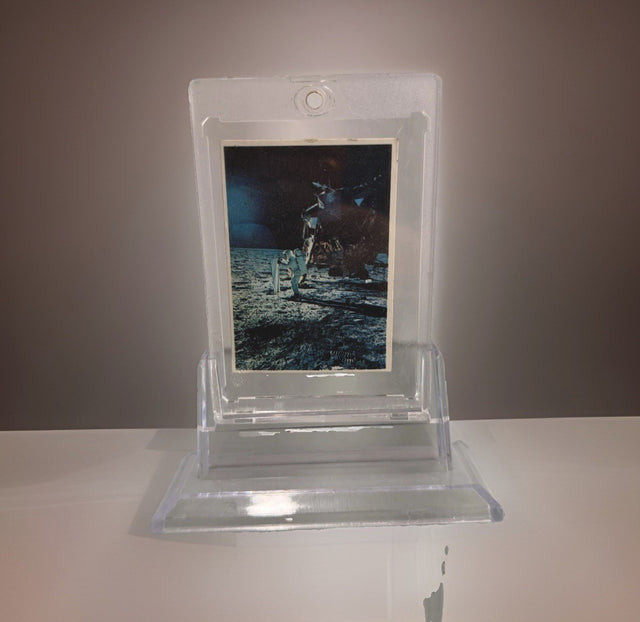
1969 Space Candy Buzz Aldrin Apollo 11 On The Moon Card #19 Taylor-Reed Display
$59.00 USD
-

1980 Polo Player Green Pink Chalk Pastel Bears Andy Warhol Signature AS-IS
$399.00 USD
-

After Andy Warhol Moon Landing Line Drawing 5/50 w/ Astronaut Autographs As-Is
$175.00 USD
-

After John Lennon "I Do" Framed Print, Marked A/P Unverified
$99.00 USD


Browse the collection for current listings.