The Space Collecting Lane Most Collectors Walk Right Past

There is a window in the collectibles market that serious collectors keep finding, and keep kicking themselves for not finding sooner.
Right now, that window is Gemini and Mercury era astronaut signatures.
Not the moon. Not Apollo 11. Not the Neil Armstrong signed photograph that every serious collector already knows about and every auction house already prices accordingly. We are talking about the program that made the moon landing possible — the men who flew before the world was fully paying attention.
Mercury. Gemini. The proving ground missions. The astronauts who strapped into capsules the size of phone booths and validated every assumption NASA needed to get to the lunar surface.
So why does this material still trade at a fraction of what Apollo commands?
Simple. The casual buyer knows Armstrong. They know Aldrin. The serious collector who does the work knows that the Mercury Seven and the Gemini crews represent some of the most historically significant — and increasingly scarce — signed material in the entire space collecting category.
This piece is for the collector who wants to understand the lane before the rest of the market catches up.
Why Mercury and Gemini Signatures Are Different From Apollo Material
Start with supply.
The Apollo program flew twenty-four men to the moon. Twelve walked on the surface. Most of them signed extensively over the decades following the missions. Some signed prolifically into old age. The signed market for lunar material, while genuinely valuable, has meaningful supply to meet demand.
The Mercury Seven — Alan Shepard, Gus Grissom, John Glenn, Scott Carpenter, Gordon Cooper, Wally Schirra, and Deke Slayton — were seven men. Full stop.
Three of them are gone in ways that matter enormously to supply: Gus Grissom died in the Apollo 1 fire in 1967, before the collecting hobby developed meaningful infrastructure. His signed material is genuinely rare. Not "described as rare" rare. Actually rare.
John Glenn, who died in 2016, was known for signing thoughtfully but not indiscriminately. His signature is recognizable, historically loaded, and increasingly difficult to source in premium form.
And the entire cohort signing together — a fully signed Mercury Seven piece — represents a convergence of seven specific signers across time that gets harder to assemble with every passing year.
When does the market price scarcity correctly?
Usually after the window closes.
The Gemini Program: Sixteen Astronauts the Market Undervalues

Gemini flew ten crewed missions between 1965 and 1966. It introduced spacewalking, orbital rendezvous, long-duration flight, and precision landing — every technical capability NASA needed for Apollo.
The Gemini crews included names that every collector should know cold: Neil Armstrong (Gemini 8), Buzz Aldrin (Gemini 12), Pete Conrad, Jim Lovell, Ed White.
Ed White died in the Apollo 1 fire alongside Grissom and Roger Chaffee. His signed material shares the same authentic scarcity problem as Grissom — not enough signed material exists to satisfy growing demand, and what does exist was produced before the hobby had proper authentication infrastructure.
Jim Lovell, still living as of this writing, remains one of the most significant living signers in the space category: Gemini 7, Gemini 12, Apollo 8, and Apollo 13. His signed material bridges two eras and carries narrative weight that few other astronaut signatures can match.
Pete Conrad — third man on the moon, Gemini 5 and Gemini 11 commander — died in 1999. His signed material is undervalued relative to his historical footprint and his place in the lunar walker canon.
Is the market pricing Conrad against his actual historical significance?
Not yet. That is the opportunity.
Understanding Signed Space Material: What You Are Actually Buying
Authentication in space memorabilia is more complicated than most collecting categories. Unlike sports cards with centralized population reports, or fine art with estate foundations, space material comes from a decentralized ecosystem of dealers, estate sales, fan mail archives, and institutional dispersals.
This creates opportunity and risk in equal measure.
The Three Authenticators That Matter
For space memorabilia, the working market recognizes three authentication houses as meaningful: Beckett Authentication Services (BAS), James Spence Authentication (JSA), and PSA/DNA.
All three operate in this category. None of them is infallible. But a piece that passes through any of the three carries market liquidity that a COA-only piece does not.
Within Beckett, the name collectors in the space category specifically watch for is Roger Epperson REAL — the music memorabilia specialist tier within BAS that has extended its methodology to broader historical autographs. When Epperson's name is attached to a space piece, the collector community treats that opinion with heightened authority.
For pieces of significant value — think high-grade Grissom material, fully signed Mercury Seven photographs, flown hardware with documentation — the additional layer of a Zarelli specialist letter changes the conversation entirely. Steve Zarelli is the recognized specialist examiner for space memorabilia. His letters are not routine authentication; they are expert opinion documents that address provenance, ink characteristics, period consistency, and historical context in a way that general authentication cannot replicate.
For serious acquisition in this category, Zarelli is not optional. He is the floor.
The JSA Distinction Collectors Often Miss
JSA issues two distinct authentication products: a Basic certification (sticker only, rapid turnaround) and a full Letter of Authenticity (LOA). These are not the same thing.
A JSA Basic sticker on a space piece tells you the piece passed a visual review. A JSA LOA means a senior examiner prepared a formal opinion document with their name attached.
For Mercury and Gemini material specifically, where the signature pool is small, the signers are aging or deceased, and forgeries have been in circulation since the early fan mail era, the distinction between Basic and LOA is not academic. It is material to value.
Do not let a seller present a JSA Basic sticker on a Grissom piece as equivalent to a JSA LOA. It is not.
PSA's Certification Verification Warning
PSA has issued warnings about forged PSA certification labels and fraudulent population report manipulation. The PSA certification-verification system exists specifically because counterfeit holders and fake cert numbers have appeared in the market.
Always verify PSA cert numbers directly through the PSA website before completing a transaction. This applies universally but is worth stating explicitly in a category where the pieces are small, the authentication documents are often older, and the provenance chains can be difficult to trace.
FBI Operation Bullpen: Why This History Matters to Space Collectors
Any serious collector in any autograph category needs to understand what FBI Operation Bullpen revealed.
Bullpen was a federal investigation that dismantled one of the most sophisticated autograph forgery operations in American history. The operation demonstrated that forgeries were not cottage industry problems — they were organized, scaled, and embedded in dealer networks that consumers trusted.
The primary targets were sports memorabilia. But the methodology Bullpen exposed — forged signatures paired with fabricated provenance, fake authentication, and dealer network laundering — applies directly to how space forgeries move through the market.
Space memorabilia is a smaller, less scrutinized category than major league sports. That makes it, in some respects, a more attractive target for sophisticated forgery operations that want to avoid the scrutiny directed at baseball and football material.
What does that mean for a collector building a Mercury or Gemini collection?
It means the authentication infrastructure is not a bureaucratic inconvenience. It is the reason your collection retains value and meaning over time.
Buy authenticated. Buy with Zarelli for significant pieces. Verify everything.
What Makes a Premium Mercury or Gemini Signed Piece

Not all signed space material is equal. Here is how working collectors in this category think about quality tiers.
Tier One: The Best Material
-
Photographs with mission-specific content
- NASA official mission photographs signed by crew members
- Signed EVA imagery for Gemini spacewalk missions
- Mercury capsule imagery signed by the pilot
-
Flown items with chain-of-custody documentation
- Items certified to have been aboard the spacecraft
- Provenance that traces to the astronaut, their estate, or NASA institutional sources
- Requires the highest level of specialist authentication — Zarelli is essential here
-
Multi-signed crew pieces
- Fully signed Gemini crew photographs command significant premiums
- Mercury Seven multi-signed pieces represent some of the most significant material in the category
-
First day covers signed by deceased astronauts
- NASA first day covers from the Mercury and Gemini era were produced in quantity but signed pieces by Grissom, White, or Chaffee represent genuine scarcity
Tier Two: Solid Market Material
- Single-signed 8x10 photographs by living Gemini-era astronauts in high grade
- Signed books — particularly mission accounts and autobiographies signed on title pages
- Signed lithographs produced in documented limited editions with clear provenance
- Single-signed first day covers with strong period documentation
Tier Three: Proceed With Caution
- Index cards and cut signatures without photographic provenance
- Fan mail era returns without authentication
- Pieces with COA-only from unknown or regional authenticators
- Material purchased at estate sales without professional review
The John Glenn Question
John Glenn is the gravitational center of Mercury Seven collecting.
His February 1962 orbital flight — the first American orbital mission — is one of the definitive moments in American history. The cultural weight of that mission, the ticker tape parades, the Congressional address, the decades of public life that followed, gave Glenn a public profile that his Mercury colleagues did not uniformly share.
Glenn signed throughout his life. He was not a reclusive signer. But he was selective, and the quality of his signatures varies considerably across different periods and contexts. High-grade Glenn signatures on meaningful content — orbital mission photographs, Friendship 7 imagery, signed NASA official portraits — carry genuine market weight.
The post-2016 market for Glenn material has been recalibrating. The collector community is still finding the right price discovery for premium Glenn pieces, which creates opportunity for buyers who do their homework now.
What is the John Glenn signed market going to look like in a decade?
Tighter. More competitive. Higher floor on premium pieces.
That is the trajectory for every astronaut from this era whose supply is fixed and whose historical significance is not in question.
Grissom, White, and Chaffee: The Apollo 1 Crew's Place in Space Collecting

January 27, 1967. The Apollo 1 fire killed Gus Grissom, Ed White, and Roger Chaffee during a launch pad test.
All three had signed material in circulation before their deaths. Grissom, as one of the Original Seven, had signed since the Mercury program's public debut. White had signed through his Gemini 4 fame — first American spacewalk, June 1965. Chaffee was newer to public profile and signed less extensively.
The scarcity of Apollo 1 crew signatures is not manufactured. These men signed for roughly five years of public life before the fire, during an era when the autograph collecting hobby had not yet developed the infrastructure that would later produce authenticated, graded, population-tracked material.
What exists from that period is what exists. No more is being produced.
Fully signed Apollo 1 crew pieces — all three signatures on a single item — are among the rarest signed configurations in the space category. The authentication challenge for these pieces is significant, which is precisely why Zarelli specialist letters matter so much here. Any three-signature Apollo 1 piece without top-tier authentication documentation should be viewed with extreme skepticism.
If someone is offering you a fully signed Apollo 1 crew piece at anything approaching an accessible price point, what does that tell you?
It tells you to slow down and authenticate before you do anything else.
Building a Mercury and Gemini Collection: A Framework
Collectors approaching this category for the first time need a framework. Here is how experienced space collectors structure their acquisitions.
Start With Authentication Infrastructure
Before you buy the first piece, establish your authentication relationships. Know your BAS submissions process. Understand what a Zarelli letter costs and what tier of acquisition justifies that cost. Have a PSA account so you can verify cert numbers on the spot.
The collectors who get hurt in this category are the ones who establish authentication infrastructure after they have already bought questionable material. Sequence matters.
Anchor on Historical Significance First
Build around the missions that matter, not just the names that are famous. Gemini 4 — first American spacewalk — creates narrative context for Ed White material. Gemini 8 — Armstrong's only Gemini flight, the first orbital docking, the emergency that required Armstrong to use reentry thrusters to stop a deadly spin — creates a separate and compelling context for Armstrong signed material that is distinct from his lunar narrative.
Content matters as much as signature. A signed photograph from a mission is different from a signed index card. Both are authentic. One has context.
Think in Terms of Deceased Signers First
Living astronauts from the Gemini era can still sign. The market for their material is real but not fixed. Deceased signer material has a fixed supply. When building a collection with an eye toward long-term significance, deceased signer pieces are the foundation.
That means Grissom, White, Chaffee for Apollo 1. It means Ed White for Gemini 4. It means Pete Conrad for Gemini and Apollo combined. It means Gus Grissom as a standalone Mercury priority.
Document Your Provenance Chain From Day One
Keep records of where every piece came from. Who sold it. What authentication accompanied it. When you acquired it. What you paid.
The provenance chain you build from the moment of purchase is an asset. It travels with the piece. Future buyers will value it. Future authentication reviews will consider it.
Red Flags: What Should Stop You Cold
This category has specific warning patterns that experienced collectors recognize immediately.
- Fan mail era returns offered as premium pieces. Fan mail was often signed by secretaries, public affairs staff, or autopens. The Mercury and Gemini programs had significant public profile. The volume of secretarial and auto-signed fan mail returns in circulation is substantial. Without authentication, fan mail returns should be treated as unsigned until proven otherwise.
- Grissom or White signatures without Zarelli or top-tier BAS/JSA LOA documentation. The supply of genuine Grissom and White material is small enough that any piece without serious authentication provenance deserves extreme skepticism.
- Fully signed Mercury Seven pieces at accessible price points. A complete set of seven Mercury astronaut signatures on a single piece is a significant item by definition. When something is described as significant and is priced accessibly, the gap between the description and the price is the first red flag.
- JSA Basic stickers presented as equivalent to LOAs on high-value pieces. Already addressed above. Non-negotiable distinction for this category.
- Provenance that runs through obscure estate sales without documentation. "Purchased at an estate sale" is not provenance. It is a starting point for provenance research, not a conclusion.
- PSA certification labels that cannot be verified through the PSA website. Verify every cert number. No exceptions. Counterfeit holders and cert numbers have appeared in this category.
- Sellers who discourage or resist authentication as a condition of sale. Any seller who objects to your authentication requirements is telling you something important.
- Ink characteristics that are inconsistent with period signatures. This requires reference material and, for significant pieces, a specialist eye. Grissom's known signature evolved across his career. Glenn's signature is well-documented across decades. Inconsistency with period exemplars is a disqualifying flag.
- Online-only provenance with no institutional or auction history. Auction history creates a paper trail. Institutional history creates context. A piece that has never appeared anywhere except in a seller's private inventory deserves additional scrutiny.
Bottom Line
Mercury and Gemini era signed material is the most historically significant undervalued segment in space collecting right now.
The supply argument is real: these missions flew decades ago, the astronauts who flew them are aging or deceased, and the signed material from the pre-Apollo 1 era was produced before the authentication infrastructure that gives today's market its pricing discipline.
The historical argument is real: you cannot tell the story of the moon without Mercury and Gemini. The men who flew those missions took risks and performed feats that made every Apollo mission possible.
The market timing argument is real: the secondary market has been pricing Apollo material correctly for some time. Mercury and Gemini are still finding their price discovery, which means the collector who does the work now is buying ahead of consensus.
But none of that matters if you buy without authentication infrastructure. The same scarcity that makes this material valuable makes it attractive to forgers. The same pre-authentication-era provenance that makes genuine pieces compelling makes questionable pieces easy to disguise.
BAS, JSA LOA, PSA/DNA verified. Zarelli for significant pieces. Provenance documented from the moment of acquisition.
Buy the history. Authenticate it properly. Build the collection that the market will eventually recognize as what it actually is.
The window is open. It will not stay open indefinitely.
FAQ: Gemini and Mercury Era Signed Space Memorabilia
Q: Is John Glenn signed material harder to find now than it was before his death in 2016?
Yes, meaningfully so. Glenn signed throughout his long public life, but post-2016 the market has been absorbing his signed material without new supply entering. Premium pieces — high-grade photographs with mission-specific content, signed NASA official portraits — have been trading at progressively firmer price points. Cut signatures and index cards are still relatively accessible, but the best material is becoming consistently harder to source at pre-2016 levels.
Q: How can I distinguish a genuine Gus Grissom signature from a secretarial or autopened piece?
This is exactly why Zarelli and top-tier specialist authentication exists. Grissom's genuine signature has documented characteristics across his Mercury and Gemini career, and experienced specialist examiners work from reference exemplars that include authenticated period examples. For a collector without deep specialist background, the only defensible answer is: do not attempt to self-authenticate Grissom material. Submit to authentication before purchase or build the authentication requirement into the purchase terms. The risk of holding an unverified Grissom piece is too high relative to the cost of specialist review.
Q: What is the difference between a Zarelli letter and a BAS or JSA authentication for space material?
BAS and JSA are general autograph authentication services with examiners who cover the full spectrum of signed material across sports, entertainment, and historical categories. They are credentialed, their opinions matter to the market, and authenticated pieces carry resale liquidity. Zarelli is a specialist opinion — a subject matter expert in space memorabilia specifically, with deep familiarity with the signing patterns, known exemplars, provenance history, and market context of the category. For routine Gemini-era pieces by living astronauts, BAS or JSA LOA is sufficient. For significant pieces — Grissom, White, Chaffee, flown hardware, multi-signed high-value configurations — Zarelli is the appropriate specialist layer, ideally in addition to, not instead of, a major authenticator's opinion.
Q: Are autopens a significant problem in Mercury and Gemini material?
Yes. The Mercury and Gemini programs generated enormous public interest, and NASA used autopen machines to manage correspondence volume. Autopen signatures from this era are in circulation and are not always easy to identify without reference material. The autopen patterns for several Mercury astronauts are documented, which helps expert examiners identify them — but it also means that autopen detection requires someone working from those reference patterns, not a casual visual review. This is another argument for specialist-level authentication on any significant piece from this era.
Q: Is a fully signed Mercury Seven piece — all seven signatures — achievable for a serious collector today?
It is achievable, but it requires patience, resources, and rigorous authentication standards at every step. The challenge is not any single signature in isolation — it is assembling seven authenticated signatures on a single piece that can be verified as genuine across all seven. Pre-assembled pieces claiming all seven signatures require the most stringent authentication review. Assembling the set incrementally — adding signatures to a piece over time as opportunities arise — creates different authentication considerations. Either path is viable for a collector with the right resources and relationships. Neither path is casual.
Q: How should I think about Ed White's signature relative to other Gemini astronauts?
Ed White occupies a unique position. His Gemini 4 spacewalk — first American EVA, June 1965 — was a globally televised event that made him one of the most publicly prominent American astronauts of the era. His death in the Apollo 1 fire, less than two years after that mission, means his signed material comes from a narrow window of public life. He signed at public events, through fan mail, and in institutional contexts, but not for decades as many Apollo-era astronauts did. High-quality White material — signed EVA photographs, mission-specific imagery — with proper authentication is undervalued relative to its historical significance. The market has not fully priced White against his actual footprint.
Q: Does the Roger Epperson REAL designation within Beckett apply specifically to space material, or is it primarily for music memorabilia?
Roger Epperson REAL is primarily the music memorabilia specialist tier within BAS — Epperson is widely recognized as the leading authenticator for rock and roll and entertainment music autographs. The Epperson designation within Beckett carries specific weight in that category. For space material, BAS operates through its general authentication process, with examiners assigned based on category expertise. The relevant consideration for space collectors is the overall BAS process and examiner credentials, plus the additional layer of Zarelli specialist opinion for significant pieces. Do not expect the Epperson REAL designation to transfer automatically to space material in the way it functions for music memorabilia.
Q: What should I do if I already own Mercury or Gemini signed pieces that have no authentication?
Get them authenticated before you do anything else — before you sell, before you insure for significant value, before you represent them to other collectors. Determine which authenticator is appropriate based on the piece's significance and value tier. For high-value pieces or any piece with a deceased signer, the Zarelli specialist letter route is worth the investment. Submit through BAS, JSA (for LOA, not Basic), or PSA for the major authentication opinion. Document every step of that process so the authentication history travels with the piece permanently. A piece with a clean authentication trail is worth more — and is easier to sell, insure, and hold with confidence — than the same piece with a question mark where the documentation should be.
Shop Space memorabilia
Explore current pieces available from the gallery.
-
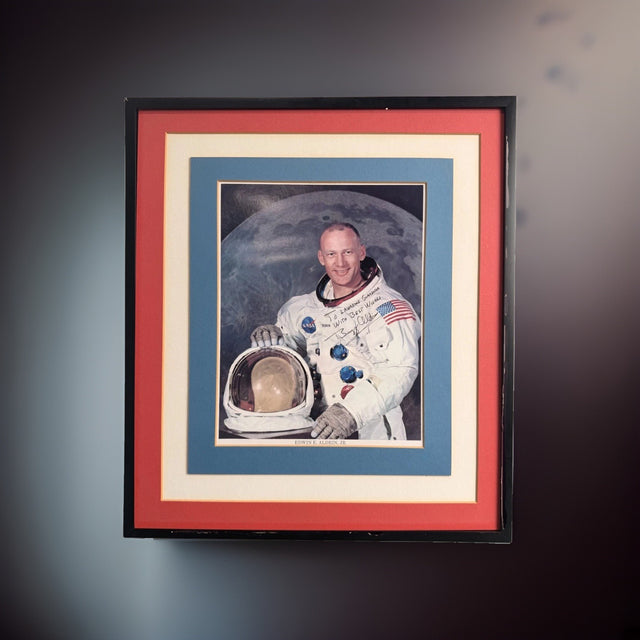
Buzz Aldrin Signed NASA 8x10 Color Photo Personalized Framed JSA LOA
$899.00 USD
-
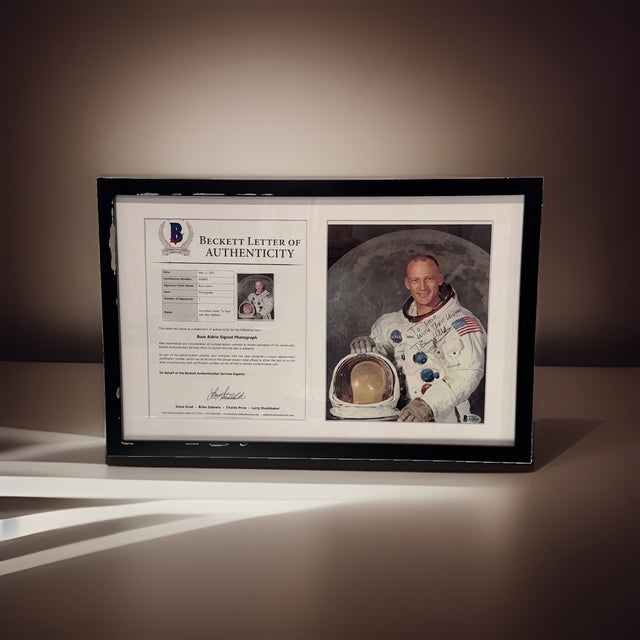
Buzz Aldrin Signed Inscribed Astronaut Photo Framed Beckett LOA A42843
$999.00 USD
-
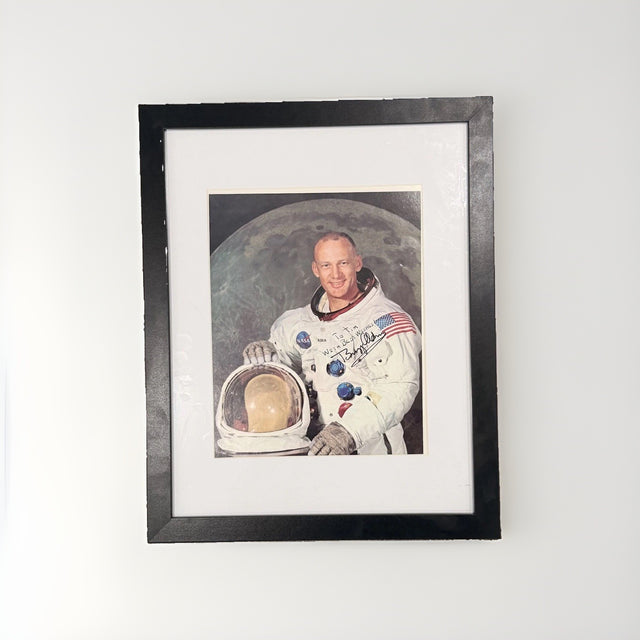
Buzz Aldrin Signed NASA Astronaut Portrait Inscribed To Tim Framed
$850.00 USD
-
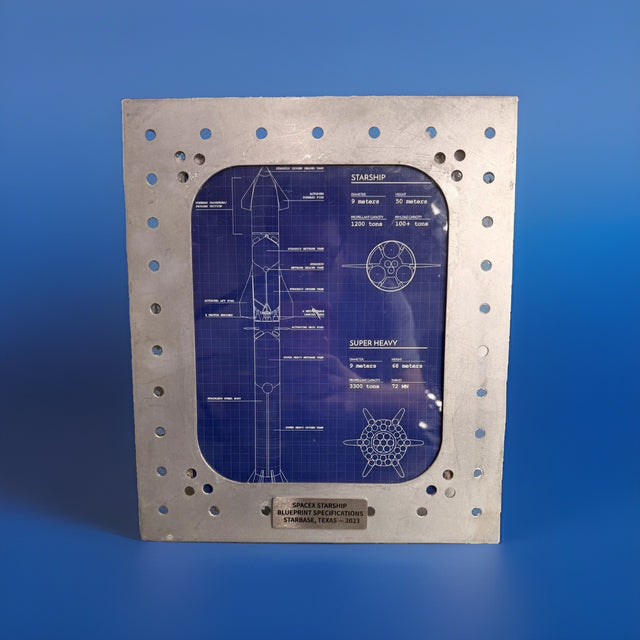
SpaceX Starship Super Heavy Blueprint Metal Display Panel Spacecraft Frame
$59.00 USD
-
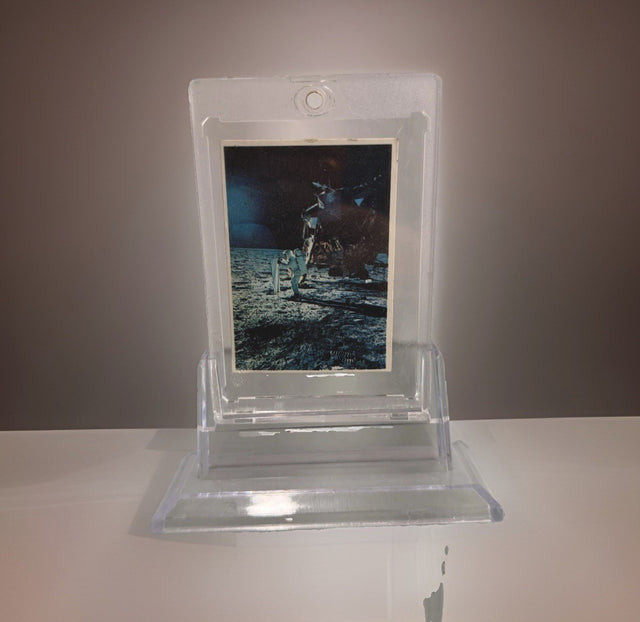
1969 Space Candy Buzz Aldrin Apollo 11 On The Moon Card #19 Taylor-Reed Display
$59.00 USD
-
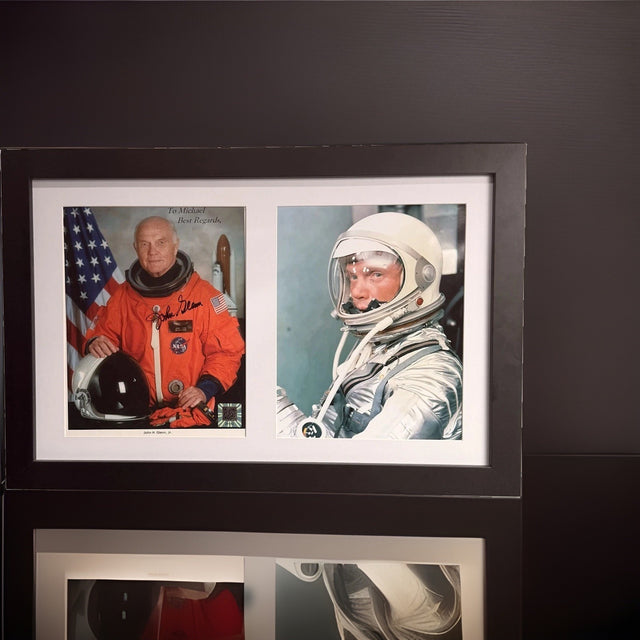
John Glenn Signed Autographed NASA Photo Display JSA Mercury Astronaut Framed
$199.00 USD
Browse the collection for current listings.