Here is the number that should frame every KAWS purchase decision you make this year: a 2016 Companion (Open Edition) in flayed black cost exactly $200 at retail. Today, that same figure carries a current fair value of $595 — a resale multiple of roughly 3.0x — and it is backed by 105 recorded public sales, the deepest comp trail of any figure in our entire catalog. That is not a rumor, not a single lucky auction result, not a screenshot from a Discord. It is a triple on a $200 toy, priced against more than a hundred real transactions.
Now hold that against a different reality from the same dataset. The 2019 Dior x KAWS BFF plush, one of the most hyped fashion-collab drops in the brand’s history, retailed for $7,500. Its current fair value sits at $4,000 — a multiple of roughly 0.53x. A collector who bought at the boutique and needs to sell today is, on paper, down more than three thousand dollars. Same artist. Same era. Same “limited” framing in the marketing. Wildly different financial outcomes.
That gap — a $200 figure tripling while a $7,500 figure lost nearly half its value — is the entire thesis of this article. Most KAWS buying guides talk about “hype” and “grails” in the abstract. We are going to do something more useful for a buyer: take the 214 releases in our catalog, isolate the ones where the original retail price is a real, known number, and compute the resale multiple (current fair value ÷ original retail) for each. Then we rank them. The multiple becomes a spine — a single, comparable metric that lets you look across dozens of drops and ask the only question that matters when you are about to spend money: is the market paying more than the sticker, and how much more, and how confident can I be in that number?
This is a financial lens, not an aesthetic one. You may love a figure that trades below retail, and that is a perfectly good reason to own it. But if you are shopping with any eye toward value retention — and most six-hundred-dollar-and-up buyers are — then the retail-to-resale multiple is the closest thing the KAWS market has to a fundamentals ratio. Let’s use it properly.
What the multiple actually measures (and what it doesn’t)

The resale multiple in this piece is deliberately simple. For every figure in our catalog where the original retail price is a real dollar figure, we divide the current fair value by that retail price. A figure that retailed for $200 and now carries a $400 fair value has a 2.0x multiple. A figure that retailed for $320 and now sits at $220 has a 0.69x multiple — it lost money.
Across the 214 releases catalogued, the value range runs from $209 to $68,000, with a median of $500 and a mean of $1,983. That mean-versus-median gap tells you the shape of the market immediately: a handful of extreme grails (ten figures at $3,000 or more) drag the average up, while the bulk of the catalog — 174 of 214 releases sit under $1,000 — lives in an accessible tier where most buyers actually shop. Thirty figures occupy the $1,000–$3,000 middle. This is a market with a long, affordable base and a very thin, very expensive top.
The multiple is a screening tool. It is emphatically not a guarantee, and there are three things it deliberately does not capture:
It does not capture holding period. A 3.0x multiple earned over eight years (the 2016 flayed Companions) is a very different annualized return than a 3.0x earned in eighteen months. We are reporting the current standing of the figure, not an IRR.
It does not capture liquidity. A high multiple on a figure with one recorded sale is a fragile number. A modest multiple on a figure with 60+ recorded sales is a robust one. That is why every figure in this article carries its comp count and confidence label alongside its multiple. More on that in the methodology section — it is the single most important discipline in this piece.
It does not capture condition, box, or authentication. Every multiple quoted here assumes a complete, authentic figure in collector-grade condition. Strip the box, break the seal, lose the certificate, and you are no longer trading the figure the multiple describes. We will return to this in the buyer-guidance section, because it is where paper gains quietly evaporate in the real world.
With those guardrails set, let’s rank the drops.
The biggest multipliers: where retail understated the market
The clearest pattern in the data is that KAWS’s open-edition, low-retail Companion figures — the ones that were deliberately produced in large numbers and sold at accessible price points — have been among the most reliable multipliers. This is counterintuitive if you assume scarcity drives value. It shouldn’t be. Low retail plus enormous demand plus a deep, liquid secondary market is a recipe for a clean, defensible multiple.
| Figure | Year | Retail | Fair Value | Multiple | Comps | Confidence |
|---|---|---|---|---|---|---|
| Companion Flayed (Open Edition) — Black | 2016 | $200 | $595 | 2.98x | 105 | high |
| Holiday Space — Gold | 2020 | $385 | $1,100 | 2.86x | 7 | medium |
| Companion Flayed (Open Edition) — Brown | 2016 | $200 | $452 | 2.26x | 86 | high |
| Companion Flayed (Open Edition) — Grey | 2016 | $200 | $440 | 2.20x | 38 | high |
| Gone — Black | 2019 | $580 | $1,250 | 2.16x | 1 | low |
| Clean Slate — Brown | 2018 | $480 | $959 | 2.00x | 21 | high |
| Small Lie — Grey | 2017 | $220 | $440 | 2.00x | 20 | high |
| What Party — White | 2020 | $260 | $514 | 1.98x | 23 | high |
| Companion (Open Edition) — Brown | 2016 | $200 | $360 | 1.80x | 42 | high |
| Clean Slate — Grey | 2018 | $480 | $861 | 1.79x | 16 | medium |
| Companion (Open Edition) — Black | 2016 | $200 | $340 | 1.70x | 61 | high |
| Companion (Open Edition) — Grey | 2016 | $200 | $335 | 1.68x | 46 | high |
| Clean Slate — Black | 2018 | $480 | $768 | 1.60x | 27 | high |
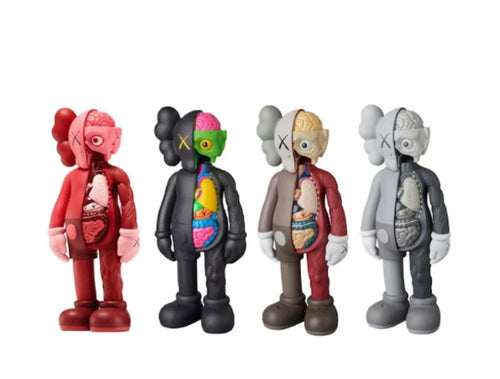
Look at what anchors the top of that list. The 2016 Companion Flayed (Open Edition) — Black is not just the highest confident multiplier at roughly 3.0x — it is the most-traded figure in the catalog, full stop, with 105 recorded sales. When a figure has tripled and changes hands over a hundred times at documented prices, you are looking at something close to a blue-chip in designer-toy terms: the multiple is high and the liquidity is real. Its brown and grey siblings sit at 2.26x and 2.20x on 86 and 38 comps respectively, reinforcing that this wasn’t a fluke of one colorway.
Why did the flayed Companions run so hard off a $200 base? Three factors stack:
The character. The Companion is KAWS’s signature figure — the crossbones-eyed, gloved everyman that anchors the entire brand. Demand for the core character is structurally deeper than for peripheral characters, and it shows up in the comp depth.
The design. The “flayed” treatment — the dissected, peeled-open anatomy variant — is one of KAWS’s most recognizable and most reproduced motifs. It reads instantly in a photo, which matters enormously for a resale market that lives on marketplace thumbnails and social feeds.
The retail anchor. At $200, the barrier to entry was low enough to pull in a massive buyer base, which in turn created the liquid two-sided market that supports a clean multiple today. A low sticker price is not a weakness for value retention — it is often the cause of it, because it seeds the deep comp trail that makes the figure easy to price and easy to sell.
The Clean Slate trio (2018, $480 retail) tells a complementary story at a higher price point. Brown at 2.00x, grey at 1.79x, black at 1.60x, all on solid comp counts. This is a named-sculpture Companion pose — the seated, head-in-hands figure — and it doubled (brown) to modestly-multiplied (black) depending on colorway. The colorway spread inside a single release is itself a lesson: brown consistently outperforms black and grey across multiple KAWS releases in this dataset. You can see it in Clean Slate, in the open-edition Companions, and elsewhere. Brown is frequently the smaller-run or more-desired finish, and the market pays a premium for it. When you are choosing between colorways of the same figure, the data says the “warmer” brown often carries the better multiple — but always check the specific comps, because it is a tendency, not a law.
Two entries in that table deserve a caution flag despite their attractive multiples. Holiday Space — Gold (2020, $385 → $1,100, 2.86x) is a genuinely strong result, but it rests on only 7 comps at medium confidence — respectable, not bulletproof. And Gone — Black (2019, $580 → $1,250, 2.16x) looks spectacular until you notice it is backed by a single recorded sale at low confidence. That 2.16x is real as far as it goes, but it is one data point. Contrast it with the flayed black Companion’s 105 comps and you understand instantly why the multiple alone is never enough. The multiple tells you what the market paid; the comp count tells you how much you should trust that it will pay it again.
The steady compounders: modest multiples you can actually bank on

Below the headline multipliers sits a broad band of figures that quietly held 1.1x to 1.5x over retail on deep, high-confidence comp trails. These are, for a value-conscious buyer, arguably the most useful figures in the entire catalog — because the number is small and trustworthy.
| Figure | Year | Retail | Fair Value | Multiple | Comps | Confidence |
|---|---|---|---|---|---|---|
| Passing Through (Open Edition) — Grey | 2018 | $200 | $303 | 1.52x | 39 | high |
| Small Lie — Brown | 2017 | $220 | $317 | 1.44x | 27 | high |
| Small Lie — Black | 2017 | $220 | $300 | 1.36x | 39 | high |
| Chum (2022, 20th Anniversary) — Black | 2022 | $280 | $364 | 1.30x | 25 | high |
| BFF — Blue | 2017 & 2018 | $280 | $355 | 1.27x | 58 | high |
| Chum (2022, 20th Anniversary) — Orange | 2022 | $280 | $348 | 1.24x | 22 | high |
| Chum (2022, 20th Anniversary) — White | 2022 | $280 | $328 | 1.17x | 47 | high |
| Time Off — Pink | 2023 | $320 | $365 | 1.14x | 28 | high |
| Kachamukku — Green/Red | 2022 | $320 | $296 | 0.93x | 42 | high |
The Chum (2022, 20th Anniversary) family is the cleanest teaching case in this band. Four colorways, all retailed at $280, all with high-confidence comp counts (22 to 47 sales each), all landing in a tight 1.06x to 1.30x range. Black leads at 1.30x ($364), white holds at 1.17x ($328), orange at 1.24x ($348), yellow at just 1.06x ($298). When a full release clusters this tightly across colorways with this much comp depth, you are looking at a figure the market has fully priced-in and agrees on. There is little upside surprise here — but there is also very little downside risk, and the number is about as reliable as this market produces. For a buyer who wants a real KAWS figure that is unlikely to lose money, a high-comp Chum at a fair price is a textbook “hold its value” purchase.
The BFF — Blue (2017/18, $280 → $355, 1.27x) deserves special mention for one reason: 58 recorded sales at high confidence. That is the second-deepest comp trail in this article. The BFF — KAWS’s furry, fuzzy-textured companion character — is a hugely popular figure, and the blue colorway’s liquidity means the 1.27x multiple is a number you can lean on hard. Its black sibling sits at 1.13x ($316) on 46 comps at medium confidence — same story, slightly softer.
And then there is Kachamukku — Green/Red (2022, $320 → $296, 0.93x), which I have included in the “steady” table on purpose, even though it trades below retail. Why? Because it has 42 high-confidence comps. This is a figure the market has priced with total clarity — and the market’s verdict is that it is worth slightly less than you paid at the boutique. That is not a failure of the data; it is the data working perfectly. A 0.93x on 42 comps is far more actionable than a 2.0x on one comp. It tells you, with confidence, that this particular drop did not multiply, and that you should buy it because you love it, not because you expect a return.
The underperformers: where the sticker price was the high-water mark
Now the uncomfortable part — because a financial guide that only shows you winners is a sales brochure, not analysis. Several KAWS drops trade below their original retail, and a few of them are cautionary tales that reveal exactly which purchase patterns to avoid.
| Figure | Year | Retail | Fair Value | Multiple | Comps | Confidence |
|---|---|---|---|---|---|---|
| Dior BFF Plush — Pink | 2019 | $7,500 | $4,000 | 0.53x | 0 | low |
| Dior BFF Plush — Black | 2019 | $7,500 | $4,000 | 0.53x | 0 | low |
| Companion 2020 (20th Anniversary) — Black | 2020 | $380 | $233 | 0.61x | 1 | low |
| Time Off — Black | 2023 | $320 | $220 | 0.69x | 3 | low |
| Kachamukku — Black | 2022 | $320 | $278 | 0.87x | 13 | high |
| Kachamukku — Green/Red | 2022 | $320 | $296 | 0.93x | 42 | high |
The Dior BFF Plush is the single most instructive line in this entire dataset. It retailed for $7,500 — a fashion-house price, not a designer-toy price — and now carries a $4,000 fair value, a 0.53x multiple. The lesson is not “collabs are bad.” The lesson is that when the retail price is set by luxury-fashion economics rather than toy-market economics, the sticker itself becomes the ceiling. Dior priced the plush at a fashion markup; the resale market prices it as a KAWS collectible; and the two do not agree. Note also the confidence: zero recorded sales, low confidence, with an observed range that swings from $650 all the way to $12,999. That enormous spread is a screaming signal that this figure is thinly and erratically traded. A buyer who sees “$12,999” in the range and assumes that is achievable is making a serious mistake — the fair value sits at $4,000 for a reason, and even that is soft. High retail plus thin comps is the most dangerous quadrant in the KAWS market.
The Companion 2020 (20th Anniversary) — Black ($380 → $233, 0.61x) is a subtler warning. Anniversary editions carry a marketing narrative — “20 years of KAWS” — that can inflate retail expectations without a matching demand base. This black colorway lost roughly a third of its retail value, on a single comp. Its brown sibling actually held far better ($486, 1.28x on 5 comps at medium confidence), which again underlines the colorway-spread point: within one anniversary release, brown compounded while black depreciated. Do not buy “the anniversary edition” as a monolith — buy the specific colorway the comps support.
Time Off — Black (2023, $320 → $220, 0.69x) rounds out the pattern. Its pink sibling holds at 1.14x on 28 high-confidence comps; the black version trades at 0.69x on just three. Same figure, same year, same retail — the market simply prefers the pink, and pays for it. Three underperforming blacks in a row (Companion 2020, Time Off, and the two Kachamukku entries where black lags green/red) is not a coincidence. Black is frequently the most-produced, least-scarce colorway in a KAWS release, and it disproportionately shows up among the underperformers. If you are buying for value retention, the “safe default” black is often the worst multiple in the set. That is one of the most immediately actionable findings in this dataset.
The Holiday series: a controlled experiment in retail pricing
If you want to watch the retail-to-resale multiple behave almost like a laboratory variable, study the Holiday series — the city- and destination-themed Companion releases KAWS has issued across the last several years. These figures share a character (the reclining or standing Companion), a broadly similar scale, and a tight cluster of retail prices. What differs is the destination, the colorway, and the comp depth. That makes them the closest thing in the catalog to a controlled experiment in what actually moves a multiple.
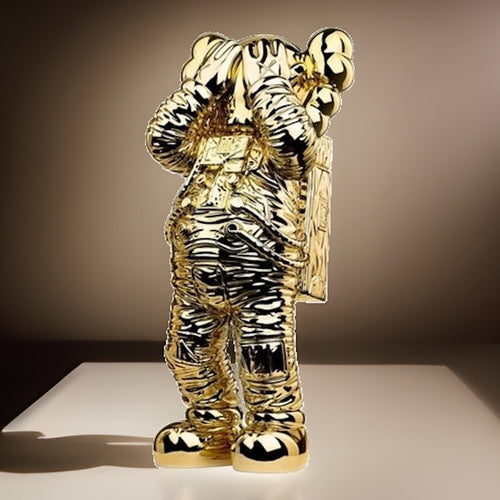
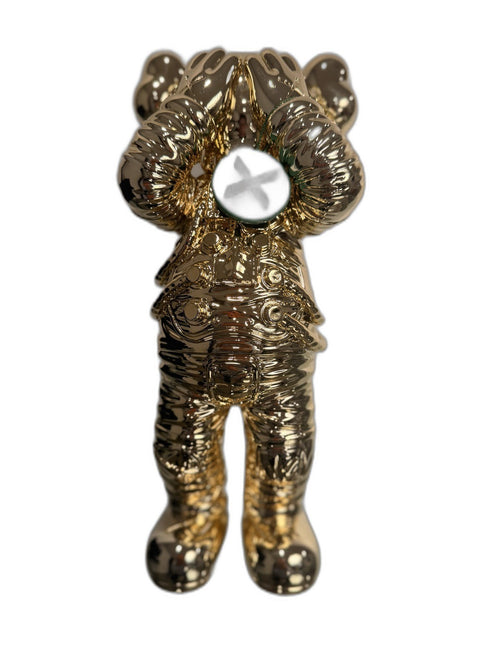
Start with the standout. Holiday Space — Gold (2020, $385 retail → $1,100) posts a 2.86x multiple on 7 comps at medium confidence — comfortably the strongest performer in the Holiday range. Its black sibling holds at $800 (2.08x) on 6 comps, and the silver at $630 (1.64x) on 4. The Space release is instructive because the gold finish — a special metallic treatment on a Companion in an astronaut context — commanded a genuine premium over the standard black and silver of the same figure. That is the colorway-and-finish effect in isolation: same character, same year, same retail, and the market paid nearly 75% more for gold than for silver. When a special finish exists within a release, the data says it frequently carries the better multiple. Just note the comp counts stay in single digits, so treat these as “strong but not deep.”
Now walk down the destinations. The Holiday Changbai Mountain — Brown (2022, $330 → $465) holds a 1.41x multiple on 10 comps at high confidence — one of the few Holiday figures with a genuinely deep, reliable comp trail. Its white sibling sits at $460 (1.39x) and black at $378 (1.15x, 7 comps, medium). The Holiday UK — Brown (2021, $250 → $396) posts 1.58x on 5 medium-confidence comps, with grey and black both at $372 (1.49x) on thinner data. The Holiday Singapore — Black (2021, $290 → $469) shows 1.62x, though on a single comp. And the newest entries — the Holiday Thailand (2025, $340) figures at grey $500 (1.47x), brown $478 (1.41x), black $420 (1.24x) — are all “insufficient” or “low” confidence simply because they are too recent to have built a trail. A 2025 release will always carry thin comps; that is a timing artifact, not a weakness in the figure, but it does mean the multiple is provisional until the market has had a year or two to vote.
The Holiday series teaches two durable lessons. First, the “special” colorway or finish within a release — the gold, the brown — tends to lead, echoing the pattern we saw in Clean Slate and the open editions. Second, a Holiday figure’s reliability tracks its age: the 2022 Changbai Mountain figures have real comp depth and defensible multiples, while the 2025 Thailand figures carry attractive-looking numbers that simply have not been tested yet. If you are buying a very recent Holiday drop, you are buying on thinner evidence by definition — size your confidence accordingly.
The What Party and Chum families: character equity in action

Two character families in the dataset show how the character itself — independent of scarcity or finish — drives a durable multiple. Both retailed in the accessible $260–$280 band, and both carry enough comp depth to trust.
The What Party Companion (the raised-arms, celebratory pose, 2020, $260 retail) is a strong, consistent multiplier. White leads at $514 (1.98x) on 23 high-confidence comps — nearly a double on a $260 figure with a deep trail behind it. Red follows at $480 (1.85x), black at $448 (1.72x, 12 comps, medium), yellow at $421 (1.62x, 12 comps, medium), and orange at $263 (1.01x, 11 comps, medium) — essentially flat to retail. That spread inside a single release, from a near-double in white down to break-even in orange, is a vivid reminder that “I bought a What Party” is not a complete description of what you own. The colorway is doing most of the financial work. White and red carried the demand; orange did not.
The Chum (2022, 20th Anniversary) family, covered in the steady-compounders table, reinforces the point from the opposite direction: it clusters tightly (1.06x–1.30x across five colorways, all high confidence) because the Chum character — the Michelin-man-inspired companion figure — has a broad, stable collector base that prices every colorway similarly. Compare the two families and you see the spectrum of “character equity”: What Party rewards you for picking the right colorway; Chum rewards you simply for buying the character at a fair price, with less colorway risk. Both are legitimate strategies. The What Party approach has more upside and more dispersion; the Chum approach is flatter and safer. Knowing which one you are making is the difference between an informed purchase and a hopeful one.
There is a broader structural point buried in these two families. Core, recurring KAWS characters — Companion, Chum, BFF, What Party — accumulate what you might call character equity: a demand base so established that it produces deep comp trails and defensible multiples release after release. Peripheral or one-off characters do not accumulate this equity, which is exactly why so many of them sit at “insufficient” confidence with a single recorded sale. When you are choosing between a core-character figure with 25 comps and a novelty figure with one, you are not just choosing between two objects — you are choosing between a liquid, priceable asset and an illiquid, unpriceable one. The core character is almost always the sounder financial position, even when its headline multiple is lower.
The plush anomaly: enormous multiples, almost no comps
One category deserves its own note because it produces the most eye-popping multiples in the entire catalog — and the least reliable ones. KAWS plush toys, particularly the mass-retail collaborations, carry tiny retail prices that generate huge headline multiples.
The Sesame Street plush figures (2018) retailed for $39.90 each and now carry a $300 fair value — a 7.5x multiple. The BFF Plush — Pink (2019) retailed around $180 and sits at $1,277, roughly 7.1x. On paper, these are the biggest multipliers in the book. In practice, every single one of them carries an insufficient or low confidence label with zero-to-two recorded sales. The 7.5x on the Sesame Street plush is computed against a fair value that has essentially no liquid market behind it. These are figures where a $39.90 sticker makes any resale look like a massive multiple — a $300 sale is “7.5x” but is still just a $300 outcome, and the thin comp trail means even that is uncertain.
The takeaway: beware multiples that are large only because the denominator is tiny. A 7.5x on a $40 plush moves you $260 in absolute terms and rests on almost no evidence. A 2.0x on a $480 Clean Slate moves you $480 in absolute terms and rests on 21 documented sales. The second is a far better financial position despite the smaller multiple. Always read the multiple in dollars and in comp depth, never in isolation.
What the multiple can’t reach: the retail-less grail tier

There is an entire class of KAWS figures where the retail-to-resale multiple simply does not apply — and understanding why is part of using the metric well. The most valuable figures in the catalog carry no known original retail price at all, marked with a dash in the data because they were secondary-market or vintage releases from the start, or because their original distribution was so limited or so long ago that a meaningful sticker price never existed in the public record.
These are the grails. The Four Foot Companion — Grey (2007 & 2009) carries a fair value of $68,000; the black version, $60,000; the brown, $45,000. The Four Foot Dissected Companion — Black (2009) sits at $48,000. The Dissected Companion 100% — Black (2010) at $7,000. None of these has a retail figure, so none has a computable multiple. And critically, every one of them carries an “insufficient” confidence label backed by a single recorded sale. A $68,000 fair value resting on one comp is the definition of a thin, illiquid, hard-to-price market. These figures are real, they are important, and they anchor the top of the catalog — but they are the opposite of the accessible open editions in every financial dimension: enormous absolute value, no retail baseline, and almost no liquidity.
The practical lesson for a buyer is that the retail-to-resale multiple is a tool built for the accessible and mid tiers — the 88 figures with real retail prices — and it is precisely in those tiers that it is most useful, because those are the figures with the deepest comp trails. The grail tier is a different game entirely: a game of provenance, relationships, and single-transaction pricing where the multiple has nothing to say. If you are shopping in the sub-$3,000 band where most buyers live, the multiple is your best friend. If you are shopping at $45,000, you are in a market where documented provenance and authentication matter far more than any ratio — and where a single comp is all you may ever get.
This is also why the accessible tier is, for most buyers, the smarter place to deploy capital. The open-edition flayed Companion at a 3.0x multiple on 105 comps gives you appreciation and the ability to actually sell when you want to. A four-foot grail gives you a headline number and a market of, effectively, a handful of collectors worldwide. Liquidity is a feature, not a footnote, and the multiple-friendly tier is where liquidity lives.
Methodology: why confidence scoring is the discipline that protects your money
Everything in this article hangs on one methodological choice, and it is worth making explicit. Every fair value in our catalog is tagged with a comp confidence label derived from how many real, recorded public sales of $200 or more sit behind it:
- High confidence — a deep, consistent comp trail (typically 20+ recorded sales). The number is robust. Across the catalog, 27 figures reach this tier.
- Medium confidence — a real but shallower trail (21 figures). Directionally reliable; treat the exact figure as an estimate.
- Low confidence — few sales, wide spreads (54 figures). The multiple is indicative only; expect meaningful variance.
- Insufficient — one recorded sale or none (112 figures). The fair value is a placeholder anchored to sparse data; do not transact on the multiple alone.
That distribution is sobering and important: more than half the catalog (112 of 214 figures) sits at “insufficient” confidence. This is the nature of the KAWS market — many figures simply do not trade often enough to price precisely. It is not a flaw in the data; it is an honest reflection of reality, and pretending otherwise is how buyers overpay.
Here is the discipline it demands. When you see a headline multiple, always read it against its comp count before you act on it. The 2016 flayed black Companion’s 2.98x is a number you can build a purchase around because 105 sales stand behind it. The Gone — Black 2.16x is a number to treat with real caution because exactly one sale stands behind it. Same market, same era, radically different reliability. The multiple is the signal; the confidence label is the noise filter. A buyer who ignores the confidence label is trading on rumor with a spreadsheet’s veneer of precision.
There is also a structural point about why low-comp figures deserve caution beyond mere sample size. Thinly-traded figures are the easiest to manipulate, the easiest to misrepresent, and the most prone to a single optimistic listing anchoring everyone’s expectations. When a figure trades once a year, one aspirational seller can distort the entire market’s perception of its value. Deep-comp figures are self-correcting — a hundred sales wash out the outliers. Thin-comp figures are not. This is precisely why the accessible, high-liquidity open editions are, paradoxically, often the safer financial holdings than the rare grails: you can actually price them, and you can actually sell them.
How a buyer should use the multiple today
So you are shopping right now. Here is how to turn all of this into a screening process rather than a wall of numbers.
Step one: use the multiple as a filter, not a verdict. Sort your candidates by resale multiple, then immediately overlay the comp count. Discard — or at minimum, heavily discount — anything with an attractive multiple and fewer than roughly a dozen comps. You are looking for the intersection of a healthy multiple and a deep comp trail. That intersection is where the flayed Companions, the Clean Slates, the high-comp Chums, and the BFF Blue live. Start there.
Step two: read colorway and character into the multiple. The data repeatedly shows brown outperforming black and grey within the same release, and core characters (Companion, BFF, Chum) trading deeper and more reliably than peripheral ones. When two colorways of the same figure are available at similar prices, the comps usually favor one clearly — let them decide.
Step three: treat sub-retail multiples as information, not insult. A 0.87x on 13 high-confidence comps (Kachamukku Black) is telling you something true and useful: this figure did not appreciate, and you should buy it for love, not return. That is a perfectly valid purchase — just an informed one.
Step four — and this is where paper multiples meet reality: condition, box, and authentication decide whether you actually own the multiple. Every figure quoted here assumes a complete, authentic, collector-grade example. The moment condition slips, the multiple you paid for stops applying. Specifically:
-
Box and packaging. KAWS collectors price the box as part of the object. A figure without its original box, or with a crushed one, routinely trades well below the fair value the multiple describes. If you are buying for value retention, buy boxed, and store boxed. Our KAWS packaging guide walks through exactly what correct, unbroken packaging looks like for each era — read it before you buy, because packaging condition is where a documented multiple quietly evaporates.
-
Authentication — the canon. For figures released in 2020 and later, KAWS x Medicom production carries a OneCOA certificate with an embedded NFC chip — the modern authentication standard. Tap it, verify it, and confirm the certificate matches the figure before money changes hands. For pre-2020 figures, there is no NFC chip, so you rely on the original hang tag, an unbroken factory seal, and a serial number that matches across the figure, box, and any accompanying documentation. A pre-2020 figure with a broken seal, a missing hang tag, or a serial that does not reconcile is a figure whose multiple you cannot trust — and whose resale you will struggle to complete. Authentication is not a formality; it is the difference between owning the asset the multiple describes and owning a look-alike with no market.
Step five: weigh absolute dollars against the multiple, not just the multiple alone. A headline multiple can flatter a small outcome. The Sesame Street plush’s 7.5x sounds enormous but moves you only about $260 in absolute terms, on almost no comps. The Clean Slate — Brown’s 2.00x is a smaller multiple but represents a roughly $479 absolute gain on a figure with 21 documented sales. If you are deploying real capital, the figure that combines a meaningful absolute dollar spread with deep comp support is almost always the sounder position, even when its multiple is not the flashiest number on the page. Multiples are a ranking tool; dollars and comps are the reality check.
Step six: cross-check the specific figure against the full catalog before you commit. A single article can only surface a slice of 214 releases. Before you buy, pull the exact figure, year, and colorway and confirm its current standing. Our complete KAWS figurine index catalogs all 214 releases with live search, and it is the fastest way to confirm that the multiple you think you are buying is the multiple the market currently supports. If you want to understand how these values and confidence scores are constructed in the first place, our methodology and data notes lay out the sourcing and scoring approach in full.
The bottom line for a buyer
The 214-figure dataset tells a clear, financially honest story. KAWS’s accessible open editions have been the most reliable multipliers — the $200 flayed Companions tripling on 100+ comps is the cleanest signal in the market. The steady compounders — high-comp Chums, BFF Blue, Small Lie — held modest but trustworthy multiples you can actually bank on. And the underperformers — the $7,500 Dior plush at 0.53x, the black anniversary Companions, the black Time Off — cluster around two patterns: luxury-fashion retail pricing that the toy market won’t validate, and the over-produced black colorways that lag their brown and pink siblings.
Read every multiple against its comp count. Buy boxed. Verify the NFC-chip OneCOA on 2020+ figures and the hang-tag-and-seal chain on everything older. And when the multiple and the comp depth and the condition all line up, you are not gambling on hype — you are buying an asset the market has already priced, in public, dozens of times over.
Buy with documented provenance from Gauntlet Gallery. Every KAWS figure we list is authenticated against the canon above, priced against the same comp data behind this article, and delivered with the documentation that lets the multiple you paid for survive to the day you decide to sell.
This article is for informational purposes only and is not investment advice. Collectible values fluctuate; past sales do not guarantee future results.