Direct answer
You can buy Invader works that are offered through a lawful, well-documented studio, gallery, publisher, dealer, auction or private-sale route. A street-sited mosaic is different. Do not remove, commission removal of, or traffic in a public or privately sited work merely because it is associated with Invader. If an offering is said to have come from a street location, its ownership, consent, removal history, chain of custody and legal status can be highly fact- and jurisdiction-specific. A familiar image, location story, photo, label or seller assurance is not enough.
The practical collecting choice is to prioritize studio editions, authorized works and secondary-market objects with a coherent record. If a purported street work is involved, stop short of assumptions, seek qualified local legal advice and require written documentation that directly addresses the object’s provenance and lawful transfer. Passing on an under-documented offer is often the most responsible decision.
Table of contents
- The essential distinction: studio work versus a work installed in place
- Why “it came from the street” is not a sufficient ownership story
- What lawful, collectible routes can look like
- How to assess a secondary-market offering without encouraging removal
- Evidence, documentation and legal limits
- Public interest, site history and ethical collecting
- A decision workflow for buyers and sellers
- What to do with an ambiguous offer
- Related guides, FAQs and source notes
The essential distinction: studio work versus a work installed in place
The phrase “Invader mosaic” can describe more than one kind of object. That matters because a work made for studio, gallery, publisher or authorized secondary-market circulation is not the same category as an artwork installed at a particular site. A work may share a visual language while having a radically different history, legal context and ethical set of questions.
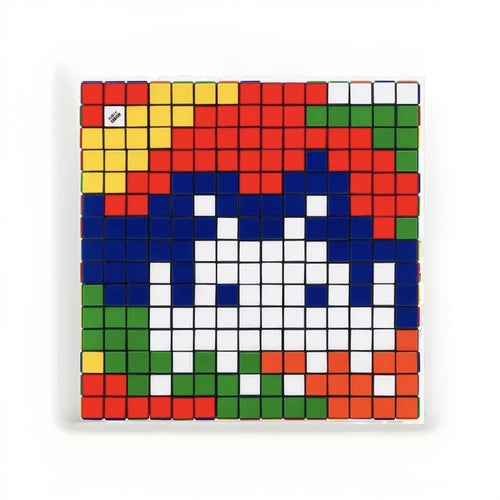
For collectors, the cleanest path is often a studio edition, documented panel, print, cube-based work or other object whose release and ownership trail can be researched. These are still works that deserve careful condition, provenance and sale-term review. But their basic route into a collection can be understood through conventional art-market documentation.
A site-specific street mosaic raises additional questions. Who owned the underlying surface? What permissions or agreements existed, if any? Has the work remained in place, been damaged, been removed, or been transferred? Who authorized any removal? Which local rules apply? What factual record connects the offered physical object to the claimed site? Those questions cannot be answered by a generic collecting guide, a seller’s story, or a photograph of a wall.
This article does not provide advice on obtaining, removing or monetizing street-installed work. It explains why a responsible buyer should distinguish a documented studio-market object from an ambiguous street-removal claim. For the context of Invader’s city interventions and mapping practice, see The Complete Guide to Invader’s Space Invasions and City Maps. For works that can be researched as collectible objects, start with Invader Tile Art: Buying Authenticated Works by the Paris Street Artist.
Why “it came from the street” is not a sufficient ownership story
The story may sound compelling: a work “was saved,” “was recovered,” “was removed before demolition,” “came from a building owner,” “was found after renovation,” or “has circulated privately for years.” None of those phrases tells you enough on its own. They are starting points for questions, not answers.
An object associated with a public or privately owned location can involve multiple interests: the artist’s rights, the building or surface owner’s interests, contract or consent questions, cultural-property and heritage concerns, local property rules, removal circumstances, the rights of an intervening custodian, and the truthfulness of sale representations. The answer can change depending on where the work was located and what actually happened. A general article cannot decide those matters for a specific object.
The ethical concern is just as important. A street-sited work may have meaning because of its site, neighborhood, public visibility and relationship to the wider project. Removing it can erase that context, create damage, invite unsafe conduct, or reward behavior that treats public art as inventory. A collector who cares about the work should not confuse access to a market with permission to create that market.
Do not rely on a seller’s vocabulary
Words such as “original street piece,” “de-installed,” “rescued,” “salvaged,” “removed,” “estate,” “with provenance,” “rare,” “authenticated,” or “from [city]” should trigger a request for specifics. Ask what the exact object is, what site is claimed, when it was there, who had authority over the surface, who removed it, what written authorization exists, how custody changed hands and what documentation transfers with the sale.
If the answer is a story with no records, do not supply the missing legal or ownership analysis yourself. An exciting provenance claim is not a substitute for a defensible chain of custody.
What lawful, collectible routes can look like
A responsible buyer can focus on formats that enter the art market through documented channels. This does not mean ignoring condition or authenticity; it simply gives the research a clearer starting point.
| Route or format | What to establish | Why it is usually more straightforward | Still verify |
|---|---|---|---|
| Studio or gallery edition | Exact release, format, dimensions, edition information and documents | Created for collector circulation rather than removed from a site | Actual-item condition, seller record and transfer terms |
| Publisher-mediated edition | Publisher/release record, exact configuration and fulfillment history | There may be an identifiable release context | Whether the offered object matches the documented issue |
| Documented panel or object | Construction, unique/editioned status, gallery or ownership record | Can be evaluated as a physical art object | Provenance, condition and installation needs |
| Print or portfolio work | Medium, edition details, paper/support and condition | Established print-research practices can apply | Marks, paper condition, framing and seller documentation |
| Secondary-market work with clear chain | Acquisition invoice, catalogue record, prior sale history and current condition | A buyer can trace the work’s path between known parties | That documents identify the exact object, not only a generic title |
No route is automatic proof. A studio edition can be poorly described; a framed print can have condition problems; a secondary-market object can be misattributed. The difference is that these formats can be researched without presuming a contested removal from a site.
The site is part of the object’s story
For a genuinely site-specific work, place matters. A claimed city, wall, building, neighborhood, route number, installation date or photograph may be useful evidence, but it must connect credibly to the physical material on offer. A picture of a mosaic on a wall does not establish that a loose panel came from that wall. A map entry does not establish current ownership. A public image should not become a treasure map.
Keep this boundary clear in your own language. It is fine to research the history of a documented public artwork. It is not responsible to publish instructions for finding, extracting, buying or selling it.
How to assess a secondary-market offering without encouraging removal
The purpose of research is to decide whether to participate in a sale, not to make an ambiguous object easier to monetize. That changes the questions you ask.
Begin with the object, not the lore
Create an identity record: exact title or description, dimensions, materials, construction, all visible marks, current condition, photographs reviewed, documents offered, seller identity, claimed location history and date of offer. Separate claims from evidence. For example:
- Claim: “Removed from a street site before demolition.”
- Evidence supplied: “One undated photo of a wall; no written authorization or custody record.”
- Status: “Not sufficient to establish lawful transfer or exact object history.”
This is not hostile. It is a disciplined record. If additional documentation arrives, update the record. If it does not, you have a clear basis to decline.
Request documentation that addresses authority and transfer
For a purported street-sited object, ask whether there are written records identifying the surface owner, removal authorization, date and method of removal, contractor or custodian, custody between removal and current seller, invoice or transfer agreement, site photographs that can be linked to the exact object, and any relevant correspondence. Then obtain qualified local legal advice before interpreting those records.
Do not ask a seller to create a new story after the fact. Do not accept a document merely because it has a signature or official-looking design. A document must be evaluated for who issued it, what authority they had, what it actually says, whether it describes the exact object, and how it fits the rest of the evidence.
Avoid turning due diligence into a public roadmap
Keep sensitive site information appropriately limited. A buyer does not need to publish a street address, removal route, named security gap, demolition schedule or other detail that could encourage damage or theft. The goal is a private, lawful review of an offered object—not a crowdsourced process for extracting public art.
Condition still matters
Even an object with strong documentation needs a condition report. The material may have been exposed outdoors, subject to weather, impact, adhesive failure, removal damage, support loss, poor packing or unqualified restoration. Ask for front, side and rear images; closeups of chips, cracks and edges; information about backing/mounting; and an account of repair, cleaning or stabilization.
Use the framework in Invader Condition Report: Mosaic, Screenprint & Rubikcubism Checks Before You Buy to write the physical condition down separately from the ownership research. If either record remains weak, do not let the other cover for it.
Evidence, documentation and legal limits
Art-market documentation has a hierarchy, but no single hierarchy fits every jurisdiction or fact pattern. An invoice may show that one person paid another; it may not establish that the seller had authority to transfer a site-specific artwork. A photograph may show a work at a location; it may not identify the loose object currently offered. A certificate may describe an image; it may not explain the removal history. A seller’s long ownership may be relevant; it may not resolve title or cultural-property concerns.
The safest approach is to use plain language about what each record supports:
- “This invoice documents a purchase between the named parties on the stated date.”
- “This image appears to show a work at the claimed site, but its relationship to the offered object has not been independently established.”
- “This letter describes a removal event; qualified local counsel should assess the issuer’s authority and its effect.”
- “No written chain of custody was provided between the claimed removal and the current seller.”
Avoid legal conclusions such as “clear title,” “lawfully removed,” “legal to sell,” or “approved by the artist” unless qualified counsel has given a written, applicable opinion and you are entitled to rely on it. Even then, describe the scope of that opinion accurately. Law, contract, property ownership and artists’ rights are jurisdiction- and fact-specific.
Authentication does not cure ownership uncertainty
Suppose an object plausibly matches an Invader visual language. That does not settle whether the material was removed with authority, whether it can be sold, or whether a buyer may display it without risk. Likewise, an ownership story does not authenticate the artwork. Treat identity, provenance, condition, ownership and legal status as distinct research threads.
For general evidence discipline around artistic attribution and counterfeits, consult How to Spot a Fake Invader: The Ultimate Authentication Guide. It does not resolve location-specific ownership or legal questions.
Public interest, site history and ethical collecting
Ethical collecting asks not only “Can I buy this?” but “What does buying this reward?” Public or site-specific art may carry shared meaning that cannot be packed into a crate. Its removal can leave a scar in a neighborhood and convert a public encounter into a private asset. An object can be visually appealing while its market pathway remains objectionable or unclear.
That is why a responsible collector should not treat secrecy as a luxury signal. A seller’s request to avoid questions, move off-platform, pay in an untraceable way, suppress provenance, conceal site history, or accept a vague explanation as “how this market works” is a reason to disengage. Privacy for a legitimate sale is different from opacity around the object’s origin.
Ethical alternatives are plentiful: studio editions, documented panels, prints, published objects and works offered through transparent secondary-market channels. These routes still reward research and collecting taste without creating demand for public-art removal.
For a studio-market Rubikcubism panel or other cube-based work, the buyer’s questions are tangible and conventional: what is the exact release, what is its physical condition, how will it be transported, and what documentation follows the object? The forthcoming How to Buy Invader Rubikcubism: Originals, Panels, Editions and Condition walks through that process without blurring it with the separate ownership questions raised by a claimed street removal.
A decision workflow for buyers and sellers
For buyers
- Identify the exact format and ask whether it was created for collector circulation or is claimed to have been installed at a site.
- For studio-market work, research the release, object, condition, ownership trail and sale terms.
- For a purported street work, do not make removal, sourcing or concealment part of your collecting process.
- Request written documentation that speaks to authority, removal and chain of custody, then seek qualified local legal advice.
- Conduct a separate condition review and disclose any uncertainty to yourself in writing.
- Pass if the seller cannot supply a coherent record, uses urgency to avoid reasonable questions, or asks you to overlook lawful/ethical concerns.
For sellers and intermediaries
Do not advertise a street-sited object as a trophy, a clandestine find, a “rescue,” or a shortcut to ownership. If you have documentation, present it accurately. If you do not, do not manufacture certainty through art-market language. Direct potential buyers to qualified counsel for questions outside your competence. Maintain privacy where appropriate, but do not turn privacy into a reason to suppress material facts.
For standard collector formats where a sale is appropriate, the forthcoming How to Sell or Consign an Invader Print, Kit or Panel offers a transparent seller workflow. It is not a guide to selling site-specific public works.
What to do with an ambiguous offer
The correct outcome of research can be “not enough information.” It is not a failure to pass. It is a successful use of a collecting standard.
If a seller cannot identify the exact object, refuses rear/condition photos, gives only a location story, cannot explain how they acquired it, lacks a transfer record, asks for unusual payment secrecy, or dismisses legal and ethical questions as irrelevant, do not attempt to solve the problem by becoming more imaginative. Document what was offered, decline politely, and focus on works with a clearer record.
The same applies when a purported street work is linked to a building sale, demolition or estate. These facts may be relevant but are not self-explanatory. Qualified local counsel can assess the specific documents and jurisdiction. A collecting guide cannot do that work safely.
Build an ethical collecting record
For every studio-market Invader work you do buy, preserve the documents and images that explain how it entered your collection. Keep the seller’s exact description, invoice, condition photographs, shipping information, release reference and any conservation or framing records. That habit supports good future disclosure and makes it less tempting to fill gaps with a dramatic narrative.
When you discuss the work publicly, describe it at the level your evidence supports. You can say that a piece is a documented studio edition or that it was acquired through a named, recorded channel when that is true. Avoid presenting a private collection as an extension of a public intervention, and avoid location details that might make other works targets. Ethical collecting is not a marketing limitation; it is a way of preserving the distinction between art made for the public realm and art legitimately placed in private hands.
Related guides
- The Complete Guide to Invader’s Space Invasions and City Maps — historical context for site-specific public interventions.
- Invader Tile Art: Buying Authenticated Works by the Paris Street Artist — a framework for documented collectible works.
- How to Spot a Fake Invader: The Ultimate Authentication Guide — attribution evidence and counterfeit-risk context.
- How to Buy Invader Rubikcubism: Originals, Panels, Editions and Condition — a straightforward path for researching a studio-market cube-based work.
- Invader Condition Report: Mosaic, Screenprint & Rubikcubism Checks Before You Buy — physical inspection as a separate research track.
FAQs
Can I legally buy an Invader street mosaic?
The answer depends on the exact object, removal history, ownership, documentation and applicable jurisdiction. Do not assume a seller’s claim settles those issues. Seek qualified local legal advice before proceeding with a purported street-sited work.
Is a photo of a mosaic on a wall enough to prove where a loose panel came from?
No. A photo can be relevant context, but it does not by itself establish that a particular offered object is the same work or that it was lawfully removed and transferred.
Is a studio Invader edition safer to buy than a claimed street work?
Studio-market formats can usually be researched through release, condition, provenance and sale documentation without assuming a contested removal. They still require work-specific due diligence.
What if a seller says a street mosaic was “rescued” before demolition?
Treat that as a claim requiring documentation about the site, authority, removal and chain of custody. Do not infer lawful ownership or transferability from the word “rescued.”
Does authentication prove I can own or sell a work?
No. Attribution/authenticity and ownership/legal status are separate questions. A work can raise ownership or removal issues even if it appears artist-related.
Should I publish the exact site of a claimed street work?
Avoid publishing details that could encourage removal, damage or theft. Discuss the ethics and due diligence at a high level, and reserve sensitive facts for appropriate professional review.
Source notes and limitations
This article is educational and is not legal advice, an authentication opinion, a title opinion, an appraisal or a statement about any individual work. Property, contract, cultural-property, public-art, removal, artists’-rights, import/export and consumer-protection issues vary by jurisdiction and facts. Consult qualified counsel in the relevant location before buying, selling, removing, transporting or displaying a purported street-sited work.
The article intentionally does not provide removal methods, locations, tactics, sourcing leads or transaction structures for public or site-specific works. It promotes documented studio-market collecting and cautious, lawful research.