Direct answer
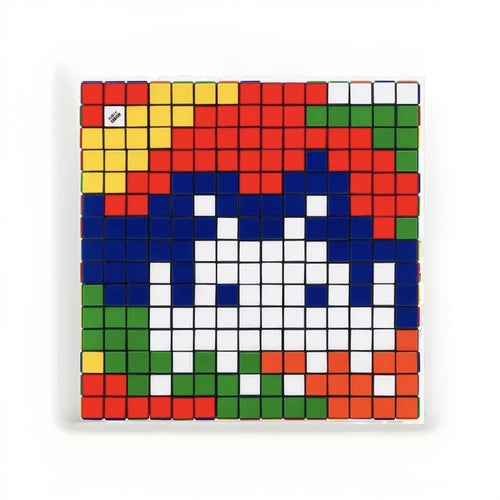
Buy Invader Rubikcubism by first establishing the exact format of the offered work—unique panel, editioned object, print-related work, or another release type—then matching its dimensions, construction, markings, condition and documentation to reliable, release-specific records. The term Rubikcubism describes a visual and material approach, not a single product specification. A cube-based work should therefore be researched as the exact object offered, rather than valued or authenticated by a familiar image alone.
Inspect the panel or object closely, ask for actual-item photographs from the front, sides and back, account for the physical support and attached cube elements, document any loss, substitution, repair or instability, and read the written sale terms before transferring funds. Where evidence is incomplete, say so in your records and price the uncertainty into the decision instead of converting it into confidence.
Table of contents
- Why Rubikcubism deserves its own buying workflow
- Identify the exact format before comparing anything else
- Original panel, editioned work and image-based edition: do not blur the categories
- What to inspect physically
- Condition reporting for cube-based work
- Documentation, provenance and authentication limits
- A practical purchase workflow
- Transport, installation and care
- What to do when the listing does not add up
- Related guides, FAQs and image briefs
Why Rubikcubism deserves its own buying workflow
Invader’s cube-based works create a particular research problem: they are visually legible at a distance but materially specific up close. The image often dominates the first impression. A buyer sees a familiar pixelated motif, a grid of color, a signature visual vocabulary, or a listing headline that uses the word Rubikcubism. None of those things tells you enough about the physical work in front of you.
Buying well requires you to separate four questions that are frequently collapsed into one.
- What format is it? A unique panel, an editioned object, a timed or publisher-mediated release, a printed work related to cube imagery, and a work merely described as “Rubik-style” are not interchangeable categories.
- What exactly is included? Support, cube elements, frame or mount, hardware, packaging, certificate, invoice and accompanying documentation may all matter, but each has a different evidentiary value.
- What is its physical condition? Cube faces, mechanical components, adhesive, backing, edges, mount and protective materials can all age or be altered differently.
- What evidence connects this object to its stated release? The strongest answer comes from a coherent record, not an isolated number, image, or certificate.
This article is a buying guide, not an assertion that every cube-based work fits one construction standard. Any particular work should be evaluated on its own release record and actual physical state. That is especially important when a listing uses broad terms such as “original,” “official,” “limited,” “signed,” “complete,” or “museum quality” without showing enough detail to support them.
For the art-historical background and the visual logic of the medium, start with Rubikcubism Explained: How Invader Turned Rubik’s Cubes Into Fine Art. For a release-by-release starting point, see Every Official Invader Print, Panel & Rubikcubism Release: A Collector’s Archive. This guide focuses on the purchase decision: how to translate that context into questions for the particular work on offer.
Identify the exact format before comparing anything else
The first step is to make a clean item record. Do it before you look at price results or negotiate. Copy the exact title as listed, then create separate fields for the information you can verify and the information supplied only by the seller.
Your record should include:
- Exact title, title variant and date stated by the seller.
- Whether the work is described as unique, editioned, timed, signed, numbered, or otherwise designated.
- Dimensions of the object itself, then dimensions of any frame, crate or presentation case.
- Material description: cube-based elements, panel or support, mounting system, frame, glaze or cover, if any.
- All visible markings, labels, signatures, numbers, stickers, stamps, publisher references or inventory tags.
- Whether the images show the exact work or illustrative/reference imagery.
- What paperwork is physically included, and what paperwork is merely mentioned.
- Seller, venue, price, fees, taxes, shipping terms, inspection period and return terms.
The point is not bureaucratic neatness. It is to stop a generic visual description from becoming the identity of the work. If two listings use the same title but have different dimensions, different construction, different released formats or different accompanying documentation, their comparability is limited.
Use format-specific language
If a seller says “original,” ask what they mean. They may mean an artist-made unique panel. They may mean an editioned work that is original rather than a reproduction. They may mean the image is not a poster. Those are different propositions. Instead of accepting a broad adjective, restate the offer precisely: “The listing describes this as a [format], measuring [dimensions], with [marks] and [documents]. Can you confirm which release record supports that description?”
The same discipline applies to “edition.” An edition designation does not tell you the medium, construction, release route, condition or completeness. It is one part of a fact pattern. Record the edition information exactly as shown, but do not infer facts that are not on the object or in the release evidence.
Original panel, editioned work and image-based edition: do not blur the categories
A useful way to think about Rubikcubism is that the visual language may travel across several formats. The same or a related image can appear in materially different forms. Your job is to identify which form you are buying and make sure the price comparison follows the form.
| Category | What to establish | Research priority | Common mistake to avoid |
|---|---|---|---|
| Unique cube-based panel or object | Support, dimensions, construction, unique identifiers, exhibition or gallery history | Actual-item detail and ownership chain | Treating an image match as enough evidence for a unique work |
| Editioned cube-based work | Exact edition designation, dimensions, issue context, physical configuration, included documents | Release-specific source plus object photos | Assuming all numbers or labels prove the entire offering |
| Timed or publisher-mediated edition | Publisher/release context, order or delivery record, standard versus optional presentation elements | Official publisher record and exact item match | Applying a unique-work condition premium without comparing format |
| Print or other image-based work | Medium, paper or support, edition information, markings, frame versus work dimensions | Print-specific catalogue and condition review | Calling it a cube panel because it depicts cubes |
| Work described with “Rubik” language by a reseller | Whether it is actually an Invader release and which one | Independent evidence before price research | Letting marketing language replace identification |
The table does not rank the categories. It tells you why a search result from one category may not be a reliable comparable for another. A well-documented edition can be a more sensible purchase than an under-documented unique-looking panel. A condition issue can matter more than a memorable title. A beautiful image can belong to an offering whose physical identity remains unclear.
The role of catalogues and prior sales
Prior auction catalogues and gallery records can be valuable because they often record dimensions, material, photographs and sale date. They are not automatically dispositive. A catalogue may have errors, a reused image, an incomplete description or a different work from the one on offer. Treat a prior record as a hypothesis to test: does the offered work match its physical details, visible marks, format and documented history?
If you find several accounts that disagree, do not choose the most favorable one. Record the disagreement and ask the seller about it. Ambiguity is not necessarily fraud, but it is a real condition of the purchase and should affect your confidence, time commitment and price ceiling.
What to inspect physically
Rubikcubism is material. The viewer should not have to infer construction from one front-facing photograph. Request a thorough image set or, when appropriate, arrange a professional condition review before completing the purchase.
Front surface and cube elements
Begin with overall straight-on images to see the composition, then request closeups under even and raking light. Look for cube faces that are absent, cracked, chipped, unusually glossy, discolored, mismatched, loose, rotated in a way that breaks the intended image, or visibly different from surrounding elements. A rotated cube might be part of an intended configuration, a handling event, or a repair result. Ask rather than guess.
Note whether the work uses standard consumer-cube components, modified elements, fixed faces, a proprietary arrangement, or another construction method. You do not need to diagnose the work from afar. You do need to avoid treating any visible cube component as inherently interchangeable. A replacement that seems visually small may alter the object’s condition and documentation story.
Support, backing and sides
Ask for side, rear and edge images. They can reveal the depth of the construction, panel material, frame or mount, labels, hardware, signs of warping, evidence of prior installation, and whether the piece has been altered or remounted. If a work is framed, determine whether the frame is part of the offered object or a later presentation decision. Keep the dimensions separate in your notes.
For a heavy, three-dimensional object, review how the weight is distributed and how it is meant to be displayed. A seller’s wall photograph is not an installation specification. If the work will be mounted, ask whether original hanging hardware is present, whether it has been modified, and what professional assessment may be appropriate for your wall and environment.
Markings and labels
Request crisp, close images of every visible mark and the surrounding surface. A cropped image of a number may be less useful than a wider image that shows its location on the object. Marks should be considered with the work’s format, construction, documentation and history—not detached and treated as a universal authenticator.
Never ask a seller to alter, remove or scrape a mark to “test” it. If examination beyond photography is required, use a qualified professional who understands the risks to the work and who can document their method.
Condition reporting for cube-based work
Condition reporting should be descriptive. Words such as “excellent” or “mint” mean little unless a buyer can see the basis for them. Ask the seller to separate the condition of the front, elements, support, frame/mount, backing and documentation.
| Area | What to review | Good disclosure looks like |
|---|---|---|
| Cube faces and colors | Scratches, chips, cracks, wear, discoloration, mismatched components | Close images and location-specific notes |
| Mechanical or attached elements | Loose, stuck or misaligned pieces; altered rotation; adhesion issues | Explanation of what was observed, not a blanket conclusion |
| Panel/support | Warping, dents, scratches, moisture signs, edge loss, paint or finish change | Front, side and rear photographs in neutral light |
| Frame/mount/hardware | Later framing, stability, missing hardware, pressure points, alterations | Clear statement of whether it is original to the release |
| Documentation and packaging | Creases, loss, replacement sleeves, separated materials | Itemized list of what transfers with the sale |
Restoration and replacement need precise words
An owner may say there has been “no restoration” because they have no knowledge of one. That is not identical to a conservator concluding that no restoration exists. Write the distinction accurately. “No restoration was disclosed by the seller” is a useful record. “No restoration has ever occurred” demands stronger evidence.
The same logic applies to components. If a cube face, element, backing, adhesive, frame or hardware has been replaced, the question is not automatically whether the work is desirable. The question is whether the alteration is accurately disclosed, physically stable and reflected in your decision.
For a fuller condition workflow across mosaic, screenprint and cube-based formats, see the forthcoming Invader Condition Report: Mosaic, Screenprint & Rubikcubism Checks Before You Buy. That article should sit beside, not replace, a work-specific professional review when the stakes justify one.
Documentation, provenance and authentication limits
Provenance is most useful when it is ordinary, specific and connected to the exact work. A dated invoice, clear installation images, a gallery record, prior auction catalogue, insurance schedule, shipping record and correspondence can each contribute to a coherent chain. The documents do not need to be dramatic. They need to describe the same physical object in a way that makes chronological sense.
Read documents for specificity
Ask whether the document names the work, states dimensions or format, records a number if applicable, identifies the seller or issuer, has a date, and connects credibly to the object. A generic certificate or broad description may be worth preserving but should not be made to carry proof it does not contain.
When paper records are thin, focus even more on actual-item photographs, seller disclosure and sale terms. Do not invent a provenance chain because a work appears plausible. A carefully worded gap is safer than a polished but unsupported story.
Authentication is an evidence process
There is no single object feature that substitutes for research. This guide does not authenticate works. It helps a buyer assemble questions and recognize what needs independent review. For a broader discussion of evidence, risk and red flags, read How to Spot a Fake Invader: The Ultimate Authentication Guide.
If uncertainty remains substantial, options include asking for additional documentation, negotiating an inspection or return term that fits the transaction, seeking specialist advice, or passing. The most expensive error is often not paying too much for a work you understand; it is paying any amount for a work you cannot later describe clearly.
A practical purchase workflow
Use the following sequence before you make an offer or bid.
- Make an exact item record. Separate seller claims from facts visible in the object and documents.
- Classify the format. Determine whether you are evaluating a unique object, an editioned cube-based work, a publisher-mediated edition, a print or something else.
- Locate release context. Use artist, publisher, gallery, catalogue and credible contemporaneous records to identify the intended format and disclosed dimensions.
- Request the missing images. Front, sides, back, edges, marks, condition details and any included documents should be visible.
- Write a condition ledger. List each issue and each unknown. Avoid letting a broad grade conceal a specific concern.
- Trace ownership records. Ask how the seller acquired the work and which documents transfer. Confirm that the records relate to this object.
- Calculate the full commitment. Include buyer’s premium, tax, shipping, insurance, crating, installation and any potential conservation or framing work.
- Read sale terms. Clarify payment, inspection, delivery, risk transfer and return policy before committing.
- Set your evidence threshold. Decide which gaps you can accept and which require you to walk away.
- Preserve the file. After purchase, keep all records, incoming condition photographs and delivery documentation together.
The workflow can feel slower than an impulsive auction bid or private-sale conversation. That is a feature. Time pressure is part of how unsupported claims become hard to question.
Transport, installation and care
Cube-based work asks for planning beyond ordinary framed paper. Confirm who is responsible for packing, crating, shipment insurance and risk of loss at each stage. Ask that the object be stabilized so that vibration, compression and shifting do not place stress on the surface, support or mounting hardware. Do not assume an existing crate is appropriate without seeing how the work is immobilized inside it.
On delivery, document the sequence: outer carton or crate, condition before opening, packing layers, front, sides, rear, closeups and all documents. Retain packing material until you know the work is sound and any delivery terms have been satisfied. If an issue appears, use the written claims procedure promptly and preserve evidence rather than immediately discarding it.
For installation, use professionals whose experience matches the object’s weight, depth and hanging system. Avoid direct sun, high heat, high humidity, unstable walls and locations where a work could be bumped or vibrated repeatedly. Care recommendations need to be tailored to the exact material and construction, so ask a qualified conservator or installer when the work’s history or stability is uncertain.
For a method of documenting multi-component Invader editions before and after delivery, see The Complete Invader Invasion Kit Collector’s Guide. The formats differ, but the habit of preserving a precise record carries across a collection.
Material claims demand the same restraint across collecting categories. A description of ink, paper, process or finish should stay tied to the exact release record and visible object rather than a broad stylistic label. The companion DEATH NYC Printmaking & Paper: How to Read What You’re Actually Buying gives a parallel method for separating observable material facts from seller terminology. It is relevant here as a research habit, not because the artists’ releases share a universal production process.
When the listing does not add up
Step back if the description and photographs conflict, if the seller will not show the rear or condition details, if dimensions do not match the stated format, if a document is vague or appears disconnected from the work, if a price is explained only with a familiar image, or if urgency is used to avoid reasonable questions.
You do not need to accuse the seller of wrongdoing to decline an under-documented offer. “I could not establish the exact configuration and condition to my standard” is a complete reason to pass. A responsible collection is built as much by the objects you decline as the ones you acquire.
Related guides
- Rubikcubism Explained: How Invader Turned Rubik’s Cubes Into Fine Art — history and visual language of the medium.
- Every Official Invader Print, Panel & Rubikcubism Release: A Collector’s Archive — release context before you compare an offered work.
- How to Spot a Fake Invader: The Ultimate Authentication Guide — evidence and counterfeit-risk context.
- Invader Condition Report: Mosaic, Screenprint & Rubikcubism Checks Before You Buy — format-specific physical inspection.
- DEATH NYC Printmaking & Paper: How to Read What You’re Actually Buying — a companion guide on describing material and medium without assumptions.
FAQs
Is every Invader work made with Rubik’s Cubes a unique original?
No. You must identify the exact release format. Cube-based visual language can appear across unique objects, editioned works and other formats. Compare the offered work only with sources and sales that match its actual category.
What condition issues matter most for Rubikcubism?
Review cube faces, attached or mechanical elements, support, backing, mount, frame, hardware and documentation separately. Chips, cracks, discoloration, loose components, altered mounting and unreported replacement can all affect the physical state and the clarity of the record.
Can an edition number authenticate a Rubikcubism work?
No. A number is one attribute to record. It should be assessed with construction, release-specific documentation, provenance, actual-item photographs and seller disclosure.
Should I buy a Rubikcubism work without seeing the back?
Not seeing the back leaves an important gap. The rear and sides can reveal support, labels, hardware, prior installation, alterations and condition. Request those images before you decide.
Can I compare a cube panel to a print with the same image?
Only with great caution. The formats, materials, condition risks, release context and market behavior may be materially different. Start with like-for-like comparisons.
Does a frame come with the artwork?
Sometimes, but do not assume it is original to the release or included in the sale. Ask the seller to state whether the frame, mount and hardware are part of the offered object and document their condition separately.
Source notes and limitations
This guide is educational and does not authenticate, appraise, insure, conserve, install or provide legal advice for any particular work. Availability, publisher records, sale terms, auction fees, taxes, shipping rules and condition can change. Verify the exact work against current release-specific records and the written terms supplied by the seller, dealer, auction house or relevant professional.
The guide intentionally does not assign universal materials, prices, condition grades or authenticity conclusions to all Rubikcubism works. Those facts must be established for the individual object being offered.