Invader gave street art its strangest medium: the Rubik’s Cube. What began in the mid-2000s as a studio experiment linking video-game pixels to a plastic puzzle became “Rubikcubism” — a self-declared art school, a body of gallery mosaics, and, at auction, a category capable of pushing a single work past €490,000. This is the complete collector’s guide to how Invader turns twisted cubes into fine art, why the six-color constraint matters, which editions exist, and how the market has priced them.
Most people meet Invader through his tiled aliens cemented onto walls in more than eighty cities. Fewer know the parallel practice he built indoors, one that trades ceramic tiles for a mass-produced 1980s toy. Rubikcubism is the artist’s most conceptually loaded body of work — a pun, a homage, a technical dare, and, increasingly, one of the most financially significant corners of his catalogue. For collectors, it is also the part of Invader’s output where the gap between a €80 print and a half-million-euro unique mosaic is widest, which makes understanding it a matter of real money, not just connoisseurship.
This guide grounds its edition data in our documented catalogue of official Invader releases — 84 verified editions spanning prints, sculptures, and HENI’s recent timed panels — and verifies every biographical, historical, and auction claim against authoritative sources including Invader’s own website, HENI Editions, MyArtBroker, Artcurial, and the reporting of Euronews and France24.
Origins

Invader emerged in Paris in the late 1990s with a simple, obsessive idea: to “invade” the world’s cities with mosaic characters modeled on the aliens from the 1978 Taito arcade game Space Invaders. The pixel — the indivisible square unit of an 8-bit screen — became his native visual language, and the ceramic tile became its physical equivalent. By the early 2000s he was already exploring what else could stand in for a pixel. The answer arrived from a toy shop.
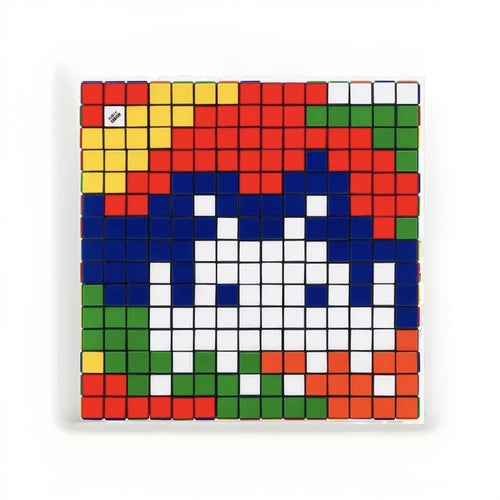
According to MyArtBroker, “since 2004, Invader has experimented outside the universe of video games and created a series of works for indoor display using Rubik’s Cubes.” The artist’s own account, published on space-invaders.com, dates the sustained practice to 2005: “In 2005, Invader continues his exploration of the link between pixels and mosaics by creating artworks made of Rubik’s cube.” The first pieces were modest — an untitled work measuring 16.5 × 16.5 cm and a sculpture titled Roiro, both dated 2005 — but the logic was immediately clear. A solved Rubik’s Cube face is a three-by-three grid of colored squares. Nine pixels per cube. Assemble enough cubes and you have a screen.
Invader named the practice himself. He defines Rubikcubism, in his own words, as “a fine art school developed in Paris in the early 21st century and characterised by the use of Rubik Cubes as a medium.” That deadpan, faux-academic tone — declaring a one-man “school” — is central to the joke and the seriousness alike. The name folds together Cubism, the movement founded by Braque and Picasso, and Ernő Rubik, the Hungarian architect who invented the cube in 1974 (Wikipedia). It is a pun that also happens to be an accurate description: an art built literally from cubes.
The practice was consecrated with an exhibition. The first show devoted to the Rubik works, simply titled Rubik Space, was held in spring 2005 at Galerie Patricia Dorfmann in Paris’s 4th arrondissement, per MyArtBroker’s catalogue notes. From there the idea traveled: North American galleries, including Jonathan LeVine in New York, and eventually a full institutional retrospective. We treat this history as verified reference, not folklore, because the market prices these works on the strength of that provenance.
It is worth placing Rubikcubism in the arc of Invader’s career, because it did not appear out of nowhere. By the mid-2000s Invader had already spent nearly a decade cementing ceramic-tile aliens onto walls, treating the city as a game board and each installation as a “level” to be completed. The Rubik works were the studio counterpart to that street campaign — a way to take the same pixel logic indoors, where it could be exhibited, editioned, and sold under gallery conditions. Where the wall mosaics are anonymous, illicit, and site-specific, the Rubik mosaics are signed studio objects designed for collectors. The two practices share a grammar but serve different economies, and understanding that split is the first thing a serious buyer needs to grasp. For the full biographical arc, our companion pillar on who Invader is traces the street project from its 1990s origins through the Flash Invaders era.
The anonymity matters here too. Invader has never publicly confirmed his legal identity, operating only under the name “Invader” (or “Space Invader”). That deliberate facelessness is not a marketing gimmick; it is bound up with the illegality of much of his street work and with a conceptual insistence that the work, not the man, is the subject. For Rubikcubism specifically, the anonymity throws the emphasis onto the object and the idea — the twisted cubes and the pun that names them — rather than onto any biographical narrative. We follow that lead and make no claim about who Invader is, only about what the documented record shows he has made.
Why Rubik’s Cubes
The choice of medium is not arbitrary, and it rewards unpacking. A Rubik’s Cube is one of the most recognizable manufactured objects of the twentieth century — a design icon, a symbol of 1980s childhood, and a mathematical curiosity all at once. For an artist whose entire project is about smuggling nostalgic, low-resolution digital imagery into public and gallery space, the cube is almost too perfect. It carries the same generational memory as the arcade alien, and it renders that memory in three physical dimensions.
There is a formal argument too. Invader had spent years arguing, through his tile mosaics, that the pixel is a legitimate unit of picture-making — that low resolution is a style, not a limitation. The Rubik’s Cube extends that thesis. Each cube is a self-contained module of exactly nine colored squares, and unlike a custom-cut ceramic tile, it is standardized, mass-produced, and instantly legible as a cultural object. When Invader builds a portrait from cubes, the viewer sees both the image and the toy, holding two ideas at once: this is a face, and this is hundreds of Rubik’s Cubes.
The cube also imposes discipline. As Invader has said of the practice, “the constraints of the object — its size and its palette limited to 6 colours — lead him to produce nearly abstract works that only reveal themselves when the viewer steps back,” or, in a distinctly contemporary twist, “when looking at them through a smartphone.” That last detail matters. A Rubik mosaic is engineered for the phone camera the way his street tiles are engineered for the naked eye at a distance — the low-resolution source resolves into a recognizable image precisely when it is re-digitized by a screen. The medium closes the loop between pixel and object and back to pixel.
Finally, the cube is a game, and games are Invader’s recurring subject. His street project began with an arcade game; the Rubik’s Cube is arguably the most famous puzzle-game ever made. Choosing it kept the work inside the artist’s core vocabulary of play, competition, and problem-solving, while opening a new formal territory that his tile mosaics could not reach.
There is also a wry inversion at the heart of the choice. The Rubik’s Cube exists to be solved — the entire cultural meaning of the toy is the restoration of order, each face returned to a single color. Invader does the opposite. He scrambles hundreds of cubes into deliberate disorder, and it is that disorder, held in place, that composes the image. A wall of his Rubik mosaics is, from a purist’s point of view, a wall of “unsolved” cubes — and yet it is precisely their unsolved state that carries the picture. The medium thereby stages a quiet argument about what “order” means: the solved cube is empty of image, while the scrambled cube is full of it. That conceptual reversal is a large part of why critics and institutions have taken the work seriously rather than dismissing it as novelty.
The Construction Process
The physical labor behind a Rubik mosaic is considerable, and it is the reason the unique works command the prices they do. Each cube must be individually twisted so that the correct color faces outward for its position in the larger image — and only one of the six faces is visible in the finished piece. According to HENI, “Rubikcubism constructs images solely using the six-colour palette and square tiles found on a Rubik’s Cube,” with the artist twisting “dozens, at times hundreds” of cubes per work.
The math of the underlying object underlines how deliberate this is. A standard Rubik’s Cube has, per Wikipedia and the Smithsonian, exactly 43,252,003,274,489,856,000 solvable positions — roughly 43 quintillion. Invader is not solving the cube in the conventional sense; he is solving a different problem, arranging each cube into precisely the scrambled state that presents the color he needs on its outward face. Every cube in the grid is its own small act of composition.
Scale varies dramatically across the body of work. The verified record sales give a concrete sense of magnitude: Rubik Mona Lisa (2005) is built from 330 Rubik’s Cubes, according to Euronews and France24 reporting on its Artcurial sale, while Rubik Space (2005) comprises 391 cube segments per MyArtBroker, and Rubik Dalai-Lama (2008) is assembled from 225 cubes. At nine visible squares per cube, a 330-cube Mona Lisa resolves into roughly 2,970 colored pixels — a resolution comparable to a small patch of an early video-game screen, which is exactly the aesthetic Invader is chasing.
Once a unique mosaic is made, Invader frequently translates it into an edition. As MyArtBroker notes, “the resulting physical artworks are then reproduced as screen prints for gallery distribution.” This two-stage process — a labor-intensive unique cube sculpture, followed by a printed edition that reproduces its image — is central to how the market is structured, and to why collectors must be scrupulous about what, exactly, they are buying. A Rubik Space screen print and the Rubik Space cube mosaic share an image and a name, but they are separated by a factor of thousands in value.
The construction also constrains what images are achievable. Because the effective resolution is coarse — a few thousand colored squares at most — Invader gravitates toward subjects that survive heavy simplification: faces with strong tonal contrast, instantly recognizable album covers and logos, and canonical artworks whose compositions are already burned into collective memory. A viewer does not need fine detail to recognize the Mona Lisa’s pose or the silhouette of the Abbey Road crossing; the mind supplies what the resolution omits. This is the same principle that lets an 8-bit sprite read as “Mario” from a dozen colored blocks. Rubikcubism works because it chooses images that are robust to compression, and part of Invader’s skill is knowing which subjects will and will not survive the translation into cubes.
There is a further physical subtlety. Real Rubik’s Cubes are not perfectly flat: each face is slightly domed, the stickers reflect light, and the black grid lines between the small cubies create a visible lattice across the whole work. Invader embraces these artifacts rather than hiding them. The grid of black seams reads, at a distance, like the scan lines of an old CRT monitor, reinforcing the video-game association, while the glossiness of the plastic gives the surface a synthetic sheen no ceramic tile or canvas could produce. The material, in other words, does aesthetic work of its own — it is not a neutral carrier for the image but an active part of how the image looks.
Color Limitations

Every Rubikcubism work is painted from the same fixed palette: the six colors of a classic Rubik’s Cube. Per the Rubik’s Cube’s standard specification, those are white, red, blue, orange, green, and yellow. There is no black, no skin tone, no gradient — a punishing constraint for figurative portraiture, and precisely the point.
Working within six colors forces Invader toward the same strategies that governed early digital art and, before it, Pointillism and mosaic. He cannot blend; he can only place. Shadow and volume must be implied by clustering darker hues (blue, red, green) against lighter ones (white, yellow), and the eye does the mixing at a distance. HENI and MyArtBroker both draw the comparison explicitly: the works convey “a similar impact to the abstractions of Pointillism or Cubism.” Where Seurat used thousands of dots of unmixed pigment, Invader uses hundreds of stickered squares, trusting optical fusion to reconstruct the image.
The constraint is also what makes the imagery legible as homage. When Invader renders Leonardo’s Mona Lisa, Munch’s The Scream, or Warhol’s Shot Marilyn in six flat colors, the translation is aggressively lossy — and that loss is the content. A masterpiece reduced to a Rubik’s palette is a statement about reproduction, iconicity, and how images survive their own degradation. It is the same insolence that let Duchamp draw a mustache on the Mona Lisa, updated for the pixel age.
For collectors, the palette has a practical dimension too: it makes the works instantly identifiable and difficult to convincingly fake at the unique level, because the color logic must be internally consistent across hundreds of modules. Our companion guide on how to spot a fake Invader covers the authentication mechanics in detail; the six-color rule is one of the first tells a knowledgeable eye checks.
Pixel Aesthetics
Rubikcubism sits at the intersection of three visual traditions: the mosaic, the video-game sprite, and modernist abstraction. Understanding how it borrows from each explains why the work reads as both nostalgic and genuinely contemporary.
From mosaic, it takes the module. A Roman or Byzantine mosaic builds an image from discrete tesserae, and Invader’s street practice is explicitly mosaic in technique. The Rubik works keep that modularity but supersize the unit: instead of a one-centimeter tile, the basic element is a whole cube face, a three-by-three block. This coarsens the resolution deliberately, pushing the image toward abstraction and forcing the “step back to see it” effect.
From video games, it takes the pixel grid and the aesthetic of low fidelity. Invader has always celebrated 8-bit crudeness as a style with its own dignity. His Rubik series titled Rubik Low Fidelity — devoted to album covers, per MIMA’s exhibition materials — even names the principle. Low fidelity is not a flaw to be apologized for; it is the register the work operates in, a refusal of high-resolution slickness.
From modernist abstraction, it takes the intellectual license to fragment and reassemble. The Cubism pun is not idle. Braque and Picasso broke the picture plane into geometric facets; Invader rebuilds the picture plane out of literal, twistable cubes. Where analytic Cubism dissolved form into planes, Rubikcubism reconstitutes recognizable icons out of a rigid grid — a sort of inverse Cubism that arrives at the same destination of “the image made strange.”
The result is work that functions on two viewing distances simultaneously. Up close, you see plastic toys, sticker seams, and the physical evidence of hundreds of hand-twisted cubes. Step back — or lift your phone — and a face, a logo, or a masterpiece snaps into focus. That oscillation between object and image is the aesthetic core of the whole enterprise.
This dual reading also links Rubikcubism to a lineage older than video games. Optical fusion — the eye blending discrete marks into continuous tone — is the same mechanism that powers Impressionist broken color, Pointillist dots, Byzantine gold-ground mosaic, and modern halftone printing. Invader’s innovation is not the mechanism but the module: he uses an object that is itself already famous, already loaded with cultural meaning, as the unit of fusion. A Seurat dot is anonymous pigment; a Rubik cube is a design icon in its own right. Every mosaic is therefore doing two things at once — making a picture and cataloguing a toy — and the tension between those two readings is what keeps the work from settling into mere spectacle. The Rubik Low Fidelity album-cover series makes this especially clear: to render a record sleeve, an object of mass-produced pop culture, in another object of mass-produced pop culture is a closed loop of consumer iconography, and Invader clearly relishes the recursion.
The word “low fidelity” deserves emphasis because it is a value statement, not a description of failure. In an art market that often prizes technical polish and photographic resolution, Invader stakes a claim for the opposite: that a deliberately degraded, blocky, six-color image can carry as much aesthetic and conceptual weight as a hyper-detailed one. This is the through-line from his earliest street tiles to the Rubik works — a sustained argument that low resolution is a legitimate, expressive, and even nostalgic visual language, worthy of the gallery and the auction room alike.
The Mathematics
It would be easy to treat the mathematics as decoration, but the numbers are load-bearing in Rubikcubism, both conceptually and commercially. Start with the object. Ernő Rubik’s cube, invented in 1974, has roughly 43 quintillion — 43,252,003,274,489,856,000 — solvable configurations, a figure the Smithsonian and Wikipedia both cite. Each of Invader’s cubes is set to exactly one of those states in order to present a single desired color on a single face. The astronomical possibility space of the toy is quietly reduced, cube by cube, to a deterministic image.
Then there is the arithmetic of resolution. With nine squares per cube face, the visible pixel count of a mosaic is simply nine times the number of cubes. A 330-cube work like Rubik Mona Lisa yields on the order of 2,970 colored squares; a 391-cube work like Rubik Space yields roughly 3,519. Those totals are computed directly from the cube counts reported by Euronews, France24, and MyArtBroker, and they explain why larger, higher-cube-count originals can carry finer detail and, generally, stronger prices.
Finally, there is the market’s own math, which we treat with the same rigor. Where we cite a growth figure or a spread, it is arithmetic on figures we have sourced, and we label it as such. MyArtBroker’s twelve-month analysis of the Rubikcubism print market, for instance, reports an average selling price of £4,296 against a range of £181 to £15,006, with roughly 16 percent annual growth in that window. We report those as MyArtBroker’s figures, not as our own valuations. The investing in Invader pillar goes deeper on market performance across his whole catalogue.
Famous Rubik Works

The Rubikcubism universe is organized, by Invader’s own account and MIMA’s 2022 retrospective, into thematic series: Rubik Masterpieces (canonical artworks re-rendered in six colors), Rubik Bad Men (portraits of villains and antiheroes), and Rubik Low Fidelity (album covers). A handful of works have become the emblematic faces of the whole practice.
Rubik Mona Lisa (2005) is the keystone. Built from 330 Rubik’s Cubes, it was, per Invader’s account, the first in his series of “insolent tributes” to the masterpieces of art history — the piece that proved the concept could carry the weight of a canonical image. Its 2020 sale (detailed below) rewrote his auction record.
Rubik Space (2005), comprising 391 cube segments, is the second Rubik’s Cube work Invader made and the one that lent its name to the founding 2005 exhibition at Galerie Patricia Dorfmann. It, too, became a landmark at auction.
The Rubik Kubrick works pay tribute to Stanley Kubrick’s films — Jack Torrance from The Shining and Alex DeLarge from A Clockwork Orange — and belong to the Rubik Bad Men lineage of villain portraits. Rubik Abbey Road (2009) renders the Beatles’ album cover, a natural fit for the Rubik Low Fidelity series. Rubik Scream reduces Munch’s icon to the six-color palette, and Rubik Dalai-Lama (2008), assembled from 225 cubes, is among the most valuable Rubik portraits at auction.
Below is a table of Rubikcubism-era editions drawn from our documented catalogue of official Invader releases, showing the year, medium, edition size, and original retail price where recorded. These are the printed and kit editions — the accessible entry points — not the unique cube mosaics that reach six figures.
| Work | Year | Medium | Edition Size | Original Retail (MSRP) | Publisher |
|---|---|---|---|---|---|
| Invasion Kit #04 (Rubik Kit) | 2005 | Sculpture kit | 150 | Not recorded | Space Shop |
| Rubik Space | 2005 | Screen print | 100 | GBP £80 | Space Shop |
| Rubik Kubrick I – Alex | 2006 | Screen print | 300 | GBP £75 | Pictures On Walls |
| Rubik Cubism (First Edition) | 2006 | Screen print | 75 | EUR €150 | Space Shop |
| Rubik Scream II | 2007 | Screen print | 50 | EUR €150 | Space Shop |
| Rubik Kubrick II | 2007 | Screen print | 300 | Not recorded | Pictures On Walls |
| Rubik Abbey Road | 2009 | Screen print | 50 | USD $300 | Jonathan LeVine Gallery |
| 6 Cubes (Blue & Yellow) | 2010 | Screen print | 20 | GBP £225 | Shop At Lazarides |
Two patterns are worth flagging. First, edition sizes in the classic era are small — often 50 to 150 — and original retail prices were startlingly low, from £75 to a few hundred euros. Second, publishers cluster around a few names — Space Shop (Invader’s own imprint), Pictures On Walls, Lazarides, and the New York gallery Jonathan LeVine — which is useful provenance signal when authenticating a piece.
HENI Rubik Panels
The most consequential recent development in Rubikcubism is HENI’s release of large-format “timed edition” giclée panels reproducing Invader’s cube mosaics. In February 2023, per HENI Editions, the publisher issued four Rubikcubism prints: Invaded Cube, Rubik Camouflage, Rubik Country Life, and Rubik Shot Red Marilyn. HENI describes them as “Diasec-mounted Giclée on aluminium composite panel,” each measuring 100 × 100 cm and weighing 13.5 kg — substantial objects that reproduce the source mosaics from Invader’s Rubik Low Fidelity and Rubik Masterpieces series.
The “timed edition” model is distinctive and worth understanding before buying. As HENI states, “the number of editions ordered in the purchase window will determine the final size of the edition” — the run is “limited by time and by demand” rather than by a fixed number announced in advance. This inverts the usual scarcity logic: instead of a pre-set edition of, say, 50, the size is discovered after the window closes. The result is that final edition sizes vary widely, and a collector cannot know at purchase exactly how rare the print will ultimately be.
Our documented catalogue records the final sizes for these HENI Rubik panels, and the spread is dramatic — from the low 400s to over 800 — which directly shapes secondary-market scarcity. The table below lays out the HENI Rubik timed editions with their verified final edition sizes, dimensions, and retail prices.
| Work | Year | Medium | Final Edition Size | Dimensions | Retail (MSRP) | Scarcity |
|---|---|---|---|---|---|---|
| Rubik Shot Red Marilyn (Timed Edition) | 2023 | Giclée panel | 774 | 100 × 100 cm | USD $3,000 | Common |
| Rubik Camouflage (Timed Edition) | 2023 | Giclée panel | 812 | 100 × 100 cm | USD $3,000 | Common |
| Rubik Country Life (Timed Edition) | 2023 | Giclée panel | 431 | 100 × 100 cm | USD $3,000 | Scarce |
| Invaded Cube (Timed Edition) | 2023 | Giclée panel | 459 | 100 × 100 cm | USD $3,000 | Scarce |
The scarcity column tells the story. All four launched at the same USD $3,000 retail, but Rubik Country Life (431) and Invaded Cube (459) closed their windows with roughly half the print run of Rubik Camouflage (812). Everything else being equal, the smaller editions carry stronger long-run scarcity, which is the single most important variable a HENI-era collector should weigh — a point developed in our Invader investing guide. These panels are the accessible face of a body of work whose originals sell for six figures, and they represent the primary way most collectors will ever own a Rubikcubism image.
Sculptures
Rubikcubism is not only a wall practice. From the outset, Invader made three-dimensional cube objects, and he productized the process through his “Invasion Kit” series — boxed multiples that let collectors own a piece of the studio vocabulary. The very first Rubik-specific kit in our catalogue is Invasion Kit #04 (Rubik Kit) from 2005, an edition of 150 from Space Shop — effectively a do-it-yourself entry into Rubikcubism released the same year as the founding Rubik Space exhibition.
The sculptural strand matters for two reasons. First, it underlines that the cube is a physical, dimensional object for Invader, not merely a source image to be printed — the earliest Rubik works included freestanding sculptures like the 2005 Roiro. Second, the kits and multiples establish a tiered accessibility that runs through the whole catalogue: unique mosaics at the top, gallery prints in the middle, and boxed kits and sculptures at the entry level. Our broader complete archive of Invader prints, panels, and Rubikcubism releases maps that full ladder across every series.
At the institutional level, the MIMA retrospective in 2022 displayed “more than a hundred works” including “the first sculptures,” per the museum’s materials — confirming that the sculptural Rubik works are treated as a core, exhibitable part of the practice rather than a novelty sideline. For collectors, sculptures and kits demand the same authentication discipline as prints: check the publisher, the edition documentation, and any signing or numbering against known norms for that release.
The MIMA show, Invader Rubikcubist, is itself a landmark worth dwelling on, because institutional endorsement is a meaningful driver of an artist’s market. Running from June 2022 to January 2023 at the Millennium Iconoclast Museum of Art in Brussels, it was, per the museum, the first exhibition entirely devoted to the Rubikcubism works, retracing “nearly twenty years of creations in cubes” across the museum’s four floors. It organized the practice into its now-canonical series — the villain portraits of Rubik Bad Men, the art-historical tributes of Rubik Masterpieces, and the album-cover homages of Rubik Low Fidelity — and in doing so gave collectors and the market a coherent framework for understanding what had, until then, been a somewhat diffuse body of work. A dedicated museum retrospective signals that a practice has moved from cult curiosity to art-historical subject, and the timing dovetailed with HENI’s decision to issue the large Rubik panels in early 2023.
Beyond the boxed kits, Invader has also produced freestanding cube sculptures — three-dimensional objects rather than wall-mounted mosaics — and small-format works that function as sculptural studies. These sit at the more affordable end of the unique-object spectrum and occasionally surface at auction. Because they are physical cube assemblages rather than prints, they carry the same conservation considerations discussed below and the same premium over editioned reproductions. A collector encountering a purported Rubik sculpture should treat it with the caution appropriate to a unique work: demand provenance, documentation, and, where the value warrants it, expert physical examination.
Authentication

Because a Rubikcubism image can exist as a unique six-figure mosaic, a small gallery print, and a boxed kit — sometimes all sharing the same title — authentication starts with correctly identifying what tier an object belongs to. Confusing a screen-print reproduction with the unique cube original is the single most expensive mistake a new collector can make.
Several structural facts help. The classic-era Rubik prints came from a short, verifiable list of publishers — Space Shop, Pictures On Walls, Lazarides, and Jonathan LeVine Gallery — and the HENI panels are documented directly by HENI with edition sizes, materials, and dimensions. Provenance that traces cleanly to one of these sources is a strong positive signal; provenance that cannot be traced is a reason for caution. Edition size is another check: our catalogue records specific numbers (for example, Rubik Abbey Road at 50, Rubik Cubism at 75), and a purported print claiming a wildly different run should raise questions.
The six-color palette provides an internal consistency test for unique mosaics: every visible square must be one of white, red, blue, orange, green, or yellow, and the shading logic must hold across the whole grid. HENI’s panels, by contrast, are authenticated through the publisher’s own documentation and the timed-edition records rather than by any Pest Control-style third-party body — and it is worth stating plainly that there is no universal central authentication authority stamping every Invader work. Collectors should rely on documented provenance, publisher records, and expert examination. For a full, step-by-step methodology, see our dedicated guide on how to spot a fake Invader.
Conservation
Rubikcubism raises conservation questions that almost no other contemporary art medium does, because the “paint” is mass-produced plastic. A unique Rubik mosaic is, physically, an array of 1980s-derived toys: ABS plastic cubes with adhesive vinyl stickers, mounted onto a backing. Each of those materials has its own aging profile, and none was engineered for museum permanence.
The vinyl stickers are the most vulnerable element. Adhesive-backed color films can fade with ultraviolet exposure, lift at the edges over time, and shift in hue — and in a work whose entire meaning depends on a precise six-color relationship, even modest fading changes the image. Sensible custodianship therefore mirrors works on paper: minimize direct sunlight and UV, maintain stable temperature and humidity, and avoid heat sources that can soften adhesives or warp plastic. Many exhibited Rubik works are framed or Diasec-style face-mounted for exactly this protective reason.
The HENI panels sidestep much of this. As HENI specifies, they are “Diasec-mounted Giclée on aluminium composite panel” — a pigment print sealed under acrylic on a rigid aluminum substrate. That construction is archival by design, resistant to the sticker-lift and cube-loosening risks of an actual cube assemblage, and it is one reason the panels function well as long-term collectible objects. For unique cube works, prospective buyers should ask specifically about prior restoration, any replaced cubes or re-stickering, and the mounting method, since all three bear on both authenticity and future stability.
Restoration ethics are unusually thorny for cube mosaics, and worth thinking through before a purchase. If a single cube in a 330-cube work loosens, fades, or breaks, is it acceptable to replace it? A replaced cube is, strictly, no longer the original material the artist placed — yet leaving a degraded or missing cube compromises the image the artist intended. There is no settled convention, and the answer affects value: extensive re-stickering or cube replacement can be viewed by the market as a condition problem, much as heavy inpainting is on a painting. Because the medium is mass-produced and superficially easy to “fix,” the temptation to over-restore is real, and a savvy collector should regard undocumented restoration with the same wariness they would bring to any other medium. Transparency — a clear condition report noting any interventions — is the collector’s best protection.
Screen prints and giclée editions follow ordinary paper-and-panel conservation practice: acid-free framing, UV-filtering glazing, stable environment, and away from direct light. The HENI aluminum panels are heavy (13.5 kg each) and rigid, which introduces its own handling considerations — secure hanging hardware and careful transport — but they are otherwise among the more durable objects in the Rubikcubism universe. In short, the more “print-like” the object, the more conventional its care; the more it is an actual assemblage of physical cubes, the more specialized and consequential its conservation becomes.
Collecting
Collecting Rubikcubism means choosing a tier and understanding what each offers. At the top sit the unique cube mosaics — the Rubik Mona Lisa, Rubik Space, and Rubik Dalai-Lama class of object — which are effectively blue-chip trophies trading at auction in the six-figure range. These are the works that define the artist’s market ceiling, and they are correspondingly rare and difficult to acquire.
In the middle sit the HENI giclée panels: large, well-made, publisher-documented reproductions of cube mosaics, launched at USD $3,000 each in 2023, with final edition sizes ranging from 431 to 812 depending on the timed-window demand. For most collectors these are the realistic way to own a Rubikcubism image at gallery scale, and the meaningful variable between them is the final edition size — the smaller runs (Rubik Country Life, Invaded Cube) are structurally scarcer.
At the entry level sit the classic-era screen prints and Invasion Kits — Rubik Space, Rubik Cubism, Rubik Abbey Road, Rubik Scream II, and the Rubik Kit — issued in small editions of 20 to 300 at original prices as low as £75. These are historically important as the works that built the practice, and their scarcity (many at 50 to 100 copies) can make well-provenanced examples desirable despite their modest original cost.
Whichever tier, three rules apply. Confirm the tier before anything else — unique versus print versus kit. Insist on provenance that traces to a known publisher or to HENI. And weigh edition size heavily, because in Invader’s market scarcity is the dominant price driver. Collectors building broader Invader holdings will find our complete guide to Invader useful for placing Rubikcubism within the artist’s full arc, and the live Invader Index catalogues the releases in one place.
Market Performance
Rubikcubism is responsible for some of Invader’s most spectacular auction moments, and the record is precise and well documented. The pivotal sale came in February 2020, when Rubik Mona Lisa (2005) sold at Artcurial in Paris for €480,200 — against a presale estimate of up to €150,000 — in what Euronews and France24 reported as a bidding war between two buyers. The sale, which coincided with the closing days of the Louvre’s blockbuster Leonardo da Vinci exhibition, set a new auction record for the artist at the time and shattered its estimate more than threefold.
That record did not stand long. In December 2020, again at Artcurial, Rubik Space (2005) — the 391-cube mosaic from the founding 2005 exhibition — realized €492,600 against an estimate of €400,000 to €600,000, per MyArtBroker’s record-prices analysis, edging past the Mona Lisa result. Then in July 2021, Rubik Dalai-Lama (2008), built from 225 cubes, achieved €468,250 at Artcurial, cementing Rubikcubism as a category capable of near-half-million-euro results.
The table below consolidates the verified Rubikcubism auction records, each sourced and cited.
| Work | Date | Auction House | Price Realized | Source |
|---|---|---|---|---|
| Rubik Space (2005) | Dec 2020 | Artcurial, Paris | €492,600 | MyArtBroker |
| Rubik Mona Lisa (2005) | Feb 2020 | Artcurial, Paris | €480,200 | Euronews / France24 / MyArtBroker |
| Rubik Dalai-Lama (2008) | Jul 2021 | Artcurial, Paris | €468,250 | MyArtBroker |
For context on how these unique-mosaic results compare to the artist’s broader ceiling: MyArtBroker records Invader’s overall top auction price as Astroboy, Tk_119 (2014), a tile mosaic that sold for US $1,220,000 at Sotheby’s New York in November 2019 — a reminder that Rubikcubism, while a major pillar, sits alongside his tile work at the top of the market.
The print market tells a quieter but instructive story. Per MyArtBroker’s twelve-month analysis of Rubikcubism editions, recent results include Rubik Abbey Road at £11,500 (buyer’s premium included) at Christie’s London in April 2025 and Rubik Space (print) at £3,800 at the same sale, against original retail prices of USD $300 and GBP £80 respectively. We present those as MyArtBroker’s reported figures; the arithmetic implication — that well-chosen early Rubik prints have appreciated by multiples of their issue price — is a computation on those cited numbers, not a valuation or a forecast. The full market picture across Invader’s catalogue is treated in our investing in Invader pillar.
| Date | Auction House | Price (inc. premium) | |
|---|---|---|---|
| Rubik Abbey Road | Apr 2025 | Christie’s London | £11,500 |
| ‘Rubik Ohh…Alright’ | Dec 2025 | Artcurial | £10,500 |
| Rubik Space (print) | Apr 2025 | Christie’s London | £3,800 |
| Rubik Albino | May 2025 | Forum Auctions London | £3,150 |
| Rubik Kubrick, The Shining | Sep 2025 | Tate Ward | £3,000 |
These print results, reported by MyArtBroker, are secondary-market prices including buyer’s premium; they illustrate the tier gap starkly. The same title — Rubik Space — is a €492,600 unique mosaic and a £3,800 screen print. Nowhere in Invader’s catalogue is the discipline of knowing exactly what you own more financially consequential.
A few structural observations follow from this record. First, the concentration of the top Rubik results at Artcurial in Paris is not coincidental: as a Paris-based artist with deep roots in the French scene, Invader has found his strongest unique-work bidding at home, and Artcurial has become the de facto venue for his headline sales. Second, the cluster of six-figure results in 2020–2021 shows how quickly this category re-rated; a medium once regarded as playful became, within a couple of auction seasons, a reliable source of near-half-million-euro results. Third, the HENI panels have introduced a new, more liquid layer to the market — hundreds of collectors now hold a Rubik image at the roughly USD $3,000 primary level, which broadens the collector base and, over time, may deepen secondary-market activity for the whole category.
What none of this establishes is a guarantee. Auction records capture specific works, on specific days, with specific bidders in the room; they are evidence of what has happened, not a promise of what will. A collector reading these numbers should treat them as a map of where demand has concentrated — canonical images, unique mosaics, small editions, strong provenance — rather than as a valuation of any particular piece they might buy. The consistent lesson across every tier is that scarcity and iconicity drive Invader’s market, and Rubikcubism, with its labor-intensive unique works and its instantly legible art-historical subjects, concentrates both.
Frequently Asked Questions
What is Rubikcubism?
Rubikcubism is a body of work Invader began in the mid-2000s in which he builds images out of Rubik’s Cubes, twisting each cube so a chosen color faces outward. He defines it, in his own words, as “a fine art school developed in Paris in the early 21st century and characterised by the use of Rubik Cubes as a medium.” The name puns on Cubism and on cube inventor Ernő Rubik.
When did Invader start making Rubik’s Cube art?
Per his own website, the sustained practice dates to 2005, with earlier experimentation from around 2004. The first dedicated exhibition, Rubik Space, was held in spring 2005 at Galerie Patricia Dorfmann in Paris, and the term “Rubikcubism” was coined by the artist that year.
What is the most expensive Rubikcubism work sold at auction?
The highest verified Rubikcubism auction result is Rubik Space (2005), which realized €492,600 at Artcurial, Paris in December 2020, per MyArtBroker. Rubik Mona Lisa (2005) sold for €480,200 at Artcurial in February 2020, and Rubik Dalai-Lama (2008) for €468,250 there in July 2021.
How many Rubik’s Cubes are in a Rubik mosaic?
It varies by work. Reporting on the record sales indicates Rubik Mona Lisa uses 330 cubes, Rubik Space comprises 391 cube segments, and Rubik Dalai-Lama is built from 225 cubes. At nine visible squares per cube, those translate to roughly 2,970, 3,519, and 2,025 colored pixels respectively.
Why only six colors?
Because a classic Rubik’s Cube has six face colors — white, red, blue, orange, green, and yellow — and Invader restricts himself to that fixed palette. The constraint pushes the work toward abstraction and gives it a kinship with Pointillism and Cubism, effects both HENI and MyArtBroker note explicitly.
What are the HENI Rubik editions?
In February 2023 HENI Editions released four Rubikcubism prints as large Diasec-mounted giclée panels on aluminum (100 × 100 cm): Invaded Cube, Rubik Camouflage, Rubik Country Life, and Rubik Shot Red Marilyn, each at USD $3,000. They were “timed editions,” meaning the final edition size was set by demand during the purchase window — ranging from 431 to 812 copies.
Are Rubik prints the same as the unique cube mosaics?
No, and the distinction is critical. A unique cube mosaic is a one-of-a-kind physical assemblage of Rubik’s Cubes and can sell for hundreds of thousands of euros. A screen print or giclée reproduces that image in an edition and sells for a tiny fraction of the price. Always confirm which tier an object belongs to before buying.
How do I authenticate a Rubikcubism work?
Trace the provenance to a known publisher (Space Shop, Pictures On Walls, Lazarides, Jonathan LeVine, or HENI), verify the edition size against documented records, and — for unique mosaics — check that the six-color logic is internally consistent. There is no single universal authentication authority for Invader, so documented provenance and expert examination are essential. See our authentication guide.
Where can I see Rubikcubism works in person?
The first exhibition devoted entirely to Rubikcubism, Invader Rubikcubist, ran at the MIMA museum in Brussels from June 2022 to January 2023, presenting more than a hundred works across four floors — from the earliest sculptures to the Rubik Bad Men, Rubik Masterpieces, and Rubik Low Fidelity series. Works also appear regularly at auction and in gallery shows.
Is Rubikcubism a good investment?
This article is educational and does not offer investment advice. What the record shows is that unique Rubik mosaics have reached near-half-million-euro auction results and that early prints have traded well above their original retail. Any future performance is uncertain, and edition size and provenance are the dominant variables. See our Invader investing guide for a fuller treatment.
This article is provided for educational and editorial purposes only. It is not investment, financial, or authentication advice, and it makes no representation or warranty about the authenticity, condition, or value of any specific work. Auction figures are drawn from cited third-party sources and reflect results at the stated dates; art markets fluctuate and past results do not guarantee future outcomes. Prospective buyers should conduct independent due diligence and consult qualified professionals before purchasing.