The Bottom Line

Invader has built one of the most systematic bodies of public art in the world: a globe-spanning "invasion" of ceramic-tile aliens installed, catalogued, and gamified over more than two and a half decades. The artist's own website reported 4,411 Invaders across 87 "territories" at the time of writing (space-invaders.com/world), while Wikipedia records that as of January 2020 he had created mosaics in 79 cities totaling 3,858 Space Invaders made from over 1.5 million ceramic tiles (Wikipedia). Artnet, quoting the artist, framed the ambition directly: he "wanted this project to have a planetary dimension" (Artnet News).
For collectors, the essential facts are these. Every street mosaic carries a city-code identifier (Paris pieces are prefixed PA; Hong Kong HK; Manchester MAN; and so on, per Wikipedia). Each is graded on a points system "ranging from 10 to 100" based on placement and difficulty (Illuminate). Only a subset of invaded cities receive a published Invasion Map — roughly 25 of about 85 invaded cities, according to Illuminate — which makes those maps a distinct collectible category. The FlashInvaders mobile app, launched by the artist, turned the whole campaign into a real-time treasure hunt with a live global leaderboard. And a parallel studio practice — screen prints, Rubikcubism panels, sculptures, and the map editions themselves — is what most collectors actually buy, since prying a genuine mosaic off a wall destroys it.
Gauntlet Gallery sells authenticated Invader works, and this guide is written for collectors who want to understand the system before they buy. For a fuller portrait of the artist, see our companion piece at /blogs/editorial/who-is-invader-complete-guide; for the studio catalogue, see /blogs/editorial/invader-complete-archive.
What a Space Invasion Is

An Invader "space invasion" is not a single event but an ongoing, city-by-city campaign. The artist selects a city, spends time scouting locations, fabricates tile mosaics in advance, and then installs them — usually at night, always cemented rather than pasted — across the urban fabric. Each installation is documented, numbered, and logged. When enough pieces are placed, the city is considered "invaded," and the artist frequently publishes a map or exhibition to mark it.
Origins and the pixel language
Invader takes his name and his visual vocabulary from the 1978 Taito arcade game Space Invaders. The low-resolution alien sprites of that game translate perfectly into ceramic mosaic: each square tile is a pixel, and the grid of the wall becomes the screen. The artist has described wanting to "liberate" the video-game characters from their screens and set them loose in physical space. This is why the medium matters — the mosaic is not a decorative choice but a literal restatement of the pixel, rendered in a material meant to last.
The choice of ceramic tile is doubly deliberate. Mosaic is one of the oldest permanent image-making techniques in Western art, running from Roman floors to Byzantine churches; by rendering a 1970s video-game sprite in that ancient medium, Invader collapses thousands of years of image history into a single gesture. The individual tile is the pixel, and the pixel is the tile — the low resolution that would be a limitation on a screen becomes, on a wall, a formal signature. It also makes the work robust: cement and ceramic survive weather, sunlight, and time in a way that a paste-up poster or a spray stencil cannot. The permanence is part of the concept, not an afterthought.
The scale of the campaign
The numbers are the headline. The artist's own site displayed 4,411 Invaders across 87 territories (space-invaders.com/world). Earlier reference points let you trace the growth curve: Wikipedia notes that by January 2020 there were 3,858 Space Invaders in 79 cities, comprising over 1.5 million ceramic tiles (Wikipedia). Artnet's 2019 profile put the figure at "more than 4,000" mosaics worldwide and reported the artist's stated goal of a "planetary dimension" to the work (Artnet News). Because the artist keeps installing, any single number is a snapshot; the honest way to state it is "several thousand mosaics across more than 80 cities and rising."
A game the artist plays against himself
Invader has described the invasion as a game with its own internal scoring. According to Illuminate, the artist "uses a complex grading system that considers the placement of each mosaic and assigns a score, ranging from 10 to 100" (Illuminate). More prominent, harder-to-reach, or more daring placements earn more points; each city accumulates a total score, and the artist is, in effect, competing against his own high scores city by city. This scoring logic later became the backbone of the public FlashInvaders app, discussed below. The takeaway for collectors: a mosaic's "score" is not a market valuation — it is the artist's own difficulty/placement rating, and it should not be confused with price.
This game-against-himself framing is not marketing gloss; it is structural. Invader has described aiming to install a coherent set of pieces per city rather than a single token work, so that each city reads as a completed "level." A piece placed high on a facade, in a hard-to-reach corner, or in a location loaded with meaning earns more points than an easy street-level placement. Summed across a city, those scores give each invaded city a total — and the artist chases new high scores city by city, the same way a player chases a high score on the original arcade cabinet. Understanding this makes the whole project legible: the invasion is a video game the artist is playing in physical space, with real cities as the board and ceramic tiles as the moves.
The Numbering System

Every mosaic in the campaign is identified by a code, and understanding that code is the single most useful literacy a collector can develop.
City codes plus sequential numbers
The system pairs a city abbreviation with a sequential number. Wikipedia's account of the campaign references codes such as MAN 47 (Manchester), HK 56 (Hong Kong), and BBO 24–27 (Bilbao) (Wikipedia). Paris pieces are prefixed PA, and the reactivation example cited below — PA_689 in Belleville — follows the same convention. In practice you will see the prefix rendered variously (with or without an underscore, e.g., "PA_689" or "PA 689"), but the structure is consistent: city code + number, assigned in the order the artist installs within that city.
Why the code matters
The code is the spine of the whole project. It ties a physical wall to the artist's own database, to the FlashInvaders app's validation system, and to any Invasion Map that depicts the city. When a mosaic is destroyed and later rebuilt (see "Reclaiming and Restoring Mosaics"), it retains its original code — the identity persists even when the physical tiles are replaced. For a collector, the code is also the primary authentication anchor: a claimed "street piece" that cannot be matched to a known city code, a documented location, and the artist's records should be treated with extreme caution. For the deeper mechanics of telling genuine from fake, see /blogs/editorial/who-is-invader-complete-guide.
What the numbering is not
The city-code numbering applies to street mosaics, not to the studio editions. A screen print or a Rubikcubism panel has an edition number (e.g., a print numbered 45/100), which is a different system entirely. Do not conflate a mosaic's PA/HK/MAN code with an edition fraction on a print — they describe different objects with different markets.
The Invasion Maps

The Invasion Maps are where the street campaign and the collectible print market meet, and they are the most directly relevant editions to the theme of this guide.
What an Invasion Map is
An Invasion Map is a published map of a single city that plots the locations of the mosaics installed there, rendered in a graphic style specific to that city. As Illuminate puts it, "Each Invasion Map is an exercise in graphic style and tells the story of the invasion of a city in its own way" (Illuminate). The maps are numbered in the top-left corner, and Illuminate notes that the first two Paris maps display "99," representing their 1999 release date (Illuminate).
How many maps exist
Not every invaded city gets a map — and that scarcity is the collectible logic. Illuminate reports that only about 25 of roughly 85 invaded cities have an official Invasion Map, with around 28 maps in existence when Paris's multiple editions are counted separately (Illuminate). Notable mapped cities span multiple continents — Paris, Los Angeles, New York, Tokyo, Vienna, Rome, Manchester, and more.
The Paris milestones the maps record
The Paris maps double as milestone markers for the campaign. Artnet records that in June 2011 Invader marked the installation of his 1,000th work in Paris with an exhibition at La Générale titled 1000 (Artnet News) — the same milestone reflected in the 2011 Paris map. Illuminate notes that a later Paris edition (dated 2024) showcases 1,500 installations in the city (Illuminate). So the "1,000th in Paris" and "1,500th in Paris" milestones are both real, both attributable, and both embedded in the map editions — a useful way to date and contextualize a given map.
Notable Invasion Map editions in our documented catalogue
Our documented catalogue of official Invader editions (84 releases, not an exhaustive universe of everything the artist has made) includes several Invasion Map and Invasion Kit editions. The table below draws only on that catalogue for edition size, medium, publisher, and retail figures; treat these as the documented issue details, not market prices.
| Edition (map / kit) | Year | Medium | Edition size | Publisher | Documented retail |
|---|---|---|---|---|---|
| Invasion Map Los Angeles (#12), Signed | 2004 | Offset lithograph | 100 | Stolen Space | USD $80 |
| Invasion Map Paris v2.0 (#20) | 2011 | — | 100 | Space Shop | EUR €200 |
| Invasion Map São Paulo (#21) | 2011 | — | 100 | Space Shop | EUR €180 |
| Invasion Map Brussels (#22) | 2012 | — | 50 | Space Shop | EUR €250 |
| Invasion Map Djerba | 2021 | Offset lithograph | 100 | Galerie Itinerrance | EUR €1,000 |
| Invasion Kit #01 (Albinos) | 2000 | Sculpture | 350 | Space Shop | — |
| Invasion Kit #16 (Flashinvaders) | 2014 | Sculpture | 250 | Space Shop | EUR €750 |
| Invasion Kit #18 (LA 2018) | 2018 | Sculpture | 300 | Space Shop | EUR €2,400 |
Source: Gauntlet Gallery's documented catalogue of 84 official Invader editions. "Documented retail" reflects issue/list figures where recorded, not current market value; a dash indicates the figure is not recorded in our catalogue.
Two patterns are worth flagging. First, the map editions are small — 50 to 100 copies in our catalogue — which is why individual city maps can be hard to source. Second, the retail trajectory is steep: an LA map documented at $80 in 2004 sits in the same lineage as a Djerba map documented at €1,000 in 2021, reflecting both the artist's rising profile and the shift from early self-published editions to gallery-published ones (Galerie Itinerrance being the artist's longtime Paris gallery).
Invasion Kits versus Invasion Maps
Do not confuse the two. Invasion Maps are 2-D printed maps of a city. Invasion Kits are sculptural editions — framed, tile-based reproductions of a specific street mosaic, sold as collectible objects (our catalogue records Kits from #01 in 2000 through #18 in 2018, mostly published by Space Shop, the artist's own outlet). Kit #16 is even titled "Flashinvaders," tying the physical object to the app. Both are legitimate collector categories, but they are structurally different products.
City by City: A Global Campaign

The invasion is organized around cities, and the city is the unit of both the artwork and the game.
How a city gets invaded
Invader typically installs a batch of mosaics per city — enough to constitute a coherent "invasion" rather than a one-off. The pieces are numbered sequentially within that city (PA, HK, MAN, BBO, and so on), and the city accumulates a total score under the artist's placement grading. Paris is the home base and the most heavily invaded city, which is why the Paris milestones (1,000th in 2011; a 2024 map showing 1,500 installations) function as the campaign's headline counters (Artnet News; Illuminate).
The global spread
The campaign is genuinely worldwide. The artist's site reported 87 territories invaded (space-invaders.com/world); Wikipedia's January 2020 snapshot counted 79 cities in 20 countries (Wikipedia). Hong Kong illustrates the pattern and its friction: Wikipedia notes Invader has installed dozens of works there since 2000, and the South China Morning Post reported that the removal of his Hong Kong works sparked public debate over whether the mosaics were culture or vandalism — a tension that follows the campaign into most cities.
Beyond the city: the invasion of space
The most literal expression of the "planetary dimension" is the artist's off-planet installation. According to reporting summarized across Graffiti Street and the European Space Agency, a mosaic coded KLN_27 was launched aboard the ATV-5 spacecraft on 29 July 2014 and installed by ESA astronaut Samantha Cristoforetti on the ISS's Columbus laboratory on 12 March 2015 — the first Space Invader placed in space. French astronaut Thomas Pesquet later became a public fan and, per Graffiti Street, in January 2023 offered to carry one of the artist's works to the Moon. Whatever the outcome, the episode captures the campaign's ethos: the invasion has no fixed borders.
Cities as characters
Because each city gets its own graphic map and its own accumulating score, cities effectively become characters in the project's story. Paris is the origin and the flagship — the most invaded city and the one whose milestones (the 1,000th work in 2011, the 1,500 installations reflected in the 2024 map) headline the whole campaign. Los Angeles, with an early Invasion Map documented in our catalogue at 2004, represents the artist's push into the United States. Hong Kong stands for the campaign's collisions with authority, where removals prompted a public argument over whether the work was heritage or graffiti (South China Morning Post). São Paulo, Brussels, Djerba, Tokyo, Vienna, Rome, and Manchester each add their own chapter — and, where a map exists, their own collectible edition. For a collector, this city-as-character logic is useful: it explains why certain city maps carry more cultural weight (and demand) than others, and why Paris material sits at the symbolic center of the market.
The rate of expansion
The trajectory of the counts tells its own story. Wikipedia's January 2020 figure of 3,858 mosaics in 79 cities (Wikipedia) versus the artist's later site total of 4,411 across 87 territories (space-invaders.com/world) implies hundreds of additional pieces and roughly eight new territories added in the intervening period — a pace that underlines why any single number is a snapshot. The campaign is not a finished body of work; it is a continuing project, and its "completeness" is a moving target by design.
Reclaiming and Restoring Mosaics

Street art is impermanent by nature, and Invader's mosaics face constant threats — but the campaign has an unusual immune system.
The threats
Mosaics are lost to theft, government removal, weather, construction, and vandalism. Because the pieces are cemented, they cannot be cleanly peeled off; as Wunderkammern and Graffiti Street both note, thieves who remove a mosaic typically destroy it in the process and must reconstruct it from new ceramics — which means a "stolen Invader" on the market is very often a rebuilt object, not the original wall piece. This is a critical caveat for anyone offered a supposedly-original street mosaic.
Reactivation
The campaign's answer to loss is "reactivation." A community of fans and volunteers — sometimes called "reactivators" — restores or rebuilds degraded and destroyed mosaics, and the artist himself re-installs pieces over time. Illuminate's documentary reporting cites the restoration of the PA_689 fresco in the Belleville district of Paris as a concrete example, and frames the principle plainly: a mosaic that is "destroyed" today may be "reactivated" in the future (Illuminate). Crucially, a reactivated piece keeps its original city code — the identity survives the physical replacement.
Reactivation is a genuinely unusual feature in street art, and it flips the usual logic of impermanence. Most graffiti and paste-up work is understood to be ephemeral; its loss is accepted as part of the form. Invader's campaign, by contrast, treats a mosaic's code as durable even when the tiles are not. Because the artist keeps a database and the community keeps hunting through FlashInvaders, a destroyed piece is not simply gone — it becomes a candidate for reactivation, either by the artist or by volunteer "reactivators" working from photographs and the original grid. The Belleville PA_689 restoration is the documented illustration, but the principle generalizes: the invasion is designed to persist through repair rather than to accept erasure.
Why this matters to collectors
Reactivation has two consequences for the market. First, it means the "same" mosaic (by code) can exist in multiple physical states over time, which complicates any claim that a removed object is the original. Second, it reinforces that the durable, ownable form of an Invader is the studio edition — prints, panels, kits, and maps — not the wall. The street campaign is meant to live on the street; the collector market lives in the editions.
FlashInvaders and the Game

FlashInvaders is the artist's official app, and it converts the private scoring system into a public game.
How it works
Players "flash" (photograph) a real street mosaic through the app. As the App Store and Illuminate describe it, the app uses photo recognition and geolocation to validate that the flash is of a genuine mosaic at its real location — you cannot, in the app's own words on its help page, "cheat from your couch," and a flash cannot be validated after the fact. A validated flash adds the Invader to the player's gallery and awards points; per Illuminate, each new piece is worth between 10 and 100 points, and every capture feeds a real-time global leaderboard (Illuminate).
The scoring lineage
The app's 10-to-100 point range is the same logic the artist uses privately to grade placements (Illuminate). In other words, FlashInvaders didn't invent a scoring system — it exposed the one already embedded in the campaign, letting the public compete on the artist's own terms. Invasion Kit #16 (2014) in our catalogue is even subtitled "Flashinvaders," marking the app's arrival as a milestone in the project itself — the app was significant enough to the artist that he issued a physical sculptural edition to commemorate it.
Why the app changed the project
FlashInvaders did something subtle but important: it turned a solitary practice into a participatory one. Before the app, the invasion was something the artist did and documented; after it, thousands of players around the world became active hunters, logging pieces, building galleries, and competing on a live leaderboard. That participation created a self-reinforcing loop — the more players hunt, the more the mosaics are noticed, photographed, and valued, which in turn raises the profile of the authorized editions. The app also functions as a distributed documentation network: because validated flashes are geolocated and matched against the artist's database, the player community effectively helps track which pieces survive, which have been damaged, and which have been reactivated. For a collector, the app is therefore best understood as the campaign's living census — not a price guide, but a real-time map of what exists on the street right now.
What FlashInvaders is not
A high FlashInvaders score, a "flash count," or a leaderboard rank has no bearing on the value of any collectible edition. The app is a documentation-and-play layer over the street campaign; it is not a pricing or authentication tool for the print and sculpture market. Treat it as cultural context, not comps.
The Physical Mosaic in the Wild

Understanding the mosaic as an object clarifies why the studio editions exist.
Made to be permanent, placed to be public
Each street piece is a hand-fabricated ceramic-tile mosaic, cemented to a wall in a chosen location and assigned a city code. The material is deliberately durable — Wikipedia's figure of over 1.5 million ceramic tiles across the January-2020 count of 3,858 mosaics gives a sense of the sheer physical labor involved (Wikipedia). The placement is deliberately public and often difficult, which is what earns a piece its score.
The pixel as a unifying idea
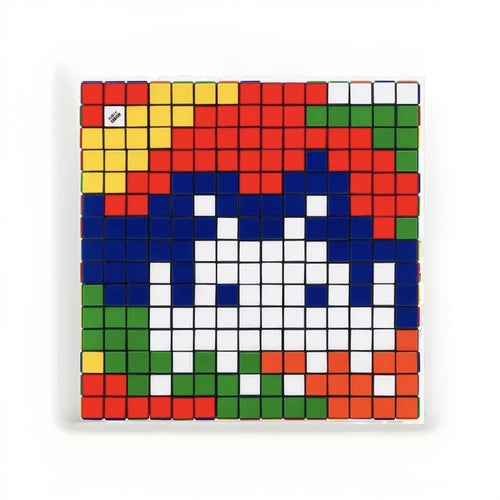
Whether on a Paris wall, on the ISS, or reinterpreted as a Rubik's-Cube panel, the through-line is the pixel. The street mosaic renders a low-res sprite in tile; the Rubikcubism work renders images in the colored squares of Rubik's Cubes. For the full story of how the cube practice grew out of the mosaic language, see our dedicated explainer at /blogs/editorial/rubikcubism-explained.
Documentation over extraction
Because a genuine mosaic cannot survive removal, the responsible way to "collect" the street campaign is through documentation and through the artist's authorized editions — not by acquiring wall fragments. This is both an ethical and a practical point: the studio market is where authenticity can actually be established.
When Street Mosaics Reach the Market

Invader's auction results have grown dramatically, but it is essential to separate what actually trades.
The headline results
The market's benchmark is the Rubikcubism practice. Invader's "Rubik Mona Lisa" (2005), made from hundreds of Rubik's Cubes, sold for €480,000 — roughly four times its estimate of €120,000–€150,000 — at Artcurial's Urban & Contemporary sale in Paris in February 2020 (Euronews). On the mosaic side, Wikipedia records a "Hong Kong Phooey" mosaic selling for HK$1.96 million (about $250,000) at Sotheby's in early 2015, and a work "NY145" reaching HK$562,500 (about $72,000) (Wikipedia). These figures establish that Invader is a genuine blue-chip name in the urban-art segment.
The authenticity problem with "street" mosaics
Here is the caution that follows every one of those results: an Invader offered as an original street mosaic is fraught. As noted above, removing a cemented mosaic destroys it, so most "removed" pieces are reconstructions (Wunderkammern). The artist does not authenticate wall pieces that have been pried off, and provenance for such objects is inherently contested. The auction market that works is overwhelmingly the market for authorized editions and studio works — the prints, panels, kits, and maps catalogued below — where issue details, publishers, and edition sizes are documented.
What our documented catalogue actually contains
Our 84-edition catalogue skews entirely toward these authorized studio releases across several eras. A high-level view:
| Era (as catalogued) | What it covers | Representative editions |
|---|---|---|
| Rubik Cubism | Rubik's-Cube images and cube-logic prints | Rubik Cubism (2006), Rubik Space (2005), Invaded Cube (2023) |
| Space Invaders & Mosaics | Mosaic-referencing prints, kits, and objects | Invasion Kits #01–#18, Space One (2013) |
| Aliens & Pixels | Pixel/alien-sprite screen prints and giclées | Binary Code (2008), Sea Of Slime (2014), 3D Little Big Space (2022) |
| Pop Icons | Pop-culture appropriations | Low Res Mona Lisa (2014), Aladdin Sane (2014), Camel (2015) |
| City Invasions | City-specific maps and lithographs | Invasion Maps (LA, Paris, São Paulo, Brussels, Djerba) |
Source: Gauntlet Gallery's documented catalogue of 84 official Invader editions; "era" labels are our catalogue's organizational scheme, not official Invader terminology.
Publishers in the catalogue trace the artist's institutional arc — from his own Space Shop and Paris's Galerie Itinerrance, through UK print houses like Pictures On Walls and Lazarides, to recent large-format editions with HENI Editions (including 2020s collaborations with Damien Hirst such as Invaded Blossom and InvadHirst). For the complete edition-by-edition breakdown, see /blogs/editorial/invader-complete-archive and our on-store reference at /pages/invader-index.
Reading the edition economics
A few structural patterns in the catalogue are worth internalizing before you buy. First, edition size and scarcity move inversely with accessibility of price in the early work: the earliest self-published Space Shop editions were small (often 30–150) and cheap at issue (double-digit euros or pounds), which is precisely why survivors from that period can be hard to source today. Second, the medium tells you about the era: screen prints and offset lithographs dominate the 2000s–2010s, while giclée prints and large-format screen prints define the recent HENI-published Rubikcubism and Pop Icons releases (many issued at USD $3,000 at retail, in editions running from the hundreds into the low thousands, per our catalogue). Third, collaborations command attention: the Damien Hirst pieces and the Shepard Fairey–Invader crossover LA_56, Los Angeles, 2002 (2019, Obey Clothing, edition 300) sit at the intersection of two collector bases and tend to draw broader demand than single-artist editions of comparable size. None of these patterns is a valuation formula — they are lenses for reading the catalogue, not price targets.
Signed versus unsigned, and why it matters
Several catalogue entries are explicitly labeled "Signed" or "Unsigned" (for example, multiple Rubik Kubrick and Invasion Kit variants). In the Invader market, as across urban art, a hand-signed and numbered edition generally carries a premium over an unsigned or open counterpart, and the presence of the artist's signature is one of the anchors of authentication. This is another reason the studio-edition market is the reliable one: an edition's signature, number, publisher, and size are documentable facts, whereas a wall mosaic's "authenticity" as a removed object is not. For the specifics of signatures, stamps, and telltales, see /blogs/editorial/who-is-invader-complete-guide.
Documentation and the Invasion Guides

The invasion is unusually well-documented — by the artist and by an ecosystem around him — and that documentation is what makes serious collecting possible.
The artist's own record-keeping
Invader maintains an official site that tallies the campaign in real time (the 4,411 Invaders / 87 territories figure cited throughout comes from space-invaders.com/world) and publishes the FlashInvaders help and city lists. The Invasion Maps are, in effect, the artist's own published guides to individual cities, and the sequential city codes give every piece a place in that record.
Third-party trackers and references
An enthusiast ecosystem supplements the official record — location trackers and community maps (for example, the long-running project at pnote.eu/projects/invaders) and finder tools help fans locate and log pieces. For collectors, secondary references such as MyArtBroker compile auction records and market history. Treat these as useful context, but anchor any purchase decision to primary documentation: the edition's publisher, edition size, and the city code for a mosaic.
Building your own literacy
The practical checklist for reading the invasion: (1) identify the city code and confirm it against the artist's records; (2) for editions, confirm publisher, year, medium, and edition size — the fields in our catalogue table above; (3) distinguish Invasion Maps (2-D city maps) from Invasion Kits (sculptural mosaic reproductions) from prints and panels; and (4) never treat a FlashInvaders score or a placement rating as a price signal. For authentication depth beyond this guide, our companion posts at /blogs/editorial/who-is-invader-complete-guide and /blogs/editorial/invader-complete-archive go deeper on signatures, publishers, and telltales.
Frequently Asked Questions

How many Space Invaders has Invader installed, and in how many cities? It depends on the date, because the artist keeps installing. Invader's own site reported 4,411 Invaders across 87 territories (space-invaders.com/world). Wikipedia's January 2020 snapshot recorded 3,858 mosaics in 79 cities in 20 countries, made from over 1.5 million ceramic tiles (Wikipedia). Artnet reported "more than 4,000" in its 2019 profile (Artnet News). The honest framing is "several thousand across more than 80 cities and rising."
What do the codes like PA, HK, or MAN mean? They are city abbreviations paired with a sequential number — PA for Paris, HK for Hong Kong, MAN for Manchester, BBO for Bilbao, and so on — assigned in installation order within each city (Wikipedia). The code is the mosaic's permanent identity, retained even if the piece is later reactivated.
How does the FlashInvaders app score work? Players photograph ("flash") a real mosaic; the app validates it via photo recognition and geolocation and awards points — reported by Illuminate as 10 to 100 per new piece — feeding a live global leaderboard (Illuminate). The app's own help page stresses you cannot validate a flash after the fact or "cheat from your couch" (space-invaders.com). A FlashInvaders score is not a market value.
How many cities have an official Invasion Map? Roughly 25 of about 85 invaded cities, with around 28 maps when Paris's multiple editions are counted separately (Illuminate). The maps are numbered in the top-left corner; the first two Paris maps carry "99" for their 1999 release.
What are the big Paris milestones? Invader marked his 1,000th Paris work with a 2011 exhibition titled 1000 (Artnet News), and a 2024 Paris map reflects 1,500 installations in the city (Illuminate).
Did Invader really put a mosaic in space? Yes. A mosaic coded KLN_27 was launched aboard ATV-5 on 29 July 2014 and installed on the ISS's Columbus module by astronaut Samantha Cristoforetti on 12 March 2015 (ESA; Graffiti Street).
What is the auction record? Among the most-cited results, the "Rubik Mona Lisa" (2005) sold for €480,000 at Artcurial in February 2020, about four times its estimate (Euronews). Wikipedia also records a "Hong Kong Phooey" mosaic at about $250,000 (Sotheby's, 2015).
Can I buy an original street mosaic? Be very cautious. Cemented mosaics generally cannot be removed without destroying them, so "removed" pieces are usually reconstructions with contested provenance (Wunderkammern). The reliable collector market is the authorized studio editions — prints, panels, Invasion Kits, and Invasion Maps.
Is the artist's identity known? No. Invader is anonymous and works under that name; this guide makes no claim about any real-world identity.
Final Word

Invader's invasion is one of the most rigorously systematized art projects of the last quarter-century: a globe-spanning grid of pixelated aliens, each numbered by city, each scored on the artist's own 10-to-100 scale, mapped in scarce published editions, gamified through FlashInvaders, and kept alive by a culture of reactivation when pieces fall. For collectors, the discipline of the project is a gift — it means the market that matters (the authorized editions, catalogued by publisher, year, medium, and edition size) is legible, while the street campaign remains where it belongs, on the wall and in the app.
Gauntlet Gallery sells authenticated Invader works, and we wrote this guide to help you read the system before you buy. To go deeper, see our companion posts: /blogs/editorial/who-is-invader-complete-guide, /blogs/editorial/invader-complete-archive, and /blogs/editorial/rubikcubism-explained, plus our on-store reference at /pages/invader-index.
This article is educational and editorial in nature. It is not investment, financial, or authentication advice, and it makes no representation about the authenticity, condition, or value of any specific work. Counts, dates, and prices are attributed to the cited sources and reflect the dates on which those sources were published; the campaign is ongoing and figures change over time. Always seek independent expert authentication and professional advice before buying or selling.