The Bottom Line

If you have five minutes, here is the philosophy in compressed form:
- The name is the thesis. Invader took the identity of the alien from the 1978 arcade game Space Invaders and turned "invasion" into a lifelong artistic operation. He is, in his own framing, not invading outer space but public space (Wikipedia).
- The medium is the argument. Handmade ceramic-tile mosaics built from a low-resolution pixel grid — a deliberately "low-tech" translation of digital imagery into a permanent, physical, weatherproof form.
- Anonymity is structural. The artist works masked, largely at night, pixelates his own image on camera, and has described himself from the start as a "UFA" — an Unidentified Free Artist. The mask keeps the focus on the work and preserves his freedom to operate (Wikipedia; Lougher Contemporary).
- The city is a game board. Through the official FlashInvaders app, finding and "flashing" a mosaic earns points and a global ranking — the artist literally turned his own street practice into a real-world video game (FlashInvaders, App Store; space-invaders.com).
- The work is legitimized and contested at once. Museums, galleries, and auction houses have absorbed Invader into the canon, while the street pieces remain, technically, unsanctioned marks in public space — the permanent tension of all street art.
For collectors, the practical takeaway is this: an Invader print is a token of a much larger, ongoing, globe-spanning conceptual project. The philosophy is not marketing wrapped around the object — it is the object's context, and understanding it is how you read scarcity, series, and cultural staying power.
The Space Invaders Metaphor

The origin is almost too neat. Space Invaders, released by Taito in 1978, is one of the foundational arcade games — rows of pixelated aliens descending inexorably toward the player, who fires upward to hold them off. It was a global phenomenon and, for a generation that grew up in the late 1970s and 1980s, a shared visual language (University of Illinois LAS).
The artist adopted both the alien and its verb. In the game, you defend against the invaders; in the artist's inversion, he becomes the invader — and the target is not Earth but the everyday urban environment. As one summary of his practice puts it, "he is not an invader of space (the universe), but of public spaces" (Wikipedia). The descending-alien imagery carries a built-in narrative of spread, proliferation, and slow conquest, and Invader leans into it: his own metaphor for the project is that of a "virus" or a "hacker" seeding a mosaic infection through the world's cities (Wikipedia).
Why the metaphor works so well
Three qualities of the 1978 game map cleanly onto street practice:
- Multiplicity. Space Invaders is never a single alien; it is a formation. Invader's practice, likewise, is not about the singular masterpiece but the swarm — thousands of pieces, city by city, that only make sense as an accumulating whole.
- Grid logic. The arcade sprite is a pixel grid, and ceramic tile is a physical grid. The medium and the source image share the same underlying geometry, which is why the translation feels inevitable rather than forced.
- Playful menace. "Invasion" is threatening in the abstract and charming in the particular. A small green alien cemented above a café door is disarming; the idea of a systematic global invasion is not. That double register — friendly and confrontational at once — runs through everything.
The metaphor is also self-documenting. The artist calls each city campaign an "invasion," numbers the pieces, and publishes "Invasion Maps" charting where the aliens have landed — several of which exist as editioned prints in our documented catalogue (for example Invasion Map Los Angeles (#12), 2004, and Invasion Map Paris v2.0 (#20), 2011). The map is not a byproduct; it is part of the artwork, the campaign log of an ongoing occupation.
A metaphor with a body count of thousands
What separates Invader from an artist who simply borrows a nostalgic reference is scale and persistence. This is not a one-time homage to an old game; it is a metaphor executed relentlessly, for more than two decades, across the planet. By the artist's own count, the invasion had reached roughly 3,858 pieces in some 79 cities across 20 countries by early 2020, comprising well over 1.5 million individual ceramic tiles (Wikipedia). The metaphor is only as powerful as its execution, and the execution is enormous.
This matters philosophically because it changes what "invasion" means. A single mural is a statement. Thousands of coordinated, numbered installations across the globe are something closer to a campaign or a colonization — which is exactly the register the 1978 game evokes. The aliens in Space Invaders were never meant to be admired one at a time; they came in waves, and their threat was cumulative. Invader's decision to work at civilization scale is what lets the arcade metaphor carry real conceptual weight rather than reading as a cute visual pun. The city, and eventually the world, becomes the screen; the artist becomes the descending formation.
Reclaiming Public Space

Strip away the game references and a straightforward political idea remains: art belongs in the street, where everyone lives, not only in institutions that most people never enter. This is the artist's stated motivation. He "believes that museums and galleries are not accessible to everyone, and so installs his work at street level for ordinary people to enjoy on a daily basis" (Wikipedia).
That is the "reclaiming" in reclaiming public space. The contemporary city is a surface almost entirely spoken for — by advertising, signage, surveillance, and commercial control. Into that regulated field, Invader inserts objects that are free to look at, that ask nothing, sell nothing in situ, and reward attention rather than payment. Critics have read the project as "a playful, anonymous space of resistance" that works against "the commodification of human sociability, and the regulation of human existence through algorithms and mass surveillance" (Wikipedia).
The "Unidentified Free Artist"
From the beginning, the artist described himself with the initialism UFA — Unidentified Free Artist — a phrase that fuses the two commitments at the heart of the work: anonymity ("unidentified") and unauthorized access to public space ("free") (Grokipedia). The freedom is literal and legal: an artist without a public identity, working without permission, can place work anywhere he can reach, unconstrained by the gatekeeping of the sanctioned art world.
This is where "invasion" stops being purely playful. To reclaim public space, you have to occupy it without asking — which means the work is, by the letter of most municipal codes, unauthorized. That tension is not a bug in the philosophy; it is the philosophy. The street pieces are gifts to the public and trespasses against the administrative order of the city, simultaneously. Remove either half and the project collapses into decoration or into pure activism. Invader keeps both.
Democratizing the museum
There is a second, quieter argument embedded in the choice to work outdoors: it is an argument about who art is for. The white-cube gallery and the ticketed museum are, whatever their virtues, filtered spaces. You enter them deliberately, often at a cost, frequently with a degree of cultural fluency that not everyone has been handed. The street filters no one. A child walking to school, a delivery driver, a tourist glancing up from a map — all encounter an Invader mosaic on identical terms, for free, without permission or preparation.
Critics have framed this as a genuinely egalitarian gesture rather than a marketing pose (Lougher Contemporary). The mosaics reward the specific act of looking up — of paying attention to a shared environment most of us move through on autopilot. In that sense the "invasion" is also an intervention in attention itself: a small, fixed prompt to notice the city you live in. The reclaiming is not only of physical surface but of the everyday gaze.
That said, it would be naïve to pretend the two worlds stay separate. The same artist who gives work away in the street also exhibits in blue-chip galleries and sells editions at auction. The philosophy does not resolve this; it holds it in tension. The street is the principle; the gallery is the practice that funds it. A collector who understands Invader understands that they are buying into the funded half of a system whose animating idea lives in the unfunded half.
Anonymity as a Principle

Invader is anonymous, and this guide keeps it that way: we do not name him, and we treat "Invader" and "Space Invader" as the artist's name. Anonymity here is not shyness or mystique-for-its-own-sake. It is load-bearing.
The practical mechanics are well documented. He "works incognito, often masked and largely at night," pixelates his own image in interviews, and appears on camera in disguises — reportedly a Salvador Dalí mask, ski goggles, and similar coverings — so he can attend even his own exhibitions unrecognized. He has said that only a few people know his real name and face, and that his own parents believe he works as a tiler in construction (Wikipedia; Illuminate Art).
Why the mask matters
Commentators generally attribute the anonymity to a cluster of reasons rather than a single one (Illuminate Art; Lougher Contemporary):
| Motive | What it protects |
|---|---|
| Focus on the art | Keeps attention on the work and the system, not the personality — the same logic that surrounds Banksy |
| Legal protection | Unauthorized street installation carries real legal exposure; a hidden identity insulates the artist from it |
| Creative freedom | An "Unidentified Free Artist" can operate anywhere without institutional or commercial constraint |
| Intrigue | The mystery is itself part of the hook that draws audiences deeper into the work |
Note the framing discipline: these are motives critics and commentators describe, not confessions. The artist has never fully explained himself, which is precisely the point. Anonymity also does conceptual work that connects back to the game: an invader is faceless by nature. The alien in Space Invaders has no biography. By erasing his own identity, the artist becomes interchangeable with his own icon — a signal rather than a celebrity.
For the collector, anonymity has a concrete consequence. Because there is no public "artist story" to inflate or deflate the work with scandal, the value of an Invader piece rests unusually heavily on the system — the catalogue, the maps, the app, the scarcity of a given edition — rather than on the shifting reputation of a named individual. That tends to make the philosophy, not the personality, the durable asset.
The Game as Art

Most street artists document their work. Invader turned documentation into a live, competitive game. In 2014 he launched FlashInvaders, the official mobile app of the project. Players hunt his mosaics in the real world, "flash" each one with their phone camera, and earn points; scores feed a global leaderboard of the top flashers, complete with a personal gallery of everything you've found and a live worldwide stream of flashes as they happen (FlashInvaders, App Store; space-invaders.com help).
The scoring rules are themselves a small piece of design wit: the larger the mosaic, the higher the points — which, as players note, feels backward, since the small pieces are often the hardest to spot (Prêt à Voyager). Point values are assigned per piece; your rank rises and falls as you compete against players around the world.
The loop closes
Consider what this actually accomplishes. The 1978 arcade game gave the artist his icon and his verb. Decades later, the artist gives the public a game of his own — one played not on a screen but across the physical city, using the very mosaics that were themselves derived from a screen. The invader from the arcade cabinet has escaped into the street; the app pulls the street back into a game.
- It makes the audience active. You don't passively receive an Invader piece; you hunt it. The work only "scores" when a viewer finds it.
- It rewards the whole system, not the single object. Value in the game accrues to completeness and coverage — echoing exactly how the art itself privileges the swarm over the standalone.
- It self-authenticates the map. Every flash is a datapoint confirming a piece exists, where, and in what condition — a crowdsourced census of the invasion.
The game logic is not a marketing add-on layered over the art. It is the art's native grammar — points, levels, high scores, "one more find" — extended from the cabinet to the world. Few conceptual gestures in street art are this internally consistent.
The player as co-author
There is something quietly radical in handing the audience a scoreboard. Traditional art asks for contemplation; a game asks for participation. By building FlashInvaders, the artist recast the viewer's role from spectator to player — someone who travels, searches, competes, and, in the process, physically re-experiences the city as a field of hidden objects. Serious flashers plan trips around uncaptured pieces; the leaderboard turns solitary looking into a global social contest.
This has a subtle effect on the meaning of the work. A mosaic that no one ever finds is, in game terms, un-scored — latent potential waiting for a player. The art is completed by the act of discovery, not by installation alone. That is a genuinely unusual proposition: the artist has made his audience necessary to the artwork's functioning, not merely welcome to it. The invasion needs witnesses to count, and the app is the mechanism that makes counting possible.
It also produces an unintended but valuable side effect for the whole project: a living, crowdsourced record. Every flash logs a piece's existence, location, and rough condition at a moment in time. In a practice constantly threatened by removal and theft, that distributed census is a form of preservation — the community, playing a game, quietly documents the invasion faster than any single archivist could.
Low-Tech Pixels in a High-Tech World

The central formal joke of Invader's work is a deliberate mismatch. He renders digital, screen-born imagery — the most fleeting and immaterial thing in modern life — in one of the oldest, most durable, most labor-intensive physical media there is: hand-set ceramic tile. Pixels become permanent. The ephemeral becomes architectural.
This is a considered choice, not a stylistic accident. The artist "ultimately chooses ceramic tile as his medium, retaining the durability, weather-proofing, and pixel-perfect production of the material" (Grokipedia). A pixel is a square; a tile is a square. The two grids fuse, and the low resolution that would read as a limitation on a modern screen becomes, in tile, a signature.
The meaning of the mismatch
Scholars have read the pixel-mosaic as "a symbol for the global upheaval brought about by digital technologies," an invitation to "reflect on the impact of digital technologies on the ways humans relate to space, time, and each other" (Wikipedia). By dragging the pixel out of the screen and cementing it to a wall, Invader makes visible something we normally never touch — and asks what it means to live inside a world increasingly made of grids and code.
The low-tech insistence extends to the editions. Our documented catalogue of official releases is dominated by hand-processes: screen prints, lithographs, giclée prints, and physical sculpture "Invasion Kits" — deliberately analog objects even when the imagery is nakedly digital. A few examples from the catalogue:
- Binary Code (2008, screen print, edition of 50) and Binary Bug (2008, edition of 100) — literal code rendered by hand.
- Low Res Mona Lisa (2014, edition of 50) and Rubik Mona Lisa-lineage works — canonical Old Master images downsampled to a pixel grid.
- Invasion Kit sculptures (from #01 in 2000 onward) — physical, buildable mosaic objects that let a collector, in effect, install their own invader.
The through-line is a refusal of slickness. In a culture obsessed with ever-higher resolution, Invader's whole aesthetic argument is for the beauty and honesty of low resolution — the blocky, legible, human-scaled pixel.
From screen to space, and back
The low-tech gesture reached its most extravagant conclusion in 2015, when a mosaic titled Space2 was carried to the International Space Station and installed on the European Columbus module, in a project involving the European Space Agency — the first street-art work aboard the ISS (space.com; space-invaders.com). It is the perfect closing joke of the whole metaphor: an artist who spent his career insisting he invades public space rather than outer space finally invaded outer space too — and did it with the same humble, hand-set, pixelated tiles.
The ISS piece crystallizes the low-tech-in-a-high-tech-world argument better than any manifesto could. The most advanced human artifact in orbit — a laboratory hurtling around the planet sixteen times a day, built on the frontier of engineering — now carries a chunk of deliberately crude 8-bit imagery rendered in ceramic. High technology and low technology, screen-culture and craft, orbital velocity and the arcade of 1978, meet in a single object. The pixel, dragged out of the game cabinet and into the street, kept climbing until it left the atmosphere.
Permanence, Impermanence, and Decay

Ceramic tile is chosen for permanence, yet Invader's street work is among the most impermanent art there is — because it lives outdoors, unsanctioned, and desirable. This paradox is central to the philosophy.
The tiles themselves are tough: many pieces have survived for years or decades, weathering urban conditions thanks to durable ceramic and specialized adhesives (Grokipedia). But permanence of material is not permanence of presence. Mosaics are removed by municipal maintenance, painted over by property owners, degraded by weather, and — increasingly — stolen. Their high market desirability has made theft a genuine threat, with people prying pieces off walls for resale (Illuminate Art; GraffitiStreet).
Reactivation
Invader's answer to decay is a concept he calls reactivation: a piece that is destroyed today may be recreated and reinstalled in the future. Because he commonly uses store-bought tiles, a damaged mosaic can be rebuilt — sometimes by the artist, sometimes by a community of dedicated "reactivators" who restore lost works to the streetscape (Illuminate Art).
This reframes the whole project. An individual mosaic is mortal; the invasion is not. The work exists less as a set of fixed objects than as an ongoing state — a map that can be redrawn, a level that can respawn. Destruction becomes just another move in the game.
There is a hard line, though, between the free street pieces and the market: Invader has been clear that street mosaics are gifts to the public, not merchandise. When a mosaic was reportedly left behind on a television set, the artist would not permit it to be sold — a stance consistent with the idea that the street work belongs to the street (TasteBueno). The objects made for the market are the editions, kits, and gallery works — which is exactly the category a collector should be buying.
Invasion versus Vandalism

Every serious conversation about Invader eventually reaches the uncomfortable question: is this art or is it vandalism? The honest answer is that the work is deliberately built to be both, and the tension is the point.
Street art broadly has traveled a well-worn arc — "once dismissed as vandalism and a burden on taxpayer resources, street art is now celebrated, commissioned, and showcased in esteemed galleries around the world" (Carousel Fine Art). Figures like Basquiat, Haring, and Banksy helped shift the culture from treating graffiti as crime to treating it as a legitimate contemporary form. But the shift is incomplete and contested. When major museums have staged street-art surveys, critics have argued the institutions were "sanctioning and glorifying vandalism" (Harvard Political Review).
Where Invader sits
Invader occupies this contradiction more precisely than most:
- Formally, the work is meticulous, permanent, catalogued, numbered, mapped, and app-tracked — everything vandalism is assumed not to be.
- Legally, an unauthorized mark cemented to public or private property without permission is, in most jurisdictions, exactly what statutes describe as vandalism — regardless of quality.
- Philosophically, the artist needs the transgression. The "free" in "Unidentified Free Artist" and the "reclaiming" in reclaiming public space both depend on the act being unsanctioned. A permitted mural is not an invasion.
So the vandalism question has no clean resolution, and Invader does not offer one. He lets the same object read as a beloved neighborhood landmark to a passerby, as protected cultural property to a collector, and as an unauthorized installation to a city administrator — all true at once. Institutions "don't quite know what to do with" this ambiguity, which is part of why street art remains genuinely disruptive even as it commands high prices (Artnet News).
The Collector and the Street

If the free mosaics belong to the street, what exactly does a collector own? The answer defines the entire Invader market: collectors buy the studio work — signed, editioned prints; sculptural "Invasion Kits"; Rubik-based pieces — objects the artist deliberately made to circulate, as opposed to the mosaics he cements to walls as public gifts.
This split is philosophically clean. It lets Invader keep the street practice non-commercial and principled while sustaining a legitimate market through works produced for the market. The two categories share an aesthetic and a mythology but never a legal status. Our documented catalogue of 84 official editions is entirely in this second category — the collectible side of the practice.
Reading the catalogue
A few patterns in the official-edition data are worth a collector's attention:
| Dimension | What the catalogue shows |
|---|---|
| Media | Predominantly hand-processes — screen prints, lithographs, giclée prints — plus sculptural "Invasion Kits" and occasional ceramics and skate decks |
| Publishers | A recurring roster including HENI Editions, Pictures On Walls, Lazarides, Space Shop, and Over The Influence, among others |
| Editions | Small to mid-size runs; many between 25 and 300, with a handful of larger "timed editions" numbering in the hundreds or low thousands |
| Retail | Historic release prices ranging from roughly £50–£100 for early-2000s prints to $1,000–$3,000 for recent HENI timed editions |
| Eras | Themed families — Rubik Cubism, Aliens & Pixels, City Invasions, Space Invaders & Mosaics, Pop Icons, Camouflage |
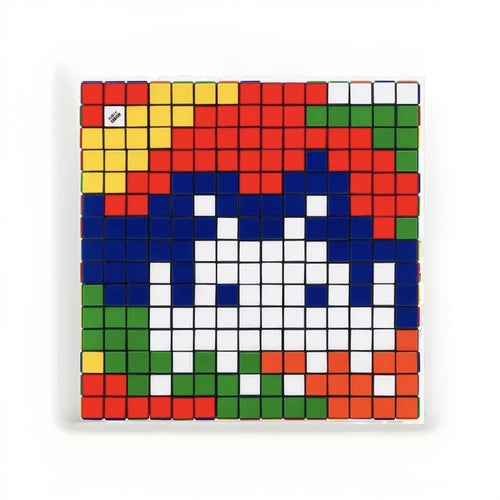
Rubik Cubism deserves its own note. Since 2004 the artist has built images from twisted Rubik's Cubes — a second low-resolution language alongside the tile grid, applied to villains, famous paintings, and album covers (Wikipedia). In our catalogue this shows up as works like Rubik Cubism (2006), Rubik Space (2005), and later Invaded Cube timed editions — the same philosophy of the constructed pixel, in a different toy.
The collector's real purchase, then, is a stake in the system: a numbered node in a global, decades-long, game-tracked, anonymously authored project. That is a fundamentally different thing from buying a decorative print, and it is why provenance and edition detail matter so much here.
How Philosophy Shapes Value

It is tempting to treat an artist's ideas and an artist's market as separate conversations. With Invader they are the same conversation. The philosophy is a value engine, and here is the mechanism, made explicit.
- Anonymity concentrates value in the work. With no public persona to rise or fall, demand attaches to the objects and the system — editions, maps, kits — rather than to a celebrity narrative. That tends to make value more legible and less hostage to personal scandal.
- The swarm logic rewards completeness. Because the practice privileges accumulation over the single masterpiece, collectors and institutions are drawn to build sets — a given era, a run of Invasion Maps, a sequence of kits. Series-thinking supports sustained demand across many pieces, not just a few trophies.
- Scarcity is structural, not manufactured. Small editions (many 25–150) and the artist's refusal to commercialize the street pieces keep the collectible supply genuinely limited. The catalogue's scarcity labels — from "Common" through "Very Scarce" and "Rare" — track real edition sizes.
- Cultural infrastructure underwrites longevity. The maps, the FlashInvaders app, the ESA space piece, museum and gallery exhibitions, and the documentary Exit Through the Gift Shop together form a dense support structure. An artist embedded in that much cultural apparatus is unusually well-insulated against fading — which is what long-term collectors are really underwriting (Wikipedia).
- The invasion is still running. Unlike a closed historical body of work, Invader's project is ongoing and global, with new invasions and editions continuing to appear. A living, expanding system keeps the whole catalogue culturally current.
None of this is a valuation of any specific work, and none of it is a promise about future prices. It is an argument that, with Invader, understanding the ideas is not a nicety — it is due diligence. The philosophy tells you why the object is scarce, why it belongs to a series, and why the whole thing has held cultural weight for a quarter-century.
Verify before you buy
Because desirability drives both theft and fakes, standard collector discipline applies with extra force: confirm the edition, the publisher, the signing, and the provenance of any specific piece through primary sources and reputable specialists before transacting. The system that makes Invader valuable is also the system against which any individual work should be checked.
Frequently Asked Questions

Is Invader the same person as Banksy? No. They are distinct, separately identified anonymous street artists who happen to share both a commitment to anonymity and an appearance in the 2010 documentary Exit Through the Gift Shop. Invader's practice is specifically the pixel-mosaic invasion; conflating the two is a common error (Wikipedia).
Why does Invader stay anonymous? Commentators attribute it to several overlapping motives: keeping attention on the art rather than a personality, protecting against the legal exposure of unauthorized street installation, preserving creative freedom as an "Unidentified Free Artist," and sustaining the intrigue that draws people in. The artist himself has never fully explained it (Illuminate Art).
What is the connection to the video game? The artist takes his name, his central icon, and his organizing verb from Space Invaders, the 1978 Taito arcade game. He casts himself as the invader and treats the city — not outer space — as the territory being invaded (University of Illinois LAS).
How does FlashInvaders work? It is the official app, launched in 2014. Players find real mosaics, "flash" them with a phone camera, and earn points toward a global leaderboard; larger mosaics are worth more points, and every valid flash is saved to the player's personal gallery (FlashInvaders, App Store).
Did Invader really put art in space? Yes. A mosaic titled Space2 was carried to the International Space Station and installed on the Columbus module in March 2015, in a collaboration involving the European Space Agency — the first street-art piece aboard the ISS, and the literal endpoint of the "invasion of space" pun (space.com; space-invaders.com).
Is buying an Invader supporting vandalism? The collectible market is in studio editions and sculptures the artist made for sale — not in the free street mosaics, which he declines to commercialize. The vandalism question attaches to the unauthorized street pieces; the editions are conventional, signed, catalogued artworks (TasteBueno).
What is Rubikcubism? A parallel technique the artist has used since 2004, building images out of twisted Rubik's Cubes — a second "pixel" language applied to villains, masterpieces, and album covers, and represented in the print catalogue by works in the Rubik Cubism era (Wikipedia).
Final Word

Invader's genius is that his philosophy is fully continuous with his method. The name states the thesis; the tile embodies the argument; the mask enforces the principle; the app extends the logic; and the market, in the end, is downstream of all of it. To understand any one Invader object, you have to understand the whole moving system it belongs to — a decades-long, globe-spanning, deliberately low-tech occupation of public space by an artist who insists on remaining faceless so that his aliens can be seen instead.
For collectors, that coherence is the real asset. You are not buying a picture of an alien. You are buying a numbered stake in one of the most internally consistent conceptual projects in contemporary art — a project that turned a 1978 arcade game into a philosophy of anonymity, play, and reclaimed public space, and then kept it running for more than twenty-five years.
To go deeper into the artist, the map of his invasions, and the full body of editions, continue with our companion guides: Who Is Invader? A Complete Guide, Invader's Space Invasions & City Maps, and The Complete Invader Archive. You can also browse available works and editions on our Invader index.
Gauntlet Gallery sells works by Invader. This article is educational and editorial in nature. It is not investment advice, and it makes no representation about the authenticity, condition, or value of any specific work. Invader is an anonymous artist; consistent with that, we do not publish or confirm any personal identity, and any purchase decision should be based on independent verification of edition, provenance, and authenticity through primary sources and qualified specialists.