The Bottom Line

Invader is one of the rare street artists whose exhibition history is genuinely instructive for collectors. Because his practice splits cleanly into two worlds — the free, illegal, un-ownable mosaics installed on city walls, and the "white cube" works (Aliases, Rubikcubism paintings, sculptures, and prints) that he shows and sells — his exhibitions are where the market-facing side of his output actually appears. Following his shows is therefore one of the more reliable ways to understand what he is making, what he is releasing, and how institutions have come to treat him.
A few load-bearing facts, each verified below and cited in the relevant chapter:
- His exhibition record stretches back to 1999, when he showed in Paris under the title New player insert coins, and it now spans galleries and museums on five continents, according to the artist's official exhibitions list at space-invaders.com.
- "Hello, my game is…" (2017) was staged at Le Musée en Herbe in Paris, not — as is sometimes misreported — at MIMA in Brussels. The Brussels connection is a separate, later museum show, Invader Rubikcubist (2022–2023). Both are covered below with their correct venues and dates.
- His largest exhibition to date, Invader Space Station (2024), occupied all nine floors of the former Libération newspaper building in Paris, per multiple press accounts.
- His auction records are set by Rubikcubism and mosaic works, not by street pieces — Astroboy, Tk_119 reached US$1,220,000 at Sotheby's in November 2019, according to MyArtBroker's record-prices tracker.
- He is the first artist to have work exhibited in space, with a mosaic installed on the International Space Station's Columbus module in March 2015, per the European Space Agency.
If you collect Invader, exhibitions are the calendar you should be watching — because show-linked print and edition releases (through publishers such as HENI Editions, Galerie Itinerrance, Over The Influence, Lazarides, and Pictures On Walls) are frequently timed to them.
From Street to Institution

To understand Invader's exhibitions, you have to understand the deliberate split at the heart of his practice.
Invader is best known for "invasions": ceramic-tile mosaics of 8-bit Space Invaders aliens and other pixel-art characters, cemented onto walls in cities worldwide. Those works are, by design, not for sale. They are installed illegally or semi-officially in public space, documented, catalogued with an alphanumeric code, and — crucially — left there. You cannot walk into a gallery and buy the mosaic on a Paris rooftop. That is the point.
Running parallel to the street work is a studio practice built explicitly for exhibition and collection. This is where the gallery and museum system enters. It includes:
- Aliases — reproductions or variations of his street mosaics, made as discrete, ownable tile works for the "white cube."
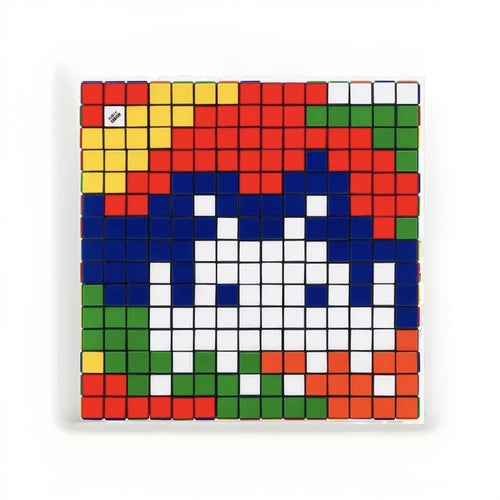
- Rubikcubism — paintings and sculptures assembled from Rubik's Cubes, a body of work Invader has pursued since the mid-2000s. Our documented catalogue of official editions traces the Rubik Cubism print (First Edition) to 2006, published by Space Shop.
- Prints, editions, sculptures, and multiples — the show-linked releases that most collectors actually own.
This two-track model explains the shape of his exhibition history. Early shows in the late 1990s and 2000s were gallery-scale and often experimental. As his profile grew, museums and biennials brought him inside institutional walls — sometimes as a subject in his own right, sometimes as part of a survey of urban or video-game-influenced art. By the 2020s, he was capable of mounting the kind of large-scale, self-authored, immersive exhibitions that only established artists command.
The through-line: anonymity never stopped institutional recognition. Invader has been shown by contemporary-art museums and biennials while remaining a masked, un-named figure. That is unusual, and it matters to collectors because it means the institutional validation attaches to the work — the mosaics, the Aliases, the Rubik pieces — rather than to a cult of personality around a named artist.
Major Solo Exhibitions

Invader's exhibition list, published on his own site, is long and international. Rather than reproduce all of it, this chapter highlights the shows that are most significant for understanding his trajectory and his market. All entries below are drawn from the official exhibitions list at space-invaders.com unless another source is cited.
The early years: Paris, Los Angeles, and the birth of Rubikcubism
Invader's first listed exhibition was New player insert coins (1999, Paris). The following year he appeared at Galerie Almine Rech in Paris (Same player shoot again, 2000) and at the Centre pour l'Image Contemporaine in Geneva (Version_2000), signalling early that his work would move between commercial galleries and institutional spaces.
The mid-2000s are pivotal because they are when Rubikcubism moved from idea to exhibition. Invader showed Rubikcubism at Six Space, Los Angeles (2005) and Rubik space at Galerie Patricia Dorfmann, Paris (2005). Los Angeles recurs as a key city: I invade HOLLYWOOD at Subliminal Projects, Los Angeles (2004) — Subliminal Projects being the gallery co-founded by Shepard Fairey — placed him inside the American street-art establishment early.
The Lazarides era: London, 2007–2016
London's Lazarides Gallery was one of Invader's most important commercial homes, and the relationship shows up repeatedly in his exhibition record:
- Bad Men Part II and Invasion London — Lazarides Gallery, London (2007)
- Low Fidelity — Lazarides Gallery, London (2009)
- Grifters — Lazarides Gallery, London (2009)
- Attack of the Space Waffles — Lazarides Gallery, London (2011)
- Still Here, A Decade of Lazarides — Lazarides Gallery, London (2016)
That decade-long association is directly reflected in the editions record: our documented catalogue lists Lazarides-published prints including L.E.D. (2017), Invaded Scream (2011), Invaded Hypnosis (2011), and Space Waffle (2011) — the last of which shares its title's world with the Attack of the Space Waffles show. Collectors reading the exhibition history alongside the editions list can see how gallery representation and print output moved together.
The Over The Influence era: Los Angeles, Hong Kong, Paris, 2018–2023
As the Lazarides relationship wound down, Over The Influence — with spaces in Los Angeles, Hong Kong, Bangkok, and Paris — became a central exhibitor of Invader's white-cube work:
- Into the white cube — Over the Influence, Los Angeles (2018)
- Hanging — Over the Influence, Hong Kong (2020). Announced as a solo exhibition of new Alias and Rubikcubist works, it ran roughly 9 July–8 August 2020, according to the gallery and press coverage, and foregrounded his "RubikMasterpieces."
- POI – Points of Invasions — Over the Influence, Los Angeles (2021)
- 4000 — Over the Influence, Paris (2022)
- Camouflages & Devils Tower — Over the Influence, Los Angeles (2023)
Here too, the editions record follows the representation. Our catalogue lists Over The Influence–published prints such as Versailles (Blue) (2018), Sunset (Glow In The Dark) (2018), and Hollyweed (Red Edition) (2018), plus the IK For MSF sculpture (2017).
Solo exhibitions at a glance
The table below collects major solo and near-solo Invader exhibitions verified against the official exhibitions list and cited press. Group shows and biennials are treated separately in International Reach.
| Exhibition | Venue | City | Year | Note |
|---|---|---|---|---|
| New player insert coins | (Paris presentation) | Paris | 1999 | Earliest listed exhibition |
| Same player shoot again | Galerie Almine Rech | Paris | 2000 | Early gallery solo |
| I invade HOLLYWOOD | Subliminal Projects | Los Angeles | 2004 | Fairey-linked LA gallery |
| Rubikcubism | Six Space | Los Angeles | 2005 | Rubikcubism enters exhibition |
| Rubik space | Galerie Patricia Dorfmann | Paris | 2005 | Rubik-cube studio work |
| Bad Men Part II / Invasion London | Lazarides Gallery | London | 2007 | Start of Lazarides era |
| Low Fidelity | Lazarides Gallery | London | 2009 | Album-art series |
| Attack of the Space Waffles | Lazarides Gallery | London | 2011 | Ties to Space Waffle edition |
| Into the white cube | Over the Influence | Los Angeles | 2018 | OTI relationship begins |
| Hello my game is | Le Musée en Herbe | Paris | 2017 | First Paris show since 2011 |
| Hanging | Over the Influence | Hong Kong | 2020 | Alias + RubikMasterpieces |
| POI – Points of Invasions | Over the Influence | Los Angeles | 2021 | — |
| 4000 | Over the Influence | Paris | 2022 | — |
| Invader Rubikcubist | MIMA | Brussels | 2022–23 | Museum survey of Rubikcubism |
| Camouflages & Devils Tower | Over the Influence | Los Angeles | 2023 | Ties to Camo editions |
| Invader Space Station | (former Libération building) | Paris | 2024 | Largest show to date |
| Triple Trouble | Newport Street Gallery | London | 2025 | With Hirst and Fairey |
Landmark Museum Shows: Musée en Herbe and MIMA

Two of Invader's most cited institutional shows are frequently conflated. They are not the same exhibition, and getting them right matters for anyone using exhibition history as provenance context.
"Hello, my game is…" — Le Musée en Herbe, Paris (2017)
"Hello, my game is…" was Invader's solo exhibition at Le Musée en Herbe in Paris. According to the museum, the French Ministry of Culture's regional listing, and press coverage from Hypebeast, StreetArtNews, and others, it ran from 26 January to 3 September 2017 and presented over 100 works. It was widely reported as Invader's first exhibition in Paris since 2011.
Le Musée en Herbe is notable as a museum with a mission oriented toward younger audiences, and the show leaned into that: it invited visitors to engage with the work in a play-forward, game-like register entirely appropriate to an artist whose entire visual language is borrowed from arcade games. For collectors, the significance is institutional: a Paris museum gave an anonymous street artist a major, months-long solo platform in his home city.
The exhibition also appears in our editions context. Our documented catalogue records the Hello My Game Is (Red) screen print — a Space Shop edition of 25 from 2009 — showing that the "Hello, my game is…" motif long predates the 2017 museum show and recurs across Invader's output.
"Invader Rubikcubist" — MIMA, Brussels (2022–2023)
The Brussels chapter is a distinct museum exhibition. MIMA (the Millennium Iconoclast Museum of Art) presented Invader Rubikcubist from 24 June 2022 to 8 January 2023, according to the museum and coverage from Brooklyn Street Art and Arrested Motion. The show was devoted entirely to Rubikcubism, retracing roughly two decades of the artist's cube-based paintings and sculptures and presenting more than a hundred works across the museum's floors, including series such as Rubik Bad Men, Rubik Masterpieces, and Rubik Low Fidelity.
It is worth noting for the record that MIMA closed permanently in 2025, per reporting tied to the museum, so this exhibition cannot be revisited in situ.
Why the distinction matters
The two shows are sometimes merged in secondary write-ups — occasionally as a phantom "Hello, My Game Is at MIMA Brussels." That is inaccurate. To be precise, and to keep provenance discussions clean:
- "Hello, my game is…" = Le Musée en Herbe, Paris, 2017.
- "Invader Rubikcubist" = MIMA, Brussels, 2022–2023.
If a work, catalogue, or listing claims association with one, confirm which institution and which year is actually meant. This is exactly the kind of small factual slip that muddies a piece's exhibition history — and Invader's authentication ecosystem already rewards precision. Our companion piece, How to Spot a Fake Invader: Authentication Guide, covers the broader verification framework.
Museum Acquisitions and Recognition

Invader's relationship to institutions runs deeper than temporary exhibitions. He has been folded into museum surveys, biennials, and — most strikingly — a space agency's outreach program.
Institutional and biennial validation
Invader's official exhibition list includes appearances well beyond commercial galleries. Among the institutional and biennial contexts on record:
- Biennale d'art contemporain, Musée d'art contemporain, Lyon (2001) — early institutional inclusion.
- Spank the Monkey, BALTIC Centre for Contemporary Art, Newcastle (2006).
- Viva la Revolución, Museum of Contemporary Art San Diego (2010).
- Art in the Streets, MOCA, Los Angeles (2011) — the landmark U.S. museum survey of street art.
- Unstoppable, Urban Nation Museum, Berlin (2017).
- Open World: Video Games and Contemporary Art, Akron Art Museum, Akron (2019) — placing him squarely in the museum conversation about games as an art medium.
- CAPITALE(S), Hôtel de Ville, Paris (2023) — a major civic survey of urban art in the French capital.
These inclusions matter because they represent recognition that does not depend on the artist unmasking. A museum can acquire, borrow, and exhibit an Alias or a Rubikcubism panel without ever knowing — or needing to know — the man behind the pseudonym.
The first artwork exhibited in space
The single most singular item in Invader's institutional résumé is not in a museum at all. In March 2015, an Invader mosaic was installed aboard the International Space Station's Columbus laboratory module. According to the European Space Agency, the piece — part of Invader's Space2 project — was carried to the ISS and installed by ESA astronaut Samantha Cristoforetti, and it is described as the first work of art exhibited in space. French ESA astronaut Thomas Pesquet later photographed and shared the mosaic during his own ISS mission, per press coverage.
For an artist whose entire iconography derives from a 1978 arcade game about aliens descending from space, putting an actual mosaic in orbit is more than a stunt — it is a conceptual capstone. It also cements a form of institutional recognition (a space agency, no less) that money cannot buy at auction.
Recognition expressed through the market
Institutional standing and market standing reinforce each other, and Invader's auction results make the point. According to MyArtBroker's record-prices tracker:
| Work | Result | Auction house | Date |
|---|---|---|---|
| Astroboy, Tk_119 (2014) | US$1,220,000 | Sotheby's, New York | Nov 2019 |
| Rubik Space (2005) | €492,600 | Artcurial, Paris | Dec 2020 |
| Rubik Mona Lisa (2005) | €480,200 | Artcurial, Paris | Feb 2020 |
| Rubik Dalai-Lama (2008) | €468,250 | Artcurial, Paris | Jul 2021 |
| 400 Chinese Cubes (2021) | €375,000 | Christie's, Paris | Dec 2021 |
| Vienna (2008) | €356,000 | Artcurial, Paris | May 2019 |
Two patterns stand out. First, the top of Invader's market is dominated by Rubikcubism and mosaic/Alias works — the exhibition-facing studio output — rather than by street pieces. Second, Artcurial in Paris appears repeatedly as the venue where his records are set, reflecting the depth of his French collector base. The Rubik Mona Lisa result in particular drew mainstream press: France 24 and Euronews reported the €480,200 hammer against a pre-sale estimate of up to €150,000, calling it a record for the artist at the time.
For a fuller treatment of pricing dynamics, scarcity, and returns, see our companion analysis, Investing in Invader: Market Performance & Rarity.
Prints, Editions, and Show-Linked Releases

For most collectors, the point of contact with Invader is not a €480,000 Rubik panel — it is a signed print or a boxed Invasion Kit sculpture. And the single most useful thing to understand about these editions is that they are frequently tied to exhibitions, galleries, and institutional relationships. The publisher named on an edition often maps directly onto Invader's exhibition history.
Drawing on our documented catalogue of official editions (a curated record of official releases, not an exhaustive account of everything Invader has ever made), several publisher-to-exhibition patterns emerge.
Publishers that mirror the exhibition record
| Publisher | Role | Example editions (year) | Ties to |
|---|---|---|---|
| HENI Editions | Recent print publisher | InvadHirst (2025); Invaded Blossom (2026); Invaded Cube (2023); Rubik Camouflage (2023) | Hirst collaborations; Triple Trouble orbit |
| Galerie Itinerrance | Paris gallery / publisher | Little Big Space (2019); Invasion Map Djerba (2021) | Paris gallery ecosystem |
| Over The Influence | Exhibiting gallery | Versailles (2018); Sunset (2018); Hollyweed (2018); IK For MSF (2017) | OTI solo shows |
| Lazarides Editions / Shop at Lazarides | London gallery era | L.E.D. (2017); Invaded Scream (2011); Space Waffle (2011); 6 Cubes (2010) | Lazarides exhibitions |
| Pictures On Walls | Print collective | Space One (2013); Oh… Alright (2011); Rubik Kubrick series (2006–07) | UK street-art print scene |
| Space Shop | Artist's own outlet | Invasion Kits #01–#18; Rubik Cubism (2006) | Direct artist releases |
A few reads for collectors:
- HENI Editions is the current center of gravity for new prints. Our catalogue lists a run of HENI-published, Hirst-collaborative timed editions — InvadHirst (2025, edition of 1,194, US$3,000) and Invaded Blossom (2026, edition of 592, US$3,000) among them — which sit naturally alongside the Triple Trouble moment (see International Reach). HENI is also the exhibitions partner behind Triple Trouble, per HENI's own exhibitions listing.
- "Timed editions" are a defining recent format. Rather than a fixed pre-set number, several HENI releases were sold for a fixed window, with the final edition size determined by demand — hence non-round numbers like 459 (Invaded Cube, 2023), 812 (Rubik Camouflage, 2023), and 1,194 (InvadHirst, 2025) in our catalogue. This matters for scarcity analysis: a "timed" edition's size is an outcome, not a cap.
- Gallery editions track gallery shows. The Over The Influence and Lazarides prints in the table above cluster around the periods when those galleries were actively exhibiting Invader. If you are dating or contextualizing a print, the publisher is a strong first clue to which exhibition era it belongs to.
- The Invasion Kit sculptures are a collector category of their own. Our catalogue runs them from Invasion Kit #01 (Albinos) (2000, edition 350) through Invasion Kit #18 (LA 2018) (2018, edition 300), most published via Space Shop. These DIY-style mosaic kits are among the most accessible entry points into owning an official Invader multiple.
For an edition-by-edition treatment, see our companion reference, Every Official Invader Print, Panel & Rubikcubism Release.
A note on show-linked scarcity
Because releases are often timed to exhibitions, exhibition dates are a useful lens on scarcity. A print pushed out alongside a major museum or gallery show may see a demand spike concentrated in that window. Our catalogue flags several editions as Rare or Very Scarce — for instance Aladdin Sane (Gold) (2014, Pictures On Walls, edition of 30, marked Rare) and Space Vibes (Red) (2009, Shop at Lazarides, edition of 30, Very Scarce). Small editions from the gallery-show era are exactly where scarcity and exhibition provenance intersect.
International Reach

Invader's exhibitions are relentlessly global, which is consistent with a practice literally defined by "invading" cities worldwide. Mapping his shows geographically reveals how deliberately international his institutional footprint is.
A world map of exhibitions
From the official exhibitions list, non-exhaustive highlights by region:
- France (home base): Paris recurs constantly — Almine Rech (2000), Patricia Dorfmann (2005), Musée en Herbe (2017), 4000 at Over the Influence (2022), CAPITALE(S) at the Hôtel de Ville (2023), and Invader Space Station (2024). Beyond Paris: the Lyon biennale (2001), Metz's Nuit Blanche (2013), and Invader was here at MaMo, Marseille (2020).
- United Kingdom: the Lazarides run in London (2007–2016), Spank the Monkey at BALTIC in Newcastle (2006), and Triple Trouble at Newport Street Gallery (2025).
- United States: I invade HOLLYWOOD (2004) and Rubikcubism (2005) in Los Angeles; multiple Jonathan LeVine Gallery shows in New York and Miami; Art in the Streets at MOCA LA (2011); Viva la Revolución at MCASD San Diego (2010); Beyond the Streets (Los Angeles 2018, New York 2019); Open World at the Akron Art Museum (2019).
- Belgium: Invader Rubikcubist at MIMA, Brussels (2022–2023), plus earlier Brussels appearances.
- Asia: I invade Tokyo (2001); Home Sweet Home at Gallery Target, Tokyo (2010); Wipe Out at the HOCA Foundation, Hong Kong (2015); Hanging at Over the Influence, Hong Kong (2020).
- Latin America: De dentro e de fora at MASP, São Paulo (2011).
- Elsewhere in Europe: Geneva (2000), Vienna's MuseumsQuartier (2008), Ravenna's MAR (2013, 2017), Ljubljana's MGLC (2006, 2021), and more.
This geographic spread reinforces the editions record. Our catalogue includes releases published by international partners — Astro Boy, Low Res Mona Lisa, and Sea Of Slime via Gallery Target in Tokyo (2014); Explosion, Scooter, and Kung Fu Club via HOCA in Hong Kong (2015); and Alert : System Infected via MGLC in Ljubljana (2021) — each mirroring an exhibition relationship in that city.
Triple Trouble: the Hirst–Fairey axis (2025)
The most prominent recent international show is Triple Trouble at Newport Street Gallery, London (2025), a joint exhibition with Damien Hirst and Shepard Fairey, presented in partnership with HENI. According to HENI and press coverage, the exhibition spans all six of the gallery's spaces and includes first-time collaborations, opening in October 2025 and running into 2026. Newport Street Gallery is Hirst's own London institution, which makes the invitation itself a marker of standing.
This show closes an interesting loop. Invader's earliest American exhibition (I invade HOLLYWOOD, 2004) was at Fairey's Subliminal Projects; our catalogue even records a 2019 Fairey–Invader collaborative screen print, LA_56, published via Obey Clothing. Two decades later, Fairey, Hirst, and Invader share a marquee London show — and HENI's InvadHirst and Invaded Blossom editions give collectors an edition-level entry point into the Hirst collaboration.
How Exhibitions Shape the Market

For a collector or investor, exhibitions are not just cultural events — they are market signals. Here is how Invader's shows translate into collecting logic, stated carefully and without overreach.
1. Exhibitions time the supply
Because Invader's edition releases are frequently tied to shows and gallery relationships, the exhibition calendar is effectively a supply calendar. A new solo show or a major collaboration (the HENI/Hirst editions around the Triple Trouble period, for example) is often when fresh, officially sanctioned works enter the primary market. Collectors who watch exhibitions get earlier visibility into what is coming.
2. Institutional shows deepen the record
Every museum survey — MOCA's Art in the Streets, MIMA's Invader Rubikcubist, Akron's Open World — adds to the documentary and institutional record around the work. That accumulating record is part of what underpins confidence in the category. It does not guarantee any specific outcome for any specific piece, but it is the kind of validation that distinguishes a durable artist from a passing trend.
3. The record-setters are exhibition-facing works
As the auction table showed, Invader's top results are Rubikcubism and mosaic/Alias works — precisely the studio output that exhibitions foreground. Street pieces, by their nature, are not the objects setting records at Artcurial and Sotheby's. This reinforces a simple collecting orientation: the exhibited studio work is the ownable, market-bearing core of the practice.
4. Provenance and exhibition history add context
A work with a documented exhibition history carries context that an otherwise identical work without one may lack. This is one reason the Hello, my game is… / MIMA distinction matters: exhibition claims are only as good as their accuracy. When evaluating a piece, treat any "as exhibited at…" claim as something to verify against the institution and the dates, not to take at face value.
5. Anonymity is a feature, not a risk, for the exhibition-validated collector
Some collectors worry that an anonymous artist is inherently riskier. Invader's exhibition history is a useful counterweight: museums, biennials, and a space agency have all engaged the work without the artist unmasking. The validation is anchored to the objects and the documented practice, which is exactly where a collector's due diligence should focus.
None of this is a promise of appreciation. Art markets are cyclical, illiquid, and idiosyncratic. But if you are going to collect Invader, using the exhibition record as a lens is a genuinely rational way to orient.
Visiting and Following Invader Shows

Invader's shows are worth seeing in person — the Aliases and Rubik panels reward close looking that photographs flatten. A practical approach:
- Follow the official channel. The artist's site, space-invaders.com, maintains the exhibitions list this guide draws on. It is the most authoritative single source for what has shown where and when.
- Track the anchor galleries. Historically, that has meant Lazarides (now closed as a gallery, but foundational to his print record), Over The Influence (Los Angeles, Hong Kong, Bangkok, Paris), and Galerie Itinerrance in Paris. HENI Editions and HENI's exhibitions arm are the current center of gravity for both editions and marquee shows like Triple Trouble.
- Watch the major museums and civic surveys. Invader appears in large group and survey formats — Beyond the Streets, Art in the Streets, CAPITALE(S) — as well as solo museum shows. These are often free or low-cost and are the best way to see institutionally contextualized work.
- Mind the "immersive" self-authored shows. Invader Space Station (2024) demonstrated that Invader can mount enormous, ticketed, immersive exhibitions on his own terms. Expect more of this format; these are the shows most likely to be paired with new editions.
- Verify before you attribute. If you are buying with an exhibition claim attached, confirm the venue, the exact dates, and that the work was actually included. Museums closing (as MIMA did in 2025) does not erase the historical show, but it does make primary verification harder — plan accordingly.
For the biography and cultural context behind the shows, see our companion guide, Who Is Invader? A Complete Guide.
Frequently Asked Questions

Where was the "Hello, My Game Is…" exhibition held? At Le Musée en Herbe in Paris, from 26 January to 3 September 2017, according to the museum, the French Ministry of Culture's regional listing, and contemporaneous press. It was widely reported as his first Paris exhibition since 2011. It was not held at MIMA in Brussels — that is a separate, later show.
What was the MIMA Brussels exhibition, then? Invader Rubikcubist, a museum survey devoted entirely to Rubikcubism, ran at MIMA (Millennium Iconoclast Museum of Art), Brussels, from 24 June 2022 to 8 January 2023, per the museum and coverage from Brooklyn Street Art and Arrested Motion. MIMA closed permanently in 2025.
What is Invader's largest exhibition? Invader Space Station (Paris, 2024), which occupied all nine floors of the former Libération newspaper building and presented several hundred works spanning mosaic, sculpture, video, and installation, according to multiple press accounts.
Is it true Invader has work in space? Yes. Per the European Space Agency, an Invader mosaic (part of his Space2 project) was installed on the ISS's Columbus module in March 2015 by astronaut Samantha Cristoforetti and is described as the first work of art exhibited in space. Astronaut Thomas Pesquet later shared images of it from orbit.
What is Invader's auction record? According to MyArtBroker's record-prices tracker, Astroboy, Tk_119 (2014) reached US$1,220,000 at Sotheby's New York in November 2019 — his highest recorded result. His top Rubikcubism results include Rubik Space (€492,600, Artcurial, December 2020) and Rubik Mona Lisa (€480,200, Artcurial, February 2020).
Which galleries have represented or exhibited Invader? His exhibition and editions record centers on Lazarides (London), Over The Influence (Los Angeles, Hong Kong, Bangkok, Paris), Galerie Itinerrance (Paris), and the print collective Pictures On Walls, with HENI Editions as the current primary publisher and exhibitions partner. Space Shop is the artist's own outlet for many Invasion Kits and prints.
Do exhibitions affect the value of Invader prints? Exhibitions time and contextualize releases and add to the documentary record, which is part of what supports the category. But no exhibition guarantees appreciation for any specific work. Treat exhibition history as context, not as a valuation. See Investing in Invader: Market Performance & Rarity.
Is Invader's identity known? No. Invader is anonymous and has remained so throughout his exhibition career, including his museum and space-agency engagements. We make no claim about his identity, and neither should any listing you evaluate.
Final Word

Invader's exhibition history is the clearest window into the market-facing half of his practice. The mosaics belong to the street; the Aliases, Rubikcubism panels, sculptures, and prints belong to the exhibition system — and it is through galleries like Lazarides and Over The Influence, publishers like HENI Editions, Galerie Itinerrance, and Pictures On Walls, and institutions from MOCA to MIMA to the ISS that this side of Invader has been validated and made collectible. For the collector, the discipline is simple: follow the shows, map the publishers to the exhibition eras, and verify every date and venue before you rely on it.
Gauntlet Gallery buys and sells works by Invader and other artists in this category. For deeper reference, explore our companion guides — Who Is Invader? A Complete Guide, Every Official Invader Print, Panel & Rubikcubism Release, and Investing in Invader: Market Performance & Rarity — and browse our full holdings via the Invader index.
This article is educational and editorial in nature. It is not investment advice, and it makes no representation or warranty about the authenticity, condition, provenance, or value of any specific work. Exhibition facts are attributed to their cited sources and were accurate to the best of our research at the time of writing; always verify independently before relying on any exhibition claim in a transaction. Consult qualified professionals before making any purchase or investment decision.