The Bottom Line

Invader is the pseudonym of an anonymous French street artist who, since the late 1990s, has cemented tens of thousands of ceramic-tile "invader" mosaics onto walls in cities worldwide, deliberately echoing the pixelated aliens of Tomohiro Nishikado's 1978 arcade game Space Invaders. For most of his career, the word "space" in his work was a pun and a concept — the space of the city, the space of the game grid, the negative space between tiles. Then he took it literally.
Two missions matter here, and the details below are drawn from the artist's own account at space-invaders.com and confirmed by third-party space and art coverage:
- Art4Space (2012): On August 20, 2012, the artist sent a mosaic — the Space One piece — into the stratosphere aboard a helium weather balloon rigged with cameras. It launched from an agricultural site near the Florida Everglades, chosen for proximity to NASA's "space coast," and returned to Earth after a flight lasting a little under four hours, yielding footage that became a 25-minute documentary premiered around Art Basel Miami Beach that December. The artist frames this as recovering "the first artwork from space."
- Space2 / Space2ISS (2014–2015): A mosaic designated SPACE_02 launched on July 29, 2014, aboard the European Space Agency's fifth and final Automated Transfer Vehicle, ATV-5 "Georges Lemaître," carried up on an Ariane 5 rocket from Kourou, French Guiana. Months later, on March 12, 2015, ESA astronaut Samantha Cristoforetti installed it on the wall of the Columbus module, where the artist and multiple outlets describe it as the first work of art exhibited in space.
For collectors, these missions spawned a small, specific cluster of "space-themed" editions — Art4Space, Little Big Space, Half Little Big Space, 3D Little Big Space, Space One, and adjacent works — that carry a narrative dimension no wall piece can. This article documents what happened, cites the sources, and maps the editions from our documented catalogue of official releases.
A note on identity, respected throughout: Invader has never confirmed a legal name and works behind a mask. This piece treats "Invader" and "Space Invader" as the artist's chosen name and makes no claim about who he is.
Art Beyond the Street

To understand why a street artist would spend years and considerable money launching ceramic tiles toward orbit, you have to understand what the "invasion" concept was always about.
The concept the name was built on
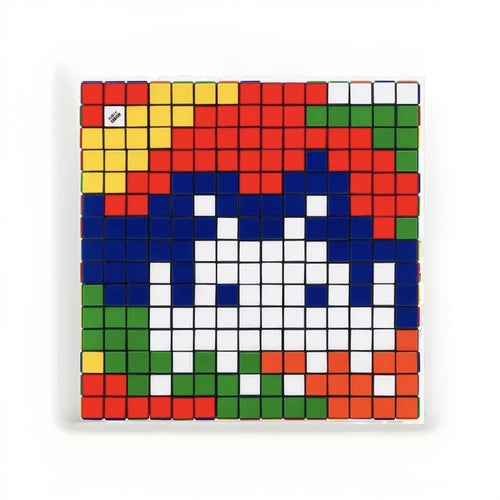
Invader's entire practice is a sustained conceptual conceit borrowed from the arcade. Beginning in the late 1990s in Paris, he began "invading" cities by installing small mosaics of the descending aliens from Space Invaders, the 1978 Taito arcade game designed by Tomohiro Nishikado. Each mosaic is hand-assembled from ceramic tiles — a medium chosen precisely because its square units mirror the low-resolution pixels of early video games. The artist catalogs these installations as "invasions," assigns them points, maps them city by city, and later built a mobile app, FlashInvaders, that turns spotting them into a global game.
The genius of the framing is that the metaphor scales. An "invasion" of Paris, Hong Kong, or Los Angeles is a playful militarization of the idea of public space. The aliens "descend" onto walls the way they descend down the arcade screen. So when the artist began talking about literal outer space, it was not a gimmick bolted onto an unrelated career — it was the concept reaching its logical extreme. If the work is about invading space, the ultimate invasion is space itself.
There is a second thread worth pulling: the ceramic tile is not an incidental material choice, and it explains why these works survive the extreme environments they were sent into. Ceramic is durable, weather-resistant, and — for an artist who wants his pieces to persist on the street for years — far more permanent than paint or paper. That same durability is exactly what a payload needs to survive a stratospheric temperature swing or the vibration of a rocket launch. The medium the artist chose for aesthetic and conceptual reasons (pixels made physical) turned out to be the medium best suited to leaving the planet. The tile is the pixel; the pixel is the alien; the alien goes to space. Each layer of the concept reinforces the next.
The mapping instinct matters too. From early in his career the artist has documented invasions with numbered systems, city "invasion maps," and points values — the terrestrial catalogue that later powered the FlashInvaders app. This bookkeeping is not incidental to the art; it is the art, treating the planet as a game board to be systematically colonized. Once you accept that framing, extending the map beyond Earth is not a leap but the next tile on the board. The ISS installation even fits the accounting logic: the artist notes the station "completes 16 orbits per day," a detail that reads like a scorekeeper's flourish — the highest-value invader, circling the board sixteen times daily.
Why the space missions are conceptually inevitable
Read in sequence, the trajectory is almost tidy. The early work invades the urban environment. The Rubikcubism experiments (translating images into scrambled Rubik's Cube faces) invade the language of another toy. The Invasion Kits invade the collector's home with do-it-yourself mosaics. And then the artist points upward. As he tells it on his own site, after roughly fifteen years "spreading space invaders at the four corners of the world," the stratosphere and then orbit were the frontier that remained.
It is worth being precise about the claim, because it is easy to overstate. The artist's assertion is not that no object made by human hands had ever been in space — obviously untrue — but that a work of art, conceived and framed as art, had never been exhibited in space, and that his balloon mission returned the "first artwork from space." Those are the claims the sources support, and this article attributes them to the artist and the agencies rather than presenting them as neutral historical fact. With that framing established, here are the two missions in detail.
Space2 and the International Space Station

The ISS mission is the crown of the space-era narrative, and — unusually for a street artist working anonymously — it is documented by an actual space agency.
How the mosaic got to orbit
According to the artist's own account on space-invaders.com, the European Space Agency offered to put its resources behind the project after ESA staff learned of his earlier, self-funded stratospheric flight (covered in the next chapter). What developed was the Space2ISS project — described by the artist as "the second and more permanent version of an invasion of space."
The hardware path is well documented in space-launch records. The mosaic, designated SPACE_02, was manifested on ATV-5 "Georges Lemaître," the fifth and final vehicle of ESA's Automated Transfer Vehicle cargo program. Per space-invaders.com, "on 29 July 2014 the green light is given and Space2 mosaic is authorized to take off on the cargo spacecraft launched by the Ariane 5 rocket." Independent space records (eoPortal, Wikipedia's entry on the Georges Lemaître ATV) confirm ATV-5 launched atop an Ariane 5 ES from Europe's Spaceport in Kourou, French Guiana, on 29 July 2014 and docked to the Russian Zvezda service module of the ISS in August 2014.
A pleasing detail worth noting for its symbolism: ATV-5 was named for the Belgian astronomer-priest Georges Lemaître, the first to propose that the universe had a definite beginning — the origin of what became Big Bang cosmology. A pixel-art alien riding a spacecraft named after the man who theorized the beginning of everything is the kind of coincidence the art world would have invented if it weren't already true.
Installation and the "first art in space" claim
The mosaic then waited. Per the artist's timeline, once the cargo ship docked, "the weightless Space2 can explore the ISS" until it found a permanent home. That home was the wall of the Columbus module, ESA's laboratory on the station.
On 12 March 2015, ESA astronaut Samantha Cristoforetti installed the mosaic. ESA's own page (esa.int/Highlights/Space_Invaders) documents the moment, noting a "small and colourful mosaic has been found on the International Space Station," identifying Cristoforetti as the astronaut associated with it, and captioning the imagery "Space2 on Columbus." The artist and multiple outlets describe the result plainly: with installation on the Columbus wall, Space2 "became the first work of art exhibited in space."
ESA did not treat this as a mere stunt. Per the agency's page, Cristoforetti planned "to join forces with these pixellated artforms to inspire primary school children in using their imaginations for combining geometry, colours and mathematics into abstract minimalism." In other words, the agency folded the mosaic into an educational mission about geometry and math — an institutional endorsement almost unheard of for a street artist who refuses to show his face.
The ground invasion of ESA
The ISS piece was the apex, but the project extended to Earth. Per space-invaders.com and ESA coverage, the collaboration also seeded mosaics at ESA ground facilities — the astronaut centre in Cologne, Germany, and the Redu Centre in Belgium among them — turning the agency's own campuses into an "invasion" grid. The pattern mirrors the artist's terrestrial practice: pick a territory, place the aliens, map the conquest. The territory just happened to be the space program.
What can be verified — and what can't
Because Invader is anonymous and much of the primary narrative originates with the artist himself, responsible reporting distinguishes tiers of certainty. The hardware facts — ATV-5 Georges Lemaître, Ariane 5, the 29 July 2014 launch, the Columbus module — are corroborated by independent space-mission records and ESA. The art-historical claim — "first work of art exhibited in space" — is the artist's framing, echoed by press; it is credible and widely repeated but is a claim of primacy, not a physically measured fact, and we present it as attributed.
| Space2 / Space2ISS — verified facts | Detail | Source |
|---|---|---|
| Mosaic designation | SPACE_02 ("Space2") | space-invaders.com |
| Launch vehicle | Ariane 5 ES, carrying ATV-5 "Georges Lemaître" | space-invaders.com; eoPortal; Wikipedia |
| Launch date | 29 July 2014, from Kourou, French Guiana | space-invaders.com; space-launch records |
| ISS docking | August 2014 (Zvezda service module) | eoPortal; Wikipedia |
| Installation date | 12 March 2015 | space-invaders.com; ESA |
| Location on station | Columbus module wall | space-invaders.com; ESA ("Space2 on Columbus") |
| Astronaut | Samantha Cristoforetti (ESA) | ESA |
| Claim | "First work of art exhibited in space" (attributed) | space-invaders.com; press |
| Ground component | Mosaics at ESA sites incl. Cologne, Redu (Belgium) | space-invaders.com; ESA |
Art4Space and the Stratosphere

Before the ISS, there was the balloon — a scrappier, more improvised mission that, in some ways, is the more astonishing feat because the artist did it largely himself.
The 2012 balloon flight
Per space-invaders.com, on 20 August 2012 the artist launched a mosaic — the Space One piece — into the stratosphere aboard a helium balloon equipped with a camera. He calls it, in his own words, an "artisanal spacecraft" that "reached stratosphere for a short journey into space before landing back on earth" and returned "the first artwork from space."
The flight profile, as reported in press coverage around the project (Miami New Times and others), had the balloon ascend into the stratosphere before the envelope burst and the payload parachuted back — a standard near-space ballooning method, executed here to carry a ceramic mosaic. Coverage cites a peak altitude in the range of roughly 21 miles (about 35 km), well into the stratosphere though far below the ~100 km Kármán line commonly cited as the edge of "space." This is an important nuance: the balloon reached near space, the stratosphere, not orbit. The artist's phrasing — "a short journey into space" and "the first artwork from space" — is evocative shorthand, and we attribute it as such rather than asserting the mosaic reached orbital space.
Miami, NASA's coast, and the recovery
The choice of Florida was deliberate and, per the artist's account, tied to a gallery relationship. Jonathan Levine of the New York gallery Jonathan LeVine Projects had offered the artist a Miami exhibition; the artist accepted in part because Miami sits just south of NASA's "space coast." After flight simulations, the team launched from the Everglades agricultural area, chosen to avoid coming down in the ocean, the Everglades wetlands, or Lake Okeechobee.
The mission returned its payload along with the footage that justified the effort. The artist's site notes the flight yielded roughly 3 hours and 55 minutes of images and film (press coverage rounds this to "over 4 hours"). From that material he produced a 25-minute short film, Art4Space, which — per his account and Miami press — premiered around Art Basel Miami Beach in December 2012 and screened at festivals including FILAF in Perpignan and Lo Schermo dell'Arte in Florence, plus showings in Miami, Brussels, Paris, London, New York, and Tokyo.
Why the balloon mattered
The Art4Space flight is the seed of everything that followed. It was the proof of concept that a street artist could, without a national space program, get an artwork above most of the atmosphere and bring back documentation. Crucially — and this is the causal link the artist draws himself — it was because of this self-funded stratospheric flight that ESA took interest and offered the resources that produced the Space2ISS mission. The homemade balloon bought the institutional rocket.
| Art4Space / Space One — verified facts | Detail | Source |
|---|---|---|
| Launch date | 20 August 2012 | space-invaders.com |
| Method | Helium balloon with onboard camera ("artisanal spacecraft") | space-invaders.com |
| Mosaic | Space One piece | space-invaders.com |
| Region reached | Stratosphere / near space (press cites ~21 mi / ~35 km) | space-invaders.com; press |
| Launch site | Everglades agricultural area, Florida | space-invaders.com; press |
| Footage returned | ~3 h 55 min of images/film ("over 4 hours") | space-invaders.com; press |
| Documentary | Art4Space, 25-min film; premiered around Art Basel Miami, Dec 2012 | space-invaders.com; Miami New Times |
| Artist's claim | "The first artwork from space" (attributed) | space-invaders.com |
The Space Invaders Come Full Circle

Put the two missions beside the arcade cabinet that started it all and the loop closes with almost uncomfortable neatness.
Space Invaders (Taito, 1978) is a game about defending Earth from descending aliens. The aliens come from space and threaten the ground. Invader's terrestrial mosaics reverse the polarity: the artist plays the invader, seeding the aliens onto the ground, city by city. And then the space missions reverse the polarity a second time and send the alien back up — no longer descending to attack Earth, but ascending to inhabit the stratosphere and, ultimately, a laboratory module orbiting the planet.
There is a genuine conceptual payoff here that separates these works from novelty. The pixel alien was born of the technological anxieties of the late 1970s — the fear, rendered in green monochrome, of things arriving from above. By physically placing that same icon in orbit, the artist stages a reconciliation: the invader is no longer a threat to be shot down but a resident, installed by an astronaut, endorsed by a space agency, teaching schoolchildren about geometry. The alien came home to the sky it was drawn to fall from.
For a practice so often dismissed as sticker-culture whimsy, the space works are the artist's strongest argument that the "invasion" was always a serious idea about occupation, territory, and the human impulse to mark the places we reach. The ISS mosaic is, in the most literal sense possible, humanity marking one of the few places it has physically reached beyond Earth — and doing it with a video-game alien.
The naming as a closed loop
Consider how the vocabulary folds back on itself. The 1978 game is called Space Invaders. The artist takes "Space Invader" as his name. His pieces are "invasions." His shop is the Space Shop; the app is FlashInvaders; the balloon piece is Space One; the ISS piece is Space2. By the time you reach the orbital mission, every word in the sentence "Space Invader sends Space One and Space2 into space" is simultaneously a proper noun, a concept, and a literal description. The redundancy is the point. The artist spent two decades saturating the word "space" with meaning so that, when he finally used it literally, the literal and figurative senses became indistinguishable. The 2012 balloon and the 2015 ISS installation are where the joke stops being a joke and becomes a fact — and the fact is somehow funnier and more resonant for it.
From arcade cabinet to orbital laboratory
It is worth sitting with the distance traveled. Space Invaders was a coin-operated cabinet in a Japanese arcade, a monochrome grid of descending pixels rendered in the crudest available graphics of its era. Four decades later, a physical, hand-laid ceramic translation of that exact icon sits inside the Columbus laboratory of a football-field-sized outpost orbiting Earth roughly sixteen times a day, installed by a professional astronaut and folded into a space agency's education program. Few objects in contemporary culture have completed a journey from low-budget entertainment to orbital art with the icon itself so completely unchanged. The alien of 1978 looks, tile for tile, like the alien on the ISS. The artist changed the context; the pixel stayed exactly the same. That fidelity is what makes the loop land: it is unmistakably the same alien, just very much higher up.
Related Space-Themed Editions

The missions generated, and sit alongside, a cluster of "space"-named editions in our documented catalogue of official Invader releases. Collectors gravitate to these because they carry the mission narrative — but it's worth being precise about which piece is which, since the naming is dense with the word "space."
Drawn from our documented catalogue (retail prices are the original publisher MSRP at release, not current market value):
| Edition | Year | Medium | Edition size | Publisher | Original MSRP | Scarcity |
|---|---|---|---|---|---|---|
| Art4Space | 2013 | Screen Print (3D edition) | 50 | Space Shop | €350 | Very Scarce |
| Space One (Red) | 2013 | Screen Print (Gold variant) | 100 | Pictures On Walls | £275 | Scarce |
| Little Big Space (First Edition) | 2019 | Lithograph | 100 | Galerie Itinerrance | €600 | Scarce |
| Half Little Big Space | 2019 | Lithograph | 100 | Galerie Itinerrance | €600 | Scarce |
| 3D Little Big Space | 2022 | Sculpture | 5,000 | MusArt | $500 | Common |
A few notes to keep the record straight:
- Art4Space (2013) is the print edition named for the balloon mission — a small (edition of 50) 3D screen print published by the artist's own Space Shop and catalogued as "Very Scarce." It is the most direct collectible echo of the 2012 stratospheric flight.
- Space One / Space-One is the name attached both to the mosaic flown on the 2012 balloon and to a related print edition. The catalogued Space One (Red) screen print (edition of 100, Pictures On Walls, 2013) is the paper cousin of the flown mosaic. Do not conflate the unique flown mosaic with the print edition; they share a name and a lineage, not an object.
- Little Big Space (2019) and Half Little Big Space (2019) are Galerie Itinerrance lithographs, each an edition of 100 — the "space" here is titular and aesthetic rather than a record of a specific mission, but they belong to the same thematic family collectors track.
- 3D Little Big Space (2022) is the outlier on scarcity: an edition of 5,000 sculptures at a $500 release price, catalogued "Common." Its large run makes it the most accessible entry point into the space-themed group, with the tradeoff that abundance, not scarcity, defines it.
The pattern across the group is instructive: the earliest, mission-adjacent editions (Art4Space, Space One) are small and scarce; the later "space" titles trend toward larger, more accessible runs. For the broader release history and how these sit within the artist's full output, see our companion pieces linked below.
Why the Space Missions Matter

Beyond the spectacle, the space works carry weight for three distinct audiences: art historians, the space community, and collectors.
For the record books
If you accept the artist's framing — and ESA's documentation lends it real credibility — the Columbus-module mosaic is a genuine first: a work conceived and presented as art, installed and exhibited in a crewed orbital laboratory. Even hedged appropriately as an attributed claim of primacy, it is a landmark. Very little contemporary art can point to an installation site orbiting Earth at, per the artist's note, sixteen orbits per day.
For the anonymity paradox
There is something quietly radical about an anonymous, mask-wearing street artist earning the collaboration of a major space agency. Institutions typically demand identifiable, accountable partners. That ESA worked with Invader — and even built a schoolchildren's education angle around the mosaic — suggests the concept was strong enough to override the usual insistence on a named author. The work spoke; the artist didn't have to.
For collectors weighing narrative premium
Provenance and story drive value in this market, and few narratives are as clean as "there is a version of this alien on the Space Station." That halo doesn't attach equally to every space-titled edition — a 2019 lithograph named Little Big Space is not a mission artifact — but the category benefits from the association. Collectors should separate the genuine mission narrative (Art4Space's balloon, Space2's rocket) from editions that merely share the vocabulary. The premium is real where the link is real.
A necessary caution: none of this constitutes a claim that any particular edition will appreciate. Mission narrative is a qualitative factor, not a valuation. The catalogue figures above are original release prices, not current values, and current market prices for any of these editions must be checked against live comparable sales.
Collecting the Space-Era Works

If you're building a space-themed Invader sub-collection, a few practical principles follow directly from the record above.
Know exactly what you're buying
The single most common confusion in this corner of the catalogue is name collision. "Space One," "Space2," "Little Big Space," "Half Little Big Space," and "3D Little Big Space" are distinct objects with distinct edition sizes, publishers, and mediums. Before purchase, confirm:
- The exact title and variant (color, "3D," "Half," edition designation).
- The publisher — Space Shop, Pictures On Walls, Galerie Itinerrance, and MusArt all appear across this group, and the publisher is a key authentication and dating anchor.
- The edition size, which ranges from 50 (Art4Space) to 5,000 (3D Little Big Space) — a 100x spread that should be reflected in price expectations.
Scarcity is not a proxy for the mission
The most historically significant works — the flown mosaics themselves — are essentially unobtainable unique objects (one is on the ISS; the balloon piece is a mission artifact). The editions are the accessible path, and among them the scarcest catalogued piece is Art4Space (edition of 50, "Very Scarce"), while the most abundant is 3D Little Big Space (5,000, "Common"). Match your goal — historical proximity vs. accessibility — to the right piece rather than assuming rarity and mission-relevance always coincide.
Authentication and documentation
As with all Invader editions, provenance documentation, correct publisher markings, and edition numbering matter enormously, and the space-themed pieces are no exception. Because these editions command a narrative premium, they are precisely the kind of works where careful authentication pays off. For a full treatment of red flags and verification steps, consult a dedicated authentication resource before committing to a purchase — and buy from sources that stand behind provenance.
Cross-references
For the wider context these space works sit inside, see:
- Who Is Invader? A Complete Guide — the biography, anonymity, and the arc from Paris walls to orbit.
- Invader's Space Invasions & City Maps — how the "invasion" system, points, and city maps work, the terrestrial logic the space missions extended.
- The Complete Invader Archive — the full documented release history, including where the space-themed editions fall in the timeline.
- The Invader index — our on-store reference to catalogued releases.
Frequently Asked Questions

Is there really a piece of Invader art on the International Space Station? By the artist's account and ESA's own documentation, yes. A mosaic designated SPACE_02 ("Space2") was installed on the wall of the Columbus module by ESA astronaut Samantha Cristoforetti on 12 March 2015. ESA's website documents the mosaic and the astronaut. The artist describes it as the first work of art exhibited in space — a claim of primacy we present as attributed rather than as an independently measured fact.
How did the mosaic get to the ISS? It launched on 29 July 2014 aboard ATV-5 "Georges Lemaître," ESA's fifth and final Automated Transfer Vehicle cargo craft, carried up on an Ariane 5 rocket from Kourou, French Guiana. The cargo vehicle docked with the ISS in August 2014, and the mosaic was installed the following March. The launch vehicle and ATV details are corroborated by independent space-mission records.
What was the Art4Space balloon project? On 20 August 2012, the artist sent a mosaic (the Space One piece) into the stratosphere aboard a helium balloon fitted with cameras, launched from an agricultural area near the Florida Everglades. It returned after a flight of roughly four hours, and the footage became a 25-minute documentary, Art4Space, shown around Art Basel Miami Beach and at film festivals. Press coverage cites a peak altitude around 21 miles (~35 km) — the stratosphere, or near space, not orbit.
Did the balloon reach outer space? Not in the strict orbital sense. It reached the stratosphere. The commonly cited "edge of space" (the Kármán line) is around 100 km; the balloon's reported peak was roughly 35 km. The artist's phrasing — "a short journey into space" and "the first artwork from space" — is evocative shorthand for a near-space flight, and we attribute it as such.
Why did ESA get involved with an anonymous street artist? Per the artist's account, ESA offered its resources after learning of the self-funded 2012 balloon flight, which then developed into the Space2ISS project. ESA also built an educational angle around the mosaic, with astronaut Cristoforetti using it to inspire schoolchildren to combine geometry, color, and mathematics. The homemade balloon effectively earned the institutional rocket.
Which editions are connected to the space missions? Most directly, Art4Space (2013, edition of 50, Space Shop) is the print named for the balloon mission, and Space One (Red) (2013, edition of 100, Pictures On Walls) is the paper cousin of the flown mosaic. Titles like Little Big Space, Half Little Big Space (both 2019, Galerie Itinerrance), and 3D Little Big Space (2022, MusArt, edition of 5,000) belong to the same thematic family but are not mission artifacts. Distinguish the mission-adjacent editions from the merely space-titled ones.
Do the space-themed editions carry a price premium? The mission narrative is a genuine qualitative factor collectors value, strongest where the link to an actual mission is real (Art4Space, Space One). But narrative is not a valuation, and edition size matters — 3D Little Big Space is catalogued "Common" at an edition of 5,000. Always check current comparable sales; the catalogue figures here are original release prices, not present-day values.
Is the "first art in space" claim reliable? It is widely repeated, originates with the artist, and is supported by ESA's documentation of the mosaic on Columbus. It is a claim of primacy about exhibited art, not a statement that no manufactured object preceded it in space. We report it as an attributed claim, which is the responsible framing given the artist's anonymity and the fact that the primary narrative is largely self-sourced.
Final Word

Invader spent the better part of two decades turning the word "space" into a pun — the space of the arcade grid, the space of the city wall. The Art4Space balloon and the Space2 mosaic on the ISS collapsed the pun into fact. A video-game alien born from late-1970s anxieties about invasion from above now, per the artist and ESA, rides the wall of an orbital laboratory, folded into a program to teach children geometry. Whatever premium the market assigns, the conceptual achievement is unusually complete: the invader finally invaded space itself, and the space program helped him do it. For collectors, the lesson is to prize the works where that narrative is real, verify title and publisher scrupulously, and keep the mission's romance separate from any judgment of value.
This article is educational and editorial in nature and does not constitute investment, financial, or authentication advice. Gauntlet Gallery buys and sells works by Invader and therefore has a commercial interest in this market. Mission facts are attributed to their sources (space-invaders.com, the European Space Agency, and reputable space and art press); claims of "first" or of reaching "space" are the artist's or agencies' framing, presented as attributed. Catalogue figures reflect original release prices from our documented catalogue of official editions, not current market values, and no representation is made about the authenticity, condition, or value of any specific work. Always verify provenance, edition details, and current comparable sales independently before buying or selling.