The Bottom Line

Invader's medium is deceptively simple and unusually rigorous. He builds pictures out of small square ceramic tiles, each tile standing in for a single pixel of a low-resolution video-game graphic. According to Wikipedia's biography of the artist, he "began making mosaics in Paris in the 1990s," using "tiles to represent the pixels in the games' 8-bit graphics," and by January 2020 had created mosaics in 79 cities, "with 3,858 Space Invaders comprising over 1.5 million ceramic tiles." That is the whole conceptual engine of the work: the grid of a tiled wall and the grid of an 8-bit sprite are the same grid.
For a collector, three craft facts matter most.
- The material is ordinary; the system is not. A single tile is worthless — you can buy the same tile in any hardware store. The value lives in the artist's authorship, the site, and the documentation that binds a record to the object. This is why a mosaic torn from a wall is, in practical terms, a pile of anonymous tiles.
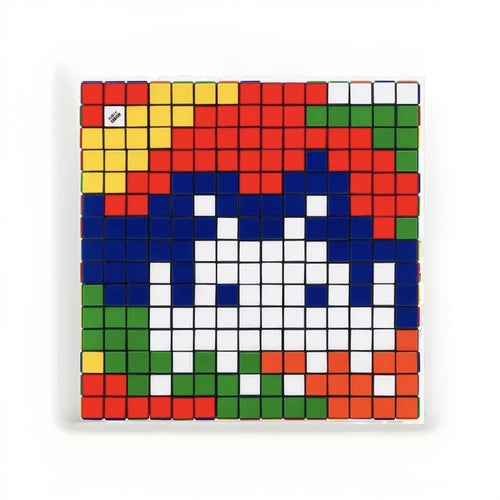
- Street works and studio works share a vocabulary but not a status. The wall mosaics are largely illegal, site-specific, and not sold by the artist. The collectible objects — Aliases, Pixel Pieces, Invasion Kits, screen prints, and Rubikcubism panels — are the sanctioned way to own the aesthetic. Understanding which is which is the single most important thing a buyer can learn.
- Authentication is a binding problem, not a signature problem. Because the raw material is generic, a credible Invader-related object needs a record — an ID card, a certificate, or a digital token — securely tied to that specific object. HENI, the artist's primary studio partner for editions and studio pieces, has built its recent releases around exactly this principle.
Everything below unpacks those points. Where a figure comes from our documented catalogue of 84 official editions, it is labeled as such; where a historical or process claim comes from the public record, it is attributed to its source.
The Anatomy of a Mosaic

Start with the unit. An Invader mosaic is a raster image made physical. Each ceramic tile is one pixel. A classic Space Invaders alien might be rendered in a couple of dozen tiles; a large city-center piece can run to hundreds. Because the source imagery is 8-bit — chunky, low-resolution, high-contrast — the translation to tile is almost mechanical. The artist has described realizing that ceramic tiles "could directly represent pixels," which led him to make paintings in mosaic tiles fixed to panels before taking the idea to the street (Wikipedia).
The grid is the whole idea
Traditional mosaic art — Roman, Byzantine, Gaudí — uses irregular tesserae to approximate curves and gradients. Invader does the opposite. He embraces the grid. There are no diagonal cuts, no shaved corners, no attempt to hide the seams. The stair-stepped edge of a diagonal line is not a limitation to be smoothed over; it is the aesthetic, borrowed wholesale from the screen. This is why the work reads instantly as "video game" rather than "decorative tilework."
The palette is deliberately narrow
Because arcade graphics of the late 1970s and early 1980s used tiny color palettes, Invader's tile selections are correspondingly limited — a handful of flat colors per figure, often on a contrasting field. The restraint is faithful to the source hardware and also serves the street: a small, bold, high-contrast icon reads from across a plaza and survives weather and grime far better than a subtle, tonal image would.
Scale, placement, and the "screen"
The wall becomes the screen. Invader chooses sites with a documented, deliberate logic — visibility, height, foot traffic, and position on the city map all factor in — and the piece is a "gift to the city" rather than a random tag, with the artist describing the overwhelming majority of placements as unauthorized (Street Art Utopia; The Talks interview). The mosaics are then "mapped, catalogued and photographed to indicate their locations within a city," and the artist prints and distributes "invasion maps" from that data (Wikipedia). The map, the photograph, and the location are as much a part of the work as the tiles.
Materials: Tiles, Grout, and Cement

This is the section collectors most often get wrong, so it is worth being precise and staying inside what is verifiable.
The tiles
The core material is small ceramic (and glazed ceramic) tile — the same industrially produced, kiln-fired material sold for bathrooms and kitchens worldwide. Its properties are exactly why Invader chose it:
- Durability and weatherproofing. Fired ceramic resists UV, rain, and pollution, so a street piece can survive years outdoors.
- Color stability. Glazed color does not fade the way paint does, keeping the high-contrast "screen" look intact.
- Modularity. A uniform square tile is, physically, a pixel. No other cheap material maps as cleanly onto a raster grid.
The trade-off is that the material is generic. As one survey of the theft problem puts it, once ripped from a wall a mosaic is "nothing more than broken, unsigned tiles that you could find in any tile store" (GraffitiStreet). Hold that sentence in mind for the authentication section — it explains the entire market structure.
Cement, adhesive, and the question of grout
For street installation, the tiles are fixed with strong exterior-grade cement or high-strength construction adhesive. Multiple accounts describe the artist and his team using "cement or extremely effective glue to make mosaics stick to walls in no time," with the mosaics "usually prepared in advance before being glued" so the on-site work is fast (Illuminate Art). Speed is not incidental — the placements are largely illegal, so the artist typically works at night and cannot linger on a ladder (Illuminate Art).
On grout specifically, collectors should be careful about assumptions. Public sources describe the tiles as adhered to the wall with cement/adhesive; they do not describe a decorative grouting step of the kind used in domestic tiling, and because each tile represents a discrete pixel, the seams between tiles are part of the pixel grid rather than something to be filled and smoothed. Where sources do not confirm a specific grouting practice, we do not assert one — the honest statement is that the visible, load-bearing material is the tile-plus-cement/adhesive system on a masonry wall.
The anti-theft engineering
Because the works became valuable, theft became a problem, and the artist re-engineered the craft in response. Wikipedia notes that to protect works he "has begun to choose sites that are more difficult to reach and to create larger works with more delicate tiles that cannot be removed without damaging the piece." In practice, the strong adhesive means that attempts to pry a mosaic off usually fail: remnants stay bonded to the wall and the removed fragment is ruined, leaving "broken, unsigned tiles" with no authentication (GraffitiStreet). Fragility, in other words, is a feature.
This is a genuinely unusual design philosophy. Most public art is engineered for permanence and against damage; Invader has effectively engineered a controlled self-destruction on tampering. The bond between tile, cement, and masonry is stronger than the bond between adjacent tiles, so force applied to lift the work shears it apart. The result is that the object cannot easily be converted into a portable commodity — which is precisely the artist's intent, given a practice that treats the street piece as a gift to the city rather than merchandise (Street Art Utopia). For collectors, this is the single most important reason to steer toward sanctioned studio editions rather than wall-removed fragments: the material was purpose-built to make the latter worthless.
What the materials tell a buyer
Because the material palette is so consistent, deviations are informative. A studio object should present clean, kiln-fired glazed tiles in a coherent limited palette on a proper panel (plexiglass for Aliases, wood for Pixel Pieces) with a signature on the reverse and its accompanying record (HENI FAQ). Mismatched tile finishes, obviously hand-cut or store-generic tiles, crude backing, or "restored" gaps patched with non-matching material are all consistent with the reconstructed-street-fragment problem described above and should prompt caution.
Materials by object type (studio vs. street)
The same tiles behave differently depending on the object. The table below summarizes the documented material systems.
| Object type | Core material | Substrate / mount | Where it lives | Sold by the artist? |
|---|---|---|---|---|
| Street mosaic | Ceramic tile | Cement/adhesive on masonry wall | Public space, site-specific | No (largely illegal placements) |
| Alias | Ceramic tile | Plexiglass panel | Gallery / collection | Yes, via HENI |
| Pixel Piece | Ceramic tile | Wood panel | Gallery / collection | Yes, via HENI |
| Invasion Kit | Ceramic tile (assembly kit) | Boxed components | Collection | Yes (Space Shop editions) |
| Rubikcubism panel | Rubik's Cubes | Backing board | Indoor display / collection | Yes |
| Screen print / giclée | Ink on paper | Paper | Collection | Yes (various publishers) |
Alias and Pixel Piece materials and substrates per HENI's Alias & Pixel Pieces FAQ; Rubikcubism construction per Wikipedia; object list and publishers per our documented catalogue of 84 official editions.
The Pixel Aesthetic and 8-Bit Roots

The craft cannot be separated from its source. Invader's entire visual system is a homage to the low-resolution graphics of early arcade and console gaming, and the material choice is downstream of that homage.
1978 and the arcade
The project takes its name and its founding image from Space Invaders, the 1978 arcade game whose marching pixel aliens became one of the most recognizable graphics of the twentieth century. Multiple sources place the start of the mosaic project in Paris in the late 1990s with a single tile rendering of a Space Invaders character (Lougher Contemporary; GraffitiStreet). The artist has said he drew inspiration from "the video games he played when he was growing up in the 1970s and 80s" (Wikipedia).
Why 8-bit maps onto tile
"8-bit" refers to the era of hardware — Atari, early Nintendo, and their arcade contemporaries — whose limited memory and displays produced chunky, blocky sprites built from a coarse grid of pixels in a small palette. That constraint is precisely what makes the imagery portable to ceramic tile. A high-resolution photograph could never be a mosaic without thousands of tiny tesserae and tonal blending; a Space Invaders alien or a Pac-Man ghost is already a grid of a few dozen colored squares. Invader's genius was recognizing that the arcade sprite and the tiled wall are the same data structure at different scales.
Beyond the aliens
While the marching alien is the signature, the vocabulary expanded to a wider retro-gaming and pop pantheon — Pac-Man, Super Mario Bros., and other 8-bit icons — all of which share the same low-resolution, high-contrast logic (Wikipedia). Our documented catalogue reflects this range: editions grouped by the studio into eras such as "Aliens & Pixels," "Space Invaders & Mosaics," "Pop Icons," "City Invasions," "Rubik Cubism," and "Camouflage." The through-line across all of them is the pixel.
The aesthetic constraints are self-imposed
It is worth appreciating how disciplined this is. Nothing about modern tile manufacturing forces an artist to work at low resolution — you could tile a photorealistic portrait with thousands of tiny mosaic chips. Invader deliberately refuses that path. He keeps the resolution coarse, the palette flat, and the edges stepped, because fidelity to the 8-bit source is the entire point. The constraint is the content. When collectors evaluate a piece, this is a useful lens: an authentic Invader-adjacent work should look more like a video-game sprite than like fine mosaic craft. Smooth gradients, blended tones, or curved anti-aliased edges are aesthetically off-model, and off-model work is worth a second, harder look. The blocky "wrongness" that a casual viewer might read as crudeness is, in fact, the signature.
From sprite sheet to city
The pixel logic also scales conceptually. A single Space Invaders alien is a small sprite; a citywide "invasion" is effectively a sprite sheet distributed across an entire urban map. The FlashInvaders app formalizes this — points are awarded for "flashing" (scanning) pieces, gamifying the hunt and turning the whole city into a playable level (Wikipedia). For the collector, the takeaway is that the 8-bit aesthetic is not just a surface style; it is a total system that governs the imagery, the material, the placement, and even the documentation.
From Sketch to Wall

The romance of street art hides a very methodical production pipeline. Understanding it helps a collector evaluate any object claiming to be part of it.
Step 1 — Source and design
A graphic is chosen or designed as a low-resolution, pixel-mappable image. For the Rubikcubism works, the artist even uses "a computer program" to "work out the precise distribution of the six colors on a Rubik's Cube required to achieve the desired image" (Wikipedia) — a good illustration of how algorithmic and grid-based the design phase is across his practice.
Step 2 — Studio pre-assembly
Crucially, the mosaic is built in the studio, not improvised on the wall. Accounts consistently describe pieces "prepared in advance before being glued," which is what makes rapid installation possible (Illuminate Art). The artist has long made "paintings in mosaic tiles stuck on panels" — the same pre-assembly logic that underlies the studio Pixel Pieces sold to collectors.
Step 3 — Site selection and mapping
Placement is researched, not random. Criteria include visibility, height, foot traffic, and position on the city map (The Talks; Street Art Utopia). Each city campaign is planned as an "invasion," and the resulting works are catalogued and photographed for the invasion maps (Wikipedia).
Step 4 — Installation
The pre-built mosaic is fixed to the wall with cement or strong adhesive, usually at night, quickly, and often at height (Illuminate Art). A full citywide campaign "usually takes around two or three weeks, with the actual installations taking at least a week," per Wikipedia.
Step 5 — Documentation and the app
The work is then absorbed into a global system. Mosaics are numbered and logged, and the public can "hunt for mosaics globally using the 'FlashInvaders' app," which turns spotting and scanning pieces into a game with points (Wikipedia). For collectors this matters because the artist's own documentation ecosystem — maps, catalogue numbers, the app — is part of what establishes that a given street work is authentic and where it stands in the corpus.
Why the pipeline matters to buyers
Each step of this pipeline leaves a trace, and traces are what authentication feeds on. The design phase leaves a defined image that should match the documented corpus. The studio pre-assembly explains why legitimate studio objects (Pixel Pieces, Aliases) exist at all — they are the same pre-built panels the artist has always made, now offered to collectors. The mapping and documentation phase produces the invasion number and photograph that anchor a specific street work in space and time. And the studio-issued record — the ID card on an Alias, the signature on the reverse — is the deliberate hand-off from "public gift" to "ownable object." When any of these traces is missing or inconsistent, the object is harder to stand behind, and the price should reflect that uncertainty. A disciplined buyer reads the pipeline backward: from the object in hand to the record, to the publisher, to the documented edition.
Studio Editions versus Street Mosaics

This is the fault line every buyer must respect. The street mosaics are not products; the studio output is.
Street mosaics are (mostly) not for sale
The wall pieces are site-specific and largely unauthorized. Removing one destroys its meaning and, practically, its value — the artist's mission "is grounded in site-specificity and accessibility," and to pull a mosaic off a wall "is to destroy the work's essence" (GraffitiStreet). The artist has gone so far as to pursue legal action over the resale of stolen mosaics (GraffitiStreet). The market lesson is blunt: a "street Invader" offered as a wall-removed object should be treated as extremely high risk.
The sanctioned collectible corpus
The legitimate way to own the aesthetic is through the artist's editions and studio pieces. Our documented catalogue of 84 official editions gives a concrete picture of that corpus. The table below summarizes the primary media and their retail (MSRP) ranges as recorded in that catalogue; it is descriptive of documented editions, not of the entire universe of the artist's output.
| Medium (per catalogue) | Typical form | Documented retail range (MSRP) | Notes |
|---|---|---|---|
| Ceramic | Physical tile object | ~€200 (e.g., Camo Space Tiles) | Closest medium to the street work |
| Sculpture (Invasion Kits) | Boxed mosaic-assembly kit | ~€75–€2,400 | Build-it-yourself mosaic editions |
| Screen print | Ink on paper | ~€50 to ~$3,000 | The largest print category |
| Giclée print | Ink on paper | up to ~$3,000 | Includes recent HENI timed editions |
| Lithograph / Offset | Ink on paper | ~$80–€1,000 | Includes invasion maps |
| Skate deck | Printed deck | ~€80 | Collaboration format |
Media, retail figures, and publishers drawn from our documented catalogue of 84 official editions. Retail (MSRP) is the original release price, not current secondary-market value.
Publishers signal legitimacy
The catalogue also shows who releases the work, which is itself an authentication signal. Names recurring across the documented editions include the artist's own Space Shop, Pictures On Walls, Lazarides Editions, Galerie Itinerrance, Over The Influence, and, most importantly for recent studio work, HENI Editions. A HENI or Space Shop provenance is not a guarantee on its own, but an edition attributed to an implausible or unverifiable publisher is a red flag worth taking seriously.
Aliases and Special Formats

Beyond prints and kits, the artist has developed studio formats that translate the street craft into ownable objects — and understanding their construction is central to collecting them.
Alias and Pixel Pieces
The Alias works are, in HENI's own framing, "unique doubles" of Invader's street mosaics — a studio counterpart tied to a specific public installation. Per HENI's FAQ, Alias artworks are ceramic tiles on plexiglass panels, while the related Pixel Pieces are ceramic tiles on wood panels. Aliases range from 52.2 x 76 cm to 195 x 102 cm, and Pixel Pieces from 47.5 x 50 cm to 104.8 x 162.3 cm. Each work "is titled and signed on the back by Invader," and each Alias is "accompanied by an ID card documenting the original invasion" (HENI FAQ). That ID card is the crux: it is the physical record that binds the object to the street work it doubles.
QR-code mosaics
Invader has built mosaics that are functional QR codes. Wikipedia notes he creates "QR code mosaics using black and white tiles," which "can be easily decoded using standard QR reader smartphone apps," with one decoded message reading "This is an invasion." These are a natural extension of the pixel logic — a QR code is, after all, just another black-and-white grid — and they collapse the line between the physical tile object and a digital payload (Wikipedia; HENI).
Camouflage
The Camouflage works apply the pixel grid to military-pattern imagery and were released as both editions and studio pieces through HENI. Our documented catalogue records screen-print Camo editions (for example, "Camo S (3C-M1)," 200 copies, and "Camo M (3C-M1)," 100 copies, both 2024, HENI Editions) alongside a Camo Space Tiles ceramic object (Space Shop, 2024). One authentication nuance worth flagging: per HENI, the Camouflage editions do not come with a Certificate of Authenticity (HENI search result summary) — a reminder that the paperwork model differs by release and must be checked per work rather than assumed.
Glow-in-the-dark
Invader has produced glow-in-the-dark formats that reward the low-light environments where street pieces often live. Our documented catalogue includes "Sunset (Glow In The Dark)" (screen print, Over The Influence, 2018, edition of 100) and glow-themed Invasion Kits such as "#15 (Glow In The Space)" (2013). These are novelty finishes layered onto the same pixel grammar — the aesthetic bends the material, not the other way around.
Lego-style and "Home" pieces
The pixel logic also translates to interlocking plastic bricks — a Lego-like modular unit that is, again, essentially a pixel. Our documented catalogue records "Home (Lego White)" (screen print, Pictures On Walls, 2010, edition of 25) and the related "Invasion Kit #12 (Home)" (Space Shop, 2010). These "Home" works sit in the studio's environment/climate themes and show how readily the pixel concept moves between tile, brick, cube, and print without losing its identity. (We describe these as documented editions; we do not assert a broader Lego program beyond what the catalogue records.)
Conservation and Removal Debates

The materials that make the work durable also make its conservation ethically fraught.
The site-specificity problem
Because the work is defined by its location, conservation is not a neutral act. Cleaning, restoring, or — most contentiously — removing a mosaic changes what the work is. The artist's position is that removal destroys the piece; commentators note that to detach a mosaic "is to destroy the work's essence, reducing it from a living public encounter to a collectible commodity" (GraffitiStreet).
The physics of removal
The strong cement/adhesive bond means removal is usually destructive by design. Thieves who attempt it typically leave remnants cemented to the wall and end up with a "ruined" fragment; some try to patch the gaps with generic store-bought tiles, but such reconstructions "fail to sell due to the lack of authentication and the adverse quality of the piece" (GraffitiStreet). The material engineering and the authentication problem reinforce each other.
Loss and impermanence
Street pieces are also lost to weathering, demolition, municipal removal, and over-painting. Impermanence is baked into the medium — which is one reason the artist's own documentation system (maps, catalogue numbers, FlashInvaders) and the sanctioned studio editions exist: they preserve the record and the aesthetic even when a given wall does not survive.
The collector's paradox
There is a real tension here that serious collectors should sit with rather than gloss over. The works most people fall in love with — the mosaics on the walls of Paris, Hong Kong, or Los Angeles — are exactly the works one should not try to own as physical objects. Their value is inseparable from their site, and detaching them destroys both the meaning and, through the anti-theft engineering, the object itself. The corollary is liberating rather than disappointing: the artist has deliberately built a parallel, legitimate channel — Aliases, Pixel Pieces, Invasion Kits, prints, and Rubikcubism panels — precisely so that the aesthetic can be owned without cannibalizing the public work. A mature Invader collection leans into that channel and treats the streets as a museum to visit, not a warehouse to raid.
Authenticating a Mosaic-Related Work

Authentication is where the craft meets the market, and Invader is a case study in why binding a record to an object is the whole game.
The core principle: bind the record to the object
For any physical Invader-related object, a valid record must be securely bound to that specific object. Because the raw tiles are generic and reproducible, a signature or a loose certificate alone is weak; what protects value is a record — an ID card, a certificate, or a verifiable digital token — that cannot easily be swapped, copied, or transferred to a different object. HENI's approach to the studio pieces reflects this: Aliases ship with an ID card documenting the original invasion, and each work is titled and signed on the back by the artist (HENI FAQ). The pairing of a physical object with a studio-issued record is the model to look for.
The fake-kit and counterfeit risk
Invader is among the most frequently counterfeited street artists, and the counterfeiting reaches the collectible formats, not just the walls. A notable documented example is a "Fake Invasion Kit #18, Los Angeles," which surfaced in a major auction context (GraffitiStreet). Because Invasion Kits are, by design, boxed sets of tiles meant to be assembled, they are an especially forgeable format — the material is generic and the "kit" concept lowers the bar for imitation. Treat any Invasion Kit without solid, publisher-linked provenance with real skepticism.
A practical authentication checklist
- Match to the documented corpus. Confirm the specific edition — title, year, medium, edition size, publisher — against a reliable catalogue. Our documented catalogue of 84 official editions records fields like a "Camo S (3C-M1)" screen print of 200 (2024, HENI) or "Rubik Space" of 100 (2005, Space Shop); an object that cannot be matched to a documented edition needs extra scrutiny.
- Verify the binding, not just the signature. Ask what record accompanies the object and whether it is tied to that object. For Aliases, that is the ID card plus a signature on the back; for other releases, check what the issuing publisher actually provides — and remember that some releases (e.g., Camouflage editions per HENI) deliberately ship without a certificate, so absence of a COA is not automatically disqualifying if it matches the release's documented terms.
- Weigh the publisher. HENI, Space Shop, Pictures On Walls, Lazarides, Galerie Itinerrance, and Over The Influence recur across documented editions; an unverifiable publisher is a warning sign.
- Be maximally cautious with wall-removed "street" pieces. Given the artist's stated opposition to removal and the litigation history, these carry legal and ethical risk on top of authentication risk.
- Never rely on identity claims. Invader is anonymous. No legitimate authentication rests on "knowing who he is." Anyone claiming personal knowledge of his identity as a selling point is a red flag, not a green one.
Anonymity is part of the system
The artist's anonymity is not a marketing gimmick to work around; it is structural. Authentication therefore flows through objects, records, publishers, and the studio's own documentation — never through the person. That is a healthy constraint for a market: it forces the diligence onto the thing you are actually buying.
Frequently Asked Questions

What exactly are Invader's mosaics made of? Small square ceramic tiles, each representing one pixel of a low-resolution video-game graphic, adhered with cement or strong construction adhesive on the street, and mounted on plexiglass (Alias) or wood (Pixel Pieces) panels in the studio (Wikipedia; HENI FAQ).
Does he use grout like a normal tiler? Public sources describe cement/adhesive as the bonding material and do not describe a decorative domestic-style grouting step; because each tile is a discrete pixel, the seams are part of the grid. We don't assert a specific grouting practice beyond what sources confirm.
Why ceramic tile and not paint or vinyl? Ceramic is weatherproof, color-stable, and — being a uniform square — literally maps onto a pixel grid. It is the only cheap, durable material that makes the 8-bit-to-wall translation exact (Wikipedia).
Where does the 8-bit look come from? The 1978 arcade game Space Invaders and the broader 1970s–80s 8-bit gaming era the artist grew up with. Low-resolution sprites in tiny palettes are already grids of colored squares, which is why they translate so cleanly to tile (Wikipedia; Lougher Contemporary).
Are QR-code mosaics real Invader works? Yes — he has built scannable QR codes out of black-and-white tiles, one of which decodes to "This is an invasion." They extend the pixel logic into a functional digital payload (Wikipedia).
Can I buy a mosaic off a wall? You should be extremely wary. Street pieces are site-specific and largely unauthorized; removal destroys the work's meaning and typically its value, and the artist has litigated against resale of stolen mosaics. Wall-removed "street Invaders" carry legal, ethical, and authentication risk (GraffitiStreet).
What's the safest way to own the aesthetic? The sanctioned editions and studio pieces — Aliases, Pixel Pieces, Invasion Kits, prints, and Rubikcubism panels — released through recognized publishers such as HENI and Space Shop, each authenticated per its release's documented terms.
How do I authenticate an Invader object? Match it to a documented edition; verify that a record (ID card, certificate, or digital token) is securely bound to that object; weigh the publisher; and never rely on any claim about the artist's identity. Watch for known forgery formats such as fake Invasion Kits (HENI FAQ; GraffitiStreet).
Final Word

Invader's craft is a masterclass in how a single, humble material can carry an entire artistic system. The ceramic tile is the pixel; the wall is the screen; the grid of 1978 arcade hardware and the grid of a bathroom floor turn out to be the same grid. That elegance is also the collector's challenge: because the raw material is generic, value depends entirely on authorship, site, and — above all — a credible record bound to the specific object in front of you. Understand the tiles, the cement, the panels, and the documentation, and you understand both the art and the market.
For a broader picture, see our companion guides: Who Is Invader? A Complete Guide for the biography and cultural context; How to Spot a Fake Invader: Authentication Guide for a deeper diligence walkthrough; and Every Official Invader Print, Panel & Rubikcubism Release for the full documented catalogue. You can also browse available works via our Invader index.
Disclosure: Gauntlet Gallery buys and sells works related to Invader. This guide is educational and editorial. It is not investment advice, and it makes no representation as to the authenticity, condition, or value of any specific work. Retail (MSRP) figures reflect original release prices from our documented catalogue and are not current market valuations. Always conduct independent due diligence and consult the relevant publisher or a qualified specialist before buying or selling.