In our advisory practice, more collector value is lost to poor conservation than to outright forgery. Forgery at least is dramatic. Conservation failures are quiet: a yellowed margin, a wavy sheet, a faded pigment, a tape stain visible on the back. They happen over years, and by the time a collector notices, the damage is permanent and uninsurable.
The good news: the standards that protect a signed print are not expensive. They are just non-negotiable.
The four enemies
Every serious print conservator works from the same short list:
- Ultraviolet light
- Humidity and its fluctuations
- Acid migration from frames, mats, and mounting
- Physical handling
Address these four and a signed screenprint will look in 2070 the way it looks today.
UV and display light
Pigments fade. Red and magenta fade fastest, then yellow, then blue. Black tends to hold. A Shepard Fairey “Obey Giant” displayed in direct afternoon sun for three years will lose its characteristic red before a collector consciously notices.
Our curators work to the following standard:
- UV-filtering glazing on every framed piece. Museum-grade acrylic such as Optium Museum Acrylic filters roughly 99 percent of UV. Tru Vue Conservation Clear glass is the glass equivalent.
- No direct sunlight on any signed work. Rotating high-value pieces off sun-facing walls during summer months is a reasonable habit.
- Interior LED lighting with no UV output is acceptable. Halogen and older incandescent bulbs emit useful wavelengths for fading and should be avoided near prints.
Standard picture-frame glass blocks almost no UV. A framer who cannot tell a collector which UV glazing they used is the wrong framer.
Humidity and environment
Paper is hygroscopic. It absorbs and releases moisture with ambient humidity, and the resulting dimensional changes cause cockling, rippling, and in extreme cases mold. The conservation target most institutional collections hold to is 45 to 55 percent relative humidity at roughly 68 to 72 degrees Fahrenheit, with low variance.
Practically, for a private collector:
- Avoid hanging works on exterior walls that experience temperature swings
- Avoid bathrooms, kitchens, basements, and any room with routine humidity above 60 percent
- Avoid direct HVAC vents, which cause localized drying and cycling
- A simple room hygrometer costs under $30 and is worth the investment for any collection over $10,000 in aggregate value
Archival framing, done right
Framing is where most collectors silently lose value. A well-intended framer using non-archival materials can damage a signed print in under a decade. Our curators require the following for any framing job:
- 100 percent cotton rag or alpha-cellulose mat board, acid-free and lignin-free
- Archival mounting using Japanese paper hinges and wheat-starch paste, or archival photo corners for unmounted works
- Never dry-mount a signed print. Dry mounting is irreversible and destroys resale value immediately.
- Never use masking tape, Scotch tape, or pressure-sensitive tapes of any kind on the reverse. Residue is nearly impossible to remove without damaging the paper.
- A spacer or mat that prevents the sheet from making direct contact with the glazing
- A sealed backing of archival foam board, with Kraft-paper dust cover
- Framer’s documentation listing the specific materials used. If the framer will not provide this, use a different framer.
For high-value works above $10,000, our curators routinely specify Optium Museum Acrylic. It is more expensive than glass, but it filters UV, blocks 99 percent of reflections, shatters safely in transit, and weighs substantially less, which matters for large Fairey or KAWS screenprints.
Storage for unframed works
Not every piece needs to hang. Rotating a collection is a perfectly legitimate strategy, and many collectors hold unframed prints in flat-file storage.
The standards:
- Each sheet interleaved with archival glassine or acid-free tissue
- Flat storage in a cotton-rag archival portfolio or a dedicated flat file
- Horizontal orientation, never rolled. Rolling a signed screenprint introduces stress cracks in ink layers that do not fully relax back
- Climate-controlled room, same humidity targets as for display
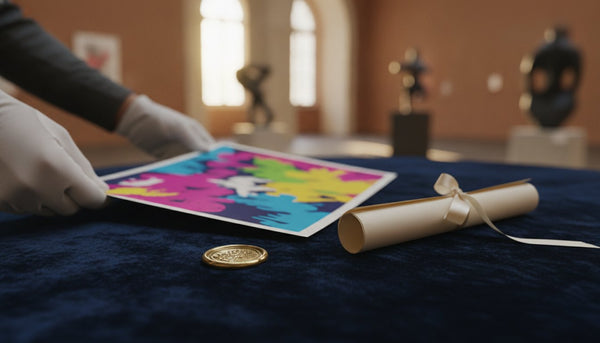
- Handled with clean cotton or nitrile gloves
Cardboard tubes and plastic sleeves are for shipping, not storage. A work stored in a tube for five years will almost never lie perfectly flat again without professional flattening.
Handling
Every time a work is touched, it is handled. Some guidelines our curators enforce during inventory:
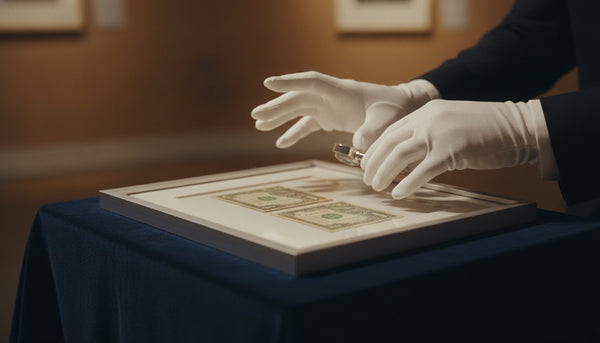
- Nitrile gloves for any direct contact with the sheet
- Pick up large sheets from opposite corners with both hands. Never lift from a single edge.
- Do not set a sheet down on a surface without first laying down a clean archival barrier
- Signatures in pencil are particularly vulnerable to smudging. Do not handle a signed print face-down on any textured surface.
When something goes wrong
If a work is damaged, wet, torn, or shows foxing or mold, stop touching it and call a professional paper conservator. Do not attempt home remedies. The American Institute for Conservation maintains a directory of credentialed conservators. Most damage is reversible by a trained conservator and made permanent by an untrained owner.