An Apollo-era artifact should arrive with a documented, unbroken chain of custody that traces the item from the astronaut, mission, or NASA program back to the present owner. In practice, the strongest files combine four layers: a signed letter of provenance from the astronaut or the astronaut's estate describing the item and its history; period documentation such as NASA paperwork, mission records, or contemporaneous correspondence that corroborates the story; a verifiable ownership trail of auction records, dealer invoices, and estate documents covering every transfer since the item left the source; and third-party authentication from the recognized space-collecting authorities — Beckett, JSA, PSA/DNA, and Zarelli Space Authentication — for any autographs or flight-flown attributions. The more of these layers a piece carries, the more confidently it can be bought, insured, and eventually resold.
That is the short answer. The long answer is where space memorabilia gets genuinely interesting, because no other collecting category leans so heavily on paperwork. A signed lithograph can be judged partly on the signature itself. A flown artifact — a fragment of Kapton foil, a checklist page, a medallion, a piece of equipment — often looks identical to an unflown counterpart. The document trail is not an accessory to the artifact; in a real sense, it is the artifact's value. This guide walks through every document a serious Apollo-era piece should carry, how the layers reinforce each other, what a complete file looks like, and how to evaluate gaps constructively rather than fearfully.
Why chain of custody carries more weight in space collecting than anywhere else
Most collectibles are authenticated primarily by examining the object. Prints are checked for paper stock, printing technique, and edition markings. Figurines are checked against packaging and production details. Space memorabilia inverts that logic. The core claim behind most Apollo-era artifacts is a historical event — "this object went to the Moon," "this checklist was aboard the spacecraft," "this signature was penned by the astronaut" — and historical events cannot be verified by looking at the object alone. Flown Kapton foil is chemically the same material as unflown Kapton foil. A beta cloth patch that traveled a half-million miles looks like one that never left Houston.
Because the physical object often cannot testify for itself, the market has developed an unusually rigorous documentation culture. Collectors, auction houses, and dealers evaluate the paper trail with the same care a title company applies to real estate. Every gap in the chain is a question the next buyer will ask, and every well-documented link is equity you can carry forward when you sell. This is why two visually identical artifacts can occupy entirely different tiers of the market: one has a letter from the astronaut, corroborating mission paperwork, and a clean auction history; the other has a story. Compare like-for-like signed objects or artifacts with matching mission association, signer, condition, authentication and provenance; a category-wide rate or median mixes different objects.
The good news for collectors is that this culture works in your favor. Space memorabilia is arguably the most transparently documented collecting category in existence. The records exist, the authentication infrastructure is mature, and a buyer who knows what a complete file looks like can purchase with a level of certainty that collectors in many other fields would envy. For a broader orientation to the category, our Apollo 11 buyer's guide covers the landscape of what was flown, retained, and distributed from the program.
Layer one: the astronaut letter of provenance
The foundation document for most privately held Apollo-era artifacts is a letter of provenance signed by the astronaut who carried or retained the item — or, for pieces surfacing from an astronaut's estate, documentation executed by the family or estate representatives. This letter is the origin point of the chain of custody, and its quality varies enormously. A strong astronaut letter does several specific things:
- Identifies the exact item, ideally with a physical description precise enough that the letter could not plausibly describe a different object — dimensions, materials, markings, serial or part numbers where applicable, and any distinguishing wear or features.
- States the flight history explicitly. "Flown to the lunar surface aboard the Lunar Module," "carried in my Personal Preference Kit," and "flown in lunar orbit" are three very different claims with very different market implications. A good letter says precisely which one applies.
- Explains how the astronaut came to possess it — carried in a Personal Preference Kit, retained from the spacecraft after the mission, presented by NASA or a contractor, or removed from equipment post-flight.
- Is signed and dated, and in the best cases notarized or witnessed. Notarization does not make the content more true, but it anchors the letter to a date and identity in a way that supports the document's own authenticity later.
- Accompanies the item photographically where possible. Letters that include a photograph of the astronaut holding or presenting the specific item are the gold standard, because they bind the document to the object in a way text alone cannot.
One subtlety worth understanding: the astronaut letter is itself an autographed document, which means it can be — and should be — authenticated like any other signature. The recognized authorities for space-related autograph material are Beckett, JSA, PSA/DNA, and Zarelli Space Authentication, the specialist service most deeply focused on astronaut and space-program signatures. A letter of provenance that has itself been certified by one of these services carries double weight: it documents the artifact and is simultaneously verified as a genuine artifact in its own right. When our gallery lists Apollo-era material in our space memorabilia collection, this letter-plus-certification pairing is exactly what we look for at acquisition.
Estate provenance: when the astronaut is no longer signing
As the Apollo generation passes, a growing share of significant material reaches the market through astronaut estates and families. Estate provenance can be excellent, but it shifts the documentary burden. Instead of a first-person letter, look for: estate inventories or probate documentation referencing the item or category of items; letters from family members describing the item's history in the household; auction house catalog entries from dedicated estate sales, which typically involve direct consignment from the family; and any period materials — photographs, correspondence, display labels — showing the item in the astronaut's possession during their lifetime. A family letter is inherently one step removed from a first-person account, which is precisely why corroborating layers matter more for estate pieces, not less.
Layer two: period documentation from the program itself
The second layer is contemporaneous paperwork — documents created during or shortly after the Apollo program that corroborate the artifact's story. This is the layer many newer collectors overlook, and it is often what elevates a good file to an exceptional one. Relevant period documentation includes:
- Stowage lists and manifests. NASA documented what went aboard each spacecraft in considerable detail. When an artifact category appears in mission stowage documentation, that record independently supports the plausibility of the flight claim. Copies of relevant manifest pages are a meaningful addition to a provenance file even though they describe categories of items rather than individual pieces.
- Personal Preference Kit records. Astronauts were permitted to carry small personal items in designated kits, and the contents were subject to documentation. Where PPK-related paperwork survives and can be connected to an item, it is powerful corroboration for the class of small flown mementos — medallions, flags, patches, jewelry-scale objects — that make up much of the accessible flown market.
- Transfer, presentation, and gift documentation. Many artifacts left the program legitimately as presentations to contractors, engineers, dignitaries, and program workers. Presentation certificates, accompanying letters, and company newsletters recording the presentation all serve as period anchors for the chain.
- Contractor and engineering paperwork. For hardware, part numbers, serial numbers, inspection stamps, and accompanying engineering documentation can tie a physical object to production records. Hardware provenance is its own specialty — matching numbers matter here the way they do in vintage automobiles.
- Period photographs and press materials. A contemporaneous photograph showing an item — in the spacecraft, in a post-flight ceremony, in an astronaut's office — is among the most persuasive documents a file can contain.
Period documentation rarely names an individual small artifact directly, and honest sellers present it accordingly: as corroboration of the account given in the provenance letter, not as standalone proof. That is the correct framing, and it is how we present such material ourselves. The layers are meant to interlock. A letter says what happened; the period record shows the claim is consistent with how the program actually operated.
The legal backdrop: why ownership history matters as much as flight history
Chain of custody in space collecting answers two distinct questions, and a complete file addresses both. The first is authenticity: is the item what it is claimed to be? The second is title: did each person in the chain have the right to own and sell it? Apollo-era material has a specific legal history that makes the second question worth taking seriously.
For decades, the ownership status of mementos retained by early astronauts was ambiguous, and that ambiguity occasionally surfaced in disputes. In 2012, United States legislation resolved the matter for the Mercury, Gemini, and Apollo eras, confirming that astronauts from those programs hold full title to the expendable artifacts and mementos they retained from their missions. This was a landmark moment for the hobby: it converted a gray area into a clear, legally grounded foundation for the private market in astronaut-retained material. Items flowing from astronauts, their families, and their estates through documented sales now rest on settled legal footing.
Two practical implications follow. First, provenance that traces to an astronaut, an astronaut's estate, or a documented program-era presentation is not just historically satisfying — it is the legal basis of clean title. Second, categories that fall outside that framework deserve extra care. Lunar samples, for example, remain government property and are not legitimately available to private collectors, which is why credible dealers do not handle them and why "moon rock" offerings should be understood as a category to avoid entirely rather than a bargain to investigate. Our guide to spotting problematic space memorabilia covers the handful of categories where this distinction matters most.
Layer three: the ownership trail from source to present
Between the astronaut's letter and today's seller there may be one transfer or a dozen. Each link should be documented, and fortunately the space market generates unusually good records. The documents that constitute this layer include:
- Auction records. Major auction results are published, archived, and searchable, and a catalog entry does triple duty: it dates the item's market appearance, records the description and provenance claims made at the time, and fixes a point in the custody chain. Lot tags, invoices, and shipping records from the sale strengthen the link further.
- Dealer invoices and receipts. A proper invoice identifies the item specifically, states the provenance as represented, and names the parties and date. Keep every one; each is a permanent link in the chain you will hand to the next owner.
- Private sale documentation. Collector-to-collector transfers are common and perfectly sound when papered — a simple bill of sale describing the item and referencing the accompanying provenance documents is all that is needed to keep the chain intact.
- Correspondence. Letters and emails between prior owners, or between owners and astronauts, often contain provenance detail that exists nowhere else. Experienced collectors preserve this material alongside the formal documents.
When evaluating an ownership trail, think in terms of continuity rather than volume. A file with three documents that connect without gaps — astronaut letter, auction record, dealer invoice — is stronger than a thick folder of material that never quite links one owner to the next. Where a gap exists, the question is whether the surrounding documents bridge it: an auction catalog that states "from the collection of the astronaut's family" effectively documents the transfer into that sale even if no private paperwork survives from before it.
Layer four: third-party authentication — Beckett, JSA, PSA/DNA, and Zarelli
The final layer is independent expert review. For space memorabilia, the authentication chain collectors and auction houses recognize is Beckett, JSA, and PSA/DNA — the industry-standard trio for autograph authentication — plus Zarelli Space Authentication, the specialist service regarded as the marquee authority for astronaut signatures and Apollo-era signed material. These services examine signatures against extensive exemplar files and issue certificates or letters of authenticity, typically with database-registered certification numbers that anyone can verify online.
Understanding what third-party authentication does and does not cover keeps expectations calibrated:
- Signature authentication is the core service. For signed photographs, covers, checklists, and documents — and for the provenance letters themselves — Beckett, JSA, PSA/DNA, and Zarelli certification is the market's baseline expectation at meaningful price levels.
- Flight attribution rests on the documentary chain. No laboratory test certifies that an object traveled to the Moon. When an authenticator's letter addresses flown status, it is an expert assessment of the provenance package — which is exactly why the underlying documents matter so much.
- Certification numbers make the file portable. A registered cert number lets any future buyer verify the authentication independently, decades from now, without relying on the seller's word. Always confirm that numbers on certificates match the service's online database before purchase.
The interplay between these layers is the whole game. An astronaut letter authenticated by Zarelli, corroborated by mission-era paperwork, carried through documented auction sales, and accompanied by verifiable certification numbers is a chain in which every link reinforces the others. Our space memorabilia authentication guide goes deeper on how each service operates, and the Apollo 11 authentication guide applies the framework to the most collected mission of all.
What a complete chain-of-custody file looks like
Here is the full framework in one view — the document categories, what each contributes, and how to weigh them:
| Document | What it establishes | Strength indicators |
|---|---|---|
| Astronaut letter of provenance | Origin, flight history, and how the item left the program | Specific physical description; explicit flight claim; signed, dated, ideally notarized; photo of astronaut with the item |
| Estate / family documentation | Origin for items surfacing after an astronaut's passing | Estate inventory or probate reference; family letters; dedicated estate-sale catalog entries |
| NASA-era records (manifests, PPK paperwork, presentation certificates) | Corroboration that the claimed history matches program practice | Documents contemporaneous with the mission; category or item references consistent with the artifact |
| Auction records | Dated custody points and the provenance as represented at each sale | Published catalog entries; invoices and lot documentation; consistency of description across appearances |
| Dealer invoices and bills of sale | Every private transfer between custody points | Specific item identification; provenance stated in writing; unbroken sequence to the present owner |
| Third-party authentication (Beckett, JSA, PSA/DNA, Zarelli) | Independent expert verification of signatures and signed documents | Database-registered certification numbers; certificates matching the exact item; letters addressing the specific claims made |
| Photographic record | Binding documents to the physical object | Period photos of the item; photos of the astronaut with the item; detailed current photos matching all documents |
Very few artifacts carry every row of this table, and they do not need to. Think of the file as a case being made: the letter asserts, the period record corroborates, the ownership trail connects, and the authentication verifies. A piece with a strong showing in three layers is a well-documented artifact by any reasonable standard. What you are looking for is coherence — every document describing the same object, telling the same story, with no link resting solely on an undocumented assertion.
Reading gaps constructively: questions, not verdicts
Almost every real provenance file has imperfections, because these objects have been in private hands for half a century. The skill is distinguishing ordinary archival wear from structural weakness. Some patterns and how to think about them:
- A missing middle link — the item traces cleanly from the astronaut into a known collection, then reappears at auction years later — is common and usually benign, especially when the descriptions at both ends match precisely. Auction catalog language often bridges these gaps explicitly.
- Generic descriptions are a more serious issue. A letter describing "a flag flown aboard Apollo" without dimensions or distinguishing details could in principle travel with any similar flag. Look for files where at least one document pins the specific object — measurements, serials, distinctive features, or photography.
- Copies versus originals. Photocopied provenance letters accompany items legitimately in some cases — for instance, when a single letter covered multiple items later dispersed — but an all-photocopy file with no original documents and no third-party certification deserves more questions before purchase.
- Claims that outrun the paper. The most common issue in the broader market is not forgery but inflation: an item with solid "flown in lunar orbit" documentation described as having reached the lunar surface. Read the actual documents and let them, not the headline, define the claim.
- Unverifiable certifications. Certificates from unknown issuers, or numbers that do not resolve in the Beckett, JSA, PSA/DNA, or Zarelli databases, add no weight to a file. The presence of a certificate matters far less than whose certificate it is.
None of these observations should make the category feel treacherous — quite the opposite. Because the documentation standards are so well established, evaluating a space artifact is more systematic than evaluating almost any other collectible. The questions are knowable, the answer sources are public, and a careful buyer can reach justified confidence in a way that has real staying power. Our authentication FAQ answers the most common documentation questions collectors bring us, and the authentication glossary defines the terms of art you will meet in catalogs and certificates.
How documentation drives value — and how to calibrate price
Documentation quality is a primary pricing variable in this category, arguably the primary variable for flown material. Identical object types trade at very different levels depending on whether the flight claim is anchored by an astronaut letter, whether the autograph material carries recognized certification, and whether the custody trail is continuous. Mission significance layers on top: lunar-surface association generally commands the strongest premiums, lunar-orbit material follows, and Earth-orbital Apollo material follows that, with the artifact's intrinsic character — a checklist page versus a foil fragment versus a crew-signed photograph — shaping the rest.
Rather than anchoring to any specific figure, calibrate against recent verified sales of comparable items with comparable documentation. Two "flown flags" are not comparables unless their documentation is comparable. For current market context, our space memorabilia price guide and Apollo 11 price guide break down the category's pricing structure, and our financial insights hub tracks how documented-provenance material has behaved as a collecting asset class over time.
The Gauntlet Gallery standard
Because chain of custody is the substance of this category, it shapes how we operate. Every Apollo-era piece we offer is acquired against the framework described in this article: we evaluate the provenance letter and its specificity, verify third-party certifications against the issuing databases — Beckett, JSA, PSA/DNA, and Zarelli Space Authentication for space material — trace the ownership trail through published auction records where the item has market history, and check the asking price against provenance-adjusted comparables from our sales database. What we pass to the buyer is the complete file, not a summary of it: original documents where they exist, verifiable certification numbers, and our own invoice adding one more well-papered link to the chain.
We would rather decline an intriguing artifact with an undocumented story than list it, and that discipline is what lets us stand behind the pieces in our space memorabilia collection without hedging. Documented provenance is not a marketing phrase in this category; it is the product.
Stewarding the file: preservation and transfer
Once you own a documented artifact, you become the custodian of its chain, and a little archival discipline protects a meaningful share of the item's value:
- Keep originals archival. Store letters, certificates, and invoices in acid-free sleeves, away from light and humidity — the same care you give the artifact. A faded, water-stained astronaut letter is a diminished asset.
- Digitize everything. High-resolution scans of every document, plus detailed photographs of the item from multiple angles, stored redundantly. Digital copies support insurance claims and let you share the file with appraisers or buyers without shipping originals.
- Never separate documents from the object. Displaying an item in one place while its file sits forgotten elsewhere is how chains get broken across decades and inheritances. Keep a note with the artifact stating where the documentation lives.
- Paper your own transactions. When you buy, get an invoice that states the provenance. When you sell or gift, provide a bill of sale referencing every document in the file. When you insure, schedule the item with its documentation summarized in the policy record.
- Add to the record. If you correspond with an astronaut's family, obtain an appraisal, or add certification during your ownership, those documents become part of the permanent file. The best collectors leave a chain stronger than the one they received.
- Plan the succession. Make sure your own estate documentation identifies significant artifacts and the location of their files, so the chain survives you as cleanly as it survived the astronaut.
Pre-purchase checklist: the questions to ask before you buy
Condensed into a working checklist, here is what to run through before acquiring any Apollo-era artifact:
- Is there a letter of provenance from the astronaut or estate — and does it describe this specific item with verifiable detail?
- Does the letter state the flight history explicitly, and does the seller's description match what the letter actually claims?
- Is any autograph material — including the provenance letter itself — certified by Beckett, JSA, PSA/DNA, or Zarelli Space Authentication, with numbers that verify in the issuer's database?
- Does period documentation (manifest references, PPK paperwork, presentation certificates, period photographs) corroborate the account?
- Can you trace ownership from the source to the current seller, with auction records or invoices covering the transfers?
- Are the documents originals, and do photographs bind them to the physical object?
- Does the category itself have clean legal standing — astronaut-retained memento, documented presentation, or hardware with legitimate release history?
- Have you compared the price against recent verified sales of comparably documented material rather than against headline results for better-documented pieces?
- Will the seller transfer the complete original file with the item, and provide their own invoice stating the provenance?
- If any answer is uncertain, have you asked? Reputable sellers welcome documentation questions — it is how this hobby earns the trust it runs on.
For collectors building broader habits around questions like these, our Collector's Hub gathers our full library of guides, and the Apollo 11 buyer's guide linked above is the natural next read for anyone focused on the program's most collected mission.
Frequently asked questions
What is the single most important document for a flown Apollo artifact?
The signed letter of provenance from the astronaut who carried or retained the item. It establishes origin, flight history, and the item's legitimate path out of the program in one document. Its value multiplies when it describes the specific item in verifiable detail and when the letter itself carries third-party autograph certification from Beckett, JSA, PSA/DNA, or Zarelli Space Authentication.
Can a laboratory test prove an object went to the Moon?
No. Flown and unflown examples of most materials are physically indistinguishable, which is why flight attribution rests on the documentary chain rather than on the object. This is the defining feature of space collecting: the provenance file does the evidentiary work that physical examination does in other categories.
Is it legal to own Apollo-era artifacts?
Yes, for the categories that reached the market legitimately. United States legislation enacted in 2012 confirmed that Mercury, Gemini, and Apollo astronauts hold clear title to the expendable mementos they retained, which secured the legal foundation of the private market. Lunar samples are the notable exception — they remain government property and are not legitimately collectible.
What if an item's chain of custody has a gap?
Evaluate whether surrounding documents bridge it. A gap between a known collection and a later auction appearance is common and often benign when descriptions match precisely at both ends. Gaps become serious when the file's specificity fails — when no document pins the exact object, or when the central claim rests on an undocumented assertion no other layer corroborates.
Do estate pieces need different documentation than astronaut-sold pieces?
The framework is the same, but the burden shifts. Without a first-person letter, look for estate inventories, family correspondence, dedicated estate-sale catalog entries, and period photographs showing the item in the astronaut's possession. Because family accounts are one step removed from the source, corroborating layers — period paperwork and third-party certification — matter even more for estate material.
Who are the recognized authenticators for space memorabilia autographs?
Beckett, JSA, and PSA/DNA are the industry-standard autograph authorities, and Zarelli Space Authentication is the specialist service most deeply focused on astronaut and space-program signatures. Certificates from these services carry database-registered numbers that any future buyer can verify independently, which is what makes their certification a durable, portable part of the provenance file.
Shop Space memorabilia
Explore current pieces available from the gallery.
-
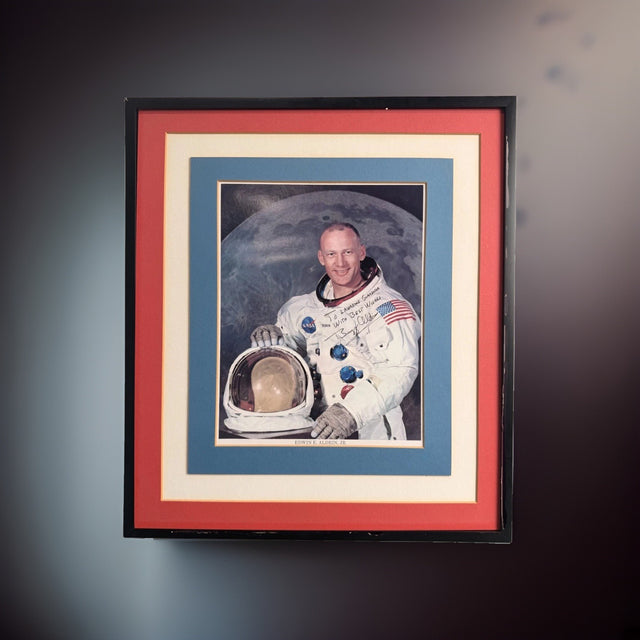
Buzz Aldrin Signed NASA 8x10 Color Photo Personalized Framed JSA LOA
$899.00 USD
-
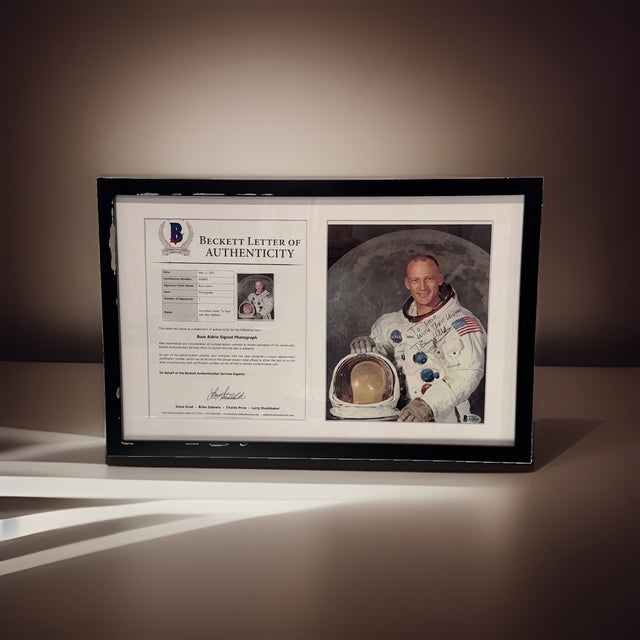
Buzz Aldrin Signed Inscribed Astronaut Photo Framed Beckett LOA A42843
$999.00 USD
-
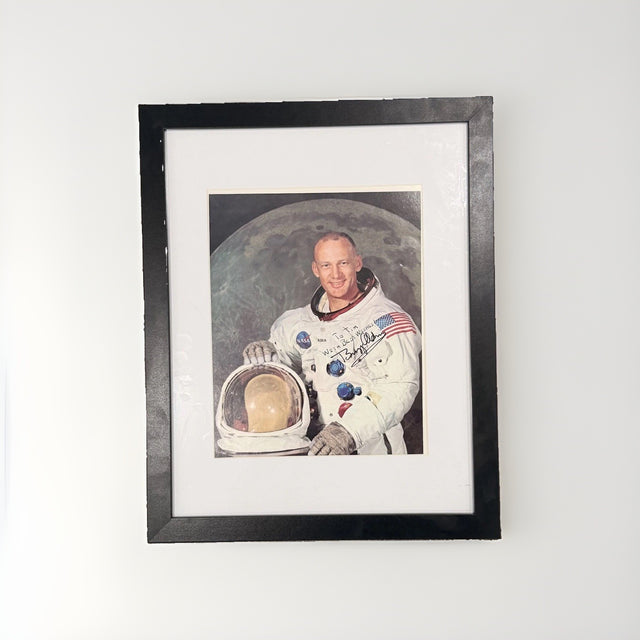
Buzz Aldrin Signed NASA Astronaut Portrait Inscribed To Tim Framed
$850.00 USD
-
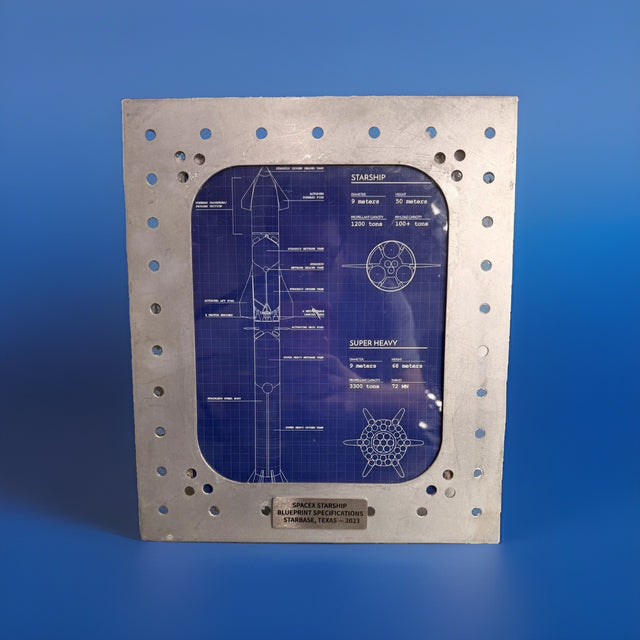
SpaceX Starship Super Heavy Blueprint Metal Display Panel Spacecraft Frame
$59.00 USD
-
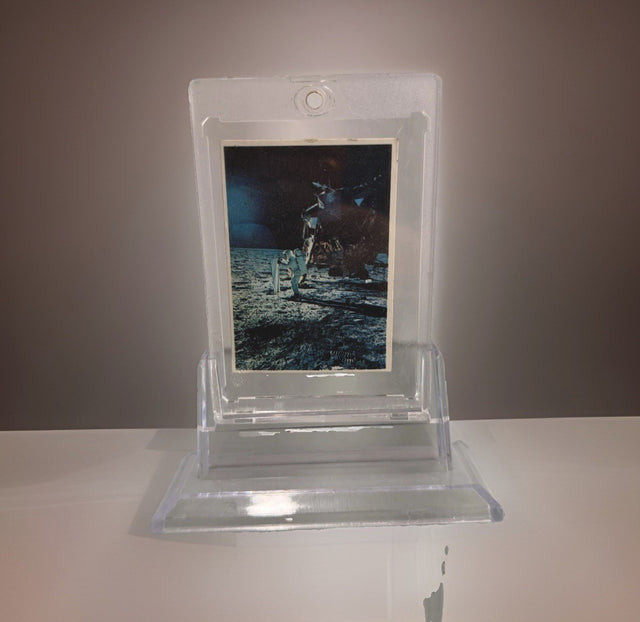
1969 Space Candy Buzz Aldrin Apollo 11 On The Moon Card #19 Taylor-Reed Display
$59.00 USD
-
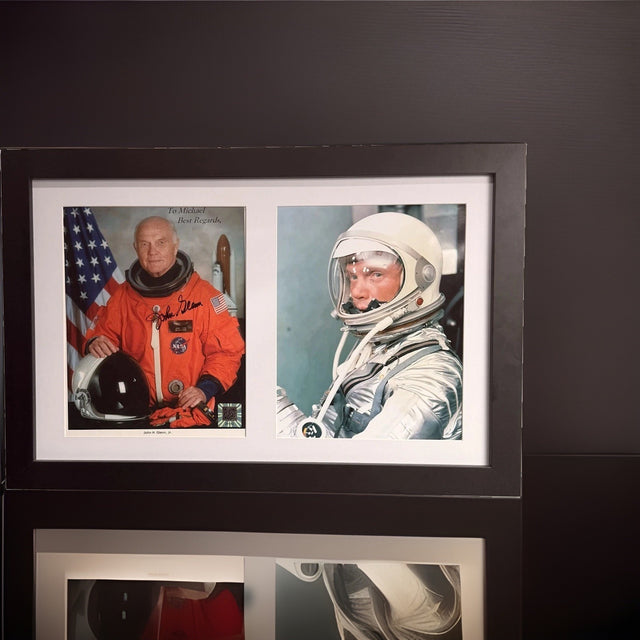
John Glenn Signed Autographed NASA Photo Display JSA Mercury Astronaut Framed
$199.00 USD
Browse the collection for current listings.