

Featured image: AI-generated interior concept using product reference photography. Scale, setting, framing, and placement are illustrative.
The stark presence of a white sculpture
Integrating a significant sculptural piece into an interior design scheme is a pivotal decision. It's a moment where form, texture, and implied narrative converge to define a space. For designers considering Cleon Peterson’s “POWER” sculpture in its striking white resin iteration, the challenge and opportunity are particularly acute. This is not a piece that recedes into the background; its very essence is to command attention, asserting a presence that is both monumental and unsettling. The matte white finish, rather than softening its impact, clarifies its lines and amplifies its stark message. When faced with a piece like this, the initial impulse might be to find a neutral corner, but that would be to misunderstand its power. Instead, we must consider how to integrate it as a focal point, a deliberate counterpoint, or even a provocative anchor. The inherent tension in Peterson’s work – the stylized violence, the faceless figures – is not merely decorative; it is a statement. Integrating such a statement requires more than just finding a spot; it demands a strategic understanding of light, shadow, scale, and the existing visual language of the room. The white sculpture, with its clean yet severe aesthetic, offers a unique set of considerations for creating an impactful display. It forces a conversation about what art can and should do within a living or working environment, pushing beyond mere aesthetics to engage with deeper themes.
The absence of color in the “POWER” sculpture shifts the focus entirely to its form and the interplay of light across its surfaces. Unlike a painted sculpture where color might guide the eye or evoke specific moods, this piece relies on its silhouette and the subtle gradations of shadow to articulate its muscularity and the menacing posture of the figure. This makes its placement intrinsically linked to the ambient lighting and the viewer’s perspective. A poorly lit corner would flatten its powerful contours, diminishing its sculptural integrity. Conversely, thoughtful illumination, whether natural or artificial, can dramatically enhance its three-dimensionality, allowing the viewer to appreciate the artist's translation of his signature two-dimensional figures into a robust, volumetric form. The sculpture’s subject matter, often described as stark depictions of power dynamics and social conflict, is rendered with a graphic simplicity that is both immediate and enduring. This visual language, while powerful, also necessitates a conversation with clients. It’s essential to ensure that the themes evoked by the artwork resonate with their sensibilities and the overall desired atmosphere of the space. This isn't just about selecting a beautiful object; it's about curating an experience that acknowledges the art's inherent challenging nature while integrating it harmoniously into a sophisticated design.
The visibility of shape and the play of shadows
The “POWER” sculpture’s matte white resin surface is a canvas for light and shadow. Its form, characterized by broad, smooth planes and sharply defined edges, is entirely dependent on these elements for its visual impact. The absence of color means that every curve, every angle, and every recess must be articulated by how light falls upon it. Consider the muscular torso and shoulders of the figure; under direct, focused light, these areas might appear almost monolithic, their volume clearly defined. However, with softer, more diffuse lighting, the transitions become more subtle, allowing the eye to trace the contours with a gentler appreciation. The weapon held by the figure, a stark, angular blade, casts its own distinct shadow across the body, adding another layer of visual complexity and reinforcing the sculpture's narrative tension. This play of light and shadow is not just an aesthetic consideration; it's fundamental to understanding the sculpture's three-dimensional presence. Without adequate illumination, the sculpture risks appearing flat, its powerful form diluted. The goal is to create conditions where the sculpture’s inherent dynamism is fully realized, where the viewer can perceive its depth and the artist’s deliberate choices in rendering form.
When positioning the sculpture, one must consider not just the primary light source but also secondary reflections and ambient light. A piece placed near a window, for instance, will interact differently with natural light throughout the day, offering a changing visual experience. Morning light might highlight one set of contours, while afternoon light might emphasize another. Artificial lighting, on the other hand, provides more control. A strategically placed spotlight, aimed at a specific angle, can dramatically enhance the sculpture's dramatic qualities, emphasizing its silhouette against a wall or casting intriguing shadows that extend beyond the physical object. The depth of the sculpture, at 2.83 inches, means it has a relatively shallow profile for its height and width, making its relationship to the backdrop particularly important. It is not a fully volumetric, free-standing piece in the traditional sense, but rather a robust, relief-like figure that asserts itself forward from its base. This shallow depth means that the shadows it casts are often more defined and less sprawling, allowing for precise control over the visual drama. The challenge is to find that sweet spot where light enhances rather than obscures, where shadows add depth without creating visual clutter. The clean lines of the sculpture demand a clean lighting approach, free from distracting glares or uneven illumination. The intent is to reveal the sculpture's powerful form, not to overwhelm it.
Dark versus pale backdrops: the contrast conundrum
The choice of backdrop for the Cleon Peterson “POWER” sculpture is paramount, directly influencing how its stark white form is perceived. The contrast between the sculpture and its surrounding environment can either amplify its presence or cause it to blend into obscurity. When placed against a pale or white backdrop, the sculpture's form relies almost entirely on shadow and subtle shifts in tone to define its edges. This approach can create a sophisticated, minimalist aesthetic, where the sculpture appears almost to emerge from the wall itself, a ghost of its own powerful form. The effect is understated but impactful, demanding closer inspection to appreciate the nuances of its shape. In such a setting, the interplay of light becomes even more critical, as strong directional light is needed to cast distinct shadows that articulate the figure’s musculature and the angularity of its weapon. Without these shadows, the sculpture might lose its three-dimensionality and appear somewhat ethereal, which may or may not be the desired effect depending on the design intent. This high-key approach can be incredibly elegant in a monochromatic scheme, allowing the sculpture to contribute texture and form without introducing additional color.
Conversely, positioning the “POWER” sculpture against a dark or deeply saturated backdrop offers a more dramatic and immediate contrast. A charcoal gray, a deep navy, or even a rich forest green wall would allow the pristine white of the sculpture to pop with undeniable force. In this scenario, the sculpture's silhouette becomes sharply defined, its edges crisp and clear against the darker plane. The dark background acts as a void, pushing the white form forward and making it the undisputed focal point. This approach often enhances the inherent tension and graphic quality of Peterson’s work, allowing the viewer to immediately grasp the figure’s confrontational stance and the stark lines of its weapon. The shadows cast by the sculpture, while still important for defining its form, might be less visually prominent against a dark wall, as the primary contrast is established by the color difference. This contrast-driven display can be particularly effective in spaces designed for high impact, such as an entryway, a gallery wall, or a prominent alcove in a living area. The decision between a pale or dark backdrop ultimately hinges on the desired mood and the overall aesthetic of the room, but both approaches offer distinct advantages for showcasing this powerful piece.
Viewing angles and their impact on interpretation
The Cleon Peterson “POWER” sculpture is designed to be viewed from multiple perspectives, each angle revealing a slightly different aspect of its form and narrative. While the primary view presents the figure in a direct, confrontational stance, moving around the piece unveils its sculptural complexities. From a slight angle, the depth of the figure becomes more apparent, the curves of the limbs and torso gaining a more pronounced three-dimensionality. The way the weapon is held, for instance, shifts from a purely frontal depiction to one that reveals the grip and the tension in the figure's arms. This dynamic quality is crucial for a piece that carries such a strong symbolic weight. The artist’s translation of his signature two-dimensional style into a three-dimensional object means that the silhouette remains strong from any angle, yet the subtle shifts in plane and shadow become richer as the viewer moves. This encourages interaction, inviting the observer to engage with the sculpture not just as a static image but as an object that occupies space and asserts its presence from every side.
Consider a hypothetical project: a minimalist urban loft with expansive windows and an open-plan living area. The client desires a statement piece that reflects a modern, edgy sensibility without overwhelming the clean aesthetic. Placing the Cleon Peterson POWER sculpture on a low, floating credenza in the center of the main living space would allow for 360-degree viewing. As one walks from the kitchen toward the seating area, the sculpture's profile changes, revealing the subtle curves of the back and the slight forward lean of the figure. From the dining table, a different angle might emphasize the angularity of the weapon and the tension in the shoulders. This dynamic viewing experience transforms the sculpture from a mere decorative object into a central element of the room's narrative, constantly re-engaging the viewer. The key is to ensure that the sculpture is not confined to a single fixed perspective, but rather integrated into a flow of movement that allows its full sculptural qualities to be appreciated. This requires careful consideration of furniture placement, traffic patterns, and sightlines within the room, ensuring that the piece is accessible and engaging from various vantage points. The sculpture's relatively compact footprint (11.61" x 7.09" x 2.83") makes it versatile for such multi-angle placement, allowing it to fit onto shelves, side tables, or even a robust pedestal without dominating the physical space.
Support depth and the illusion of negative space
The base of the “POWER” sculpture, while integral to its stability, also plays a crucial role in its visual presentation. The figure stands on a rectangular plinth, which is then affixed to a wider, shallower base. This design choice creates a substantial foundation, anchoring the figure visually. However, its true impact comes from how it interacts with the surrounding negative space. The figure occupies three-dimensional space, while the openings between its limbs make the silhouette especially important. Judge it from more than one position before choosing a display surface. This creates an interesting illusion: while the sculpture has a physical depth of 2.83 inches, the negative space around the figure’s legs and arms creates a sense of greater dimensionality and openness. The spaces between the arms and the torso, and between the legs and the central support, become as important as the solid forms themselves, allowing light to pass through and defining the sculpture’s outline with greater clarity. This interplay of solid and void is a hallmark of strong sculptural design, giving the piece a lightness despite its powerful subject matter.
When considering placement, the depth of the support should influence the choice of surface. A shallow shelf might visually crowd the base, making the sculpture appear less stable or imposing. A deeper surface, such as a substantial console table or a mantelpiece, provides ample room around the base, allowing the negative space to breathe. This creates a more considered display, where the sculpture is given room to assert its presence without feeling constrained. For instance, in a contemporary living room featuring bespoke joinery, a recessed niche designed with a slightly deeper shelf could perfectly frame the sculpture. The depth of the niche could be planned to exceed the sculpture’s base depth by several inches, creating a generous border of negative space around it. This not only highlights the sculpture but also allows the intricate shadows cast by the figure to play out on the back wall of the niche, adding an extra layer of visual interest. The objective is to ensure that the sculpture's base feels grounded and deliberate, not precariously balanced or visually cramped. The careful consideration of the support's depth in relation to its display surface contributes significantly to the overall perceived weight and dignity of the artwork.
Navigating the subject matter with clients
Cleon Peterson’s artistic output is consistently characterized by stark, often violent imagery, exploring themes of power, conflict, and social struggle. The “POWER” sculpture, while rendered in a minimalist white, carries this thematic weight. The faceless figure, the aggressive stance, and the weapon it wields are not subtle. This makes the conversation with clients about integrating such a piece into their home or professional space particularly important. It's not simply a matter of aesthetic preference, but of aligning the artwork's narrative with the client's values and the intended atmosphere of the room. Some clients may be drawn to the raw energy and critical commentary inherent in Peterson’s work, seeing it as a bold statement piece that provokes thought and conversation. For them, the sculpture might represent a powerful reflection on contemporary society, a visual anchor for a space that embraces challenging ideas. They might appreciate the graphic simplicity as a sophisticated abstraction of complex themes, rather than a literal depiction of violence. In such cases, the designer’s role is to facilitate this connection, ensuring the placement and context amplify the desired interpretation.
However, other clients might find the imagery too intense, or misinterpret its intent as promoting aggression rather than critiquing it. It is crucial to approach these discussions with sensitivity and clarity, explaining Peterson’s broader artistic context and the stylistic choices that define his work. The matte white finish, for example, can be presented as a deliberate artistic choice that abstracts the subject, stripping away sensationalism and focusing on pure form and symbolic meaning. It allows the viewer to engage with the underlying structure and posture without the immediate distraction of color. The conversation should center on how the client perceives the piece and what kind of dialogue they want their art to generate. Is it meant to be a conversation starter? A personal reflection? Or simply an object of aesthetic appreciation? Understanding these nuances helps in guiding the client toward a decision that feels authentic and comfortable. The designer acts as an interpreter, bridging the gap between the artist's intent and the client's personal space, ensuring that the powerful presence of the sculpture enhances, rather than detracts from, the desired environment. This careful navigation transforms a potentially difficult conversation into an opportunity for deeper engagement with art and its role in daily life.
Project example: anchoring a contemporary study
Consider a hypothetical project for a client who is a legal professional, working from home in a dedicated study. The room is designed with clean lines, rich wood tones, and minimalist furniture, aiming for an atmosphere of focused intensity and intellectual rigor. The client appreciates modern art that has a strong conceptual underpinning and is not afraid of provocative statements, provided they are presented with sophistication. The challenge is to introduce a piece that commands attention without creating visual clutter or disrupting the room’s inherent seriousness. The Cleon Peterson “POWER” sculpture is identified as a potential centerpiece. Its stark white form and themes of power and conflict resonate with the client's professional world and personal aesthetic.
The study features a large, custom-built desk in dark walnut, positioned against a wall painted in a deep, muted charcoal gray. Above the desk, a floating shelf, also in dark walnut, spans the width of the wall. This shelf is chosen as the primary display location for the sculpture. The deep gray wall provides an ideal high-contrast backdrop, making the white resin sculpture immediately pop and its silhouette sharply defined. The shelf depth is a generous 10 inches (planning assumption), providing ample negative space around the sculpture’s 2.83-inch depth, ensuring it feels grounded and deliberate. To illuminate the piece, a recessed LED spotlight is installed directly above the sculpture, angled slightly to create dramatic shadows that emphasize its musculature and the angularity of the weapon. These shadows play against the dark gray wall, adding depth and a sense of movement to the static form. The light source is carefully calibrated to avoid glare on the matte finish, ensuring the sculpture's texture remains visible.
On the opposite wall, a large-format screen print, Cleon Peterson A Perfect Trade, is selected. This monochrome print, also by Peterson, echoes the sculptural piece’s graphic style and stark black-and-white palette. Framed simply in a thin black metal frame with museum-quality acrylic for light filtering, it provides a two-dimensional counterpoint to the sculpture, reinforcing the artist’s aesthetic and thematic concerns. The print is hung at eye level from the desk, creating a visual dialogue across the room. The overall effect is one of curated intensity: the sculpture on the shelf acts as a powerful anchor, its form and subject matter resonating with the room’s intellectual purpose, while the print on the opposing wall expands on this theme. The white sculpture, against the dark backdrop and under focused lighting, becomes a focal point that is both visually arresting and conceptually engaging, perfectly aligning with the client’s desire for art that is both beautiful and thought-provoking.
Final considerations for integration
Integrating the Cleon Peterson POWER sculpture into a professional interior requires deliberate staging that accounts for shape visibility and contrast. Measuring 11.61" x 7.09" x 2.83", the matte white resin piece features precise silhouettes and negative space that rely heavily on light and backdrop selection. Set against a dark wall, the white outline reads as a crisp silhouette. Against a pale background, directional side lighting becomes necessary to cast deep shadows across the surface, defining the forms of the two figures in conflict.
Because the work measures 2.83" deep, placement requires a display surface with sufficient depth, such as a sturdy mantle, deep ledge, or console, ensuring sightlines from multiple viewing angles capture the depth of the relief. Position the center slightly lower than standing eye-level if the piece will primarily be viewed from seated furniture. Leave ample negative space around the sculpture rather than surrounding it with small decorative items that clutter its profile.
Unlike benign art objects, the narrative subject matter of power, dominance, and social confrontation requires a thoughtful client conversation prior to installation. Frame the piece as a bold graphic statement and a provocative focal point rather than neutral decor. Highlight how its monochromatic palette tempers the intense subject matter, allowing it to ground a minimalist setting or balance adjacent visual elements without disrupting the broader design narrative.
Shop Cleon Peterson
Explore current pieces available from the gallery.
-

Cleon Peterson POWER Sculpture White Resin Ltd Edition 500 Beyond The Streets NT
$600.00 USD
-
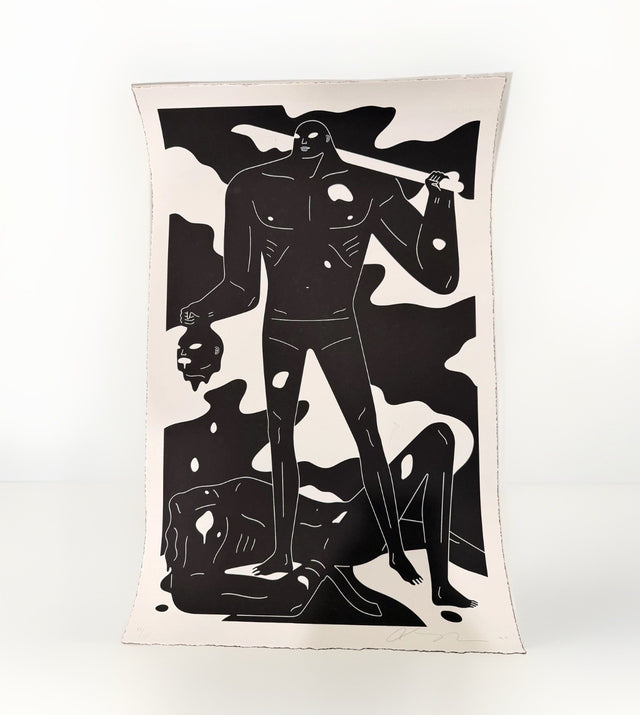
Cleon Peterson A Perfect Trade White Screen Print Signed Numbered /125
$325.00 USD
Browse the collection for current listings.