A fair price for an astronaut-signed NASA photo is not a single number — it is the intersection of seven measurable factors: who signed it, the significance of the mission, the subject and vintage of the photograph itself, the quality and placement of the signature, whether the piece is personalized, the strength of its authentication (Beckett, JSA, or PSA/DNA, ideally reinforced by Zarelli Space Authentication for Apollo-era material), and its documented provenance. Two photos signed by the same astronaut can trade at very different levels because of these variables. The reliable way to arrive at a fair price is to score a specific piece against each factor, then compare it to recent verified sales of genuinely comparable examples — same astronaut, same photo type, same authentication standard — rather than to asking prices.
That framework is what this guide unpacks. Astronaut autographs are one of the most rewarding corners of the collectibles market precisely because pricing is knowable: the factors are consistent, the authentication standards are mature, and the sales record is deep enough that a disciplined collector can benchmark almost any piece. Learn it once and you will never again wonder whether an asking price is grounded in the market or in wishful thinking. Compare like-for-like signed objects or artifacts with matching mission association, signer, condition, authentication and provenance; a category-wide rate or median mixes different objects. Research references: space memorabilia.
Why There Is No Single "Fair Price" — and Why That Is Good News
New collectors often search for a universal answer: "What is an astronaut-signed photo worth?" The honest answer is that the category spans an enormous range. A signed photo from a lesser-known shuttle-era astronaut and a crew-signed Apollo lunar-surface image occupy entirely different tiers of the market, even though both are technically "astronaut-signed NASA photos."
This breadth is actually an advantage. It means there is an entry point for nearly every budget, and it means value is driven by identifiable characteristics rather than hype. Unlike some collectible categories where prices move on fashion, astronaut autograph values track durable fundamentals: historical significance, signing scarcity, and documentation quality. Those fundamentals can be researched, verified, and compared.
The practical consequence is that "fair price" is always a piece-specific question. The right mental model is a checklist, not a price tag. Work through the factors below in order, and by the end you will know exactly which comparable sales matter for the piece in front of you. For a structured walkthrough of the whole category, our Apollo 11 buyer's guide pairs naturally with this article.
Factor 1: The Astronaut — Signing Habits Drive Scarcity
The single largest pricing variable is the identity of the signer. Within that, the market cares about three things: historical role, signing behavior during the astronaut's lifetime, and current availability of material.
Historical role
Moonwalkers occupy the top tier — only twelve people have walked on the lunar surface, and their signatures anchor the entire category. Command module pilots and other Apollo crew members form the next tier, followed by Gemini and Mercury pioneers, whose material combines deep historical importance with the scarcity that comes from small program rosters. Shuttle-era and ISS-era astronauts are generally the most accessible tier, with hundreds of individuals and, in many cases, active signing through appearances and organized signings.
Signing behavior
Two astronauts with identical résumés can have very different market profiles because of how they approached autographs. Some signed generously for decades, through the mail and at events, leaving an ample supply. Others signed reluctantly, stopped signing entirely at some point, or restricted their signatures to specific settings. Neil Armstrong is the famous example: he stopped signing autographs for the public in the mid-1990s, and that decision permanently capped the supply of authentic Armstrong material. Scarcity created by signing behavior is just as real as scarcity created by history.
Availability today
For deceased astronauts, supply is fixed and the market re-prices accordingly over time. For living astronauts who still sign, new supply enters the market regularly, which tends to keep prices for standard signed photos more stable. When you evaluate a piece, ask: is this signature from a fixed, closed supply, or from an ongoing one? Verified comparable sales will reflect the difference clearly — our space memorabilia price guide explains how these tiers typically behave relative to one another without pinning the market to numbers that go stale.
Factor 2: Mission Significance
Mission context multiplies or moderates the astronaut factor. The same signer's photo can carry meaningfully different value depending on which mission the image and inscription reference.
- Apollo 11 sits alone at the top. The first lunar landing is one of the most collected events in human history, and material connected to it enjoys the deepest, most liquid market in the category.
- Other Apollo lunar landings (12, 14, 15, 16, 17) follow, each with its own collector base and its own points of interest — first use of the lunar rover, longest surface stay, and so on.
- Apollo 13 is a special case: a mission that never landed but became legendary, with sustained collector demand driven by the story itself.
- Mercury and Gemini material appeals to collectors who prize firsts — first American in orbit, first spacewalk — and benefits from very small crew rosters.
- Shuttle and ISS missions are the volume tier, with notable exceptions for historic flights and crews.
When comparing sales, match mission to mission. An Apollo-era signed photo should be benchmarked against Apollo-era sales, not against the broader astronaut market. Mixing tiers is the most common way collectors mis-estimate fair value.
Factor 3: The Photograph Itself — Subject, Vintage, and Format
Collectors sometimes fixate on the signature and treat the photo as a mere carrier. The market does not. The photograph's subject, printing vintage, and condition all move the price.
Subject matter
Iconic imagery commands a premium. A portrait of the astronaut in the white spacesuit — the classic official NASA pose — is the standard collectible format and the easiest to benchmark. Lunar-surface imagery, launch photography, and in-flight scenes each have their own followings. As a general rule, the more closely the image connects the signer to their defining moment, the stronger the demand: a moonwalker signing a photo of themselves on the lunar surface is a more resonant object than the same signature on a generic publicity still.
Vintage prints versus later reprints
NASA imagery has been reproduced continuously for decades, so the same famous image exists in many physical forms: period prints made near the time of the mission, official lithographs produced for public distribution, and modern reprints of every quality level. Period-original prints on photographic paper are the most prized carriers; official NASA lithographs signed by the astronaut are a well-established and widely collected format; a signature on a recent inkjet reprint carries the least carrier value, even when the autograph itself is genuine. When you review a listing or a comparable sale, establish what the physical object actually is — the same signature on different carriers belongs to different comp sets. Our space memorabilia authentication guide covers how print type is assessed alongside the autograph.
Format and condition
Standard formats such as 8x10 photographs are the baseline; larger presentation formats can carry premiums when demand supports them. Condition matters the way it does across works on paper: surface quality, corner and edge integrity, toning, and any restoration all factor in. A crisp, well-preserved example will consistently out-comp a handled one, and honest condition disclosure is part of what separates a documented sale from an unreliable one.
Factor 4: Signature Quality and Placement
Not all authentic signatures are equal in the market's eyes. Buyers pay for eye appeal, and eye appeal is a combination of several observable traits:
- Boldness and contrast. A strong, dark signature that stands out against its background is worth more than a faint or fading one. Ink that has held its color over decades signals both quality materials and good storage.
- Completeness.
- Placement. A signature positioned in a clear area of the image — sky, spacesuit, open background — reads better than one lost in a busy or dark portion of the photograph.
- Period of signing. Signatures evolve over a lifetime. Collectors of specific astronauts often prefer examples from particular eras, and vintage-signed period photos (signed near the time of the mission) form their own premium niche.
When you pull comparable sales, look at the photos of the actual items sold, not just the descriptions. Two "signed 8x10s" by the same astronaut can differ meaningfully in realized price purely on signature strength and placement, and the images attached to verified sales records will show you why.
Factor 5: Inscriptions and Personalization
Personalization — "To John, best wishes" — is one of the most consistent pricing variables in all autograph collecting, and space material follows the pattern. A personalized photo typically trades below an equivalent unpersonalized example, because the dedication narrows the pool of buyers who want it on display.
There are two important nuances. First, mission-related inscriptions work in the opposite direction: an astronaut adding their mission, their role, or a famous quote in their own hand adds content, not clutter, and the market generally rewards it. Second, personalization is not a defect — it is often evidence. A photo inscribed to a named recipient with a documented connection to the astronaut or the program can carry provenance value that partially or fully offsets the personalization discount, particularly when the accompanying paperwork tells the story.
When comparing sales, treat personalized and unpersonalized examples as separate comp sets, and note whether an inscription is a dedication (narrowing) or mission content (enhancing).
Factor 6: Authentication — The Foundation Under Every Price
Everything above assumes one thing: the signature is genuine. Authentication is not one factor among seven so much as the gate the other six stand behind. An unauthenticated astronaut signature is not a discounted version of an authenticated one — it is a different, riskier asset, and the market prices that risk severely.
The space category has a particular history that makes third-party review essential: for decades, NASA responded to the public's enormous appetite for astronaut autographs partly with secretarial signatures and autopen machines — mechanical devices that reproduce a signature. These items were produced in good faith as souvenirs, but they are not hand-signed autographs, and distinguishing them from authentic signatures is precisely the kind of judgment professional authenticators exist to make. This is why experienced collectors treat certification as the starting point of a fair price, not an optional extra.
The industry-standard trio, plus the space specialist
For signed space material, the recognized authentication standard is the industry trio — Beckett Authentication Services, JSA (James Spence Authentication), and PSA/DNA — with Zarelli Space Authentication as the space-focused specialist whose opinion carries particular weight on Apollo-era material. Zarelli's concentration on astronaut and aerospace autographs makes it the marquee endorsement for the most significant pieces, and serious Apollo-era items frequently carry a specialist opinion alongside one of the trio. If any of these names are unfamiliar, our authentication glossary defines each service and the terms you will see on their certifications.
| Authentication status | What it tells the market | Effect on fair price |
|---|---|---|
| Beckett, JSA, or PSA/DNA certification | Signature reviewed by a recognized third-party authority; item enters the mainstream market | Full market pricing; comparable sales are directly usable |
| Trio certification plus Zarelli Space Authentication | Generalist and specialist agreement — the strongest documentation profile for Apollo-era material | Strongest buyer confidence and deepest resale market |
| Dealer COA only (no recognized third party) | Depends entirely on the dealer's reputation and documentation practices | Benchmark against certified comps with caution; factor in the cost and uncertainty of obtaining certification |
| No authentication | Buyer assumes the full risk of secretarial, autopen, or forged signatures | Trades at a deep discount to certified examples, and for good reason |
The pricing implication is direct: when you compare sales, compare like with like. A certified example's realized price is not a valid comp for an uncertified one. If you are evaluating an uncertified piece, the fair-price question becomes two questions: what would it be worth certified, and what is the realistic probability it passes? For a grounding in how questionable pieces surface in this category, our guide on how to spot a fake in space memorabilia is the place to start — not to make you an authenticator, but to help you recognize when professional review is non-negotiable.
Factor 7: Provenance and Documentation
Provenance answers a different question than authentication. Authentication says "this signature is genuine." Provenance says "here is where this object has been." The strongest pieces have both, and the market rewards the combination.
Meaningful provenance for astronaut-signed photos includes original signing documentation (a photo of the astronaut signing the piece, or paperwork from an organized signing), letters or envelopes showing the item's history, prior auction records, and chains of ownership from named collections. Material descended from program insiders — engineers, contractors, NASA employees — carries a narrative that collectors value, especially when the paper trail is intact.
Documentation also compounds over time. A photo that sells today with certification, signing provenance, and a recorded sale becomes an easier, more confident purchase for its next owner, which supports its next price. This is why we insist on documented provenance for every piece our gallery handles: the paperwork is not overhead, it is part of the asset. When you weigh two similar pieces at different prices, the one with the richer file is often the better value even at the higher figure.
How to Compare Verified Sales — The Method That Replaces Guesswork
With the seven factors profiled, pricing becomes a matching exercise. Here is the discipline we apply, and the one we recommend to every collector:
- Define the piece precisely. Astronaut, mission association, image subject, print type and format, signature characteristics, inscription status, certification status, provenance depth. Write it down — vagueness here is where pricing errors begin.
- Use realized prices, never asking prices. Asking prices measure sellers' hopes. Realized prices measure what buyers actually paid. Only completed, verified sales belong in your comp set.
- Match the certification standard. Certified comps for certified pieces; treat uncertified sales as a separate, noisier data set.
- Match the carrier. Vintage print comps for vintage prints, lithograph comps for lithographs, reprint comps for reprints. This is the most frequently skipped step.
- Weight recent sales more heavily. The astronaut autograph market moves — signing retirements, anniversaries, and estate releases all shift supply and demand. Sales from years ago are context, not benchmarks.
- Look at the spread, not just the average. A cluster of sales tells you the market's range for the type; where a specific piece lands inside the range is determined by signature quality, condition, and documentation.
- Adjust for venue. Auction results include buyer's premiums and reflect competitive bidding; dealer sales include curation and guarantees. Understand what each number represents before comparing them.
When we price a signed photo for our space memorabilia collection, we are not estimating — we are locating the piece inside a verified sales record and adjusting for its specific profile. Collectors can apply the same logic at smaller scale using auction archives and documented sale records; the method matters more than the size of the data set. For a broader view of how we read market data across categories, see our financial insights hub.
Common Pricing Mistakes — and How the Framework Prevents Them
- Benchmarking against asking prices. Listings that sit unsold for months are evidence of what the market will not pay. The framework's insistence on realized sales eliminates this trap.
- Ignoring the carrier. Comparing a signed modern reprint to a signed vintage print because "it's the same image" conflates two different objects. Factor 3 keeps the comp sets separate.
- Treating all certifications as equal. A certificate from an unrecognized issuer is not the same signal as Beckett, JSA, or PSA/DNA. The market prices the difference; so should you.
- Overpaying for rarity claims. "Rare" is the most overused word in collectibles. Actual scarcity shows up in the sales record — if comparable examples appear regularly, the piece is not rare, whatever the listing says.
- Undervaluing documentation. Two pieces at the same price with different provenance depth are not the same value. The better file is worth paying for, because it travels with the piece to resale.
- Skipping specialist review on major pieces. For significant Apollo-era material, the incremental step of specialist space authentication is small relative to the confidence it adds. The strongest pieces in the market carry it.
The Gauntlet Gallery Approach
Our gallery handles astronaut-signed material the same way we handle every category: authenticated sourcing first, comps second, price last. Signed space pieces we offer are benchmarked against verified sales from our comparable-sales database, carry the documentation profile appropriate to the category — the Beckett/JSA/PSA-DNA standard, with Zarelli Space Authentication as the specialist reference for Apollo-era material — and come with documented provenance that transfers to the buyer. We publish our research openly in our buyer's guides because informed collectors make better buyers, and better buyers make a healthier market.
If you are building toward a significant piece — a moonwalker signature, a crew-signed photo, an Apollo 11 item — start with the Apollo 11 authentication guide and the Apollo 11 price guide, which apply everything in this article to the category's flagship mission.
The Fair-Price Checklist
Before you buy any astronaut-signed NASA photo, run this checklist. If you can answer every item, you know what fair looks like for that specific piece.
- Who signed it, and what is their signing-supply profile (still signing, stopped, deceased)?
- What mission does the piece connect to, and how does that mission tier trade?
- What is the physical object — vintage print, official lithograph, or modern reprint — and what is its condition?
- How strong is the signature: bold, complete, well-placed, in stable ink?
- Is it personalized, and if so, does the inscription narrow the audience or add mission content?
- Is it certified by Beckett, JSA, or PSA/DNA — and for Apollo-era material, does it carry Zarelli Space Authentication?
- What provenance documentation accompanies it, and does the paperwork transfer with the sale?
- What have genuinely comparable examples — same astronaut, same carrier, same certification standard — actually sold for recently?
- Does the asking price sit inside the range those verified sales define, adjusted for this piece's specific strengths and weaknesses?
- Is the seller able to show their work — documentation, sourcing, and comps — or are you being asked to take the price on faith?
A fair price is simply the price this checklist supports. When a piece scores well on the factors and the asking price sits inside the verified-sales range for its true comp set, you are looking at a fair deal — and often, when documentation is strong, a good one. For more terminology and category background as you research, our collector glossary and the Collector's Hub are open resources.
Frequently Asked Questions
Why do prices for the same astronaut's signed photos vary so much?
Because the signature is only one of seven pricing factors. The photograph's subject and vintage, the signature's quality and placement, personalization, certification status, and provenance depth all move the price independently. Two signed 8x10s by the same astronaut can occupy different comp sets entirely — one a certified vintage print with signing provenance, the other an uncertified modern reprint. The market prices the whole object, not just the name.
Does a personalized inscription always lower the value?
Usually a dedication to a named recipient trades below an equivalent unpersonalized example, because fewer buyers want someone else's name on their display piece. But mission-related inscriptions added in the astronaut's hand — mission names, roles, quotes — typically add value, and a personalization with documented provenance to a program insider can offset the discount. Evaluate what the inscription is before assuming it is a negative.
Is third-party authentication really necessary before buying?
For any meaningful purchase, yes. The space category's history includes secretarial signatures and autopen reproductions produced in enormous quantities, and distinguishing them from hand-signed autographs is a professional judgment. Certification from Beckett, JSA, or PSA/DNA — with Zarelli Space Authentication as the specialist standard for Apollo-era pieces — is what allows a piece to trade at full market pricing and gives you usable comparable sales.
How do I find verified comparable sales?
Use realized prices from completed, documented transactions: auction archives with published results and dealer sales with recorded documentation. Match your piece precisely — same astronaut, same print type, same certification standard, similar condition — and weight recent sales most heavily. Asking prices on marketplaces are not comps; they measure hope, not the market.
Are vintage NASA prints worth more than modern reprints of the same image?
Yes, consistently. A period print or official NASA lithograph is a collectible object in its own right, so the signed example combines carrier value with autograph value. A modern reprint contributes little beyond the signature it carries. The same autograph on different carriers belongs to different comp sets, which is why identifying the physical object is an essential step before pricing.
What makes Apollo-era signed photos the most valuable tier?
Fixed supply meeting the deepest demand. Apollo material connects to humanity's only crewed lunar landings, the astronaut rosters were small, and every signer's supply is now finite. Apollo 11 sits at the apex as the first landing, with the other lunar missions and Apollo 13 close behind. Mercury and Gemini pioneers benefit from similar scarcity, while shuttle-era material remains the accessible entry tier.
What documentation should transfer to me when I buy?
At minimum, the third-party certification (card, letter, or serial-numbered record) and the seller's provenance file: prior sale records, signing documentation if it exists, and any chain-of-ownership paperwork. Good documentation is part of the asset — it supports your purchase price today and your resale price later. A seller who cannot produce a file is asking you to price the piece as undocumented.
Shop Space memorabilia
Explore current pieces available from the gallery.
-
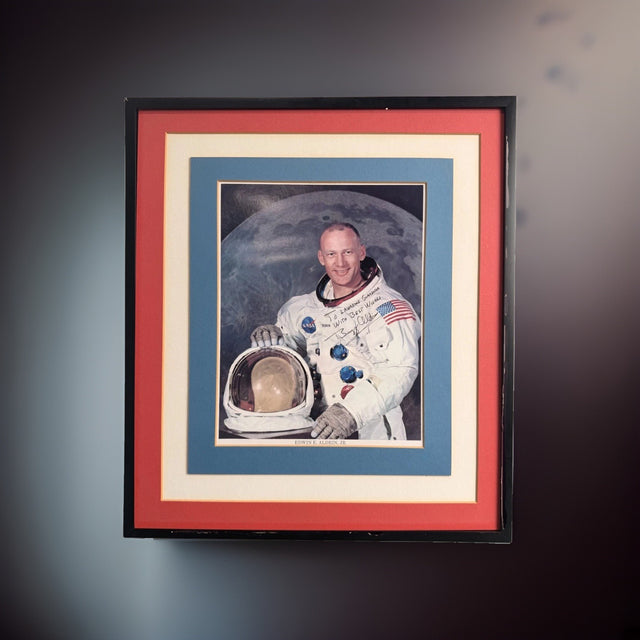
Buzz Aldrin Signed NASA 8x10 Color Photo Personalized Framed JSA LOA
$899.00 USD
-
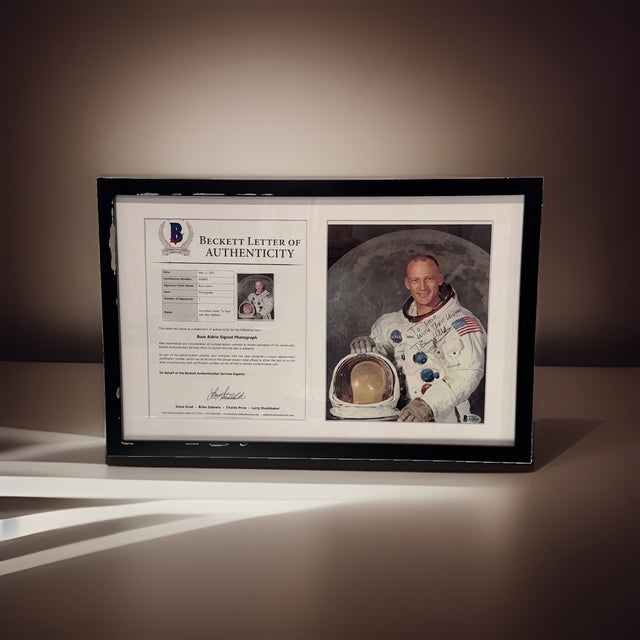
Buzz Aldrin Signed Inscribed Astronaut Photo Framed Beckett LOA A42843
$999.00 USD
-
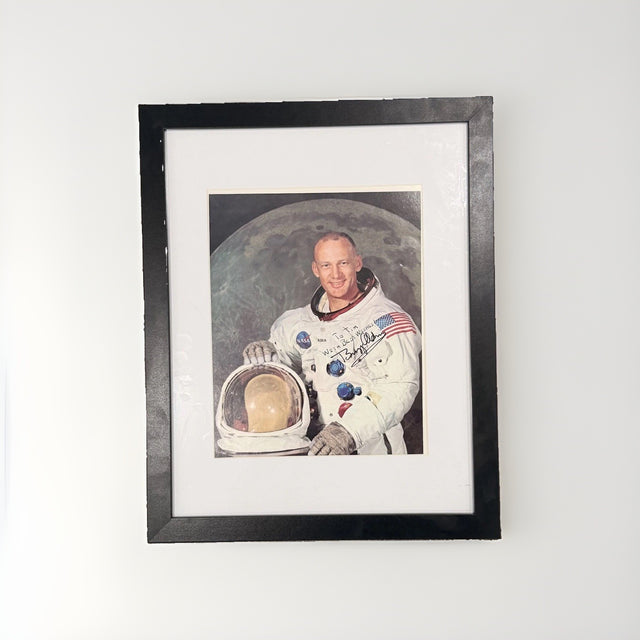
Buzz Aldrin Signed NASA Astronaut Portrait Inscribed To Tim Framed
$850.00 USD
-
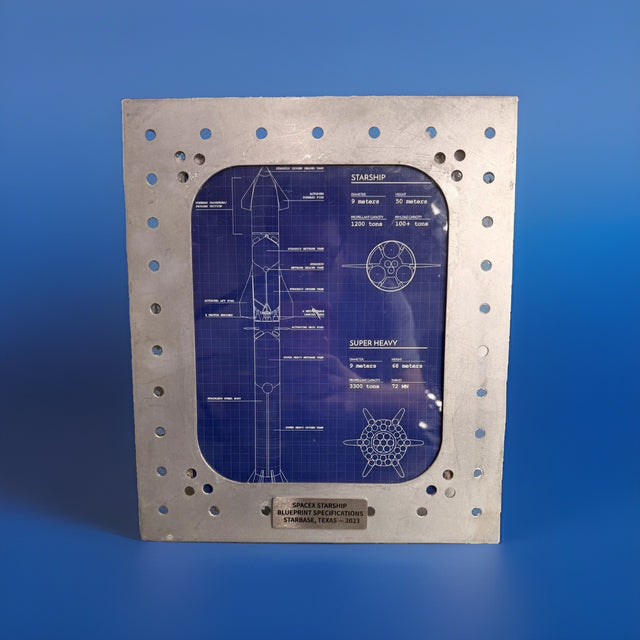
SpaceX Starship Super Heavy Blueprint Metal Display Panel Spacecraft Frame
$59.00 USD
-
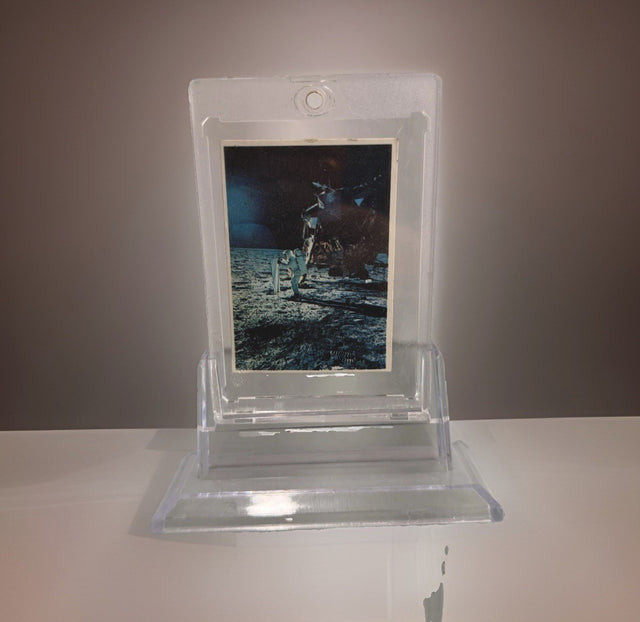
1969 Space Candy Buzz Aldrin Apollo 11 On The Moon Card #19 Taylor-Reed Display
$59.00 USD
-
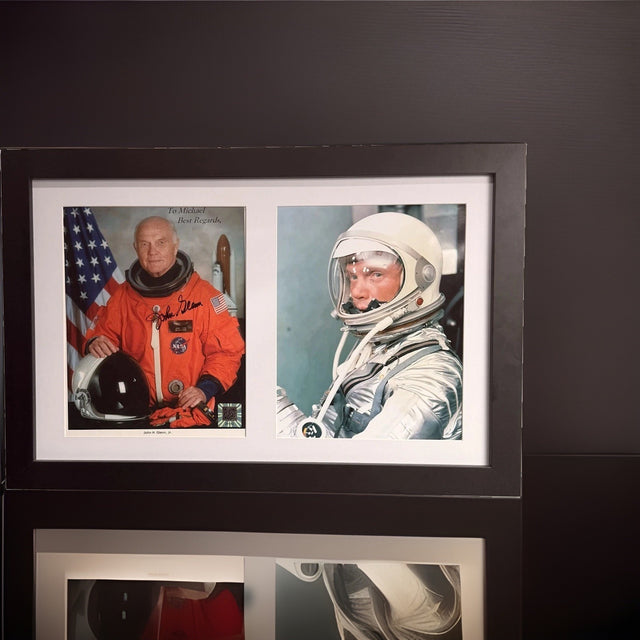
John Glenn Signed Autographed NASA Photo Display JSA Mercury Astronaut Framed
$199.00 USD
Browse the collection for current listings.