A genuine DEATH NYC certificate of authenticity should show four things above all: the artist's own signature on the certificate, the official metal gold seal affixed to the work, artwork details that match the print in hand exactly — title, edition number, dimensions, and medium — and internal consistency between the certificate and the pencil markings on the print itself. If any one of those elements is missing, mismatched, or looks like a photocopy rather than an original document, treat the certificate as unverified until proven otherwise. A COA is only as strong as its connection to the specific piece it accompanies, which is why the most important habit a collector can build is reading the certificate and the print together, side by side, rather than glancing at the paperwork and filing it away.
That is the short answer. The longer answer — the one that turns a casual buyer into a confident collector — involves understanding why DEATH NYC's documentation works the way it does, what each element of the certificate is actually telling you, and how to build a provenance file that protects the value of your print for as long as you own it. Compare the exact image, edition, medium and presentation with dated completed sales, distinguishing hand-sprayed originals from editioned prints. Future resale value is uncertain.
Why the DEATH NYC certificate matters more than most
DEATH NYC is a pseudonymous artist working out of New York whose limited-edition prints remix pop culture, luxury iconography, and art-historical references into instantly recognizable mashups. The work is prolific, affordable relative to blue-chip street art, and traded heavily on the secondary market — three characteristics that make documentation unusually important. When an artist releases work frequently and the prints change hands often, the certificate of authenticity becomes the connective tissue between the artist's studio and the collector's wall.
Because the artist works under a pseudonym, there is no public gallery representation structure of the kind that surrounds many contemporary printmakers, and no third-party committee reviewing individual works. Authentication for DEATH NYC rests on the artist's own system: a certificate of authenticity signed by the artist, paired with the official metal gold seal affixed to each piece. That self-contained system is elegant precisely because it is simple — but simplicity only protects you if you know what to look for. A collector who understands the certificate can verify a print in minutes; a collector who doesn't is relying entirely on the seller's word.
The good news is that the checking process is learnable, repeatable, and does not require special equipment beyond good light, a careful eye, and ideally a loupe or macro camera lens. Our DEATH NYC authentication guide covers the artist's documentation system as a whole; this article focuses specifically on the certificate — the piece of paper that too many buyers accept without reading.
The anatomy of a DEATH NYC certificate of authenticity
Think of the certificate as a small dossier with a job to do: it must identify one specific artwork, attribute it to the artist, and carry marks of origin that are difficult to reproduce casually. Every checkpoint below serves one of those three functions.
1. The artist's signature on the certificate
The single most important element on a DEATH NYC COA is the artist's signature. This is not a printed facsimile or a rubber stamp of a signature — it should be an original, hand-applied signature on the certificate itself. When you examine it, look for the qualities that distinguish genuine handwriting from reproduction:
- Ink sitting on or in the paper. A real signature has variable ink density — heavier where the pen paused, lighter on fast strokes. Under magnification, printed reproductions reveal dot patterns or perfectly uniform tone; real ink does not.
- Natural stroke variation. Hand-signed marks show speed, pressure, and lift. If the "signature" on the certificate is pixel-identical to a signature you find in listing photos of a different certificate, that uniformity is a signal to slow down and ask questions.
- Consistency with the artist's known signing style. You do not need to be a forensic document examiner to build a mental library. Study several verified examples — the kind you'll find documented across authenticated dealer listings — and compare the general character of the mark: its rhythm, its proportions, the way it starts and ends. Our guide on how to spot a fake DEATH NYC walks through this comparative approach in depth.
A helpful mindset: you are not trying to "authenticate" the signature in isolation. You are checking that the signature is original ink, plausibly consistent with verified examples, and part of a certificate whose every other detail also checks out. Authentication is cumulative — each verified element raises confidence, and it is the full stack of checkpoints, not any single one, that gives you certainty.
2. The official metal gold seal
The second pillar of DEATH NYC's system is the official gold seal — a metal seal affixed to each piece. This is a physical object, not a printed graphic, and that distinction is the entire point. A printed gold-colored circle can be reproduced by anyone with a decent printer; an affixed metal seal has dimensionality, texture, and a tactile presence that flat reproductions cannot fake convincingly.
When checking the seal:
- Confirm it is physically present and physically metal. Run your eye across it at a raking angle in good light. A genuine affixed seal catches light three-dimensionally; it has edges, relief, and reflectivity that shift as you move. A printed imitation stays flat and uniform from every angle.
- Check the affixing. The seal should be properly adhered, not loose, curling, or showing signs of having been peeled from another surface and reapplied. Transfer damage — adhesive residue, tearing at the edges, a seal that sits crooked over surface scuffing — suggests the seal did not begin its life on this piece.
- Look at condition congruence. A seal and the work it is affixed to age together. A pristine seal on heavily handled paperwork, or a scuffed seal on an otherwise crisp presentation, is not automatically disqualifying, but it is a question worth asking the seller directly.
The seal-plus-signed-certificate combination is what makes DEATH NYC's documentation robust: reproducing either element alone is hard, and reproducing both convincingly, in a way that also matches the print's own markings, is dramatically harder. That layered difficulty is what you are actually verifying when you work through this checklist.
3. Artwork identification details
A certificate that does not clearly identify one specific artwork is a weak certificate, no matter how official it looks. Read every identifying detail and confirm each against the physical print:
- Title or description of the work. The certificate should describe the image you are holding. Vague language that could apply to dozens of different prints ("limited edition art print") is a red flag; specific language that names the actual composition is a green flag.
- Medium and dimensions. Measure the sheet yourself. If the certificate states dimensions, they should match your measurement within normal tolerance. If the certificate describes the medium — for example, a print on paper — confirm that description fits what you see and feel.
- Edition information. DEATH NYC prints are released in limited editions and are numbered by hand in pencil. The edition number on the certificate must match the pencil number on the print exactly. A certificate for 45/100 paired with a print numbered 62/100 is a mismatch, full stop — even if both items are individually genuine, the pairing is wrong, and a wrong pairing undermines the documentation value entirely.
- Date information, where present. If the certificate carries a date, it should be plausible relative to everything else you know about the work and the seller's account of its history.
We deliberately avoid quoting specific edition sizes here because they vary across releases; the correct approach is always to check the edition documentation for the particular print in front of you rather than assuming a standard. When in doubt, compare against verified listings of the same image — the kind of like-for-like comparison our gallery runs against our comparable-sales database before any piece enters our DEATH NYC collection.
4. Internal consistency and document quality
Finally, step back and assess the certificate as a document:
- Is it an original document, not a photocopy or a printout of a scan? Copies of certificates carry almost no evidentiary weight, because a copy can accompany any number of prints. Original ink, original seal, original paper.
- Is the information internally consistent? Title, numbering, dimensions, and description should all agree with each other as well as with the print.
- Is the presentation coherent? Genuine certificates are produced with care. Obvious spelling errors in the artist's name, mismatched fonts that look hastily assembled, or layout that differs wildly from verified examples all warrant scrutiny. Small variations across release periods are normal — artists refine their paperwork over time — which is why comparison against multiple verified examples beats fixating on any single template detail.
Matching the certificate to the print: the side-by-side audit
The certificate never stands alone. Its entire purpose is to vouch for one particular object, so the second half of your check happens on the print itself. Lay the print and certificate side by side and work through this sequence:
- Pencil signature on the print. DEATH NYC prints are hand-signed in pencil. Confirm the signature is graphite — pencil has a soft sheen and sits in the paper's tooth, visible under magnification — not printed as part of the image. Compare its character to the ink signature on the certificate; they are different instruments, but they come from the same hand and should share a family resemblance.
- Pencil edition number. Confirm it is genuinely hand-written and that it matches the certificate's edition number digit for digit.
- Print quality. Examine the image surface. Legitimate limited-edition prints show clean, deliberate production: crisp color, intentional registration, consistent surface. Muddy color, visible pixelation at close range, or ink-jet banding on a work described as a fine-art edition are questions to raise before purchase.
- Paper stock. Fine-art prints are produced on substantial paper. Thin, glossy, poster-weight stock under a work sold as a limited edition deserves a direct question to the seller.
- The seal, again, in context. Confirm the metal gold seal's placement is consistent with verified examples and that nothing about its application looks like an afterthought.
This audit takes ten minutes and eliminates the overwhelming majority of problematic pairings before money changes hands. It is exactly the process our own intake follows: every DEATH NYC work our gallery offers arrives through authenticated sourcing, is checked certificate-against-print on intake, and is documented with its provenance before it is ever listed.
Strong documentation vs. weak documentation at a glance
| Checkpoint | Strong (proceed with confidence) | Weak (pause and verify) |
|---|---|---|
| Certificate signature | Original ink, natural stroke variation, consistent with verified examples | Printed facsimile, dot pattern under magnification, identical to other certificates pixel-for-pixel |
| Gold seal | Metal seal, three-dimensional, cleanly affixed, ages congruently with the piece | Flat printed graphic, loose or reapplied seal, adhesive residue, missing entirely |
| Edition number | Hand-written in pencil on the print; matches certificate exactly | Mismatch between print and certificate; number printed rather than hand-applied |
| Artwork details | Specific title/description, dimensions that match your own measurement | Generic description usable for any print; dimensions that don't match the sheet |
| Document status | Original certificate accompanying the work | Photocopy, scan printout, or "certificate available separately" |
| Provenance | Coherent ownership story: source, purchase records, prior sale history | No history offered; seller cannot say where the piece came from |
Notice that nothing in the strong column requires expertise you cannot build in an afternoon. The skills compound quickly: after side-by-side reviewing a handful of verified examples, the weak-column tells start jumping out at you within seconds. Our buyer's guides hub collects this comparative training material across every category we deal in.
Green flags: what a healthy purchase looks like
Authentication guides often dwell on danger, but the constructive framing is more useful: know what good looks like, and everything else sorts itself. A healthy DEATH NYC purchase usually includes most of the following:
- The seller volunteers documentation photos — certificate, seal, pencil signature, pencil numbering — before you even ask, shot clearly enough to examine.
- The certificate and print details agree completely, and the seller can tell you where the piece came from: the original release, a prior collection, a documented resale.
- The seller welcomes questions and answers them specifically rather than deflecting to "it comes with a COA" as a conversation-ender. A certificate is the beginning of verification, not the end of it.
- The price sits within the range of recent verified sales for that image and edition. You don't need to memorize numbers — compare against recent verified transactions, which is precisely what our DEATH NYC price guide and the market context in our financial insights hub are built from. An offer dramatically below the verified-sale range is not automatically fraudulent, but it shifts the burden of proof onto the documentation.
When most of these are present, you are in ordinary, healthy market territory — which describes the vast majority of DEATH NYC transactions. The market for this artist is active and largely well-behaved; the certificate system exists to keep it that way.
How our gallery approaches DEATH NYC verification
At Gauntlet Gallery, DEATH NYC works pass through the same discipline as everything else we sell. Sourcing is authenticated: we acquire from documented channels and verify the certificate-print pairing on intake using the exact side-by-side audit described above. And provenance is preserved: the documentation that arrives with a piece — certificate, seal, purchase history — stays with it and transfers to the buyer.
We publish our comparative research openly because informed buyers make better collectors, and better collectors make a healthier market. If you are earlier in your journey, the DEATH NYC buyer's guide covers the artist's market from the ground up, and the Collector's Hub gathers our full library of guides, glossaries, and market references in one place.
Provenance: turning one certificate into a permanent record
Checking the COA at purchase is half the job. The other half is preserving and extending it, because provenance is cumulative — every documented transaction adds weight, and gaps are far easier to prevent than to repair later. We recommend every collector build a simple provenance file per work:
- The original certificate, stored flat and archivally. Keep it with the work or in a dedicated document file — never laminate it (lamination is irreversible and can be read as tampering), never trim it, never "improve" it.
- Your purchase records. Invoice or receipt, the listing as it appeared, and your correspondence with the seller. Screenshots are fine; dated originals are better.
- Your own photographic record. On arrival, photograph the front of the print, the pencil signature and numbering in close-up, the certificate, and the metal gold seal. These images document condition and pairing at a fixed point in time.
- Condition notes. A few honest sentences about the sheet, colors, and any handling marks. Update after framing or moving.
- Chain of custody going forward. If you ever sell, pass the complete file to the next owner. Works that travel with full documentation are easier to sell and command more confidence — a pattern we see over and over in verified sale records.
If any of the terminology in your documentation is unfamiliar — edition conventions, print media, condition language — our authentication glossary defines the vocabulary collectors actually encounter on certificates and listings.
The complete pre-purchase checklist
Print this, or keep it on your phone. Before buying any DEATH NYC work:
- Request clear photos of the certificate, the metal gold seal, the pencil signature, and the pencil edition number.
- Confirm the certificate carries an original artist signature in ink — not a printed reproduction.
- Confirm the metal gold seal is present, three-dimensional, and cleanly affixed.
- Match every certificate detail to the print: title/description, dimensions, medium, edition number.
- Verify the edition number on the certificate matches the pencil number on the print exactly.
- Confirm the certificate is an original document, not a copy.
- Ask for the work's history and expect a specific answer.
- Compare the asking price against recent verified sales for the same image and edition.
- On arrival, repeat the side-by-side audit in person before finalizing your acceptance window.
- Start your provenance file the same day the work arrives.
Ten steps, none difficult, and together they cover every realistic failure mode of a certificate-backed purchase. Collectors who follow this list buy with confidence — and just as importantly, they enjoy the work more, because unresolved doubt is the tax on every undocumented purchase.
Frequently asked questions
Does every DEATH NYC print come with a certificate of authenticity?
DEATH NYC's documentation system pairs a certificate of authenticity signed by the artist with the official metal gold seal affixed to each piece. When a work is offered without its certificate, the burden of verification rises substantially: you are left relying on the print's own pencil signature and numbering, the seal, and the seller's provenance. Missing paperwork is not automatically disqualifying, but it should be reflected in your diligence and in the price you are willing to pay.
What if the certificate looks genuine but the edition numbers don't match?
A number mismatch between certificate and print means the pairing fails, even if each item might be genuine on its own. Certificates are issued for specific works; a certificate for a different impression documents nothing about yours. Raise it with the seller — occasionally an honest mix-up during a multi-print sale can be corrected by reuniting the right documents — but do not complete a purchase on a mismatched pairing.
Can the metal gold seal be faked?
Any physical mark can be imitated, which is why no single element should carry your entire verification. The metal seal's value is that convincing reproduction takes real effort — dimensionality, material, and clean application are hard to counterfeit casually — and that effort must succeed alongside a convincing signed certificate and matching pencil markings. Checking all elements together, against verified examples, is what makes the system reliable in practice.
Is a photocopy of a COA worth anything?
Very little. A copied certificate can accompany any number of prints, so it cannot testify to the one in your hands. Treat a work offered with only a photocopy as effectively undocumented: examine the print's own pencil signature, numbering, and seal with extra care, ask detailed provenance questions, and price accordingly. When you buy documented works, insist on the original certificate transferring with the piece.
How do I verify the price is fair once the documentation checks out?
Compare against recent verified sales of the same image and edition rather than asking prices, which can drift far from what buyers actually pay. Focus on completed transactions from credible sources over a recent window.
Should I get a DEATH NYC print independently authenticated by a third party?
DEATH NYC's own system — the artist-signed certificate plus the official metal gold seal — is the operative documentation for this artist, and there is no external committee that reviews individual works. Your best protection is disciplined verification of that system: original signature, genuine affixed seal, matching details, coherent provenance, and purchase from sellers who source and document transparently.
The bottom line
A DEATH NYC certificate of authenticity is a simple document doing an important job, and checking it well takes minutes once you know the sequence: original artist signature on the certificate, official metal gold seal affixed to the piece, complete agreement between the certificate's details and the print's own pencil signature and numbering, and an original document backed by a coherent ownership story. Learn what good looks like, keep your provenance file current, and buy from sources that verify before they sell. Browse our authenticated DEATH NYC collection to see fully documented examples, or start with the authentication FAQ if you have a specific question we haven't answered here.
Shop Death NYC
Explore current pieces available from the gallery.
-
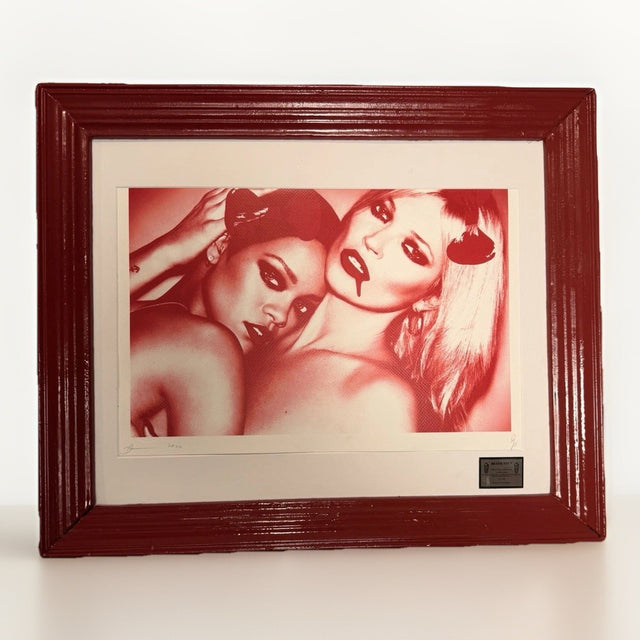
Death NYC — Kate Moss Rihanna Red Drip 2020 A/P Artist Proof Framed
$91.88 USD
-
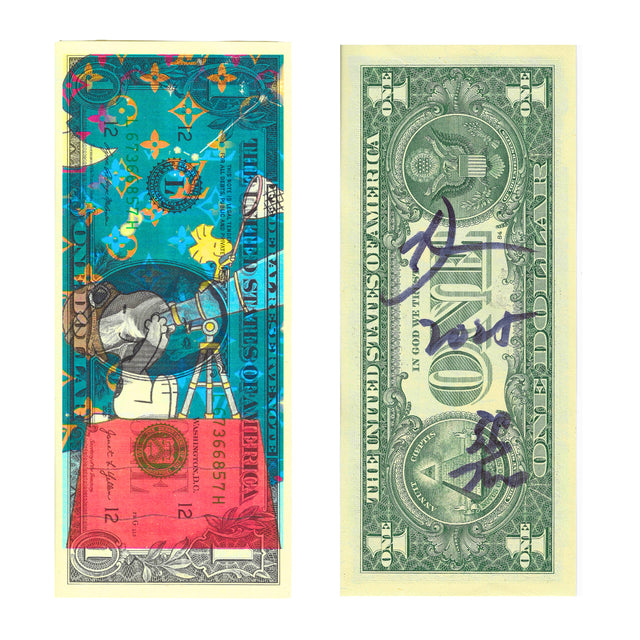
Death NYC Snoopy Woodstock Telescope LV Dollar Bill Art Signed Numbered COA
$55.00 USD
-
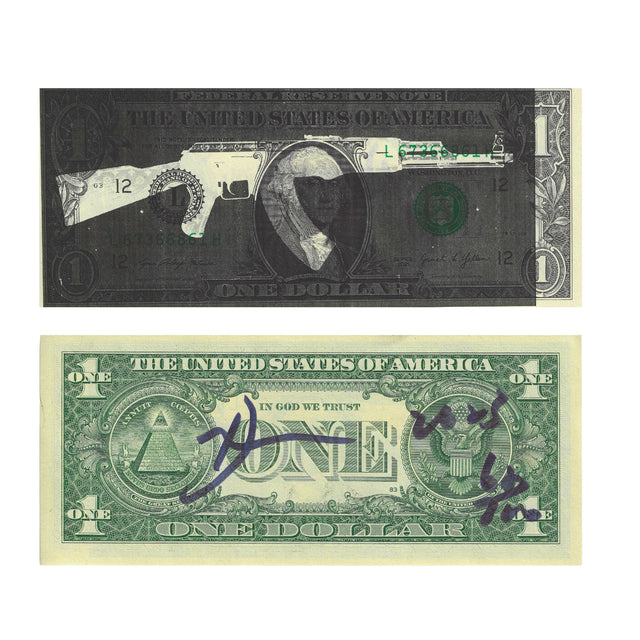
Death NYC Gun Dollar Bill Art Signed Numbered COA Black White Pop Street Art
$50.00 USD
-
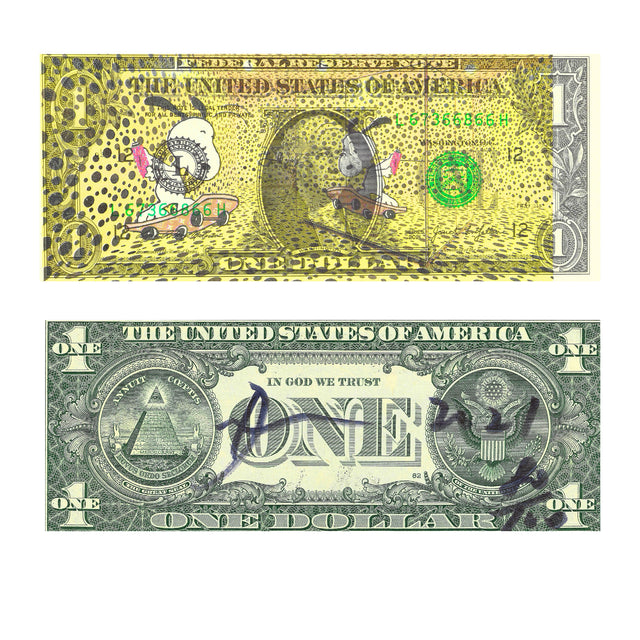
Death NYC Snoopy Skateboard Dollar Bill Art Signed Numbered COA Pop Street Art
$75.00 USD
-
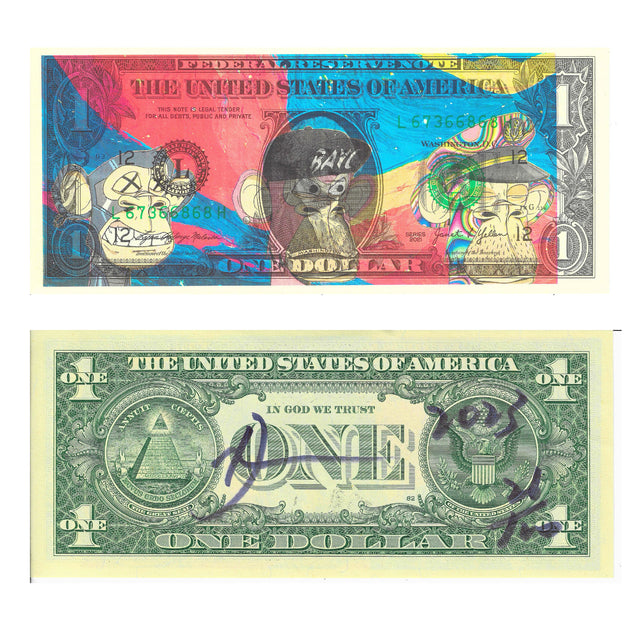
Death NYC Bored Ape Dollar Bill Art Signed Numbered COA Pop Street Art
$40.00 USD
-
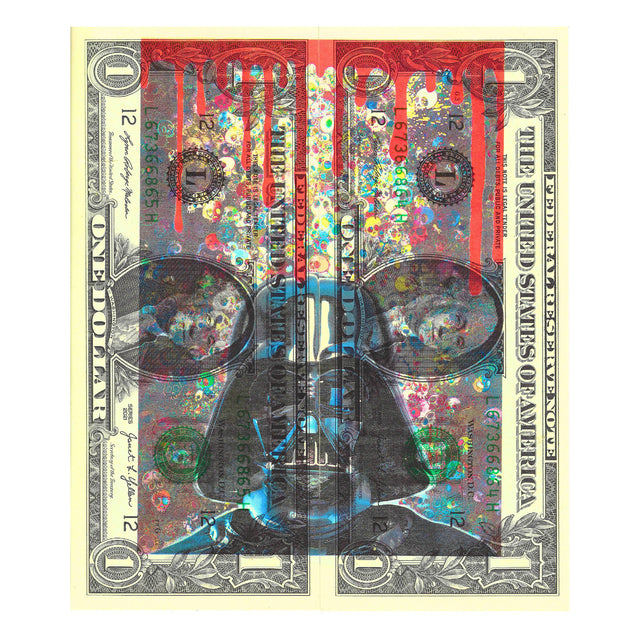
Death NYC Darth Vader Star Wars Dollar Bill Art Signed Two Bills COA Unframed
$100.00 USD
Browse the collection for current listings.