You can tell an original NASA photograph from a reproduction by examining four things together: the paper it was printed on, the markings printed in the margins or stamped on the back, the photographic process used to make the print, and the paper trail that accompanies it. Original vintage NASA prints were made photographically — as continuous-tone chromogenic or gelatin silver prints on period photographic paper stocks, often carrying watermarks such as "A Kodak Paper" on the verso — and they typically bear NASA serial numbers, caption text, or agency stamps. Reproductions, by contrast, are usually later photomechanical or inkjet copies on modern paper with no period markings and no provenance. No single tell decides the question; the strongest conclusions come from stacking several forms of evidence, which is exactly how our gallery evaluates every space photograph we handle.
That is the short answer. The long answer is one of the most rewarding rabbit holes in all of collecting, because NASA photographs occupy a fascinating middle ground: they were produced by a government agency in real quantity, distributed freely to press outlets and contractors, and yet the earliest photographic prints — the ones made close in time to the missions themselves — have become genuinely scarce and eagerly collected objects. Understanding how those prints were made and marked is the key to telling them apart from the millions of posters, lithographs, and digital reprints that share the same iconic images. This guide walks through every layer of that evaluation, the same way we approach it at Gauntlet Gallery when a space photograph crosses our desk.
First, Define "Original": What Collectors Actually Mean
The word "original" causes more confusion in space photography than in almost any other collecting category, so it is worth pinning down before we discuss physical tells. With a painting, the original is a single unique object. With a NASA photograph, the camera original — the actual film exposed on the lunar surface or in Earth orbit — stays in government archives and essentially never enters the market. What collectors mean by an "original NASA photograph" is a vintage print: a photographic print made from NASA's film, on photographic paper, at or near the time of the mission, typically by or for the agency and its network of contractors and press recipients.
Within that definition there is a spectrum of desirability. Prints made soon after the mission, from early-generation duplicates of the flight film, sit at the top. Photographic prints made years or decades later from the same negatives or transparencies still count as photographic prints, but collectors distinguish them as later printings. And then there is everything that is not a photograph at all — offset lithographs, posters, magazine plates, and modern inkjet output — which reproduces the image without any photographic printing process. These are the "reproductions" the question is really about, and the good news is that they are usually the easiest category to identify once you know what to look for.
A useful mental model: you are not just asking "is this image real?" — the image is almost always real, since it originates from NASA's own film. You are asking "what generation is this object, when was it printed, and on what?" That reframing turns a scary authentication problem into a solvable identification problem. If any of the vocabulary in this guide is new to you, our collector's glossary and authentication glossary define the key terms in plain language.
How NASA Photographs Were Distributed — and Why That Matters
Physical tells only make sense against the backdrop of how these objects came into the world. During the Mercury, Gemini, and Apollo programs, NASA operated a large photographic operation. Film returned from missions was processed and duplicated, and photographic prints were produced for internal use, for contractors, and — crucially for collectors — for the press. News organizations received glossy photographic prints, frequently in the standard 8-by-10-inch format, often with caption information attached or printed on the reverse. Contractors such as the companies that built the spacecraft received prints for their own communications and archives. NASA field centers produced and released prints under their own credit lines.
This distribution history explains several things at once. It explains why genuine vintage NASA prints exist in meaningful numbers rather than as unique objects. It explains why so many surviving examples carry press-related markings — agency caption text, wire-service stamps, newspaper archive notations — which, far from hurting value, often function as period evidence. And it explains why provenance stories so often run through the estates of journalists, engineers, contractor employees, and NASA staff: those were the people who received prints in the first place. When our gallery evaluates a space photograph, the plausibility of its distribution story is weighed right alongside the physical evidence, and you can read more about how we structure that evaluation in our space memorabilia authentication guide.
The same history also explains the reproduction side of the market. Because these images were government-produced and freely circulated, they have been reprinted endlessly — in books, on posters, as commemorative lithographs, and today as on-demand inkjet prints. None of that reprinting is sinister in itself. The problem arises only when a later reproduction is offered, knowingly or not, as a vintage print. Your job as a buyer is simply to make sure the object matches the description.
The Physical Tells: What to Examine, in Order
1. The paper stock and its watermark
Turn the print over. The single most useful starting point on many vintage color NASA prints is the paper manufacturer's watermark printed faintly on the verso. Kodak papers of the Apollo era commonly carry repeating text such as "A Kodak Paper," and later stocks carry different wording; because Kodak changed its verso markings over time, the watermark helps place a print within a broad production window. A print carrying a period-consistent watermark is not automatically vintage — later prints could be made on old paper in principle, and watermark styles overlapped — but a print whose paper markings postdate the claimed era is definitively a later printing. Conversely, a supposed "1969 original" on paper marked with wording Kodak introduced much later has told you everything you need to know. Treat the watermark as a dating floor and ceiling, not a certificate.
Beyond the watermark, feel and look at the paper itself. Vintage photographic papers have a characteristic weight, surface sheen, and edge appearance. Fiber-based and early resin-coated papers age differently: gentle tonal warmth, occasional silvering in dark areas of black-and-white prints, subtle curl. Modern inkjet papers tend to look and feel conspicuously new — bright white, uniform, often with an obvious coating. Paper that fluoresces brilliantly under ultraviolet light suggests the optical brightening agents common in modern stocks, whereas many earlier papers respond far more modestly. A small UV flashlight is one of the cheapest tools in the space collector's kit.
2. NASA numbering and margin markings
NASA assigned identifiers to its mission photography, and those identifiers frequently appear on legitimate prints. Apollo-era frames are catalogued in a mission-magazine-frame convention — the famous Apollo 11 portrait of Buzz Aldrin, for example, is universally known by its AS11-series frame number — and prints distributed by the agency often display an identifying serial in the border of the image or on the reverse, sometimes alongside a NASA caption describing the scene, the mission, and the credit line of the issuing center. Learning to read these numbers pays off quickly: they let you confirm that the image on the paper matches the caption, they anchor the photograph to a specific mission and magazine, and their typography and placement are themselves period evidence.
Among collectors of color prints from the Apollo era, particular attention is paid to the color of the serial number printed in the margin. Prints with the identifier appearing in red are widely regarded in the collecting community as indicative of early NASA-generated printings, while black-numbered examples are generally associated with later production runs; number-less borderless prints require the other tells to do more of the work. As with the watermark, treat number color as one strong data point rather than a verdict — conventions varied across centers, eras, and print runs, and the honest position is that margin numbering is read together with paper, process, and provenance, never alone.
3. Verso stamps, captions, and archive markings
The back of a vintage NASA print is often busier than the front. Legitimate period prints may carry ink stamps from NASA centers, printed or affixed caption text describing the image, wire-service and press-agency markings, dates received by newspaper photo desks, and the pencil or grease-pencil annotations of working photo editors. These markings accumulate naturally over a print's working life and are difficult to fake convincingly as an ensemble: the inks, the typewriter faces, the aging of adhesive on a caption slip, the way a stamp has struck slightly unevenly — all of it forms a texture of authenticity that a modern reproduction simply lacks. A verso that is perfectly, pristinely blank is not disqualifying (plenty of genuine prints were never stamped), but a verso rich in coherent period markings is powerful supporting evidence.
Read the markings critically, though. Do the dates make sense relative to the mission? Does the caption describe the actual image on the front? Are stamps from entities that plausibly handled the print? Incoherence among the markings — a caption for a different mission, a stamp style that looks anachronistic — is exactly the kind of inconsistency that separates assembled fakery from organic history. Our guide to spotting problem space memorabilia covers these incoherence patterns in more depth.
4. The printing process under magnification
This is the tell that most reliably separates photographs from reproductions, and it requires nothing more than a 10x loupe. A true photographic print — chromogenic color or gelatin silver black-and-white — is continuous-tone: under magnification, tones grade smoothly into one another with no repeating structure, because the image is formed by dyes or silver within the emulsion itself. A photomechanical reproduction such as an offset lithograph reveals a regular halftone dot pattern, typically as neat rosettes of tiny cyan, magenta, yellow, and black dots. A modern inkjet print reveals a fine spray of dots in irregular dithered patterns. Ten seconds with a loupe will tell you which of the three families you are holding.
This single test instantly reclassifies an enormous share of the "vintage NASA photo" listings you will encounter online. A halftone dot structure means you are looking at a poster, book plate, or press-kit lithograph — a period object, possibly, and collectible in its own modest right, but not a photographic print. An inkjet dot structure means the object was printed in the digital era, full stop. Neither can be an original in the sense collectors mean, no matter what the listing says.
5. Format, borders, and presentation
Vintage NASA and press prints most commonly survive in the 8-by-10-inch format, with larger exhibition prints existing but less common. Precise machine-cut borders, image proportions consistent with the original film format, and mounting or handling wear consistent with age all contribute to the picture. Be alert to mismatches: an image cropped in a way that suggests it was lifted from a book plate, a print size that corresponds to a modern standard rather than a period one, or "aging" that appears only at the edges while the surface looks factory-fresh. Genuine wear is distributed the way decades of storage actually distribute it.
Original vs. Reproduction at a Glance
| Feature | Vintage NASA photographic print | Later photographic reprint | Modern reproduction (litho/inkjet) |
|---|---|---|---|
| Image structure under loupe | Continuous tone, no dot pattern | Continuous tone, no dot pattern | Halftone rosettes or inkjet dither |
| Paper verso | Period watermark (e.g., "A Kodak Paper" era stocks) or period fiber paper | Later photographic paper markings | Modern coated stock, often bright white |
| Margin/verso markings | NASA serials, captions, center or press stamps common | Sometimes present, often absent | Absent, or printed decoratively as part of the image |
| UV response | Typically modest | Varies with paper era | Often bright fluorescence from optical brighteners |
| Provenance depth | Press, contractor, NASA-adjacent histories common | Thin to moderate | None predating the digital era |
| Collector status | The sought-after category | Collectible, priced accordingly | Decorative only |
Notice that the middle column is the hard case. Distinguishing a mission-era print from a photographic reprint made years later is genuinely more demanding than spotting a poster, because both are real photographs. That is where the paper watermark, the numbering conventions, the verso markings, and the provenance chain have to be read together — and where experienced eyes earn their keep.
The Generation Question: Why "When Was It Printed?" Is the Real Issue
Because NASA's negatives and duplicate films survived, photographic prints of the great mission images have been made continuously ever since. A chromogenic print made decades after a mission can pass the loupe test perfectly — it is, after all, a real photograph. Its paper, however, will be of its own era; its verso will lack period distribution markings; and its history will not reach back to the mission window. Collectors therefore price prints along a generational gradient: mission-era prints first, later vintage printings next, and contemporary photographic reprints after that. All can be legitimate objects when described accurately. The sin is not being a later print; the sin is a later print wearing an earlier print's description.
This is also why we caution collectors against relying on image quality as a tell. Intuition says the original should look best, but early-generation vintage prints can show the color shifts of age while a modern reprint from a drum-scanned transparency looks dazzling. Condition and image punch tell you about generations of duplication and the passage of time — they do not, by themselves, tell you what you most want to know, which is when the paper met the light.
Signed NASA Photographs: A Second Authentication Layer
Many of the most desirable space photographs carry astronaut signatures, and a signature adds an entirely separate authentication question on top of the print question. A vintage print with a non-genuine signature is damaged goods; a modern reprint with a genuine signature is a legitimate and popular collectible, accurately described. The two evaluations must be run independently.
For the signature side, the industry-standard third-party authenticators are Beckett, JSA, and PSA/DNA, and for space material specifically, Zarelli Space Authentication is the marquee specialist — particularly for Apollo-era and flight-related items, where mission-specific expertise matters. When we offer signed space photographs, those are the names we look to, alongside documented provenance for the item itself. A photograph that pairs a correctly identified vintage print with a specialist-certified signature is the blue-chip configuration of this category. Our Apollo 11 authentication guide walks through how these layers stack for the most collected mission of all, and the authentication FAQ answers the most common certification questions collectors send us.
Provenance: The Evidence That Travels With the Print
Physical examination tells you what an object is; provenance tells you where it has been, and in this category the two reinforce each other unusually well. The strongest space-photograph provenances trace to the kinds of hands that plausibly held prints in the period: newspaper and wire-service photo archives, the estates of aerospace engineers and contractor employees, NASA staff families, and long-standing private collections with purchase records. Supporting documents — archive deaccession records, estate paperwork, old auction invoices, even dated personal correspondence — convert a plausible story into a documented one.
Evaluate provenance with the same critical eye you bring to the verso stamps. A story should be specific, checkable, and consistent with the object: a press-archive print should look like it lived in a press archive. At Gauntlet Gallery, documented provenance is a pillar of how we source: we favor material whose history we can articulate and pass on to the next owner, because provenance compounds — every well-documented sale adds a link that makes the object easier to stand behind in the future. It is the same philosophy that runs through all of our buyer's guides, whatever the category.
What Reproductions Get Right — and Where They Give Themselves Away
It helps to think like the reproduction for a moment. Modern reprints get the image itself essentially perfect; scanning technology guarantees that. What they cannot easily replicate is the object-hood of a vintage print: paper manufactured decades ago, watermarks discontinued long ago, stamps from defunct photo desks, the accumulated coherence of a working print's life. That is why every serious examination flows from image (least useful) to object (most useful). The most common failure modes we see in the market are honest ones — sellers describing inherited posters as "original NASA photos" in good faith, or listing modern photographic reprints without generation information. Deliberate deception exists but is rarer, and it almost always collapses under the loupe-watermark-verso-provenance sequence because faking all four coherently is far harder than faking any one.
This is also why we encourage collectors to see authentication as constructive rather than adversarial. The point is not to catch villains; it is to describe objects accurately so that every tier of the market — from decorative reprints to museum-grade vintage prints — can be bought and sold with confidence at its correct level.
How Gauntlet Gallery Evaluates a Space Photograph
When a space photograph is considered for our space memorabilia collection , it moves through the same layered review this guide describes: process verification under magnification, paper and watermark assessment, reading of all margin and verso markings against the claimed era, and a provenance review that has to cohere with the physical evidence. For signed pieces, we look to the industry-standard trio of Beckett, JSA, and PSA/DNA, with Zarelli Space Authentication as the specialist benchmark for space material. Compare like-for-like signed objects or artifacts with matching mission association, signer, condition, authentication and provenance; a category-wide rate or median mixes different objects.
That comps discipline matters more in this category than most, because the spread between a modern reprint and a documented vintage print of the same image is wide, and asking prices online routinely blur the tiers. Rather than quote figures that age badly, we maintain living pricing resources: our space memorabilia price guide and Apollo 11 price guide lay out the tier structure, and our financial insights hub tracks how verified sales data moves across our categories. Comparing recent verified sales for the specific print type you are considering is always the sound approach.
A Practical Buying Checklist
- Loupe the surface. Continuous tone means photograph; halftone rosettes mean lithograph; dithered spray means inkjet. This one step resolves most listings.
- Turn it over. Look for a paper watermark and check that its era matches the claim. "A Kodak Paper"-style verso text is a classic period indicator on Apollo-era color prints; modern paper wording on a claimed vintage print ends the inquiry.
- Read the numbers. Confirm any NASA serial matches the image and mission. Note margin number color on color prints — red numbering is regarded by collectors as pointing toward early NASA printings — while treating it as one data point among several.
- Assess the verso ensemble. Stamps, captions, and archive markings should be coherent with each other and with the front of the print.
- Check UV response. Brilliant fluorescence suggests modern optically brightened paper.
- Interrogate the provenance. Ask where the print has been since the mission era, and ask for whatever documentation exists.
- Separate the signature question. If signed, look for certification from Beckett, JSA, PSA/DNA, or Zarelli Space Authentication, and evaluate the print's generation independently.
- Price against verified comps. Match the price to the print's actual tier using recent verified sales, not asking prices.
- Buy from sellers who describe generation explicitly. A seller who tells you unprompted whether a print is vintage or a later printing is a seller who understands the category. Our Apollo 11 buyer's guide expands each of these steps for the mission most collectors start with.
Caring for the Print Once You Own It
Identification and preservation are two halves of the same stewardship. Vintage chromogenic prints are inherently vulnerable to fading, so light management is the first rule: display with UV-filtering glazing away from direct sun, or store flat in archival, acid-free enclosures. Keep prints in a stable, moderate environment — heat and humidity swings accelerate dye fading and paper degradation. Handle by the edges, ideally with clean cotton or nitrile gloves, and never write on, tape, or laminate a print; even verso annotations should be avoided, since the verso is, as this guide has argued at length, half the evidence. Keep provenance documents physically together with the print in the same archival housing, and record your own acquisition details — seller, date, listing description — because you are now a link in the chain. A well-kept file is the cheapest value-add in collecting.
The Bottom Line
Telling an original NASA photograph from a reproduction is a learnable skill, not a dark art. The loupe separates photographs from photomechanical and digital copies in seconds. The paper and its watermark bracket the printing era. The serial numbers, caption text, and stamps tie the object to NASA's actual distribution machinery, with red-numbered margins prized by collectors as markers of early printings. Provenance stitches the whole story together, and for signed examples, specialist certification from the recognized authenticators adds the final layer. Stack those tests and the market's noise resolves into clear tiers — and once you can see the tiers, you can collect this material with real confidence. Explore our authenticated space memorabilia collection, or start with the broader resources on our Collector's Hub if you are building your evaluation toolkit from scratch. The photographs that documented humanity's greatest voyages deserve owners who can read them properly — and after this guide, that includes you.
Frequently Asked Questions
What does "original" mean for a NASA photograph?
Collectors use "original" to mean a vintage photographic print made from NASA's film on photographic paper at or near the time of the mission, typically for the agency, its contractors, or the press. The camera-original film remains in government archives, so vintage prints are the collected form. Later photographic reprints and non-photographic reproductions sit in lower tiers and should be described as such.
Do all real vintage NASA prints have red serial numbers?
No. Red-numbered margins on Apollo-era color prints are regarded by collectors as pointing toward early NASA printings, and black numbers toward later runs, but conventions varied across centers, eras, and formats, and many genuine prints carry no margin number at all. Number color is one data point to be read alongside paper stock, verso markings, printing process, and provenance — never a standalone verdict.
Is a photo printed from NASA's website worth anything?
As a collectible, essentially no — it is a modern reproduction anyone can produce. Its value is decorative. Collector value concentrates in vintage prints with period paper, markings, and provenance, and to a lesser degree in later photographic printings when accurately described. That is why the same image can appear at wildly different price levels without any contradiction.
What tools do I need to examine a NASA photograph?
Three inexpensive tools cover most of the work: a 10x loupe to check whether the image is continuous-tone or a dot-pattern reproduction, a small ultraviolet flashlight to gauge whether the paper shows the bright fluorescence typical of modern optically brightened stocks, and good raking light to study surface, stamps, and wear. Beyond that, the essential tool is reference knowledge of NASA numbering and period paper markings.
Can a reproduction still be signed by a real astronaut?
Yes, and this is common. Astronauts have signed modern reprints for decades, and a genuine signature on a later print is a legitimate collectible when described accurately. The signature and the print are separate authentication questions: the signature is evaluated by authenticators such as Beckett, JSA, PSA/DNA, or Zarelli Space Authentication, while the print's generation is evaluated through paper, markings, and provenance.
Why does the back of the photo matter so much?
Because the verso carries most of the dateable evidence: the paper manufacturer's watermark that brackets the printing era, NASA caption text, agency and press stamps, and archive annotations accumulated during the print's working life. A coherent ensemble of period verso markings is very difficult to fabricate convincingly, which makes the back of a vintage NASA print often more informative than the front.
How should I price a vintage NASA photograph I want to buy?
Anchor on recent verified sales of comparable prints — same mission, same image where possible, same generation and condition tier — rather than on asking prices, which routinely blur the tiers. Dealer price guides that explain the tier structure help you place a given print correctly.
Shop Space memorabilia
Explore current pieces available from the gallery.
-
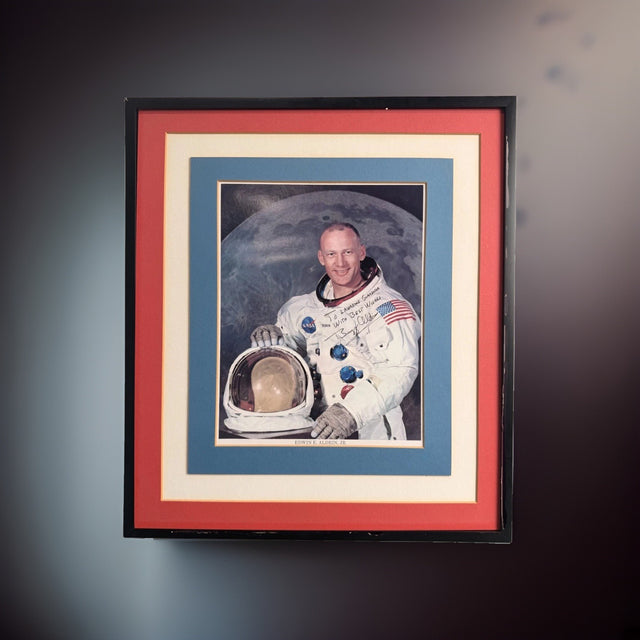
Buzz Aldrin Signed NASA 8x10 Color Photo Personalized Framed JSA LOA
$899.00 USD
-
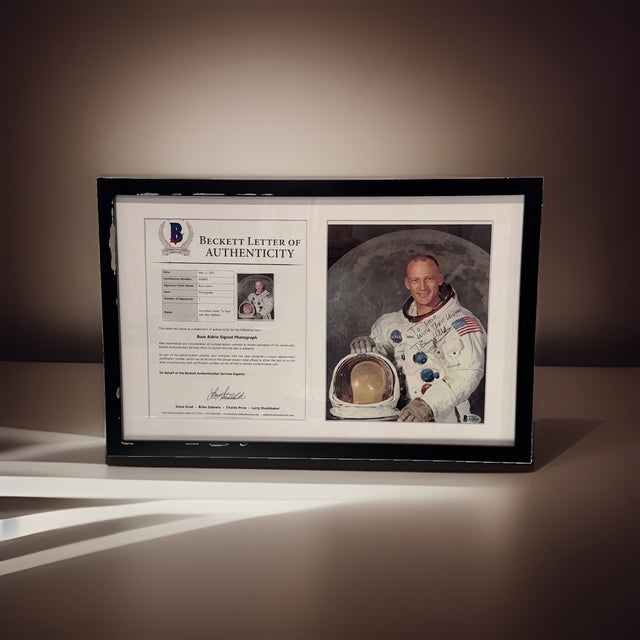
Buzz Aldrin Signed Inscribed Astronaut Photo Framed Beckett LOA A42843
$999.00 USD
-
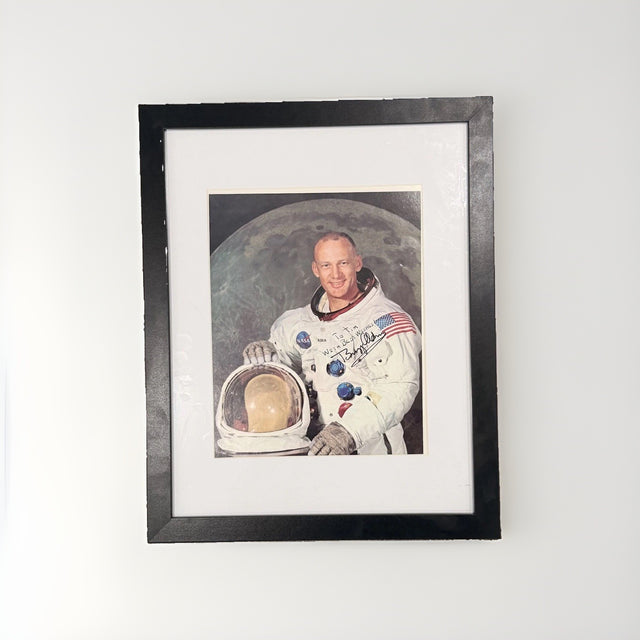
Buzz Aldrin Signed NASA Astronaut Portrait Inscribed To Tim Framed
$850.00 USD
-
SpaceX Starship Super Heavy Blueprint Metal Display Panel Spacecraft Frame
$59.00 USD
-
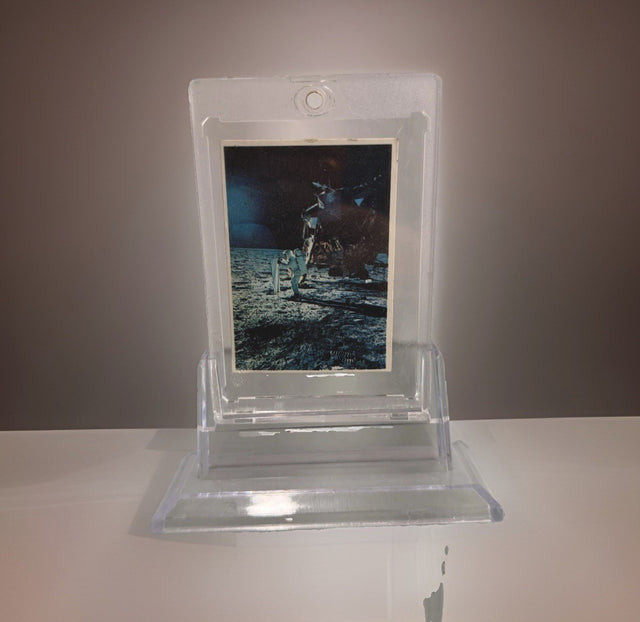
1969 Space Candy Buzz Aldrin Apollo 11 On The Moon Card #19 Taylor-Reed Display
$59.00 USD
-
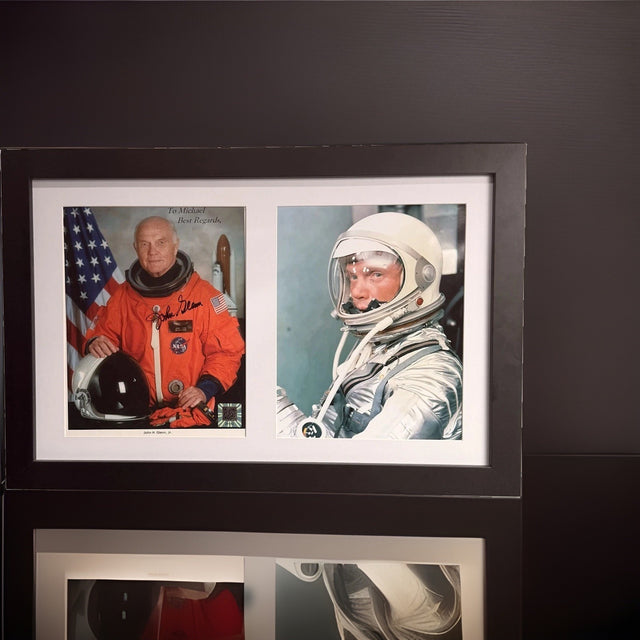
John Glenn Signed Autographed NASA Photo Display JSA Mercury Astronaut Framed
$199.00 USD
Browse the collection for current listings.