In every serious art transaction, one document does more work than any other: the certificate of authenticity. Authenticity certificates establish that a work is what it is claimed to be — made by the claimed artist, in the claimed year, in the claimed edition. They are the foundation of the entire provenance chain. And yet the art market is full of collectors who have paid significant money for works with certificates that are legally worthless.
What Is an Authenticity Certificate?
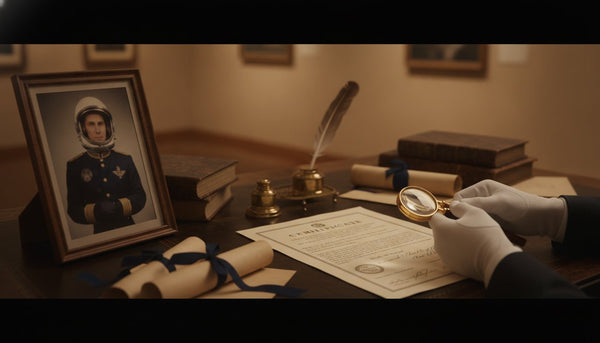
An authenticity certificate (COA) is a document — physical or digital — that attests to the genuineness of an artwork. At minimum, it records the artist, title, medium, dimensions, date, and edition information (for editioned works) and is signed by a party with authority to make that attestation: the artist, the artist's estate, the original publisher, or an accredited authentication body.
Critically, a COA is only as credible as the entity issuing it. A gallery-issued certificate with no other supporting documentation carries far less weight than a certificate signed by the artist themselves, or one issued by a recognized authentication foundation with a defined evaluation methodology.
Types of Art Authentication
Artist-Signed Certificate
The gold standard for living artists. If the artist signed the certificate themselves — not just the work — that is the strongest possible authentication for a contemporary piece.
Publisher or Printer Certificate
For editioned prints, the original publisher or print workshop that produced the work is the authoritative source. Artist-signed certificates from studios like Shepard Fairey's OBEY Giant apply the same principle — primary-source documentation from the point of production.
Gallery Certificate
A certificate issued by the gallery that sold the work is a standard component of any sale. It should record all identifying information and be signed by a named representative of the gallery. Gallery certificates are necessary but not always sufficient on their own.
Third-Party Authentication
For works where primary documentation is unavailable or in doubt, third-party authentication bodies provide independent analysis. In the sports and entertainment memorabilia space, Beckett Authentication Services (BAS), Professional Sports Authenticator (PSA), and James Spence Authentication (JSA) are the recognized standards.
Blockchain and Digital Authentication
A growing number of galleries and authentication services are recording COA data on public blockchains — creating an immutable, publicly verifiable record. Gauntlet Gallery uses blockchain verification for select works via our TrueCOA platform, built on Polygon with QR-linked digital certificates.
What a Proper Authenticity Certificate Must Include
- Artist full name
- Title of the work
- Year created
- Medium and support (oil on canvas, screenprint on paper, etc.)
- Dimensions in standardized units
- Edition information for editioned works (e.g., 42/150, AP 3/10)
- Unique identifier or catalogue number
- Issuing party's full name and contact information
- Signature of the issuing authority
- Date of issue
- Photograph of the work (front and back)
Red Flags: When Certificates Cannot Be Trusted
- Self-issued certificates: A seller certifying their own work is a conflict of interest, not authentication.
- Anonymous issuing bodies: Look up any organization named on the certificate. Many are shells with no methodology.
- Missing contact information: A legitimate issuer wants future buyers to be able to verify. No contact info = no accountability.
- Vague descriptions: "Oil painting, approximately 24x36 inches, circa 1990s" is description, not authentication.
- No photograph: Without a photograph, the certificate cannot be reliably linked to the specific work.
- Certificates for deceased blue-chip artists: Anyone can print a certificate. The only credible authentication for works by deceased artists comes from recognized foundations or major auction specialists.
Major Authentication Bodies by Category
Sports Memorabilia
Beckett Authentication Services, PSA/DNA, and JSA are the three market-recognized US standards. Gauntlet Gallery requires at least one of these for all signed sports memorabilia.
Contemporary Street and Pop Art
Artist studio certificates are primary. For Banksy, Pest Control is the only recognized authentication body — there is no substitute. For KAWS, OneCOA provides blockchain-verified authentication. For Shepard Fairey, his studio issues certificates directly.
What Authenticity Certificates Mean for Value
Properly documented works consistently outperform undocumented works at auction. The premium varies — for high-volume artists like Fairey or Banksy, the difference between a work with full primary documentation and one with questionable documentation can be 40–60% of sale price.
Every work at Gauntlet Gallery ships with comprehensive documentation. Contact us for questions about authentication for specific works or artists.