Apollo memorabilia derives its value from five interlocking factors: flight status (whether an item actually traveled to space, and especially to the lunar surface), provenance (an unbroken, documented chain of ownership, ideally tracing back to an astronaut or NASA source), astronaut association (signatures, personal ownership, or crew use), rarity (how few examples exist and how seldom they reach the market), and condition paired with credible authentication from recognized third parties such as Beckett, JSA, PSA/DNA, and Zarelli Space Authentication. An item that scores highly on all five — say, a flown checklist page signed by a moonwalker with astronaut letter provenance — sits at the top of the collecting pyramid. An item weak on all five is a souvenir. Everything else falls somewhere in between, and understanding exactly where is the collector's real work.
That is the short answer. The long answer is far more interesting, because Apollo collecting is one of the few categories where a single word on a certificate — "flown" — can transform an object's meaning entirely. Below, we break down each value driver in depth, explain how the major categories of Apollo material compare, walk through the authentication standards that govern this market, and finish with a practical buying checklist and a collector FAQ.
Why Apollo Material Occupies a Category of Its Own
Between 1961 and 1972, the Apollo program carried out humanity's only crewed voyages beyond low Earth orbit. Six missions landed on the Moon — Apollo 11, 12, 14, 15, 16, and 17 — and exactly twelve people walked on the lunar surface. No one has repeated the feat since December 1972. That simple historical fact underwrites the entire market: the supply of genuine Apollo-era artifacts is permanently fixed, while the pool of collectors, institutions, and space enthusiasts who want a tangible connection to the Moon landings keeps growing with every anniversary, documentary, and renewed lunar program in the news.
Compare this with almost any other collecting category. New paintings are painted, new cards are printed, new guitars are signed. But nothing new can ever be flown on Apollo. The hardware was built, launched, splashed down, and dispersed decades ago. The astronauts who could sign items are a small and, sadly, shrinking group. Scarcity in Apollo collecting is not a marketing device — it is a closed historical ledger.
There is also an emotional dimension that is easy to underestimate. Apollo artifacts are among the very few objects a private collector can own that physically left Earth and, in the rarest cases, reached another world. A flown Robbins medallion or a lunar-surface-used checklist page is not merely a collectible; it is a relic of the single most ambitious engineering achievement in human history. Buyers respond to that, and the market reflects it. Our gallery's space memorabilia collection is curated around exactly this principle: objects with a real, documented connection to the program, not generic space-themed souvenirs.
The Five Pillars of Apollo Value
1. Flight Status: Flown Beats Everything
The single most powerful word in space collecting is flown. An object that traveled aboard a spacecraft occupies a completely different tier from an identical object that stayed on the ground. Within "flown," there is a further hierarchy that every serious collector internalizes:
- Lunar-surface flown — items that were carried down to the Moon aboard the lunar module and stood on the surface. This is the apex of the entire category.
- Lunar-orbit flown — items that traveled to the Moon aboard the command module but remained in orbit while the landing crew descended.
- Earth-orbit or mission flown — items flown on Apollo missions that did not reach the Moon, or on related programs.
- Unflown, program-used — training hardware, backup equipment, mission control materials, and items handled during the program but never launched.
- Unflown, commemorative — official souvenirs, post-mission signed photographs, and celebratory items produced around the program.
Each step up this ladder typically represents a meaningful jump in desirability, and the gap between "flown" and "unflown" is the widest of all. This is why flight certification matters so much: the claim must be provable, not merely plausible. A flown item without documentation supporting its flight status trades, in practice, like an unflown item — the market prices the evidence, not the story.
2. Provenance: The Chain of Custody Is the Asset
In Apollo collecting, provenance is not a nice-to-have — it is often the majority of the value. Because flown and unflown examples of many items look identical (a beta cloth patch that went to the Moon looks exactly like one that never left Houston), the paperwork is the difference. The strongest provenance chains in this category include:
- Astronaut letters of provenance — a signed statement from the astronaut who carried or owned the item, describing what it is and how it was acquired. When an item comes directly from an astronaut's personal collection with such a letter, it carries the gold-standard pedigree.
- NASA documentation — transfer paperwork, stowage lists, or official records connecting an item to a mission.
- Major auction pedigree — prior sale through a recognized auction house with a published catalog description, which creates a public, checkable record.
- Family estate provenance — items descending through an astronaut's or NASA engineer's family, ideally supported by a family letter.
It is worth noting that United States legislation enacted in 2012 confirmed the ownership rights of Mercury, Gemini, and Apollo astronauts over many of the mementos they retained from their missions. That clarity was good for the entire market: it means items with legitimate astronaut provenance can be bought and sold with confidence. Collectors should still expect the provenance story to be specific, internally consistent, and documented — vague claims like "from a NASA employee" without supporting paperwork add little. We cover how to read and weigh provenance documents in detail in our space memorabilia authentication guide.
3. Astronaut Association: Signatures and the Moonwalker Premium
Autograph material is the most accessible entry point into Apollo collecting, and it follows its own clear logic. Signatures of the twelve moonwalkers command the strongest and most consistent demand, with Neil Armstrong occupying a special position: the first human on the Moon became famously reluctant to sign later in life and eventually stopped signing altogether, which permanently constrained the supply of authentic examples. Signatures of command module pilots and non-landing Apollo crews follow, then the wider astronaut corps of the era.
Beyond the name itself, several attributes affect the desirability of a signed piece:
- Format — signed photographs (especially iconic mission imagery), signed covers, cut signatures, and signed books each trade differently. Crew-signed items, bearing all members of a mission's crew, are especially prized.
- Inscription and content — a signature with a mission-related inscription or date can be more desirable than a bare signature; heavily personalized inscriptions can cut both ways.
- Vintage versus later signature — items signed during or near the program era often carry a premium over signatures obtained decades later at shows.
- Condition of the medium — fading, silvering of ink, and surface damage all matter, since the signature and its substrate are inseparable.
Because astronaut autographs have been actively forged for decades — demand always attracts imitation — third-party authentication is effectively mandatory for signed Apollo material. We explain the specific red flags to understand in our guide to spotting problematic space memorabilia, but the constructive framing is simpler: buy certified, buy documented, and the risk largely disappears.
4. Rarity: A Permanently Closed Supply
Rarity in Apollo collecting operates at several levels. There is program-level rarity — the missions happened once, and the material culture they produced is finite. There is item-level rarity — some categories, like flown lunar-surface equipment, exist in tiny numbers, while others, like commemorative covers, were produced in quantity. And there is market-level rarity — some items exist but essentially never trade, because they sit in museums or long-term private collections.
Astute collectors learn to distinguish genuine scarcity from apparent scarcity. A category can feel rare simply because examples are seldom listed, even though many exist in collections; conversely, a category can seem common because a few examples circulate repeatedly. This is where transaction data becomes invaluable. That distinction between asking prices and realized prices is one of the most important habits a new collector can build, and it is the foundation of our financial insights resources. Compare like-for-like signed objects or artifacts with matching mission association, signer, condition, authentication and provenance; a category-wide rate or median mixes different objects.
5. Condition and Certification: The Multiplier
Condition works differently in Apollo collecting than in, say, comic books or coins. Honest wear consistent with an item's history can be neutral or even positive — a checklist page is expected to show use; a flown patch may show handling. What the market penalizes is damage unrelated to the item's story (moisture staining, tape repairs, trimming, fading from poor display) and any restoration that muddies originality. What the market rewards is stability, completeness, and credible certification.
Certification deserves emphasis as the final multiplier on all the other pillars. An uncertified item with a strong story still forces every future buyer to re-underwrite the claim from scratch. A certified item with the same story carries its evidence with it. That difference compounds over time: certified, well-documented items are more liquid, easier to insure, easier to sell, and easier to pass to heirs. In our experience, documentation quality is the most reliable single predictor of how smoothly an Apollo item will trade.
Flown vs. Unflown: How the Tiers Compare
The table below summarizes how the main tiers of Apollo material differ across the value pillars. It is a framework, not a price guide — for market-level guidance, see our space memorabilia price guide and Apollo 11 price guide.
| Tier | Typical examples | Key value driver | Documentation expectation | Relative scarcity |
|---|---|---|---|---|
| Lunar-surface flown | Checklist pages used on the Moon, LM-stowed equipment fragments | Direct physical presence on the Moon | Astronaut letter and/or NASA records; usually auction pedigree | Extremely rare |
| Lunar-orbit / mission flown | Flown Robbins medallions, flown flags, flown beta cloth patches, flown covers | Certified flight status | Astronaut or crew provenance; serial/records where applicable | Rare |
| Program-used, unflown | Training hardware, mission control documents, contractor-built components | Authentic program connection | NASA or contractor paperwork; credible chain of custody | Uncommon to scarce |
| Signed commemorative | Astronaut-signed photographs, covers, books, cut signatures | The signature and the signer | Third-party authentication (Beckett, JSA, PSA/DNA) | Varies widely by astronaut and format |
| Unsigned commemorative | Period souvenirs, unsigned patches, models, publications | Nostalgia and display appeal | Minimal | Generally plentiful |
The Major Categories of Apollo Memorabilia
Robbins Medallions
Among flown Apollo artifacts, Robbins medallions occupy a uniquely collectible niche. These sterling silver medallions were struck for the astronauts by the Robbins Company, carried aboard the missions, and made available afterward to the astronauts themselves — meaning a flown Robbins medallion combines flight status, astronaut provenance, and a defined, documented production in one compact object. Each mission's medallion carries its own design, and the flown examples are distinguished from unflown restrikes by mission records and provenance. For collectors who want a genuine flown-to-the-Moon artifact in a standardized, well-understood format, Robbins medallions are the classic answer. Verify the specific mission's documentation conventions before buying, and insist on a clear flight attribution.
Flown Flags, Patches, and Beta Cloth
Small flags and fabric patches were popular flight souvenirs because they packed light — crews carried quantities of them in their personal preference kits and official stowage. Beta cloth, the fireproof woven-fiberglass fabric adopted after the Apollo 1 fire, appears both as flown crew equipment and as unflown souvenir patches, which makes the flown/unflown distinction especially important in this category. A flown flag or patch typically presents mounted on a signed presentation certificate from an astronaut, and that presentation — item, statement, and signature together — is the collectible unit. Never separate one from the other.
Insurance Covers and Postal Items
Apollo-era crews famously signed quantities of postal covers before their missions — the so-called insurance covers — as a pragmatic hedge for their families at a time when conventional life insurance was difficult for lunar astronauts to obtain. These covers, along with flown covers and launch-day postmarked items, form a rich philatelic corner of the hobby. Their appeal combines crew signatures, dated postmarks that anchor them in time, and a genuinely moving human story. As always, the flown examples and the crew-signed examples sit well above ordinary event covers, and certification of the signatures is essential.
Checklists, Flight Plans, and Documents
Paper flew on every mission — checklists, flight plan pages, cue cards, star charts, data cards — and used flight paper is among the most evocative material in the category, because the crews physically handled it while executing the mission. Lunar-surface-used pages are the pinnacle. Provenance is everything here: the page must be traceable to the specific document and mission, typically through astronaut provenance. Unflown training and mission control documents form an attractive, more accessible parallel category with their own following.
Hardware and Components
Actual spacecraft hardware — from small component fragments to substantial artifacts — reaches the market through well-documented channels: astronaut retention, NASA disposal decades ago, and contractor sources. Hardware appeals to collectors who value engineering as much as history. The diligence bar is higher because attribution requires matching part numbers, contractor records, or credible expert analysis, and because "Apollo-era style" hardware without mission attribution is common. Buy hardware on documentation, not on appearance.
Signed Photography
The iconic images of Apollo — the visor portrait, the flag salutes, Earthrise — signed by the astronauts who took or appeared in them, are the display centerpiece of many collections. Value follows the signer hierarchy discussed above, the vintage of the print and signature, and condition. Crew-signed examples of a mission's signature image are particularly sought after. Our Apollo 11 buyer's guide walks through this category in depth for the most collected mission of all.
Authentication: The Standards That Govern This Market
Space memorabilia is a category where authentication standards are mature and well understood, which is genuinely good news for collectors: the path to buying safely is clearly marked. For signed material, the industry-standard third-party authenticators are Beckett Authentication Services, JSA (James Spence Authentication), and PSA/DNA — the same trio that anchors the broader autograph world. Their certifications are recognized by auction houses, dealers, and insurers alike, and a certificate from any of the three materially improves an item's liquidity.
For Apollo-era material specifically — and above all for flight-flown artifacts — Zarelli Space Authentication is the marquee specialist. Space memorabilia raises questions that generalist autograph authentication does not: whether an item's flight claim is consistent with mission records, whether a provenance letter matches known astronaut practices, whether an artifact type is even plausible for the mission claimed. A specialist opinion that addresses the object and its story, not just a signature, is what separates confident ownership from hopeful ownership at the top of this market.
At Gauntlet Gallery, authenticated sourcing is the foundation of how we operate in this category: signed and flown space material is anchored to the Beckett / JSA / PSA-DNA standard, with Zarelli Space Authentication as the specialist benchmark for Apollo-era flight-flown pieces, and every piece is offered with documented provenance. We would rather pass on an attractive item with an unverifiable story than list it — and we encourage collectors to apply the same discipline. If a term in a certificate or catalog description is unfamiliar, our authentication glossary defines the vocabulary, and our Apollo 11 authentication guide applies these standards to the most collected mission specifically.
How We Evaluate Apollo Material: The Comps Discipline
Beyond authentication, the second half of valuing Apollo memorabilia is market evidence. Any individual asking price tells you what one seller wants; only realized sales tell you what the market pays. A flown item with an astronaut letter is not comparable to the same item type with no letter, and treating them as comparable is the most common valuation mistake we see.
A few practical habits follow from the comps discipline that any collector can adopt:
- Weight recent, verified sales most heavily. Markets move; a sale from many years ago is context, not evidence of current value.
- Match documentation quality, not just item type. The certificate and provenance are part of the asset.
- Distinguish asking from realized. Unsold listings at high prices are not comps.
- Beware unique-item extrapolation. The rarest Apollo pieces have thin comparable sets; humility about precision is appropriate at the top end.
For collectors who want to go deeper on market structure and category trends, our price guide library and financial insights resources translate this comps discipline into category-level guidance.
Provenance, Care, and Record-Keeping: Protecting the Value You Buy
Once you own an Apollo piece, its value becomes your responsibility, and the good news is that stewardship is straightforward. Three practices matter most.
Preserve the documentation as carefully as the object. Certificates, astronaut letters, auction invoices, and correspondence are integral to the asset. Store them archivally, keep digital scans in more than one place, and never discard packaging or paperwork that connects the item to its source. If a presentation pairs an artifact with a signed certificate, keep them together permanently.
Control the environment. Paper, fabric, and ink — the dominant materials in Apollo collecting — share the same enemies: ultraviolet light, humidity swings, heat, and acidic storage materials. Display framed items with UV-filtering glazing away from direct sunlight; store documents and covers in archival, acid-free sleeves; keep fabric items flat and supported. Signatures in particular can fade badly under prolonged light exposure, and that loss is irreversible.
Maintain a collection record. A simple inventory noting each item's description, source, purchase date, documentation, and current location pays for itself many times over — for insurance, for estate planning, and for eventual resale. Provenance you can hand to the next owner in an organized file is provenance that adds value. Our Collector's Hub gathers practical resources on all three of these fronts.
A Practical Buying Checklist for Apollo Memorabilia
Before purchasing any Apollo item, walk through this sequence:
- Define the claim. What exactly is being asserted — flown? Lunar-surface flown? Astronaut-owned? Signed? Each claim needs its own support.
- Match evidence to claim. Flight claims need astronaut letters, NASA records, or equivalent documentation. Signature claims need third-party certification from Beckett, JSA, or PSA/DNA — and for significant flight-flown Apollo pieces, Zarelli Space Authentication is the specialist standard.
- Read the provenance critically. Is the chain specific, dated, and internally consistent? Does it name people and events that can be checked?
- Assess condition honestly. Distinguish honest mission-consistent wear from damage and restoration. Ask for detailed photographs of any area of concern.
- Check the market. Compare recent verified sales of genuinely comparable items — same type, flight status, and documentation tier — rather than relying on asking prices.
- Buy from accountable sources. Established dealers and auction houses that stand behind their descriptions, publish their authentication standards, and answer questions transparently are worth their premium.
- Plan the stewardship. Know how you will store, display, insure, and document the piece before it arrives.
Collectors who follow this sequence consistently find that the intimidating parts of Apollo collecting — the forgery stories, the murky provenance tales — simply stop applying to them. The well-documented segment of this market is a rewarding, transparent place to collect, and it is the only segment we operate in. Browse our current space memorabilia offerings or start with the buyer's guide library if you are earlier in the journey.
Frequently Asked Questions
Is flown Apollo memorabilia always more valuable than unflown?
As a rule, yes — flight status is the single strongest value driver in the category, and lunar-surface-flown material sits at the very top. But the premium depends entirely on proof. The market prices evidence.
Which Apollo astronaut signatures are most sought after?
The twelve moonwalkers anchor demand, with Neil Armstrong in a class of his own because he stopped signing later in life, permanently limiting authentic supply. Crew-signed items from the landing missions — especially Apollo 11 — are perennially strong. Beyond the moonwalkers, command module pilots and the wider Apollo-era astronaut corps all have collector followings, with desirability generally tracking mission significance and signing habits.
What documentation should come with a flown Apollo artifact?
The gold standard is a signed letter of provenance from the astronaut who carried or owned the item, describing the object and its flight history. NASA records, stowage documentation, and published auction pedigree add further support. For signatures, expect third-party certification from Beckett, JSA, or PSA/DNA; for significant Apollo-era flight-flown pieces, a Zarelli Space Authentication opinion is the specialist benchmark.
Are Robbins medallions a good entry point for flown-artifact collecting?
They are the classic one. Robbins medallions were struck for the astronauts, flown aboard the missions, and distributed to the astronauts afterward, so a flown example combines flight status, astronaut provenance, and a standardized, well-documented format in a single compact object. Verify the flight attribution and provenance for the specific mission, and buy certified examples from accountable sources.
How can I tell whether an Apollo item's price is fair?
Compare it against recent verified sales of genuinely comparable items — matching not just the item type but the mission, flight status, signature, condition, and documentation tier. Realized prices, not asking prices, are the evidence.
Does wear reduce the value of Apollo memorabilia?
Not necessarily. Honest wear consistent with an item's history — use marks on a flown checklist, handling on a mission-used object — is expected and can even support authenticity. What hurts value is unrelated damage such as moisture staining, fading from poor display, tape repairs, or restoration that compromises originality. Preserve items archivally and protect signatures from light to keep condition stable.
Shop Space memorabilia
Explore current pieces available from the gallery.
-
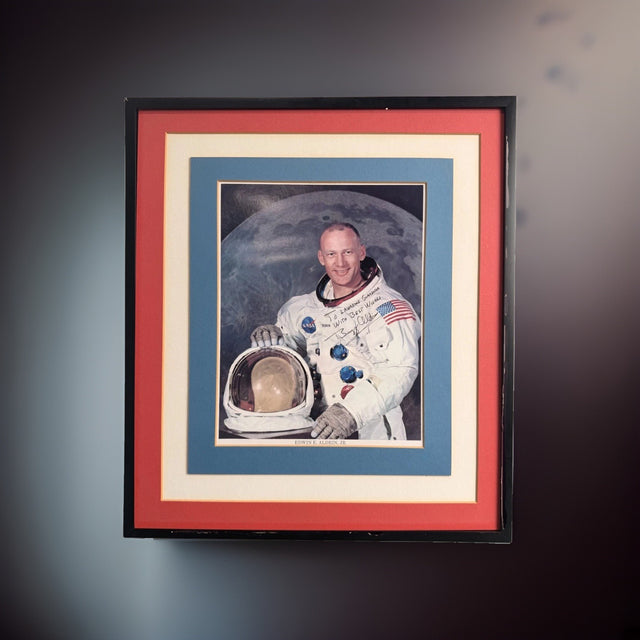
Buzz Aldrin Signed NASA 8x10 Color Photo Personalized Framed JSA LOA
$899.00 USD
-
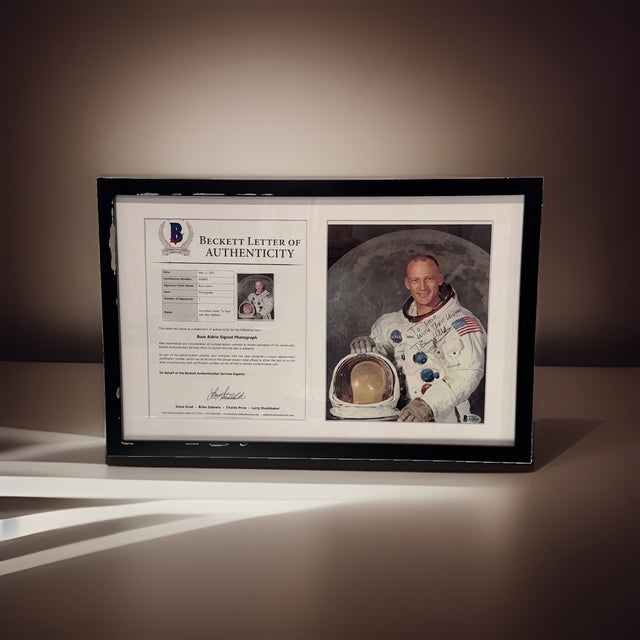
Buzz Aldrin Signed Inscribed Astronaut Photo Framed Beckett LOA A42843
$999.00 USD
-
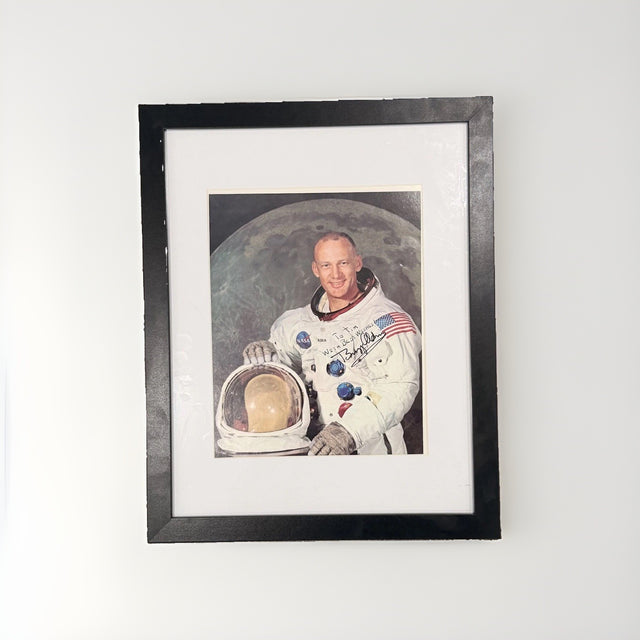
Buzz Aldrin Signed NASA Astronaut Portrait Inscribed To Tim Framed
$850.00 USD
-
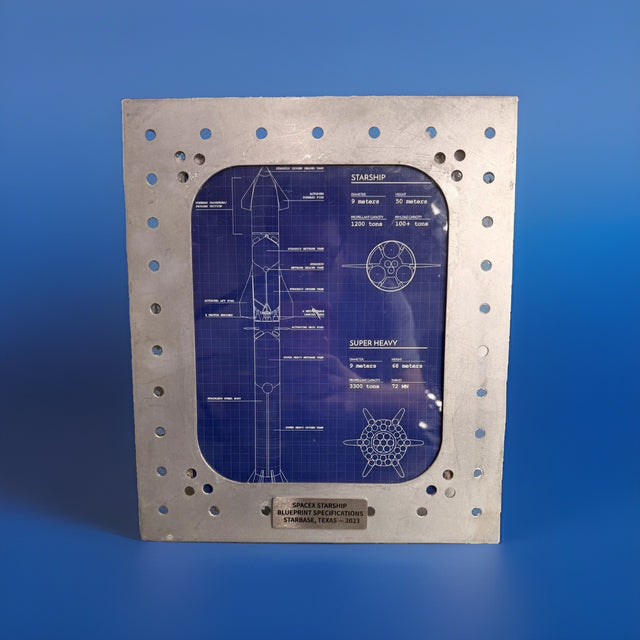
SpaceX Starship Super Heavy Blueprint Metal Display Panel Spacecraft Frame
$59.00 USD
-
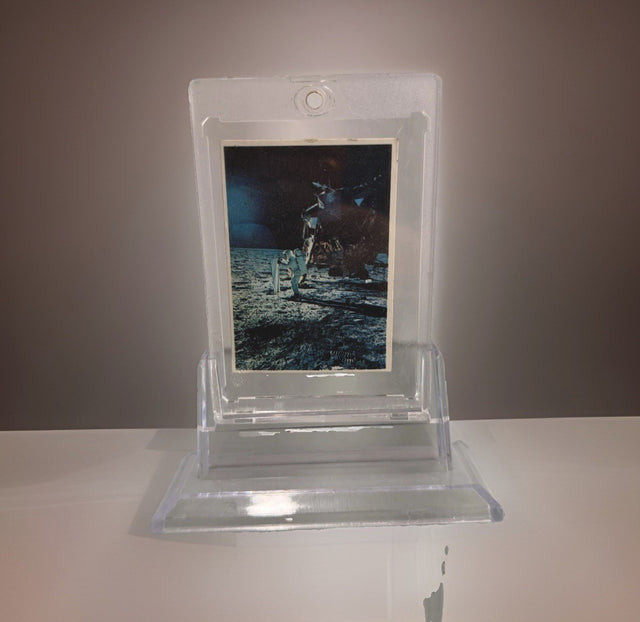
1969 Space Candy Buzz Aldrin Apollo 11 On The Moon Card #19 Taylor-Reed Display
$59.00 USD
-
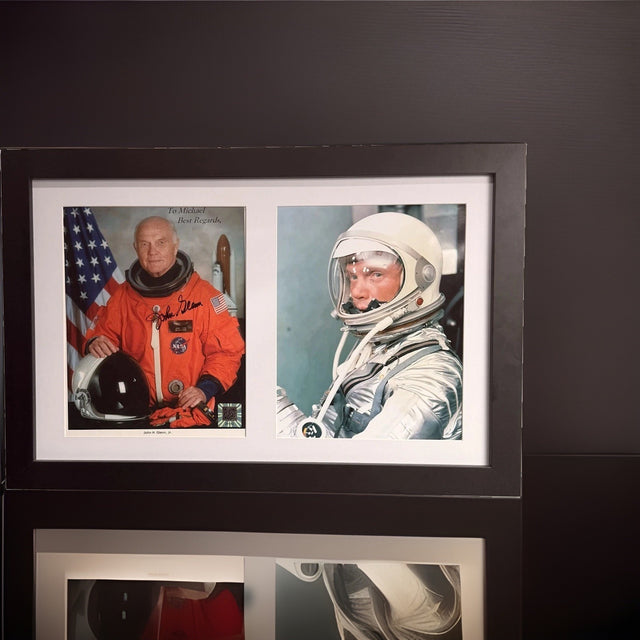
John Glenn Signed Autographed NASA Photo Display JSA Mercury Astronaut Framed
$199.00 USD
Browse the collection for current listings.