A DEATH NYC edition number tells you exactly where a print sits within its limited run. Written in pencil as a fraction — for example 45/100 — the second figure (the denominator) is the total number of impressions the artist released in that edition, and the first figure (the numerator) is the individual print's assigned position within that run. On a DEATH NYC print, the edition number almost always appears in the lower margin alongside the artist's hand-signed signature and a pencil date, and the piece is typically accompanied by a certificate of authenticity signed by the artist. In short: the edition number is the print's identity card — proof that it belongs to a deliberately limited, documented release rather than an open-ended reproduction.
That is the quick answer. But for collectors, the edition number is only the beginning of the story. Understanding what those two little pencil figures actually mean — and just as importantly, what they do not mean — is one of the most useful skills you can develop as a DEATH NYC collector. In this guide, we will break down the anatomy of an edition number, explain how DEATH NYC's distinctive release model shapes the way editions are numbered, decode the special notations you may encounter, and walk through how the edition number fits into authentication, valuation, and smart buying. Compare the exact image, edition, medium and presentation with dated completed sales, distinguishing hand-sprayed originals from editioned prints. Future resale value is uncertain.
The Anatomy of an Edition Number
Edition numbering is one of the oldest conventions in printmaking, and DEATH NYC follows it in the classic form. When an artist produces a limited edition, each impression is numbered by hand — traditionally in pencil, because pencil cannot be photomechanically reproduced with the same texture and pressure as a genuine graphite inscription. The number takes the form of a fraction:
- The denominator (the bottom or second number) states the total size of the edition. If a print is numbered out of 100, the artist committed to releasing no more than 100 numbered impressions of that image in that format.
- The numerator (the top or first number) identifies the specific impression you are holding. Print 45/100 is simply the impression that was assigned the number 45 within that run.
Two points about this convention surprise newer collectors. First, the numerator does not necessarily reflect the order in which prints were physically produced. In traditional printmaking, sheets are often printed, dried, and then numbered as a batch, so impression 3 was not necessarily pulled before impression 97. For digitally produced editions — the category most DEATH NYC works fall into — every impression in the run is effectively identical in quality, which makes the production-order question even less meaningful. Second, the edition number is a promise about scarcity, not a grade of quality. Number 1/100 and number 100/100 came off the same process and carry the same image; the fraction tells you how rare the image is, not how good your particular copy is.
What the edition number does establish is accountability. By numbering each sheet, the artist creates a fixed, checkable universe of legitimate impressions. That is why the edition number is a cornerstone of provenance: it lets a specific physical object be tied to a specific documented release. If you ever want to dig deeper into printmaking terminology — impressions, proofs, states, colorways — our collector's glossary covers the full vocabulary in plain language.
How DEATH NYC's Release Model Shapes Its Editions
DEATH NYC is a New York–based artist known for a prolific, drop-driven release model. Rather than issuing a handful of large editions per year the way many studio printmakers do, DEATH NYC releases new images frequently — often in rapid succession — each as its own small limited edition. The images themselves are dense pop-culture collages: remixed advertising iconography, luxury-brand motifs, comic and cartoon references, and nods to art history, layered together in the artist's signature mash-up style.
This release cadence has three practical consequences for how you should read a DEATH NYC edition number.
Small denominators are the norm
Because each image is released as its own compact edition, DEATH NYC denominators are typically small. The most frequently encountered structure in the works our gallery handles is an edition capped at 100 impressions, though you should always read the actual denominator on the sheet rather than assume — the artist has used other edition structures, and the pencil inscription on the print itself, together with its accompanying documentation, is the authority for that specific work. A small denominator means genuine scarcity at the level of the individual image: once the run is complete, that exact release is finished.
The date matters as much as the number
DEATH NYC prints characteristically carry a pencil date alongside the signature. Because the artist releases so many images, the date functions almost like a serial identifier for the release itself — it anchors the print to a specific moment in the artist's output. When collectors and dealers catalogue DEATH NYC works, the combination of image, date, and edition number is what defines the piece precisely. Two visually similar prints with different dates are different releases, each with its own edition. When you record a DEATH NYC print in your own collection inventory, always capture all three elements together.
Volume across the catalogue, scarcity within each edition
Newer collectors sometimes conflate two different questions: "How many DEATH NYC prints exist?" and "How many impressions of this print exist?" The artist's total catalogue is large — that is part of the project's identity and part of why the work is accessible. But each individual release remains a genuinely limited edition, and the edition number is what documents that limit. The scarcity that matters for your specific print is the scarcity stated in its denominator. Understanding this distinction is essential when you compare DEATH NYC to artists with slower release schedules, and it is a theme we explore at length in our DEATH NYC buyer's guide.
Reading the Full Margin: Signature, Date, and Number Together
The edition number never travels alone. On a properly finished DEATH NYC print, the lower margin carries a small cluster of hand-applied information, and experienced collectors learn to read it as a unit:
- The signature. DEATH NYC signs by hand in pencil. The signature confirms the artist personally released the impression and stands behind it as part of the edition.
- The date. The pencil date ties the impression to its specific release. As discussed above, in a catalogue this prolific, the date is a critical identifier — treat it as part of the print's name.
- The edition number. The fraction, in pencil, stating this impression's place in the run.
When you examine a print in person, look at these inscriptions under good light and, ideally, gentle magnification. Genuine pencil work sits on top of the paper's surface: you can see graphite sheen at an angle, slight pressure variation within strokes, and the way the line interacts with the paper's texture. A printed facsimile of an inscription, by contrast, is flat, uniform, and embedded in the same layer as the image. You do not need to be a forensic examiner to appreciate the difference — you just need to slow down and actually look. Our guide on how to spot a fake DEATH NYC walks through this kind of hands-on examination step by step, with the emphasis where it belongs: on knowing what genuine finishing looks like, so anything else stands out immediately.
One more note on condition: because the inscriptions are graphite on paper, they are physically delicate. Never run a finger across the margin, never erase near it, and handle sheets by the edges with clean, dry hands. An edition number that has been smudged or partially abraded does not invalidate a print, but crisp, undisturbed inscriptions are what collectors want to see, and preserving them is entirely within your control.
Edition Notations Decoded: What Each Marking Means
Beyond the standard fraction, limited-edition printmaking uses a family of special notations. You will encounter these across the print world, and it pays to know them when evaluating any DEATH NYC listing or, for that matter, any limited edition print. Here is the standard vocabulary:
| Notation | Name | What it means |
|---|---|---|
| 45/100 | Standard edition number | Impression 45 from a numbered edition limited to 100. The core commercial edition. |
| AP or A.P. | Artist's proof (épreuve d'artiste, sometimes E.A.) | Impressions reserved for the artist outside the numbered run. Traditionally a small percentage of the edition size. Often numbered among themselves (e.g., AP 2/10). |
| PP | Printer's proof | Impressions reserved for the printer or production studio, also outside the numbered edition. |
| HC | Hors commerce ("not for sale") | Impressions produced for exhibition, promotion, or archive use, not originally intended for the commercial market. |
| 1/1 or "unique" | Unique work | A one-of-one — either a genuinely unique piece or a unique variant (hand embellishment, distinct colorway) of an existing image. |
| Unnumbered | Open edition or proof | No stated limit, or an unnumbered proof. An unnumbered sheet is not automatically illegitimate, but it sits outside the numbered edition and should be documented and priced accordingly. |
A few practical rules follow from this table. First, when a listing describes a proof, ask how the proof is annotated on the sheet itself — genuine proofs carry their designation in pencil just as numbered impressions carry their fraction. Second, remember that proofs exist in addition to the numbered edition, so the true total count of impressions for an image is the edition size plus any proofs. This is standard across printmaking and not unique to DEATH NYC. Third, if a seller cannot tell you what the notation on a sheet means, that is a signal to slow down and verify before buying — not necessarily a sign of bad faith, but a sign that the documentation trail needs attention. Our authentication glossary defines all of these terms and more if you want a reference to keep handy.
What the Edition Number Tells You About Value — and What It Doesn't
Collectors ask us constantly whether a low edition number is worth paying more for. Here is the honest, market-grounded answer.
The denominator drives value; the numerator mostly doesn't
Scarcity lives in the denominator. An image released in a run of 100 is scarcer than an image released in a much larger run, and across the print market generally, smaller editions command a premium over larger ones, all else being equal. The numerator — your specific position in the run — has far less economic significance. For digitally produced editions where every impression is identical, position in the run tells you nothing about quality. Some collectors do pay modest premiums for psychologically appealing numbers — 1/100, a collector's lucky number, or the final impression in a run — but this is a preference premium, not a quality premium, and it tends to be small and inconsistent. When we analyze resale results in our comparable-sales database, the factors that actually move DEATH NYC prices are the image itself (subject matter and collaboration of motifs), condition, completeness of documentation, and timing — not whether the sheet happens to be numbered 12 or 87.
Condition and documentation outrank the number
If you are choosing between two impressions of the same image, choose on condition and documentation first, numerator last.
Avoid over-reading any single sale
Because DEATH NYC's catalogue is large and individual editions are small, any single image may trade only occasionally. That makes it easy to over-read one strong or weak result. The disciplined approach is to compare multiple recent verified sales of the same or closely similar releases before forming a view on value. We maintain a dedicated DEATH NYC price guide that explains how to build those comparisons properly, and our financial insights hub covers the broader methodology we apply across every category we handle. We deliberately avoid quoting one-size-fits-all dollar figures in evergreen guides like this one, because edition-level markets move — verified, recent, like-for-like comparisons are always the right tool.
Edition Numbers and Authentication: The Documentation Chain
The edition number is a load-bearing part of a DEATH NYC print's authentication story, but it works as one link in a chain rather than as a standalone guarantee. Here is how the chain fits together on a properly documented piece.
The certificate of authenticity
DEATH NYC works are typically accompanied by a certificate of authenticity signed by the artist. The COA documents the work and stands as the artist's own attestation that the impression is a legitimate part of the release. When you receive a DEATH NYC print, check that the certificate's details are consistent with the physical print — the image, the date, and the edition information should tell one coherent story. A certificate that describes a different edition than the sheet in front of you is a red flag worth resolving before money changes hands.
The official seal
Authenticated DEATH NYC pieces carry a metal official gold seal affixed to the work. Together, the artist-signed COA and the affixed seal form the core physical authentication package for DEATH NYC — a refreshingly direct system compared to categories that rely on third-party opinion. The seal is a tangible, on-the-object marker; the COA is the signed paper trail; and the pencil inscriptions on the sheet tie both to a specific impression of a specific release.
How the edition number binds the chain together
Think of it this way: the signature says who, the date says when, the edition number says which one, and the COA plus seal say this specific object is vouched for. Remove any link and the story weakens. This is why our gallery only sells DEATH NYC works with the full package intact, and why documented provenance — an unbroken record of where the piece has been since release — adds a further layer of confidence on top. If you want the complete picture of how DEATH NYC authentication works, including what to check on the COA and seal, our DEATH NYC authentication guide covers it end to end, and the authentication FAQ answers the questions we hear most often across all categories.
How to Verify an Edition Number Before You Buy
Verification is not complicated, but it rewards a methodical approach. Here is the process we recommend — and the one our own gallery follows when taking DEATH NYC works into inventory:
- Read the inscription itself. Confirm the edition fraction, signature, and date are present, in pencil, and hand-applied. Look for graphite sheen and pressure variation under raking light or magnification.
- Check internal consistency. The fraction should be sensible on its face: the numerator must not exceed the denominator, and the handwriting of the number should be consistent with the signature and date around it.
- Match the documentation. Compare the print against its certificate of authenticity. Image, date, and edition details should align. Confirm the metal gold seal is present and properly affixed.
- Photograph everything at intake. Take clear, well-lit photographs of the full sheet, the margin inscriptions in close-up, the seal, and the certificate. These photographs become part of the work's provenance file and will serve you at resale time.
- Compare against known examples. Look at verified listings and sale records of the same or similar releases. Consistent presentation across genuine examples — where the inscriptions sit, how the finishing is applied — gives you a baseline.
- Ask the seller the right questions. Where did the piece come from? Is the original COA included? Are there intake photographs? A reputable seller answers these readily. When you buy from an authenticated-source dealer, this work has already been done for you — every piece in our DEATH NYC collection arrives with its documentation verified before it is ever listed.
None of this requires fear. The overwhelming majority of DEATH NYC transactions are exactly what they appear to be, and the artist's documentation system — signed COA plus affixed seal plus pencil inscriptions — makes honest verification straightforward. The checklist simply makes sure you capture the value of that system rather than skipping past it.
Provenance: Turning an Edition Number into a Paper Trail
The edition number identifies the print; provenance tells its story over time. Building a provenance file is one of the highest-return habits a collector can adopt, and it takes minutes per acquisition.
For each DEATH NYC print you own, keep a simple record containing:
- The image description, pencil date, and full edition number (e.g., "45/100").
- The original certificate of authenticity, stored flat and safe — ideally separately from the framed work, with a copy kept alongside it.
- Purchase records: invoice or receipt, seller identity, and date of purchase.
- Intake photographs of the sheet, inscriptions, seal, and certificate.
- Any condition notes, framing records, or conservation work over time.
When the day comes to sell, trade, or insure the work, this file transforms the conversation. A print with a complete provenance file is easier to authenticate, easier to price against comparable sales, and simply more attractive to the next buyer. In our experience handling collections, documented works consistently sell faster and more smoothly than identical works with patchy paperwork. Provenance is the compounding interest of collecting — the edition number is the account it accrues to.
A related housekeeping point: if you reframe a DEATH NYC print, instruct your framer to use archival, reversible methods and never to trim the margins. The margin carries the signature, date, and edition number — the print's entire documentary identity. A trimmed margin permanently damages both the object and its market standing.
A Collector's Buying Checklist
Pulling everything together, here is the checklist we suggest running before any DEATH NYC purchase, whether it is your first print or your fiftieth:
- Edition number: Present, in pencil, hand-applied, internally consistent.
- Signature and date: Present in pencil alongside the number; consistent hand throughout.
- COA: Artist-signed certificate included, with details matching the physical print.
- Seal: Metal official gold seal present and affixed.
- Condition: Clean sheet, full margins, no trimming, no smudging of inscriptions, no undisclosed damage.
- Comparables: Price sanity-checked against multiple recent verified sales of the same or similar releases, not a single data point.
- Seller: Transparent about sourcing, willing to provide detailed photographs, and able to answer documentation questions directly.
- Paper trail: Invoice or receipt provided so your provenance file starts complete on day one.
If a listing clears every line, you can buy with real confidence. If it stumbles on one or two, that is not automatically disqualifying — it is a prompt to ask better questions before committing. And if you would rather have all of this handled before you ever see the listing, that is the case for buying from an authenticated-source dealer in the first place: our gallery verifies documentation, photographs every work, and prices against verified comparable sales as a matter of standard practice. Browse the DEATH NYC collection to see what fully documented listings look like, or start with the broader library of buyer's guides and the Collector's Hub if you are building foundational knowledge across categories.
Frequently Asked Questions
Is a lower edition number on a DEATH NYC print worth more?
Generally, no. The denominator (edition size) drives scarcity and value; the numerator is essentially an identifier. For digitally produced editions, every impression is identical in quality, so 3/100 and 97/100 are equivalent objects. Some collectors pay small preference premiums for number 1 or the final number, but condition and complete documentation matter far more to resale outcomes than the numerator ever will.
Where do I find the edition number on a DEATH NYC print?
Look in the lower margin of the sheet. DEATH NYC prints characteristically carry a pencil edition fraction together with the artist's hand-signed signature and a pencil date. Examine the inscriptions under good light: genuine pencil shows graphite sheen and pressure variation, sitting on top of the paper's surface rather than printed flat within the image layer.
What does AP mean instead of a number?
AP stands for artist's proof — an impression reserved for the artist outside the standard numbered run. Proofs are a normal, legitimate part of printmaking convention and are often numbered among themselves, such as AP 2/10. Related notations include PP (printer's proof) and HC (hors commerce). Remember that proofs exist in addition to the numbered edition, so the total impression count is edition size plus proofs.
How do I verify that a DEATH NYC edition number is genuine?
Confirm the fraction, signature, and date are hand-applied in pencil; check the numerator does not exceed the denominator; match the print against its artist-signed certificate of authenticity; and confirm the metal gold seal is affixed. Then compare the piece against verified examples and recent documented sales of the same release. Buying from an authenticated-source dealer means this verification is completed before the work is listed.
Does the pencil date on a DEATH NYC print matter?
Yes — treat it as part of the print's identity. Because the artist releases images frequently, the date anchors an impression to a specific release. Visually similar prints with different dates are different editions. When cataloguing or insuring a DEATH NYC work, always record the image, the date, and the edition number together as one identifying set.
Are DEATH NYC prints open edition or limited edition?
DEATH NYC works are released as limited editions: each image is issued in a numbered run with a stated cap, hand-signed and dated in pencil. The artist's overall catalogue is large because new images are released frequently, but each individual release is genuinely limited. The scarcity that matters for your print is the one stated in its own denominator, so always read the actual inscription.
What documents should come with a numbered DEATH NYC print?
Expect the artist-signed certificate of authenticity and the metal official gold seal affixed to the piece, plus a purchase invoice from the seller. Keep intake photographs of the sheet, the margin inscriptions, the seal, and the certificate. Together these form the provenance file that supports authentication, insurance, and eventual resale — documented works consistently transact more smoothly than undocumented ones.
Shop Death NYC
Explore current pieces available from the gallery.
-

Death NYC — Kate Moss Rihanna Red Drip 2020 A/P Artist Proof Framed
$91.88 USD
-
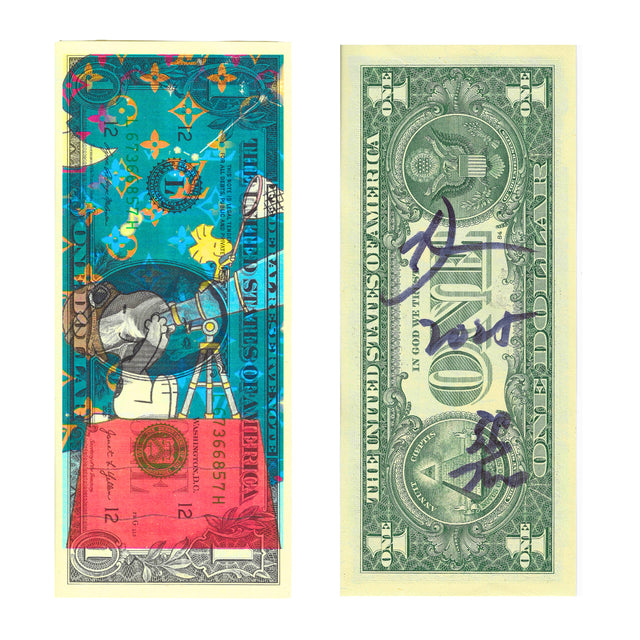
Death NYC Snoopy Woodstock Telescope LV Dollar Bill Art Signed Numbered COA
$55.00 USD
-
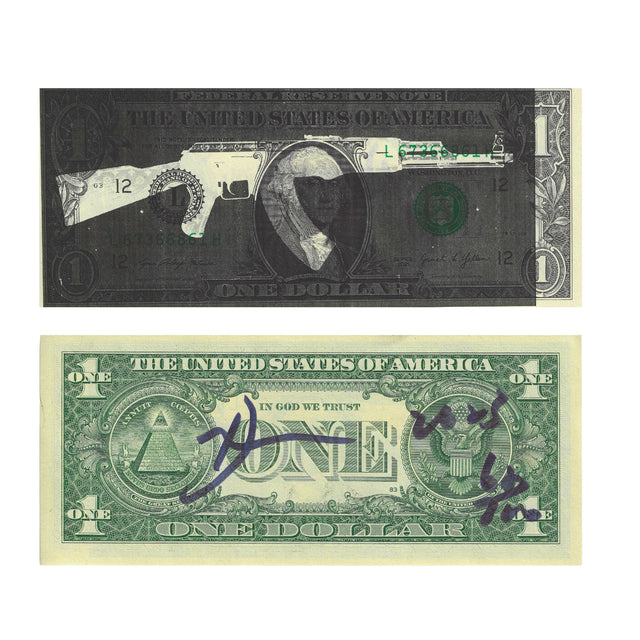
Death NYC Gun Dollar Bill Art Signed Numbered COA Black White Pop Street Art
$50.00 USD
-
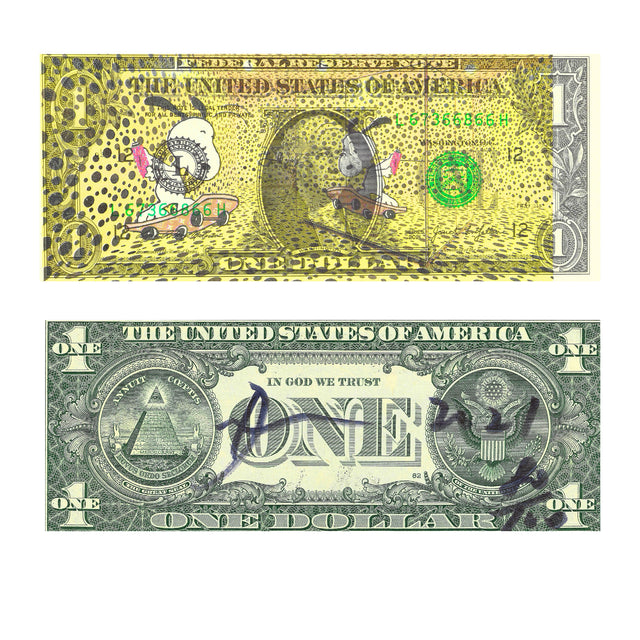
Death NYC Snoopy Skateboard Dollar Bill Art Signed Numbered COA Pop Street Art
$75.00 USD
-
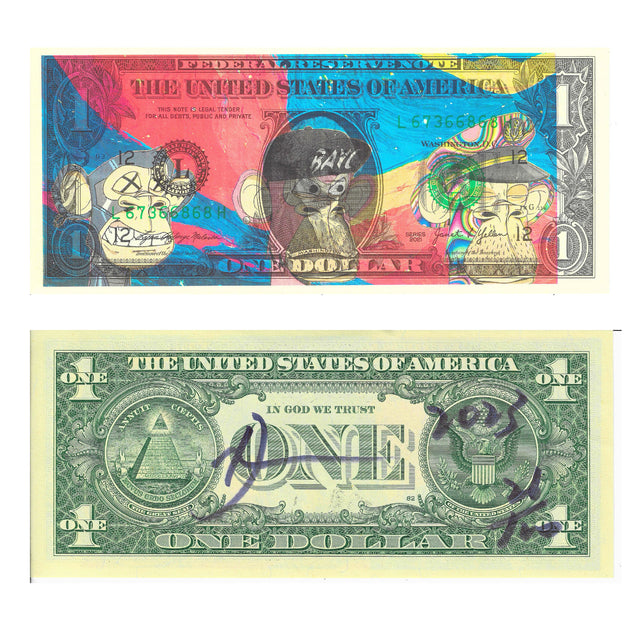
Death NYC Bored Ape Dollar Bill Art Signed Numbered COA Pop Street Art
$40.00 USD
-
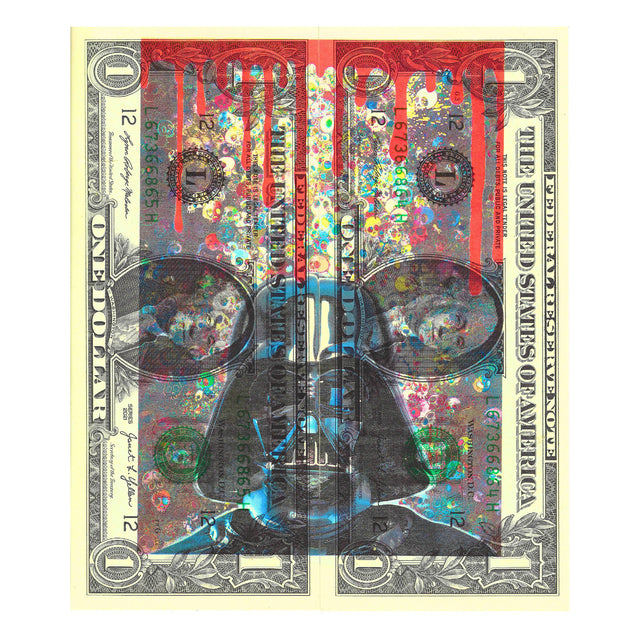
Death NYC Darth Vader Star Wars Dollar Bill Art Signed Two Bills COA Unframed
$100.00 USD
Browse the collection for current listings.