Signed Street-Art Prints Under $500 That Still Hold Value
To buy original street art for your home for under $500, focus on hand-signed, numbered prints and small studio editions from established or fast-rising street artists, bought from a dealer who documents provenance and edition details. The sweet spot is a signed screenprint, giclée, or hand-embellished multiple that has a genuine artist signature, a clear edition number, and a paper trail — bought below the level where speculation inflates the price. At Gauntlet Gallery that means signed Shepard Fairey retail editions, DEATH NYC hand-signed pieces, Invader-adjacent screenprints, and emerging-name editions curated for authenticity rather than hype.
The rest of this guide explains exactly where value lives at the sub-$500 tier, which formats hold up over time, how to read an edition, what to avoid, and how to verify a signature before you spend a dollar. It is written for someone furnishing a real wall — not a warehouse full of speculative flips — but every principle here doubles as a resale-protection strategy. Good decor and good collecting are the same decision made twice.
Why "Under $500" Is the Smartest Entry Point in Street Art
Street art is one of the few blue-chip-adjacent collecting categories where the entry price and the resale floor still sit close together. A $40,000 Banksy screenprint and a $250 signed charity print by the same generation of artists are governed by the same forces — edition size, signature, condition, and provenance — but the smaller print carries far less downside. When you spend under $500, you are usually buying below the threshold where auction speculation, flipping, and hype cycles distort the number. That is precisely why these prints tend to hold their value: the price is anchored to real demand from people who want the image on their wall, not to a bidding war.
The mistake most first-time buyers make is assuming "cheap" means "worthless later." In street art the opposite is frequently true. Open editions and retail-release prints from major artists have repeatedly re-rated upward over five- and ten-year windows as the artist's overall market matured. The print you bought to fill a hallway becomes the print a later collector wants because it is the affordable, recognizable, wall-friendly version of an artist they now revere. The under-$500 tier is where the household demand and the collector demand overlap most cleanly.
There is a second, quieter reason this tier holds value: liquidity. A signed print at $250–$450 has an enormous pool of potential buyers — decorators, gift-givers, new collectors, and people who simply love the image. A five-figure original has a tiny pool. When you eventually sell, breadth of demand protects you far more than a big headline number ever will. The affordable, authenticated, signed print is the most liquid object in the entire category.
The Direct Answer: Where to Buy for Home Decor Without Losing Value
If your goal is original street art that looks intentional on the wall and keeps its value, buy in this order of preference:
- A curated dealer that authenticates and documents provenance — the safest path, because someone with a reputation is standing behind the signature, the edition, and the condition. This is the model behind Gauntlet Gallery's collector trust hub.
- Artist retail drops and charity editions — buying at the source (an artist's own store release or a documented benefit print) gives you the cleanest possible provenance and the best entry price.
- Established secondary marketplaces, but only with authentication — fine for experienced buyers who know how to read a signature, a paper stock, and an edition line, and who insist on returns.
What you are optimizing for is not the lowest sticker price. It is the lowest risk-adjusted price: a real signature, a documented edition, honest condition grading, and a seller who will still be reachable in three years. Every dollar you "save" by skipping authentication is a dollar you are lending against the day you try to resell. For a deeper walk through the decor-first side of this decision, see our companion guide on how to buy street art that fits your interior.
What "Signed" Actually Means — and Why It Matters at This Price
The single biggest value differentiator under $500 is the difference between a hand-signed print and a plate-signed or unsigned one. A hand signature — applied in pencil or paint by the artist after printing — is a direct act of authorship. A plate signature is simply the artist's signature reproduced as part of the printed image; every copy has it, and it proves nothing about who touched that specific sheet. Under $500, hand-signed pieces consistently outperform plate-signed equivalents on resale, sometimes by a wide margin, because the market treats the pencil signature as the artist's personal endorsement of that individual object.
Signature location, medium, and consistency all matter. Most street artists sign in the lower margin (the "deckle" area) in graphite pencil, often alongside the edition fraction and sometimes a date or blindstamp. Learn what a given artist's genuine signature looks like across multiple verified examples before you buy — genuine signatures are consistent in slant, pressure, and letterforms. For Shepard Fairey specifically, our guide to reading a Fairey print's paper, signature, and date shows exactly which tells confirm an authentic sheet.
Formats That Hold Value Under $500
Not every "print" is built to last, financially or physically. Here is how the common sub-$500 formats stack up, from most collectible to most cautionary.
| Format | What It Is | Typical Under-$500 Reality | Value-Hold Outlook |
|---|---|---|---|
| Signed screenprint (SN) | Hand-pulled screenprint, hand-signed and numbered in a stated edition | Smaller editions or lower-demand images from major artists; larger editions from emerging names | Strong — the category benchmark for holding value |
| Hand-embellished multiple (HPM) | A print with unique hand-added paint or collage; each is one-of-a-kind within the run | Rare under $500 from top names; achievable from rising artists | Strong when authenticated — uniqueness supports value |
| Signed giclée / archival pigment | High-resolution inkjet on archival paper, hand-signed and numbered | Common and legitimate; quality depends on paper and printer | Moderate to strong — signature and edition size drive it |
| Retail / charity edition | Prints released through an artist's store or a documented benefit | Frequently the best value at this tier; clean provenance | Strong — source provenance is a durable advantage |
| Open edition (signed) | Unnumbered but hand-signed; no fixed edition cap | Affordable entry to a major name's work | Moderate — signature helps; unlimited supply caps upside |
| Unsigned / plate-signed poster | Reproduction with no hand signature | Cheapest option; effectively decor, not a collectible | Weak — buy for the image, not the investment |
The pattern is consistent: a real hand signature plus a defined edition plus documented provenance is what carries value forward. A signed, numbered screenprint at $400 is a fundamentally different object from an unsigned poster at $40, even if they show the same image. One is a collectible with a floor; the other is wallpaper you happen to like.
Where the Value Lives: Artists and Routes to Look At First
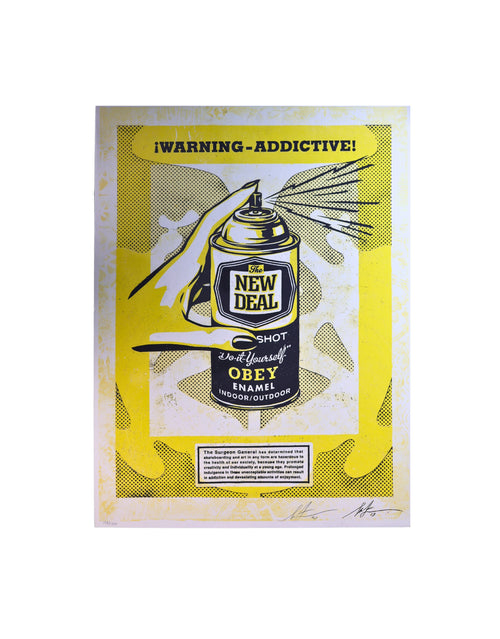
Shepard Fairey (OBEY)
Fairey is the anchor of accessible street-art collecting. His studio releases a steady stream of signed, numbered screenprints and retail editions, many of which historically launched at prices that put a signed piece within reach of a real budget. Because his catalog is deep and his market is mature, there are always Fairey editions circulating below $500 on the secondary market — and the affordable ones have a long track record of holding and, in many cases, appreciating. Start with the Shepard Fairey collection, and if you want to understand which images matter most, our Shepard Fairey buyer's guide and the Fairey print index map the landscape. Note the authentication reality for Fairey: there is no artist certificate-of-authenticity program. You authenticate a Fairey through provenance, signature, edition numbering, paper and printing quality, and a reputable dealer — never through a claimed "COA from the artist."
DEATH NYC
DEATH NYC produces small, hand-signed, numbered editions — typically pop-culture mash-ups on paper — that frequently sit comfortably under $500. What makes them attractive at this tier is documentation: genuine DEATH NYC pieces come hand-signed and numbered with a certificate of authenticity and a gold seal. That combination of a small stated edition, a hand signature, and an included COA is exactly the profile that holds value in the affordable bracket. Browse the DEATH NYC collection to see the format in practice.
Invader
The French artist Invader anchors the mosaic-and-pixel corner of street art. His most famous works are five- and six-figure objects, but screenprints and editions connected to his practice can appear at accessible price points, and the recognizability of the pixel-art aesthetic makes them strong wall pieces. Explore the Invader collection for what is currently available and authenticated.
Emerging and mid-tier names
The richest hunting ground under $500 is the tier just below the household names: artists with a real gallery history, consistent output, and growing demand, whose signed editions still trade in the low hundreds. This is where a curated dealer earns their keep — separating a rising artist with genuine momentum from a name that is merely being marketed. The broader Gauntlet Gallery catalog and the art index are built for exactly this kind of discovery, and the buyer's guides hub collects the artist-by-artist detail in one place.
How to Read an Edition Before You Buy
An edition line — something like "24/150" written in pencil in the margin — is one of the most important pieces of information on the sheet, and one of the most misunderstood. The bottom number is the edition size: how many prints exist in that run. The top number is this print's position in the run. Both numbers matter, but not the way most people assume.
- Edition size drives scarcity. A run of 100 is scarcer than a run of 500. Smaller editions from the same artist, all else equal, tend to hold value better because supply is capped lower.
- The individual number rarely matters much. A low number like 1/150 or a "milestone" number can carry a small premium with some collectors, but for most street-art prints, 12/150 and 112/150 are worth the same. Do not overpay for a "cool" number.
- APs, PPs, and HPMs sit outside the main run. Artist's Proofs (AP) and Printer's Proofs (PP) are small quantities produced alongside the numbered edition; hand-embellished multiples (HPM) are unique variants. These can command premiums, but they can also be faked or misrepresented — verify them harder, not less.
Whenever an edition claim can't be squared with what you can see on the sheet — the signature, the paper, the margins, the printing — treat that as a stop sign, not a haggling opportunity. For a fuller breakdown of proof types in one artist's system, our guide to street-art price tiers shows how edition and format map onto price across the whole range, from $100 decor prints to five-figure originals.
Provenance and Authentication at the Affordable Tier
It is tempting to think authentication only matters for expensive pieces. The opposite is true: at the affordable tier, where authentication is often skipped, is precisely where fakes and misrepresented prints proliferate. A forger has little incentive to fake a $40,000 print that experts scrutinize — and every incentive to churn out "signed" $200 prints that buyers accept on trust. The under-$500 market is where careful buying protects you most.
Provenance is the chain of custody: where the print came from, who owned it, and what documentation travels with it. Strong provenance can be as simple as a dealer invoice that names the edition, an original release receipt, or a documented COA where the artist or studio issues one. The goal is a paper trail that a future buyer can also trust. When you sell, provenance is what lets the next person pay with confidence instead of suspicion.
Gauntlet Gallery's house standard is TrueCOA — a blockchain verification program that lets a buyer confirm a specific object against a record rather than relying on a loose paper certificate that could accompany anything. You can read how the verification model works at truecoa.com. It is important to be precise about what a COA is and isn't: a certificate is only as trustworthy as the party that issued it. For some artists (DEATH NYC) a COA and gold seal are part of the genuine package; for others (Shepard Fairey) there is no artist COA at all, and a certificate "from the artist" is a red flag. A trustworthy program tells you which is which instead of stamping everything with the same generic paper.
Condition: The Value Lever Everyone Underrates
For prints on paper, condition is not a footnote — it is a primary driver of value, and it is entirely within your control to inspect. Two copies of the same signed edition can differ by a wide margin in price purely because one was framed properly and one spent a decade in sunlight. Because you are buying to hang the piece, condition also determines whether the print still looks the way the artist intended.
Inspect (or insist the seller document) each of these before buying:
- Fading and light damage. Screenprint inks and pigments can shift under UV. Look for uneven color, a yellowed sheet, or a "ghost" where a mat covered part of the image.
- Foxing and staining. Brown spots (foxing), water marks, or adhesive stains materially reduce value and are hard to reverse.
- Creases, dents, and handling. Soft corner bumps are common; hard creases through the image are serious.
- Trimming. A sheet cut down from its original size — sometimes to remove damage or fit a frame — loses value and can compromise the margin where the signature lives.
- Prior framing damage. Tape residue, hinge marks, and mat burn on the reverse are common and worth noting.
Good news for the buyer: honest condition grading is a sign of a serious seller. A dealer who volunteers a small flaw is telling you they document everything — which is exactly the behavior that protects your resale later. Once the piece is home, framing is your ongoing insurance policy; our guide to framing and protecting street-art prints in a real home covers UV glazing, acid-free materials, and the reversible mounting that keeps a print collectible.
A Practical Sub-$500 Buying Checklist
Before you commit, run every candidate print through this sequence. If it fails a step, the "deal" isn't one.
- Signature. Is it a hand signature (pencil or paint) rather than a plate signature? Does it match verified examples of the artist's hand?
- Edition. Is there a stated edition size and number? Does the format (SN, AP, PP, HPM, open) match what the seller claims?
- Authentication route. Does the authentication match the artist? (COA + gold seal for DEATH NYC; provenance + dealer for Fairey; TrueCOA where Gauntlet backs the piece.) Reject any COA that contradicts the artist's real chain.
- Provenance. Is there an invoice, receipt, or documented history that a future buyer could also trust?
- Condition. Have you seen high-resolution images of the full sheet, margins, and reverse? Is grading honest and specific?
- Seller. Will this seller still exist and stand behind the sale in three years? Do they accept returns if the piece is misrepresented?
- Price sanity. Is the number anchored to real comparable sales, not a hopeful "retail" figure? When in doubt, pay a fair price to a documented source rather than a suspiciously low one to an anonymous one.
Common Mistakes That Destroy Value
Most of the value that evaporates in the affordable tier is lost to avoidable errors, not bad luck:
- Buying the image, ignoring the object. Two prints of the same image can be worlds apart in value depending on signature, edition, and condition. The picture is not the asset; the authenticated object is.
- Trusting a generic COA. A certificate from an unknown issuer, or one that contradicts the artist's real authentication chain, adds risk rather than removing it.
- Overpaying for a "low number." For most prints the specific edition number barely moves value. Pay for scarcity (small edition size), not novelty.
- Skipping condition inspection. Fading, foxing, and trimming are silent value-killers. Always see the full sheet and the reverse.
- Chasing hype names with no documentation. A trendy name with no provenance is a worse buy than a lesser-known artist with a clean paper trail.
- Buying to flip instead of to keep. The buyers who hold value best are the ones who bought pieces they actually wanted to live with. Genuine demand is the most durable moat.
Building a Wall That Also Builds Value
The most satisfying way to spend under $500 repeatedly is to build a coherent wall rather than accumulating one-offs. A small group of signed, authenticated prints — say a Fairey retail edition, a DEATH NYC piece, and one emerging-name screenprint — reads as an intentional collection, looks far more expensive than the sum of its parts, and spreads your risk across several artists. When one artist's market runs hot, you benefit; when another cools, you are diversified. Our guide to building a street-art wall that mixes Fairey, Invader, DEATH NYC, and KAWS walks through how to make disparate artists hang together as one statement.
Ground every purchase in the same discipline you would apply to a five-figure piece — signature, edition, provenance, condition — and the affordable tier stops being the "starter" bracket and becomes what it actually is: the most liquid, most defensible, most rewarding place to collect street art. Start from the collector trust hub, buy authenticated, and the print you hung because you loved it will still be worth hanging — and worth selling — years from now.